 By admin
 INTRODUCTION:
There are legends who change music.
Then there are legends who change culture itself.
Elvis Presley did both.
Long before social media influencers, fashion icons, or celebrity branding existed, there was a young man from Tupelo, Mississippi, who unknowingly became the blueprint for modern stardom. He wasn’t simply singing songs. He was creating a new language of style, attitude, and self-expression that would echo across generations.
Today, nearly fifty years after his passing, the image remains instantly recognizable: the towering pompadour, the curled lip, the dazzling stage outfits sparkling under arena lights.
No introduction needed.
No explanation required.
Just one name:
Elvis.
And perhaps that is his greatest achievement. He didn’t merely perform trends—he created them.
“Before Elvis, there was nothing.” — John Lennon
While historians often focus on Elvis Presley’s revolutionary impact on rock and roll, many forget another truth: he transformed the very idea of what a performer could look like.
He turned clothing into theater.
He transformed hair into a symbol of rebellion.
And he made individuality fashionable.
The Hair That Shook America
In the conservative America of the 1950s, appearance mattered.
Young men were expected to wear neat, traditional hairstyles. Society prized conformity. Standing out was often discouraged.
Then came Elvis.
His famous pompadour wasn’t merely a haircut—it was a declaration.
Dark, thick, heavily styled, and impossibly high, Elvis’s hair became one of the most recognizable features in entertainment history. Inspired partly by rhythm and blues performers and partly by his own sense of style, he carefully crafted the look that would eventually become his trademark.
Teenagers immediately noticed.
Parents immediately worried.
Barbers across America suddenly found themselves receiving unusual requests.
Young men walked into shops carrying magazine photos and saying the same thing:
“I want my hair like Elvis.”
The reaction from older generations was swift.
Critics called the style wild, improper, and rebellious. Newspapers debated whether Elvis represented moral decline. Schools even attempted to regulate hairstyles inspired by him.
But resistance only fueled the phenomenon.
Because for millions of young people, looking like Elvis meant something far deeper than fashion.
It meant freedom.
It meant confidence.
It meant refusing to fit neatly inside society’s expectations.
Elvis’s hair wasn’t just styled with pomade. It was styled with defiance.
The irony, of course, is that what once scandalized America eventually became timeless. Decades later, versions of the Elvis pompadour continue to appear in fashion magazines, runways, films, and music videos around the world.
The King never truly left the building.
Pink Jackets, Flashy Suits, and Fearless Fashion
Long before rhinestone cowboy culture dominated country music, Elvis embraced bold fashion choices.
At a time when male performers typically wore conservative suits, Elvis preferred striking colors, dramatic cuts, and distinctive details.
Pink jackets.
Bold patterns.
Extravagant tailoring.
He understood something many artists would learn much later:
People don’t simply listen with their ears.
They watch with their eyes.
Early in his career, Elvis often shopped for unique clothing that separated him from everyone else on stage. He loved high collars, sharp tailoring, and outfits that reflected both elegance and excitement.
Some critics mocked his appearance.
Others considered it excessive.
Fans adored it.
Because Elvis looked like no one else.
In an era defined by conformity, originality itself became revolutionary.
The Hollywood Years Expanded the Image
When Elvis moved into films during the late 1950s and 1960s, his influence on fashion exploded.
Millions watched him on movie screens worldwide.
Whether wearing leather in Jailhouse Rock, military uniforms, Western attire, or stylish resort clothing in his musical films, Elvis continually reinvented his image.
Each new movie introduced audiences to another version of Elvis.
The rebel.
The romantic hero.
The soldier.
The entertainer.
And with every reinvention, fans eagerly adopted pieces of his style.
Leather jackets surged in popularity.
Open-collar shirts became fashionable.
Sideburns became essential.
Suddenly, Elvis wasn’t merely selling records.
He was shaping wardrobes.
Every new Elvis appearance became a fashion event before “fashion events” even existed.
Modern celebrity branding owes a tremendous debt to the path Elvis pioneered.
The 1968 Comeback: Black Leather and Raw Power
By 1968, many critics believed Elvis’s greatest days were behind him.
Rock music had evolved.
The cultural landscape had changed.
Then came the legendary television special now known simply as the ’68 Comeback Special.
And everything changed.
Dressed entirely in black leather, Elvis stepped onto the stage with a look that was simultaneously simple, dangerous, and unforgettable.
Gone were the polished Hollywood costumes.
This Elvis looked hungry again.
Authentic.
Alive.
The black leather outfit instantly became one of the most iconic looks in entertainment history.
It symbolized rebirth.
Strength.
Relevance.
The special didn’t merely revive Elvis’s career.
It reminded the world that true icons never disappear.
They reinvent themselves.
Countless performers—from rock stars to country singers—would later embrace similar aesthetics, consciously or not following the road Elvis had already traveled.
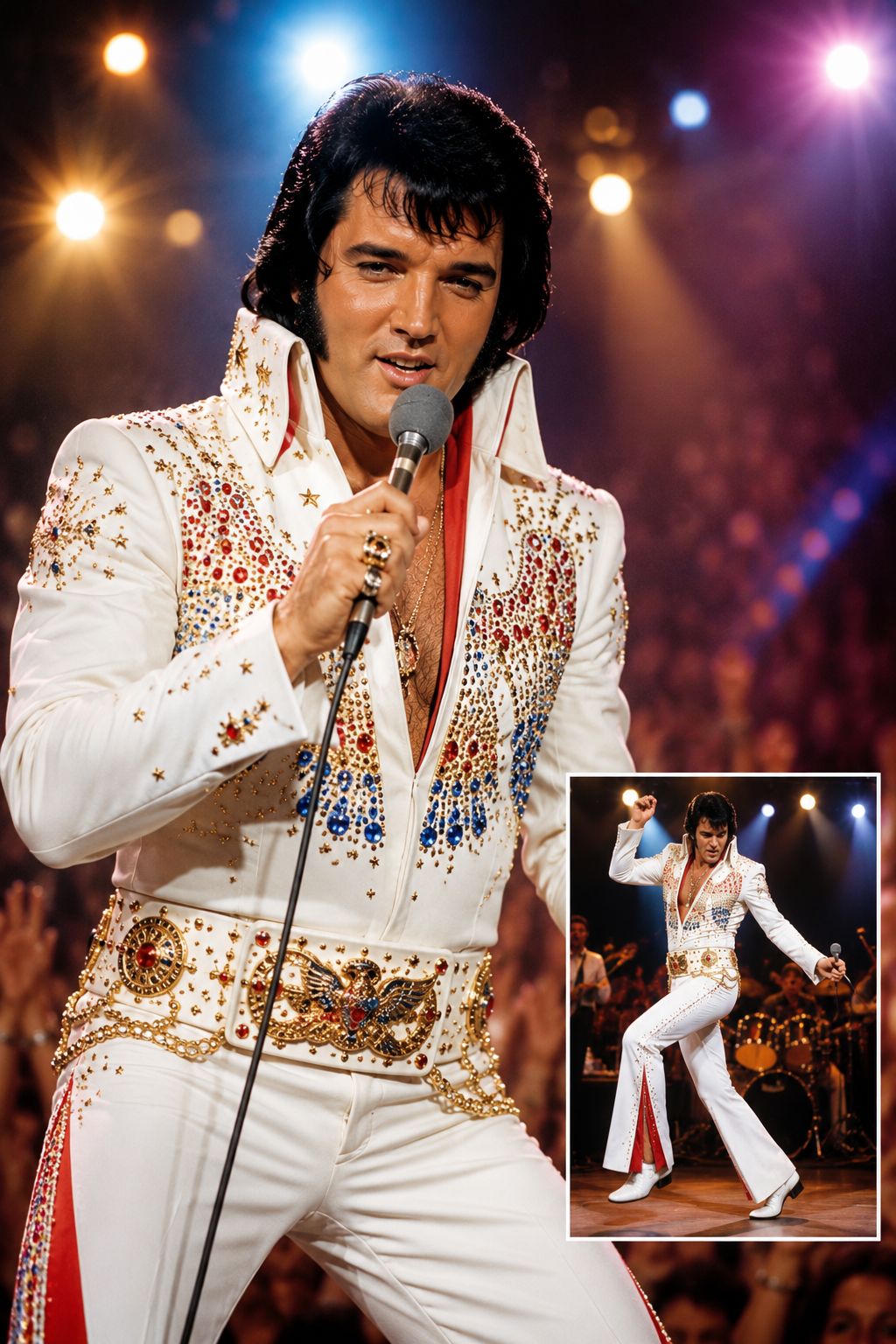
The Jumpsuits That Became Legendary
If the pompadour introduced Elvis to the world, the jumpsuits transformed him into myth.
When Elvis returned to live performances in Las Vegas during the late 1960s and early 1970s, he recognized that enormous arenas required enormous visual impact.
Simple suits would no longer suffice.
Working with designer Bill Belew, Elvis unveiled a series of spectacular stage costumes unlike anything audiences had ever seen.
White jumpsuits adorned with rhinestones.
Gold embellishments.
Flowing capes.
American eagle motifs.
Intricate embroidery.
The outfits sparkled under stage lights and instantly elevated concerts into grand theatrical experiences.
Some critics initially viewed the costumes as excessive.
Fans saw magic.
And history proved the fans right.
Today, those jumpsuits remain among the most famous stage costumes ever created.
From The American Eagle Suit to The Aloha from Hawaii ensemble, each costume represented a fusion of music, patriotism, spectacle, and personality.
No artist before Elvis had transformed concert clothing into such an essential part of performance identity.
The influence remains unmistakable.
Country superstars, pop icons, and arena performers continue to embrace dazzling stage wardrobes because Elvis demonstrated that visual storytelling could amplify emotional connection.
Elvis understood something timeless: when audiences remember a performance, they remember both what they heard and what they saw.
More Than Style—A Reflection of the Man
Perhaps the most remarkable aspect of Elvis’s fashion evolution is that it mirrored his personal journey.
The rebellious teenager with the pompadour.
The Hollywood leading man.
The leather-clad comeback artist.
The rhinestone-covered global superstar.
Each look reflected a different chapter of his life.
Each era revealed new dimensions of his identity.
And through every transformation, one constant remained:
Elvis never stopped being unmistakably Elvis.
That authenticity explains why his influence endures.
Fashion trends come and go.
Cultural icons rise and fade.
But genuine originality never loses its power.
Nearly half a century after his passing, Elvis Presley still inspires musicians, designers, actors, and dreamers around the globe.
Because he did more than sing.
He dared to be different.
And in doing so, he gave millions of others permission to do the same.
The music changed history.
The style changed culture.
The legend changed everything.
And even now, no one wears the crown quite like The King.
VIDEO: