 By admin
 INTRODUCTION:
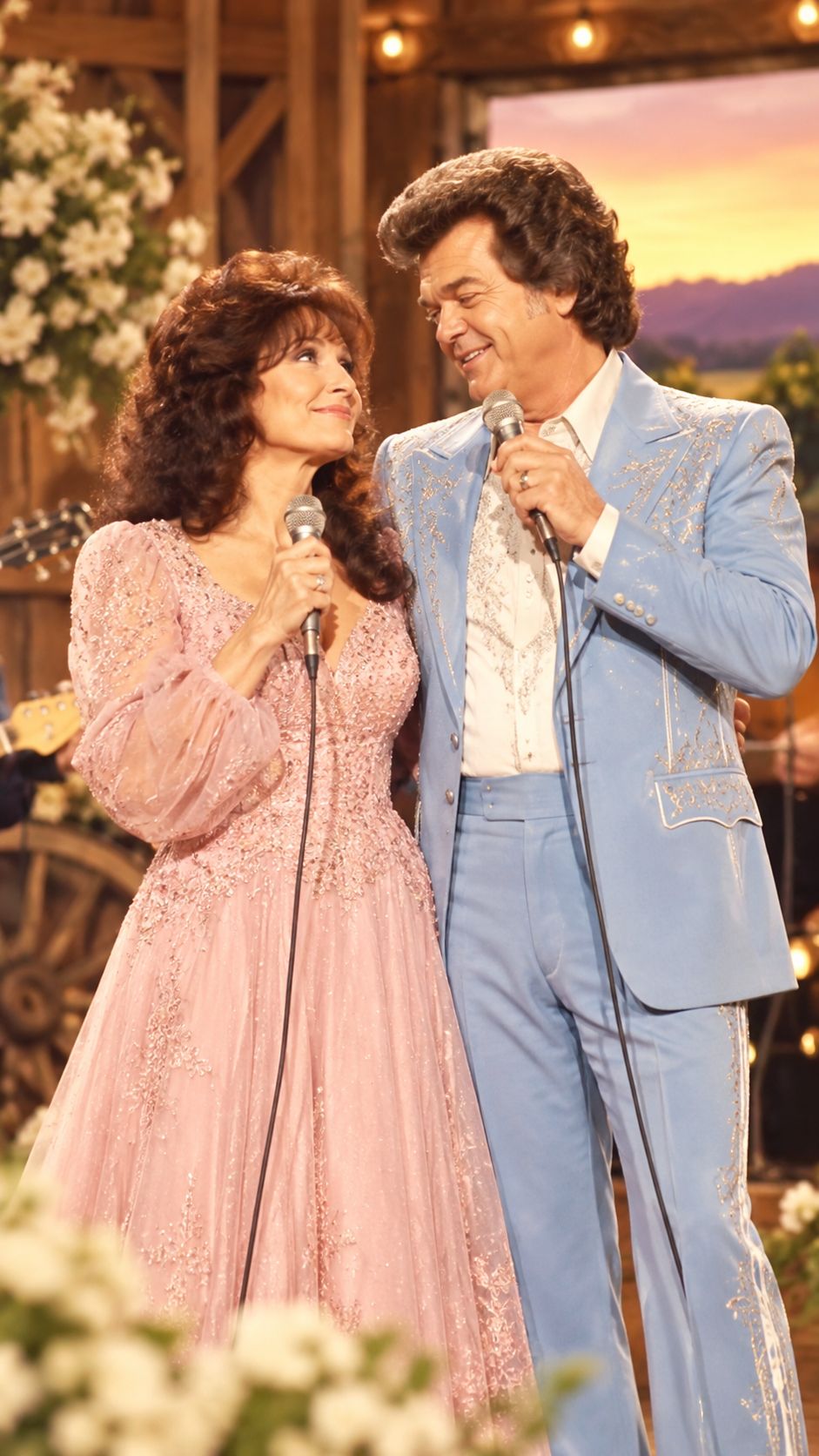
There are country duos that sound good together.
And then there are duos that seem to tell a story simply by standing beside one another.
Conway Twitty and Loretta Lynn belonged to that rare second category.
When their voices met in the early 1970s, something happened that Nashville had not quite heard before. Twitty brought his deep, dramatic, almost conversational baritone. Lynn brought grit, vulnerability, humor, and the unmistakable voice of a woman who had spent her life turning hard experiences into songs.
Together, they didn’t merely record duets.
They created miniature dramas about love, temptation, marriage, regret, desire, and the complicated choices people make when nobody is watching.
And that may be the real reason their partnership has endured.
The official history is impressive: their first major duet, “After the Fire Is Gone,” reached No. 1 in 1971, and the pair went on to become one of the most successful male-female duet teams in country music history. They won the CMA Vocal Duo of the Year award repeatedly, while Twitty and Lynn also earned a Grammy for their work.
But statistics don’t explain the magic.
The story does.
Two Completely Different Roads to Nashville
Before Conway Twitty ever stood beside Loretta Lynn, both artists had already lived remarkably complicated musical lives.
Loretta Lynn was born in Butcher Holler, Kentucky, the daughter of a coal miner. Her childhood was shaped by poverty, family, hard work, and the culture of rural Appalachia. She married young, became a mother, and eventually transformed those experiences into songs that spoke directly to working-class women.
Her rise was anything but overnight.
She began recording in 1960, scored success with “I’m a Honky Tonk Girl,” and gradually developed a reputation as one of country music’s most fearless songwriters and performers. Her songs frequently dealt with subjects that many women were expected to keep private.
Then there was Conway Twitty.
Born Harold Lloyd Jenkins in Mississippi, he initially became famous in rock ‘n’ roll before making an extraordinary transition into country music. His country career eventually produced 40 No. 1 Billboard country hits, an astonishing record at the time.
His voice was completely different from Lynn’s.
But perhaps that was precisely the point.
He didn’t sound like her.
She didn’t sound like him.
And yet they sounded as though they belonged in the same story.
Then Came “After the Fire Is Gone”
Their partnership truly caught fire with “After the Fire Is Gone.”
The song wasn’t a simple romantic duet.
It was about a relationship that exists in the shadows — the kind of complicated emotional territory that country music has always explored particularly well.
Lynn and Twitty approached the song almost like two actors in a dramatic scene.
He sounded controlled.
She sounded emotionally exposed.
And between those two voices was tension.
“They weren’t just singing to the audience. They sounded as though they were singing to each other.”
That distinction mattered.
The song became a No. 1 country hit in 1971 and won the Grammy for Best Country Performance by a Duo or Group with Vocal.
Suddenly, Nashville knew something important:
This pairing worked.
And it worked spectacularly.
The Secret Was Their Contrast
The magic of Conway and Loretta wasn’t that they were similar.
It was that they were opposites.
Twitty’s voice carried a sense of confidence and restraint. He could sound like the man who had already made a decision and was trying to live with it.
Lynn, meanwhile, could make a single line feel like a confession.
Her voice could move from playful to wounded in seconds.
That contrast created a believable emotional conversation.
Consider what happens when you put those qualities together.
Conway could represent certainty.
Loretta could represent doubt.
Conway could sound seductive.
Loretta could sound suspicious.
Conway could sing about desire.
Loretta could answer with consequences.
That was the chemistry.
And it was more sophisticated than simply having two famous singers share a microphone.
They Didn’t Need to Pretend Their Characters Were Perfect
This may be one of the most important reasons their recordings remain compelling.
Their songs rarely presented love as perfectly clean.
Relationships could be messy.
People could be selfish.
Promises could be broken.
Temptation could appear even when commitment already existed.
Country music audiences recognized those contradictions.
And Lynn, especially, had already built her career around giving women permission to speak honestly about subjects that were often considered uncomfortable.
Songs such as “You Ain’t Woman Enough,” “Fist City,” and “The Pill” demonstrated her willingness to confront subjects directly rather than hide behind polite language.
So when she sang alongside Twitty, the emotional stakes felt real.
She wasn’t simply playing the stereotypical female half of a male-female duet.
She had a point of view.
And Conway’s presence gave that point of view another dimension.
The Hits Kept Coming
After “After the Fire Is Gone,” the partnership became remarkably consistent.
“Lead Me On.”
“Louisiana Woman, Mississippi Man.”
“As Soon as I Hang Up the Phone.”
“Feelin’s.”
Their recordings produced a remarkable run of chart success, including five No. 1 duet hits between 1971 and 1975, according to the Songwriters Hall of Fame.
Their chemistry wasn’t a one-song accident.
It was repeatable.
That is much harder to accomplish.
Many artists can stumble upon one great duet.
Far fewer can create an entire catalog of songs that audiences immediately associate with them as a pair.
“Louisiana Woman, Mississippi Man” Was Pure Country Storytelling
If “After the Fire Is Gone” revealed the emotional side of their partnership, “Louisiana Woman, Mississippi Man” showed how much fun they could have with the format.
The song played with regional identity, romance, personality, and the playful tension between two strong characters.
It was almost as if the two singers were competing with each other while simultaneously admitting they belonged together.
That dynamic became one of their trademarks.
He had the swagger. She had the fire.
And listeners loved hearing the two collide.
The Country Music Hall of Fame specifically identifies “Louisiana Woman, Mississippi Man” as one of their classic duets, alongside “After the Fire Is Gone” and “Feelin’s.”
Their Awards Tell Only Part of the Story
From 1972 through 1975, Lynn and Twitty were the CMA Vocal Duo of the Year.
That achievement matters because it demonstrates that their partnership wasn’t merely popular with fans.
The industry recognized it too.
Yet there is an interesting irony here.
Both artists were enormous solo stars.
Conway had his extraordinary run of country No. 1s.
Loretta was already one of the defining women in country music.
Neither needed the other to become famous.
That makes the partnership even more fascinating.
They came together not because one artist needed to be rescued by the other.
They came together because their musical personalities made each other stronger.
And That’s Where the “Real Story” Gets Interesting
When people remember legendary duos, it’s tempting to imagine that the magic must have come from some secret romance or hidden personal drama.
But the historical record gives us something more interesting.
Their partnership was fundamentally a professional and artistic collaboration built around extraordinary musical chemistry.
They understood what each voice could do.
They understood how to tell a story.
And they understood that the best duet isn’t necessarily two people singing beautifully at the same time.
It’s two people creating tension between the lines.
That’s why their recordings still feel alive.
You can almost hear the characters thinking.
You can hear the hesitation.
The challenge.
The attraction.
The frustration.
The regret.
And sometimes, the humor.
Their Friendship Became Part of Country Music History
Photographs from the era capture Lynn and Twitty together at awards events, performances, and Nashville gatherings. The Country Music Hall of Fame even preserves an image of the pair holding their CMA awards.
Those photographs now carry a different emotional weight.
At the time, they were simply two major stars at the height of their careers.
Today, they look like snapshots of a vanished Nashville.
A Nashville where recording sessions, touring, radio, television, and award shows helped create musical partnerships that could last for years.
Their era was not perfect.
But it produced something increasingly rare:
a duet partnership that became bigger than either individual performance.
The Tragedy of Time
Conway Twitty died suddenly in 1993 at age 59 after suffering a stomach aneurysm while traveling from a show in Branson, Missouri, toward Nashville.
Loretta Lynn continued performing and recording for decades.
She died in 2022 at age 90.
By then, the world in which their partnership had been born had changed dramatically.
But the recordings remained.
And perhaps that is the cruel beauty of music.
The people disappear.
The photographs fade.
The stages are dismantled.
The crowds go home.
But press play, and suddenly Conway Twitty and Loretta Lynn are still standing there together.
Still arguing.
Still flirting.
Still challenging one another.
Still telling stories.
Why Their Partnership Still Matters
Today, country music is filled with collaborations.
Artists from different generations routinely join forces.
But Conway Twitty and Loretta Lynn demonstrated something timeless:
A great duet isn’t about splitting the spotlight.
It’s about creating a world together.
Their greatest recordings weren’t simply songs about two people.
They were conversations between two voices with completely different emotional colors.
Loretta brought the authenticity of someone who had lived through the stories she sang.
Conway brought a theatrical, emotionally charged vocal style that could make even a simple lyric feel dangerous.
Together, they created something neither could have created alone.
“Their voices didn’t merely blend. They challenged each other.”
And that’s why decades later, their partnership still feels surprisingly modern.
The real story isn’t that Conway Twitty and Loretta Lynn made a lot of successful records.
The real story is that they understood the emotional architecture of a great country song.
They knew when to push.
When to hold back.
When to tease.
When to hurt.
And when to let silence say what words couldn’t.
Their partnership was legendary because it wasn’t built on perfection.
It was built on contrast, character, chemistry, and truth.
And perhaps that is why, long after both voices have fallen silent, one simple recording can still make listeners stop what they’re doing and listen.
Because for a few minutes, Conway Twitty and Loretta Lynn are still telling us what it feels like to be human