 By admin
INTRODUCTION:
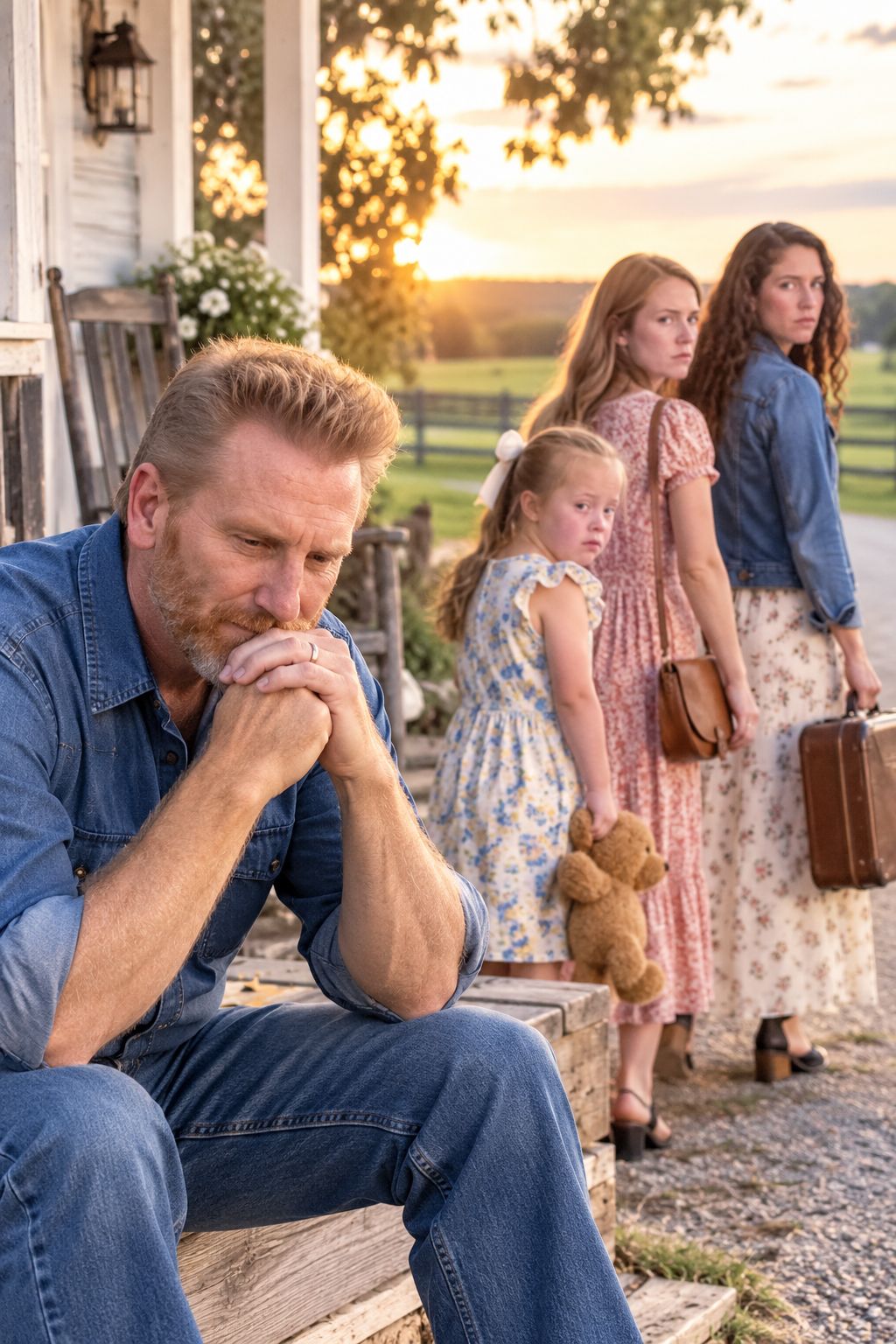
For years, Rory Feek was almost impossible to separate from the image of the devoted country father.
He was the husband who stood beside Joey Feek through her heartbreaking battle with cancer. He was the widower who documented grief, faith, family and fatherhood for millions of readers. And after Joey’s death, Rory became something larger than a country songwriter: to many fans, he represented resilience.
But behind that carefully constructed public image, a deeply painful family conflict was unfolding.
Today, the story surrounding Rory Feek and his two adult daughters, Heidi and Hopie, is no longer simply a story about country music, grief or faith. It is a story about estrangement, childhood memories, accusations over the safety of a younger sister, and a family that has found itself arguing publicly over matters most parents would never want strangers to see.
And perhaps the most heartbreaking element is this:
The people making the accusations aren’t former employees, anonymous critics or internet trolls.
They are Rory’s own daughters.
The family fracture nobody saw coming
Rory’s relationship with Heidi and Hopie became increasingly strained as disagreements developed over their younger sister, Indiana.
Indiana, the daughter Rory shared with Joey, was only two when Joey died in 2016. For years, Heidi and Hopie remained important figures in Indiana’s life. Heidi later said Indiana had regularly stayed with her and that the sisters had maintained a close relationship with the child.
According to Heidi, that relationship gradually disappeared.
She claimed that visits became less frequent, overnight stays were stopped and eventually communication itself was restricted. In 2024, Heidi and Hopie announced that they were pursuing legal action concerning Indiana’s care and their ability to maintain contact with her. The details of the legal proceedings involving Indiana, a minor, have not been publicly disclosed.
That transformed a private family disagreement into a national story.
The question that immediately captivated fans was simple:
How could a family that once appeared so close reach this point?
“We no longer believe Indiana is safe”
The sisters’ concerns went far beyond disagreements over parenting.
Heidi publicly stated that she and Hopie no longer believed Indiana was safe under their father’s care. She also raised concerns about people and communities surrounding Rory, including Homestead Heritage, an organization with which Rory had become associated.
The sisters cited reports and allegations involving abuse within or connected to the broader organization and argued that Indiana’s circumstances required greater protection. Rory rejected their characterization of the situation and denied that Homestead Heritage was a cult. He also insisted that Indiana was loved and cared for.
It is crucial to understand what happened here.
These are competing accounts, not a simple story in which one side has been conclusively proven right.
Heidi and Hopie made serious allegations. Rory strongly disputed them. Public reporting has also noted that the underlying legal proceedings are ongoing and that details have remained private because Indiana is a minor.
Yet the emotional impact was undeniable.
Because suddenly, Rory Feek wasn’t only being discussed as a country father who had survived tragedy.
He was being discussed as a father whose adult daughters said their relationship with him had become deeply damaged.
The childhood allegations made everything darker
Perhaps the most disturbing part of the sisters’ statements was that their concerns about Indiana were intertwined with memories of their own childhood.
Heidi and Hopie described experiences they said had left lasting emotional scars.
In one widely reported response to Rory, the sisters accused him of abandoning them during childhood and described episodes of anger and physical behavior that they said had frightened or hurt them. Heidi also raised an account involving a childhood injury and claimed she did not receive medical attention as quickly as she believed she should have.
Those allegations remain contested.
Rory’s own published account of some childhood events differs significantly from his daughters’ recollections. That distinction matters because memories inside a fractured family can collide in ways that are impossible for outsiders to fully reconstruct.
But emotionally, the daughters’ message was unmistakable.
They were saying that the conflict over Indiana wasn’t something that suddenly appeared in adulthood.
They believed it was connected to unresolved wounds that had existed for years.
And that is what made the story so painful for longtime fans.
“Love is action, not words.”
That phrase became central to the sisters’ public response.
They were essentially arguing that saying “I love you” wasn’t enough. In their view, love had to mean showing up, listening, protecting and accepting accountability.
Rory’s response: A father fighting back
Rory did not remain silent.
In an extensive public statement, he described the controversy as a painful family dispute and argued that social media was not the appropriate place to resolve it.
He maintained that Indiana had never been more loved or better cared for. He rejected the idea that his daughters’ allegations accurately reflected the reality of their younger sister’s life. He also accused Heidi of acting out of anger and said he believed the situation had become an attempt to hurt him.
His response revealed something important about the dispute.
From Rory’s perspective, he was not abandoning his older daughters.
He was protecting his youngest.
From Heidi and Hopie’s perspective, however, the situation looked almost exactly opposite.
They believed they were trying to protect Indiana.
That is the tragic paradox at the center of the entire story.
Both sides say they are acting out of love.
And both sides believe the other has misunderstood what love requires.
Then came an even more painful revelation
The family conflict became even more complicated after Hopie publicly revealed that a DNA test had shown Rory was not her biological father.
Rory had raised Hopie as his daughter, and the revelation created another emotional fault line.
Rory said that the discovery did not change how he felt about her and that he continued to consider her his daughter. But Hopie later said the deeper problem in their relationship wasn’t the DNA result itself.
It was what happened afterward.
She objected to private family information being publicly discussed and said she had asked her father not to shame her mother. She also said their relationship was broken because Rory had refused to participate in family therapy.
That distinction is devastating.
Because it suggests the DNA test wasn’t necessarily the beginning of the fracture.
It became another chapter in a much older story.
The “country hero” image begins to crack
Celebrity culture often creates a dangerous illusion.
We see a musician singing about family and assume we understand his family.
We see photographs of a father holding his daughter and assume we know what happens after the camera is turned off.
We read a memoir about grief and faith and assume the author has conquered every private struggle.
But families aren’t songs.
They’re messy.
They’re contradictory.
They’re full of memories that can mean entirely different things to different people.
Rory’s public identity was built partly around vulnerability. He shared his grief after Joey’s death. He wrote about raising Indiana. He invited audiences into intimate chapters of his life.
That openness helped create an extraordinary bond with fans.
But it also meant that when his daughters began speaking publicly, the conflict collided directly with the identity millions of people had built around him.
The result was almost inevitable:
People who once viewed Rory as a symbol of devoted fatherhood suddenly found themselves questioning everything.
Yet there is another danger here.
The opposite conclusion — that every accusation must therefore be true — would be equally irresponsible.
The photographs that changed the conversation
The controversy resurfaced dramatically in 2026 when Indiana underwent open-heart surgery.
Rory shared updates about her medical crisis, including photographs and emotional descriptions of the frightening moments surrounding her hospitalization.
Instead of bringing the family together, the posts reignited the dispute.
Heidi accused her father of the “ongoing exploitation” of Indiana and objected to photographs being taken during her sister’s medical emergency. Hopie similarly questioned why a parent would document such vulnerable moments for an online audience.
Again, the disagreement wasn’t merely about a photograph.
It represented two completely different philosophies about privacy, parenting and storytelling.
Rory appeared to see documenting his family’s journey as part of the way he communicates with the world.
His daughters appeared to see some of those same actions as crossing a boundary around Indiana’s privacy.
And because Indiana is a child with special needs, the ethical question becomes even more complicated.
At what point does documenting a family’s story become exploiting someone’s vulnerability?
There is no easy answer.
The tragedy behind the headlines
Perhaps the saddest part of this entire saga is that Heidi and Hopie don’t describe themselves as people who simply stopped loving their father.
Quite the opposite.
Hopie has publicly said she loves Rory and always will, even while describing their relationship as deeply broken. She has also said she wants things to be different for Indiana.
That sentence reveals the emotional contradiction beneath the headlines.
Estrangement doesn’t always mean hatred.
Sometimes it means loving someone while believing you cannot safely remain close to them.
Sometimes it means wanting reconciliation but refusing to accept the relationship on its old terms.
And sometimes it means desperately wishing the person you remember could become the person you need today.
A family story without a clean villain
The easiest way to consume this story is to choose a side.
Rory’s supporters can say his daughters have taken private disagreements online and unfairly attacked a grieving father.
His daughters’ supporters can say that their accusations deserve to be heard precisely because they are the people who grew up inside the family.
But the deeper story is more uncomfortable.
There are serious allegations.
There are serious denials.
There are private legal proceedings whose details are not public.
And there is a child at the center of it all.
That means outsiders should be cautious about treating social-media statements as courtroom verdicts.
What can be said with confidence is that the Feek family has experienced a profound rupture, and that Rory’s relationship with Heidi and Hopie has become one of the most painful chapters of his public life.
The man once celebrated for singing about love, faith and family now finds himself separated from two of his adult daughters.
And the daughters who once looked to him as their father are publicly challenging the story he tells about their family.
That is more complicated — and far more human — than a simple “hero versus villain” narrative.
The question that remains
Years from now, the headlines may disappear.
The social-media posts may be forgotten.
The legal dispute may eventually reach a resolution.
But the family will still have to live with what was said.
That’s the part celebrity coverage often misses.
A viral accusation can generate millions of clicks in a day.
A family has to live with it for decades.
Maybe reconciliation will come.
Maybe it won’t.
Maybe time will soften the anger. Maybe private conversations will eventually accomplish what public statements never could.
But for now, the Feek family story stands as a painful reminder that the image of a perfect country family can hide a much more complicated reality.
And perhaps the most heartbreaking question isn’t whether Rory Feek is a hero or an outcast.
It’s whether a father and his daughters can ever find a way back to one another after the world has heard both sides of their deepest wounds.
Because sometimes the hardest song to sing isn’t about losing someone you love.
It’s about loving someone who is still alive — and wondering if you’ve already lost them.
VIDEO: