 By admin
 INTRODUCTION:
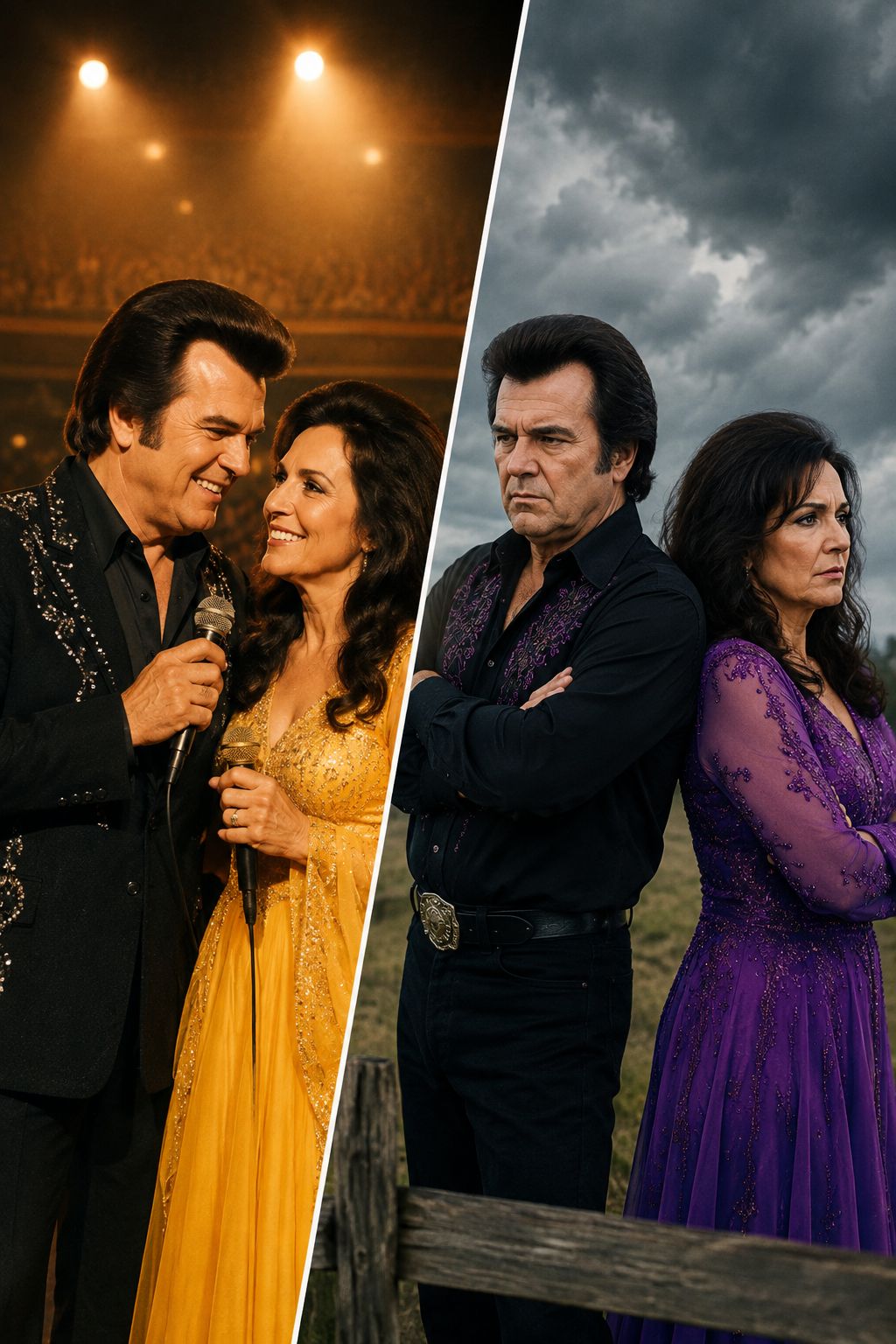
There are some partnerships in country music that feel almost impossible to recreate.
Then there was Conway Twitty and Loretta Lynn.
When their voices met, something happened that neither artist could quite produce alone. His smooth, restrained delivery collided with her fiery Kentucky honesty. He sounded like the man with a secret. She sounded like the woman who already knew it.
Together, they created a musical relationship so convincing that millions of fans wondered whether the chemistry was real.
It was.
But not in the way people imagined.
The chemistry was musical. The friendship was real. The partnership was extraordinary.
And eventually, the road that had brought Conway Twitty and Loretta Lynn together began pulling them in different directions.
The story is sometimes remembered as one of rivalry, betrayal, or a mysterious falling-out. But the historical record tells a more complicated—and perhaps more heartbreaking—story. There is no strong evidence that Conway and Loretta became bitter personal enemies. In fact, Loretta later described Conway as a friend, and PBS documented her saying that the rumors of a romantic relationship between them were simply untrue.
The real tragedy was that one of country music’s greatest partnerships could not last forever.
And that ending began long before the final goodbye.
THE UNLIKELY PAIR WHO SHOULD NOT HAVE WORKED
On paper, Conway Twitty and Loretta Lynn seemed almost completely opposite.
Loretta was the outspoken Coal Miner’s Daughter, a woman whose songs confronted marriage, motherhood, jealousy, infidelity, and the struggles of ordinary women.
Conway was the polished, mysterious hitmaker whose deep voice could turn a love song into a confession.
Yet their differences became their greatest strength.
They had already established themselves as major solo stars when their professional partnership took shape. Their first major duet success, “After the Fire Is Gone,” arrived in 1971 and immediately demonstrated that their voices belonged together. The song became a No. 1 country hit and helped launch one of the most successful male-female partnerships in country music history.
What followed was extraordinary.
Between 1971 and 1988, they recorded 11 studio albums together, while their singles included multiple Top 10 successes and five No. 1 country hits. They also won the CMA Vocal Duo of the Year award four consecutive times, from 1972 through 1975.
They weren’t simply recording duets.
They were creating characters.
Every glance, every pause, every argument in a song felt believable.
And that realism created a problem.
Fans started wondering:
Were Conway and Loretta secretly in love?
Loretta eventually made her position clear.
“Everybody thought me and Conway had a thing going. And that’s the farthest from the truth.”
She described him as a friend and emphasized that her husband, Doolittle Lynn, respected Conway deeply.
That detail matters.
Because the legendary chemistry between Conway and Loretta was not built on a secret romance.
It was built on trust.
WHEN THE STAGE BECAME A WORLD OF ITS OWN
Their performances became almost theatrical.
Conway would play the smooth, confident man.
Loretta would challenge him.
He would push.
She would push back.
Sometimes the songs were funny. Sometimes they were passionate. Sometimes they were heartbreaking.
Songs such as “Louisiana Woman, Mississippi Man,” “Lead Me On,” “Feelins’,” and “After the Fire Is Gone” gave them a repertoire that could move effortlessly between humor, conflict, desire, and regret.
That was the genius of the partnership.
They didn’t have to agree.
They simply had to sound like they believed the story.
And audiences believed them.
For years, the two appeared inseparable on stage.
But behind the scenes, both were still individual superstars.
Loretta had her own enormous career, including landmark songs such as “Coal Miner’s Daughter,” “Fist City,” “You Ain’t Woman Enough,” and “The Pill.” Conway was simultaneously building one of the strongest solo careers in country music, with songs such as “Hello Darlin’” and a remarkable succession of No. 1 hits.
That created an unavoidable tension—not necessarily between the two people, but between two careers.
How long could the partnership continue without overshadowing either artist?
THE TURNING POINT WASN’T A FIGHT—IT WAS TIME
This is where the story becomes misunderstood.
There is a temptation to turn the ending of Conway and Loretta’s full-time touring partnership into a dramatic feud.
But the available evidence points somewhere else.
They stopped touring together full-time in 1981.
That doesn’t sound like the explosive ending of a friendship.
It sounds like something more painful:
Life moving on.
By then, both artists had spent years carrying enormous careers.
Loretta had become one of the most influential women in country music. Conway was one of the genre’s dominant male stars. Their individual identities were simply too large to remain permanently attached to the same touring machine.
And sometimes the saddest endings are not caused by hatred.
They’re caused by distance.
By schedules.
By ambition.
By changing priorities.
By realizing that something beautiful cannot remain exactly as it was forever.
FROM PARTNERS TO “RIVALS”
Calling them “rivals” makes for a powerful headline.
But historically, it needs context.
Conway and Loretta were certainly competitors in the larger country music industry. Both were charting artists. Both were award-winning stars. Both had their own fan bases and solo careers.
Yet there is little credible evidence that they became bitter personal rivals.
In fact, Conway’s own official biography describes Loretta as his duet partner and notes that the pairing became the most awarded male-female duet partnership in country music history. It also records Conway’s philosophy that his fans were enough of an award for him.
The “rivalry” was therefore less about hatred and more about the unavoidable competition between two enormous stars trying to maintain their own identities.
And perhaps that is what makes the story so compelling.
They didn’t destroy one another.
They simply couldn’t remain frozen in the same chapter forever.
THE LASTING HEARTBREAK
The cruelest part of their story is what happened afterward.
Conway continued performing and recording, maintaining a legendary work ethic. According to his official biography, he never missed a show during 36 years of touring.
Loretta continued building her own legacy.
She became a symbol of honesty in country music—a songwriter whose stories about working-class life, marriage, motherhood, and womanhood changed what a female country star could say publicly. The Grand Ole Opry describes her as one of its most celebrated members and notes her extraordinary career and influence.
But the old magic of Conway and Loretta could never be completely duplicated.
Then came the loss that made the ending permanent.
Conway Twitty died in 1993.
Suddenly, there was no possibility of another great reunion.
No new album.
No surprise television performance.
No final tour.
No chance to recreate the chemistry that had once electrified country audiences.
The partnership had already changed.
Now it was history.
WHAT CONWAY AND LORETTA LEFT BEHIND
Decades later, their music still refuses to disappear.
Their grandchildren eventually carried the family connection forward through Twitty & Lynn, featuring Tre Twitty and Tayla Lynn. The duo has performed the grandparents’ songs and even made its Grand Ole Opry debut in 2022, helping introduce a new generation to the extraordinary musical relationship of Conway and Loretta.
That continuation says something important.
The Conway-Loretta story didn’t really end.
It evolved.
Their grandchildren have described the experience of sharing their grandparents’ legacy as something deeply personal, performing the same songs that once brought Conway and Loretta together on stages across the country.
And perhaps that is the greatest proof that the partnership mattered.
Not the rumors.
Not the imagined feud.
Not the idea that they secretly hated one another.
The music survived.
THE TRUTH IS MORE EMOTIONAL THAN THE RUMOR
The most powerful version of this story isn’t that Conway Twitty and Loretta Lynn became enemies.
It is that two people created something so convincing that audiences wanted their relationship to be bigger than it really was.
They became symbols.
They became characters.
They became inseparable in the public imagination.
But behind those performances were two independent artists who had their own lives, marriages, ambitions, families, and careers.
Loretta never needed Conway to become a legend.
Conway never needed Loretta to become one.
But together, they became something neither could have created alone.
That is the tragedy.
And that is the beauty.
They didn’t have to be lovers to sound like they understood each other’s hearts.
They didn’t have to be lifelong touring partners to leave a lifelong musical legacy.
And they didn’t have to become bitter enemies for their partnership to eventually come to an end.
Sometimes, two stars simply reach the point where the road divides.
One keeps going one direction.
The other takes another.
The audience is left behind, holding onto the songs.
Years later, when the opening notes of “After the Fire Is Gone” or “Louisiana Woman, Mississippi Man” begin playing, something remarkable happens.
For a few minutes, Conway is back.
Loretta is back.
The stage lights come on again.
And the two voices that once seemed destined to last forever meet in perfect harmony.
That is why their story still hurts.
Because the greatest country duets aren’t remembered merely because they were successful.
They’re remembered because, for a brief moment in music history, two completely different people sounded like they belonged to the same heartbeat.
And once that heartbeat stopped, country music was never quite the same again.
VIDEO: