 By admin
 INTRODUCTION:
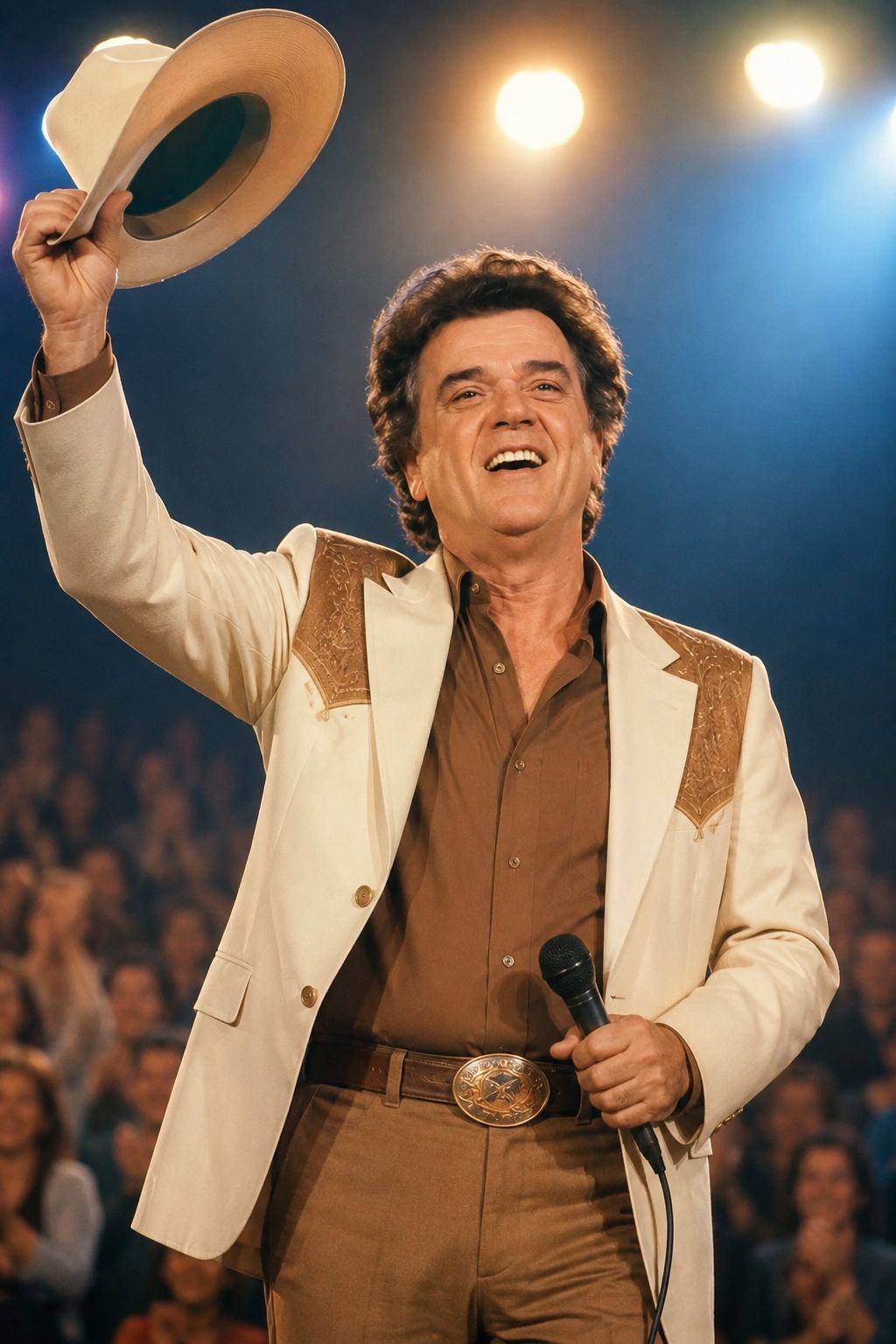
There are moments in country music when an entire room seems to hold its breath.
The lights go down. The band settles into place. Thousands of voices disappear into a sudden silence. Then a familiar figure steps toward the microphone.
No long introduction.
No elaborate speech.
No need to explain what comes next.
He simply says two words:
“Hello Darlin’…”
And the crowd knows.
For generations of country fans, those two words have been more than the opening of a song. They became a signal—a promise that Conway Twitty was about to take everyone on a journey through love, regret, memory, and heartbreak.
Released in 1970, “Hello Darlin’” became Twitty’s signature recording, spending four weeks at No. 1 on Billboard’s Hot Country Singles chart and eventually becoming one of the most recognizable songs in country music history.
But the fascinating part of the story isn’t simply that the song became a hit.
It is how close those two words came to sounding completely different.
A Song That Almost Stayed Hidden
Long before country radio embraced Conway Twitty, he was known primarily as a rock-and-roll performer.
Born Harold Lloyd Jenkins, Twitty had already experienced major success with songs such as “It’s Only Make Believe.” Yet behind the scenes, he was writing country songs even while his career was moving in another musical direction.
“Hello Darlin’” was one of those songs.
Twitty wrote it in 1960, but there was no obvious place for the song in his career at the time. So it remained among his stored-away material while he continued pursuing opportunities in rock and pop.
Think about that for a moment.
One of the most recognizable openings in country music history was sitting quietly in storage.
A song that would eventually become synonymous with its creator was, for years, simply another unfinished possibility waiting for the right moment.
That moment arrived when Twitty committed himself to country music.
In the late 1960s, he brought the song to producer Owen Bradley, one of Nashville’s most influential studio figures. Bradley heard something special in the composition—but he also heard a problem.
The opening needed something different.
Something human.
Something intimate.
Something that didn’t sound like a conventional country vocal.
Bradley’s solution was remarkably simple.
Instead of singing the first two words, Twitty should speak them.
And that tiny decision changed everything.
Two Words That Changed the Record
There is a reason the opening of “Hello Darlin’” still feels different decades later.
Twitty doesn’t immediately attack the melody.
He doesn’t oversing.
He doesn’t try to prove anything.
He speaks.
That makes the moment feel almost private—as though the listener has accidentally walked into a conversation between two people who once loved each other.
The famous opening establishes the emotional situation immediately: an unexpected reunion with someone from the past.
The narrator sees the woman he once loved.
She’s still beautiful.
She’s moved on.
And he hasn’t.
That contrast becomes the emotional engine of the entire song.
According to the song’s published credits, Twitty wrote the song himself, with Owen Bradley producing the recording.
The brilliance is that the title phrase itself appears only at the beginning. After that, the song moves into the painful conversation underneath those two words.
And that makes the opening even more powerful.
“Hello Darlin’” isn’t really a greeting.
It’s the doorway into everything the singer is afraid to say.
When Heartbreak Became a Conversation
Country music has always understood something that other genres sometimes forget:
Heartbreak doesn’t always arrive screaming.
Sometimes it arrives quietly.
Sometimes it sounds like someone trying to act as though everything is fine when it isn’t.
That’s exactly what makes Twitty’s performance so effective.
The narrator asks how she’s doing. He asks about her new love. He tells her that he hopes she’s happy.
On the surface, he is being polite.
Underneath, he’s falling apart.
Eventually, the mask begins to crack.
He admits that he can’t sleep.
He admits that he cries through the night.
And then comes the confession he has been trying to avoid: he still loves her, he misses her, and he’s sorry for what he did.
That emotional progression is why the song remains so devastating.
It doesn’t begin with desperation.
It arrives at desperation.
First comes the greeting. Then comes the memory. Then comes the regret. And finally comes the realization that some loves never completely leave.
That’s classic country storytelling at its most effective.
The Crowd Learned the Ritual
Once “Hello Darlin’” became a hit, it developed a life beyond the recording studio.
The song was released in March 1970 and quickly became a major country success. It spent four weeks at No. 1 and was recognized as the No. 1 country song of 1970 by the cited historical accounts.
But radio success was only part of the story.
The song became a concert favorite.
Historical material about the song describes the reaction when Twitty performed those first two spoken words live: audiences immediately recognized what was coming, and the response could be explosive.
That created something rare between an artist and his audience.
A ritual.
Twitty didn’t have to explain the song.
He didn’t need to announce the title.
He could walk onto the stage, approach the microphone, and begin.
The fans already knew.
“Hello Darlin’…”
And suddenly, thousands of people were singing along with a memory that belonged to nobody and everybody at the same time.
That’s the strange power of great country music.
A song can be intensely personal while somehow becoming part of the emotional biography of an entire generation.
Why Conway Didn’t Need to Say Much
Part of Twitty’s appeal came from restraint.
His official biography describes him as a master of understatement onstage, noting that he generally avoided excessive banter and preferred to communicate through his music.
That philosophy fits “Hello Darlin’” perfectly.
Imagine the opposite.
Imagine Twitty walking onto the stage and giving a three-minute speech about lost love before beginning the song.
It wouldn’t have the same magic.
Instead, he gave the audience two words.
That’s it.
The audience supplied the rest.
They knew the melody.
They knew the story.
They knew where the heartbreak was going.
And many of them probably had their own version of the story.
Maybe they had once seen an old love after years apart.
Maybe they had watched someone they loved walk away.
Maybe they had made a mistake they wished they could undo.
Maybe they simply remembered a time when a certain song played on the radio and life felt completely different.
“Hello Darlin’” gave those memories somewhere to live.
The Secret Wasn’t the Voice—It Was the Pause
Twitty had an extraordinary voice: deep, smooth, controlled, and instantly recognizable.
But the genius of “Hello Darlin’” isn’t simply the sound of that voice.
It’s the space around it.
That tiny pause before the song truly begins.
That conversational delivery.
That feeling that he isn’t performing at you.
He’s talking to you.
The opening feels almost like a scene from a movie.
A man sees the woman he once loved.
He doesn’t know what to say.
So he starts with the safest words imaginable.
Hello. Darlin’.
And then everything he has tried to bury begins to surface.
That is why the opening became legendary.
It wasn’t flashy.
It was believable.
More Than a Hit—A Country Music Calling Card
By the time Twitty’s career reached its later years, “Hello Darlin’” had become inseparable from his identity.
His official biography lists it among the defining songs that marked his career across three decades. It also notes that Twitty wrote 19 of his No. 1 hits and received Grammy nominations for compositions including “Hello Darlin’.”
That’s an extraordinary legacy.
But perhaps the greatest compliment came from the audience itself.
Fans didn’t merely recognize the song.
They recognized the moment.
The opening became a kind of musical handshake between Conway Twitty and everyone in the room.
He said two words.
They knew the rest.
And that’s something statistics can never fully capture.
Why “Hello Darlin’” Still Hurts
More than half a century after its release, the song continues to connect because its central emotion has never become outdated.
People still miss people.
People still regret mistakes.
People still wonder what might have happened if they had made a different choice.
People still encounter old loves unexpectedly.
And sometimes, after years have passed, two people can stand face to face and realize that the past isn’t as far away as they thought.
That’s the world Conway Twitty captured.
Not with complicated poetry.
Not with excessive production.
But with a simple conversation.
And two words that became immortal.
“Hello Darlin’” was never just the beginning of a song. It was the beginning of a memory.
The Moment Country Music Will Never Forget
There are thousands of country songs.
Hundreds of legendary singers.
Countless unforgettable choruses.
But only a handful of songs become so closely associated with an artist that the opening notes—or even the opening words—are enough to summon an entire era.
“Hello Darlin’” is one of them.
Conway Twitty didn’t need a grand announcement.
He didn’t need fireworks.
He didn’t need a long introduction.
He needed only two words.
And somewhere in the darkness, the crowd already understood.
They knew they were about to hear a story about the one person you never quite stopped loving.
They knew the heartbreak was coming.
They knew the memories would hurt.
And they knew that, for a few minutes, Conway Twitty was going to make an entire room feel like it was standing inside an old photograph.
“Hello Darlin’…”
Two words.
One voice.
One unforgettable song.
And an emotional legacy that country music still hasn’t forgotten.
VIDEO: