 By admin
 INTRODUCTION:
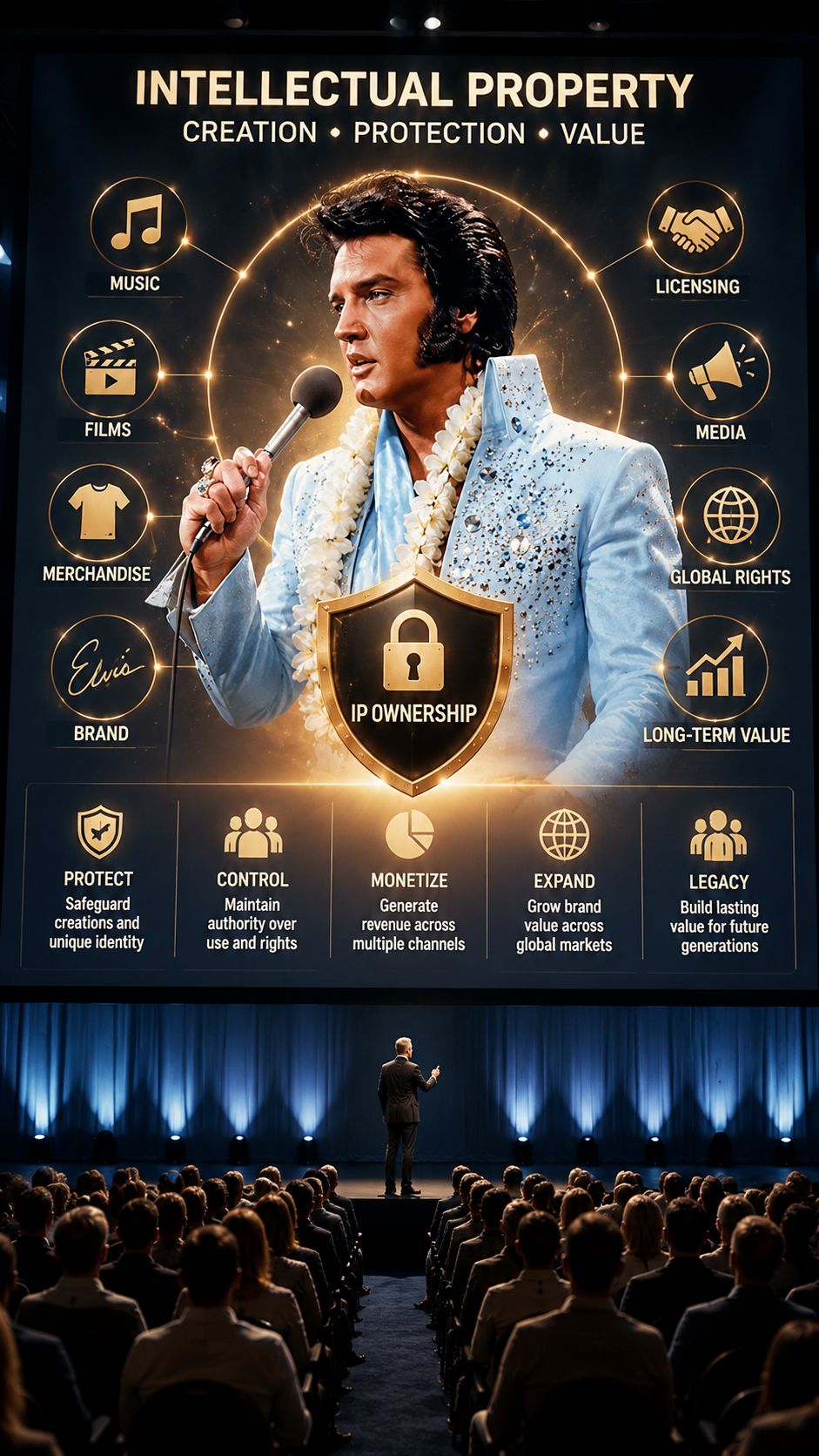
There are few names in music history that carry the emotional weight, cultural power, and commercial endurance of Elvis Presley. More than four decades after his passing, the King of Rock and Roll remains one of the most profitable entertainment brands on Earth. While countless artists have sold millions of records, very few have transformed into economic empires capable of generating revenue long after the final curtain call.
The story of Elvis Presley is not merely a story about music. It is a story about intellectual property, brand ownership, nostalgia, and one of the most powerful business lessons ever witnessed in the entertainment industry. What happened after his death in 1977 shocked the music world. Instead of fading into history, the value of the Elvis Presley brand exploded. Merchandise sales multiplied. Licensing deals expanded globally. Tourism surrounding Graceland became a massive industry. Films, documentaries, collectibles, and digital media continuously introduced new generations to his legacy.
Death ended the man, but it unlocked the business machine.
The remarkable reality is that Elvis Presley became worth dramatically more as a commercial asset after his passing than during many periods of his living career. Understanding why reveals a hidden truth about modern entertainment: in today’s economy, intellectual property can become more valuable than the artist who created it.
The Birth of an Entertainment Empire
When Elvis Presley burst onto the scene in the 1950s, he was more than a singer. He represented a cultural revolution. His fusion of Rock and Roll, Country Music, Blues, and Gospel created a sound that changed popular music forever.
Songs such as Heartbreak Hotel, Hound Dog, Jailhouse Rock, Love Me Tender, and Can’t Help Falling in Love became cultural landmarks. Millions purchased records, attended concerts, and watched his films.
Yet despite his fame, the business structure surrounding Elvis Presley was relatively traditional. Revenue came primarily from album sales, touring, film contracts, and merchandise. While enormous by the standards of the era, the global licensing ecosystem we know today barely existed.
What nobody fully understood was that Elvis Presley was not merely an artist.
He was intellectual property.
The Moment Everything Changed
On August 16, 1977, the world learned of the death of Elvis Presley.
Many believed the commercial story was over.
Instead, it was only beginning.
History has repeatedly shown that the death of a legendary artist often creates an emotional surge among fans. Album sales increase. Media coverage intensifies. Collectibles become more desirable.
But with Elvis Presley, the phenomenon operated on an entirely different scale.
The reason was simple:
The brand had become immortal.
Fans no longer viewed Elvis as a performer. They viewed him as a symbol.
Symbols do not age.
Symbols do not make career mistakes.
Symbols do not disappear from public memory.
The image of Elvis Presley became permanently frozen in cultural history.
Graceland: Turning Memory into Revenue
One of the most brilliant business decisions involved transforming Graceland into a tourism destination.
Before opening to the public, the estate represented a costly property requiring maintenance. After becoming a tourist attraction, it evolved into one of America’s most successful music-related destinations.
Today, visitors from around the world travel to experience the home of Elvis Presley. The estate generates revenue through admission tickets, exhibitions, events, souvenirs, hospitality services, and exclusive experiences.
The lesson was revolutionary.
Instead of selling only music, the brand began selling access to memory.
People were not purchasing a ticket to see a house.
They were purchasing a connection to a legend.
The Hidden Power of Nostalgia
Modern entertainment companies understand something that earlier generations rarely measured:
Nostalgia is an economic asset.
Every generation discovers Elvis Presley differently.
Some remember watching him on television.
Others discover Jailhouse Rock through movies.
Younger audiences encounter his influence through streaming platforms, documentaries, and social media.
This constant rediscovery creates what economists call an evergreen asset.
Unlike a traditional product that becomes obsolete, legendary intellectual property renews itself continuously.
Every new fan effectively restarts the revenue cycle.
This is why music legends often remain financially powerful decades after their deaths.
The emotional connection never expires.
Licensing: The Billion-Dollar Multiplier
Perhaps the biggest industry secret lies in licensing.
Most consumers see a photo of Elvis Presley on a shirt, poster, advertisement, or collectible and think of it as simple merchandise.
In reality, every authorized use represents a licensing transaction.
Companies pay for rights to use:
- The image of Elvis Presley
- His signature
- His likeness
- His recordings
- His film appearances
- His trademarks
- His branding elements
One image can generate income repeatedly across hundreds of products.
This creates a business model far more scalable than touring or recording.
A living artist has limited hours in a day.
Intellectual property has no such limitation.
The brand can appear simultaneously in thousands of locations around the world.
Why Dead Celebrities Often Earn More
The Elvis Presley phenomenon helped reveal a broader industry reality.
Many deceased stars become more profitable because the marketplace gains complete certainty.
A living celebrity carries risk:
- Career decline
- Public controversies
- Creative failures
- Changing public tastes
A deceased icon becomes historically fixed.
The public remembers the highlights rather than the struggles.
This creates a stable commercial asset that businesses feel comfortable licensing.
The same principle later appeared with legends across multiple genres, including Johnny Cash, Frank Sinatra, Michael Jackson, and Prince.
Their estates increasingly functioned like multinational corporations.
The Streaming Era Changed Everything Again
The digital revolution introduced another unexpected advantage.
Unlike physical records, streaming platforms never run out of inventory.
Every stream of Can’t Help Falling in Love or Heartbreak Hotel generates royalties.
Every documentary introduces the music to new listeners.
Every viral social media trend can resurrect interest in songs recorded decades earlier.
The internet effectively removed geographical limitations.
Today, a teenager thousands of miles from Graceland can discover Elvis Presley instantly.
This perpetual accessibility transformed legacy catalogs into long-term financial engines.
The Ultimate Lesson About Modern IP Ownership
The greatest lesson from the Elvis Presley story extends far beyond music.
It demonstrates that intellectual property has become one of the world’s most powerful economic assets.
The value is no longer confined to the original product.
A song becomes a catalog.
A catalog becomes a brand.
A brand becomes a licensing platform.
A licensing platform becomes a global business ecosystem.
This transformation explains why corporations aggressively acquire music rights, film libraries, character franchises, and entertainment catalogs.
The asset is not the recording itself.
The asset is ownership of the story, the image, the emotion, and the cultural meaning attached to it.
The real gold was never the record. It was the right to control what the record represented.
That is the hidden industry secret behind the extraordinary growth of the Elvis Presley empire after his passing. His life created the legend. His music created the audience. But intellectual property ownership created the billions.
In the modern entertainment economy, the most valuable performers are not always the ones standing on stage. Sometimes they are the icons whose stories continue generating revenue long after the spotlight has gone dark.