 By admin
 INTRODUCTION:
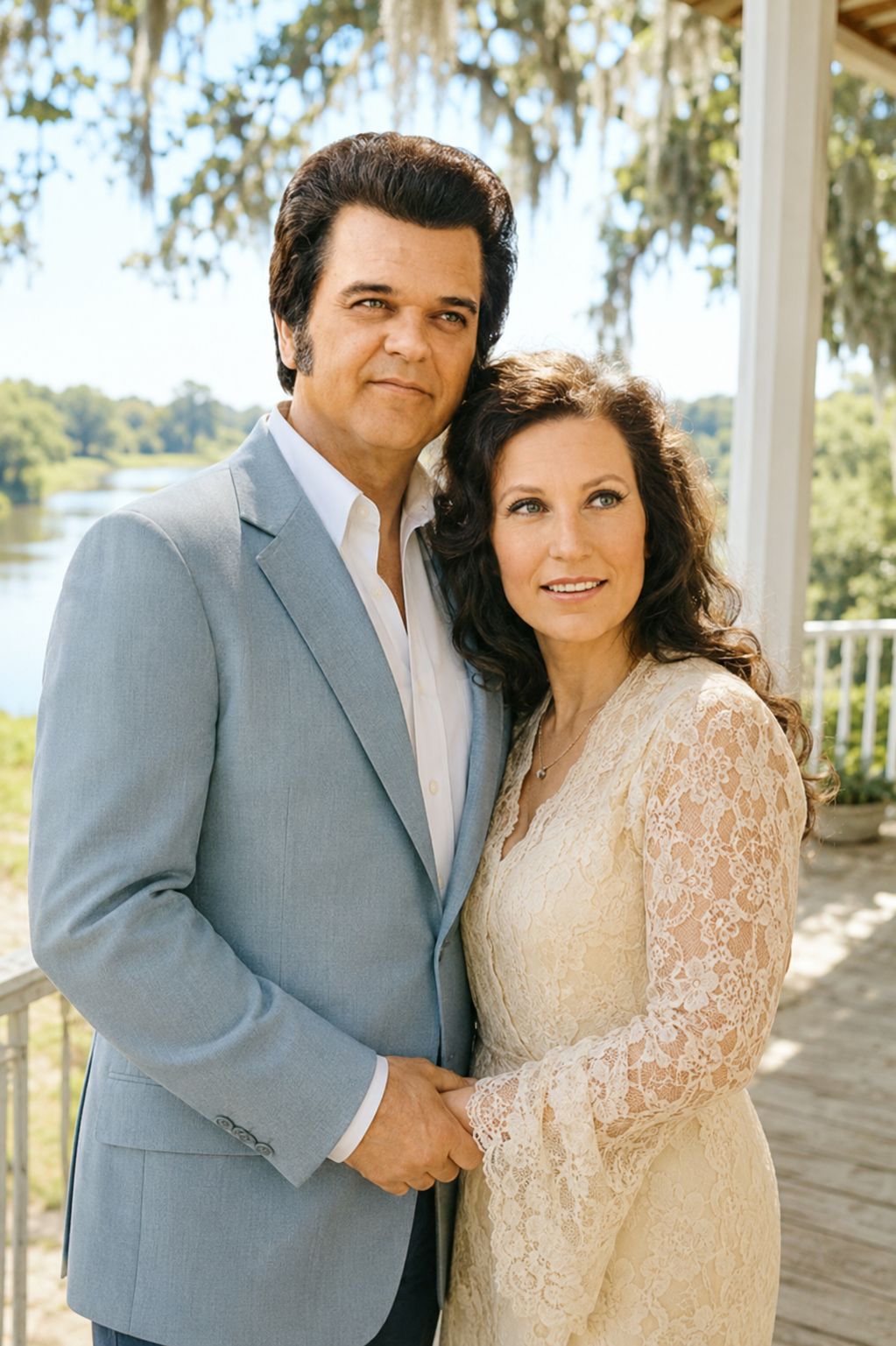
There are love songs about heartbreak. There are love songs about jealousy, regret, marriage, temptation, and goodbye.
And then there are songs that simply refuse to let distance win.
When Loretta Lynn and Conway Twitty came together on “Louisiana Woman, Mississippi Man” in 1973, they turned a river into a romantic obstacle and transformed a simple long-distance relationship into one of country music’s most memorable stories of determination.
The premise sounds almost playful: she is a Louisiana woman, he is a Mississippi man, and the mighty Mississippi River stands between them.
But beneath the upbeat rhythm and spirited vocals lies something much deeper.
It is the universal feeling of loving someone who isn’t always within reach.
The song was released in May 1973 as the title track from the duo’s album Louisiana Woman, Mississippi Man. Written by Becki Bluefield and Jim Owen and produced by legendary Nashville producer Owen Bradley, the single quickly became a major success. On August 18, 1973, it reached No. 1 on the Billboard country chart, where it remained for one week and spent 13 weeks overall.
But statistics cannot explain why this song still feels alive decades later.
For that, you have to listen to the two voices.
A River Between Two Hearts
The brilliance of “Louisiana Woman, Mississippi Man” is that the Mississippi River is not merely scenery.
It is the antagonist.
It is the wall standing between two people who desperately want to be together.
And yet the song never treats that wall as permanent.
Instead, Conway Twitty and Loretta Lynn sing as though the distance is an inconvenience — something that might slow them down, but certainly cannot stop them.
“The Mississippi River can’t keep us apart.”
That sentiment is the emotional engine of the entire song.
The man wants to cross the river to reach the woman waiting on the other side. She is equally determined to close the distance herself. The lyrics even bring alligators into the adventure, giving the story a humorous Southern flavor while reinforcing just how far these lovers are willing to go.
The song’s central idea is remarkably simple:
When love is strong enough, geography becomes a challenge instead of a barrier.
And that is exactly why so many listeners connected with it.
Long before smartphones, video calls, instant messages, and GPS directions, being separated from someone you loved could mean real physical distance.
A river.
A highway.
A train ride.
A long night of waiting.
There were no quick messages saying, “I’m almost there.”
There was only the promise that somehow, someday, you would make it to the other side.
Conway and Loretta Made the Story Feel Real
Of course, the song would not have become a classic with just clever lyrics.
It needed the right voices.
And Conway Twitty and Loretta Lynn had something almost impossible to manufacture: chemistry.
Their voices did not simply blend.
They reacted to each other.
Conway’s deep, confident delivery gave the song its masculine swagger, while Loretta’s voice answered with warmth, determination, and a touch of Southern fire.
One calls out.
The other responds.
Then they come together.
That call-and-response structure makes the listener feel as if two people are actually having a conversation across the river.
PBS’s American Masters later highlighted the pair’s easy chemistry and the way their duet performances sometimes caused audiences to speculate about their relationship. Lynn herself pushed back against that interpretation, explaining that Conway was a friend and that her husband, Mooney, also respected him.
That distinction matters.
Their chemistry was musical.
It was not dependent on a real-life romance.
They were performers who understood how to tell a love story convincingly.
And perhaps that is what made them so effective.
They could step into the emotional world of two fictional lovers and make millions of listeners believe in it.
The Magic Was in the Contrast
Part of the song’s appeal comes from its unusual mixture of romance and humor.
This is not a slow, sorrowful ballad about someone staring out a window in the rain.
It moves.
It smiles.
It runs toward the obstacle.
There is urgency in the performance, but there is also joy.
That was an important part of the song’s identity.
As The Boot noted, the track was upbeat despite its theme of separation, combining electric guitar, pedal steel, fiddle, and other elements into a lively country arrangement.
That musical choice changes everything.
Instead of saying, “Distance is breaking us,” the song essentially says:
“Distance is getting in our way — so let’s go around it.”
That is a very different kind of love story.
It is optimistic.
It is stubborn.
It is Southern.
And it is unmistakably country.
A Love Story Hidden Inside a Geography Lesson
There is something almost poetic about using the Mississippi River as the centerpiece of a love song.
The river is enormous.
It is powerful.
It has shaped communities, economies, cultures, and entire regions of American history.
But to two people in love, it becomes something very personal.
One mile can feel like a thousand miles when the person you love is standing on the opposite shore.
That is the genius of the song.
The river represents every obstacle people have ever faced in relationships.
Distance.
Work.
Family responsibilities.
Timing.
Money.
Circumstances.
Even fear.
The physical river is only the surface.
The real story is about whether love can survive separation.
And Conway and Loretta answer that question with confidence.
Yes.
Why the Song Still Feels Relevant
More than five decades later, long-distance relationships have changed dramatically.
Technology has made communication easier.
People can see each other instantly from thousands of miles away.
They can send photographs, voice messages, videos, and texts within seconds.
Yet emotional distance has not disappeared.
In some ways, it has become more complicated.
A person can be only a few feet away and still feel emotionally unreachable.
That is why “Louisiana Woman, Mississippi Man” remains more than a nostalgic country hit.
It captures something timeless.
The desire to close the distance between two hearts.
The song’s characters don’t spend their time questioning whether the relationship is worth the effort.
They simply find a way.
That determination is what makes the story so satisfying.
The river may be wide, but the heart has already decided where it belongs.
The Beginning of Another Chapter for the Duo
“Louisiana Woman, Mississippi Man” was not an isolated success.
It became part of a remarkable run for Loretta Lynn and Conway Twitty.
The single was their third No. 1 country hit as a duo, following earlier successes and helping establish their partnership as one of the defining male-female collaborations in country music.
The album itself was equally successful, reaching No. 1 on the U.S. Billboard Hot Country LPs chart — the duo’s first album to accomplish that feat.
And the story did not end there.
The pair continued producing memorable duets, eventually scoring another No. 1 with “As Soon as I Hang Up the Phone” in 1974.
But there was something particularly special about “Louisiana Woman, Mississippi Man.”
It was fun.
It was energetic.
It was romantic without becoming overly sentimental.
And most importantly, it gave listeners two characters who were willing to fight their way through an obstacle instead of surrendering to it.
More Than a Duet
The greatest country songs often take an ordinary situation and make it feel enormous.
That is what happened here.
A man is on one side of the Mississippi.
A woman is on the other.
They want to be together.
That’s it.
Yet through Conway Twitty’s rich voice and Loretta Lynn’s unmistakable strength, the situation becomes something larger.
It becomes a declaration.
A promise.
A challenge to every obstacle standing between two people.
And perhaps that is why the song still works.
Because everyone understands distance.
Everyone has missed someone.
Everyone has wanted to be somewhere else with someone they loved.
Everyone knows what it feels like to look toward the other side and wonder how long it will take before you finally get there.
“Louisiana Woman, Mississippi Man” gives that feeling a melody.
It gives it a rhythm.
And it gives it two legendary voices.
The Legacy of a Love That Wouldn’t Stay on Its Side of the River
When the song reached No. 1 in 1973, it was another victory for a duo that had already discovered how powerful their voices could be together.
But its lasting legacy goes beyond charts.
The song became a snapshot of an era when country music could tell a complete story in just a few minutes.
No elaborate production was necessary.
No complicated plot.
Just a woman, a man, a river, and enough love to make crossing it worthwhile.
That simplicity is precisely what makes the song unforgettable.
Some love stories are separated by miles. Others are separated by rivers. But the strongest ones are measured not by the distance between two people — but by how determined they are to reach each other.
That is the heart of “Louisiana Woman, Mississippi Man.”
And perhaps that is why, all these years later, Conway Twitty and Loretta Lynn still sound as if they are standing on opposite sides of the water, calling to one another.
The river is still there.
The distance is still there.
But the message remains unchanged:
Love does not always make the road easier. Sometimes, it simply makes you willing to cross it.
VIDEO: