 By admin
 INTRODUCTION:
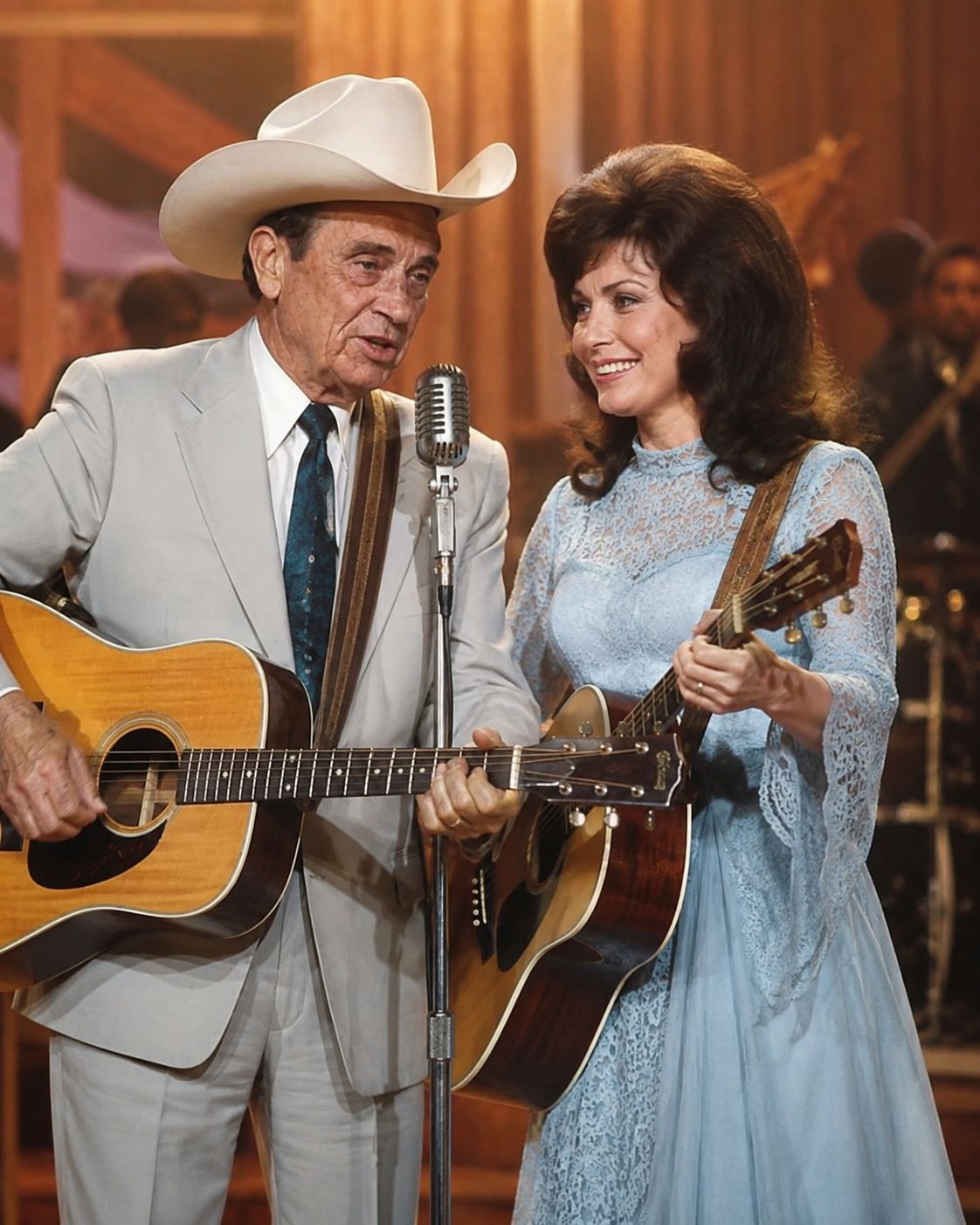
Long before Loretta Lynn became the legendary “Coal Miner’s Daughter,” before the awards, the No. 1 records, the sold-out concerts, and the songs that would speak for generations of women, she was simply a little girl in Butcher Hollow, Kentucky, listening to a radio.
It was an ordinary radio in an extraordinary home.
And on Saturday nights, that radio opened a window to another world.
From the hills of Kentucky, Loretta and her family listened to the Grand Ole Opry. The sound came through the old family radio imperfectly, but it was enough. Enough for a young Loretta to hear the voices that seemed impossibly far away.
One of those voices belonged to Ernest Tubb.
Years later, Loretta remembered something almost heartbreaking about those nights: whenever Tubb sang, she would cry.
She didn’t fully understand why.
She simply felt something.
And perhaps that is one of the most beautiful truths about country music: sometimes a song reaches us long before we understand the life that will make us understand it.
“Every time Ernest Tubb would sing, I would cry.”
For a little girl who had never imagined becoming a major country star, that voice on the radio represented something almost mythical.
She was listening to a man who had already become a giant of country music.
She could not have known that one day she would stand beside him.
She could not have known that the man she heard through that little radio would eventually look at her and say, in effect, I want her.
But that is exactly what happened.
THE GIRL FROM BUTCHER HOLLOW NEVER IMAGINED THIS
Loretta Lynn’s childhood was a world away from the glamour of Nashville.
She grew up in a poor coal-mining family in Butcher Hollow, Kentucky. Her father, Ted Webb, worked in the mines, and the family lived with the realities of hardship that would later become the emotional foundation of Loretta’s songwriting.
The future superstar wasn’t raised with a grand plan to conquer country music.
She was raised in a family where music was something you heard coming through the radio.
And that distinction matters.
Because Loretta didn’t merely study country music.
She lived inside it.
The voices she heard became part of her emotional vocabulary.
Then came Nashville.
Loretta’s first major breakthrough arrived with “I’m a Honky Tonk Girl” in 1960. She and her husband, Oliver “Doolittle” Lynn, famously drove from radio station to radio station promoting the record themselves. The song eventually reached the country charts and helped open the door to the Grand Ole Opry.
Suddenly, the little girl who had listened to Ernest Tubb on the radio was walking into the world she had once only heard from a distance.
And Ernest Tubb was there.
ERNEST TUBB DIDN’T JUST HEAR A SINGER — HE HEARD SOMETHING SPECIAL
Tubb was not simply a successful country singer.
He was one of Nashville’s great gatekeepers.
Through his Ernest Tubb Record Shop and his legendary Midnite Jamboree radio program, he gave emerging artists a platform at a time when a single radio appearance could change a career.
The Country Music Hall of Fame notes that Tubb was known for helping other artists—taking musicians on tour, recommending performers to Opry management and producers, and showcasing young talent through Midnite Jamboree. Loretta Lynn was among the artists whose careers benefited from his support.
And Loretta remembered going to him.
She later recalled that she essentially begged Ernest Tubb to put her on his program.
He listened.
Then he made a simple judgment.
“That little girl can sing.”
Those words may sound small today.
But imagine what they meant to Loretta.
The man whose voice had once made her cry in a Kentucky home was now standing in front of her, listening to her voice.
The distance between fan and idol had disappeared.
THEN CAME 1964
By 1964, Loretta Lynn was no longer merely a promising newcomer.
She had become an established Nashville performer and a member of the Grand Ole Opry, having officially joined the cast in 1962.
And Ernest Tubb wanted her as a duet partner.
According to PBS’s timeline of Lynn’s career, 1964 marked the beginning of a significant recording and performing partnership between Lynn and Tubb. They would collaborate on recordings and live performances, beginning a series of country partnerships that became an important part of Lynn’s career.
Among their early collaborations was “Mr. and Mrs. Used to Be.”
Think about the symbolism.
A little girl had once listened to Ernest Tubb from the hills of Kentucky.
Now, in 1964, her voice was sitting beside his on a country record.
The student had not replaced the teacher.
She had become his musical equal in the moment.
And that is what makes the story so powerful.
“MR. AND MRS. USED TO BE” WAS MORE THAN A DUET
Country music has always understood the emotional power of two voices telling the same story from opposite sides.
That was especially true of Loretta Lynn.
Her greatest strength was never simply vocal technique. It was emotional honesty.
She sang about marriages, arguments, betrayal, loneliness, motherhood, pride, temptation, regret and survival.
She sounded like someone who had actually lived the stories.
That quality made her an extraordinary duet partner.
And alongside Ernest Tubb, the contrast worked.
His seasoned, unmistakable voice carried the weight of an older generation of country music.
Loretta brought something different: vulnerability, directness and the unmistakable perspective of a woman who wasn’t afraid to tell the truth.
Together, they created something that felt conversational rather than manufactured.
They weren’t trying to sound perfect.
They were trying to sound real.
That was the essence of classic country music.
THE MAN ON THE RADIO BECAME A MENTOR
There is another reason this story deserves to be remembered.
Ernest Tubb did not simply participate in Loretta Lynn’s career.
He helped create opportunities for her.
He was among the Nashville figures who recognized her potential early.
The Grand Ole Opry has documented how Tubb’s Midnite Jamboree became an important launching pad for emerging country artists. Lynn herself remembered the Ernest Tubb Record Shop as one of the places where her career began taking shape.
And Tubb’s generosity was part of a larger philosophy.
He knew what it meant to be helped.
He had received assistance early in his own career and later became known for extending opportunities to others.
The Country Music Hall of Fame describes him as one of country music’s great supporters of developing artists.
Loretta was one of them.
And eventually, she would become one of the most important women country music had ever produced.
IMAGINE WHAT THAT MUST HAVE FELT LIKE
There is something almost cinematic about imagining Loretta in those early years.
A young woman from a Kentucky mining community.
A mother.
A wife.
A newcomer to Nashville.
A singer trying to find her place in a business dominated by established stars.
And somewhere in the back of her memory was that old radio.
The voice of Ernest Tubb.
The voice that had made her cry when she was a little girl.
Now she was standing in the same musical world.
Now he knew her name.
Now he wanted to sing with her.
That is not merely a career milestone.
That is a childhood dream quietly becoming real.
THE BEGINNING OF A MUCH BIGGER LEGACY
The partnership between Loretta Lynn and Ernest Tubb continued beyond that first 1964 collaboration. The Country Music Hall of Fame records that Tubb and Lynn made music together from 1964 through 1969.
Their collaboration became one chapter in Lynn’s extraordinary rise.
Within only a few years, she would release songs that challenged expectations about what women could say in country music.
“Don’t Come Home A-Drinkin’ (With Lovin’ on Your Mind)” became her first No. 1 hit in 1967.
“Fist City” followed.
Then came “Coal Miner’s Daughter,” the autobiographical song that transformed her childhood into one of the most recognizable stories in American music.
But before all of that, there was the radio.
There was the little girl.
And there was Ernest Tubb.
SOMETIMES LEGENDS BEGIN BY LISTENING
We often tell the stories of great artists backward.
We begin with the awards.
The Hall of Fame.
The famous songs.
The photographs.
The legendary performances.
But Loretta Lynn’s story reminds us to go back further.
Go back before the fame.
Before Nashville.
Before the Grand Ole Opry.
Before the records.
Back to a Kentucky home where a little girl listened to country music coming through a radio.
She heard Ernest Tubb.
She cried when he sang.
She didn’t know why.
Perhaps she was simply feeling something she had no words for yet.
Perhaps she was already learning what country music could do.
Years later, she would stand beside that same man and sing.
And the symbolism is almost too perfect.
The voice that once came through the radio became the voice beside hers.
The childhood idol became a collaborator.
The distant star became an ally.
And the little girl who never imagined dreaming that big became Loretta Lynn—one of the most influential women country music has ever known.
“That little girl can sing.”
Ernest Tubb said it early.
History eventually proved him right.
And perhaps that is the part of the story worth remembering most.
Before the world called Loretta Lynn a legend, Ernest Tubb heard something in her that others were still learning to hear.
He heard a voice.
He heard honesty.
He heard heart.
And he opened the door.
Loretta Lynn walked through it.
Then she spent the rest of her life opening doors for others.
That is how country music passes from one generation to another—not just through records, but through people.
Through mentors.
Through belief.
Through one artist hearing another and saying, You belong here.
For Loretta Lynn, that journey began with a little radio in Kentucky.
And years later, the voice she once listened to from afar was standing beside her.
What began as admiration became friendship, collaboration and history.
Sometimes the most beautiful country music stories are not about fame at all.
They’re about coming full circle.
And Loretta Lynn’s journey with Ernest Tubb may be one of the most touching examples of that truth.
VIDEO: