 By admin
 INTRODUCTION:
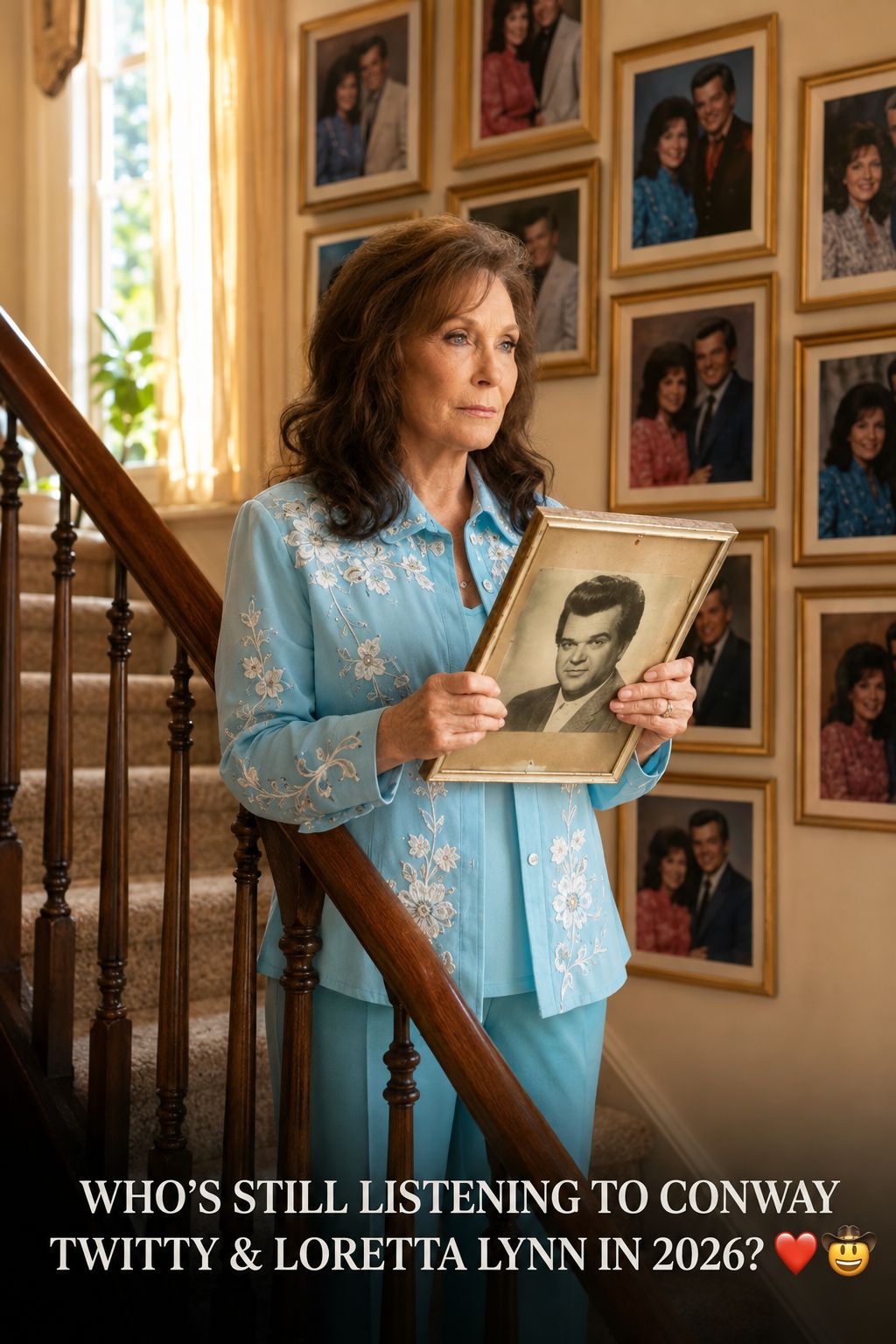
There are some country songs that sound beautiful.
And then there are songs that feel like memories.
“I’d Rather Have What We Had” belongs in the second category.
Decades after Loretta Lynn and Conway Twitty stood together behind microphones and transformed complicated emotions into country music, the song has taken on an entirely different weight. What once sounded like a story about a troubled relationship now feels, to many listeners, like a meditation on everything that time eventually takes away.
The song appeared on Two’s a Party, the 1981 album that became the final collaborative studio album of their remarkable decade-long partnership. Loretta Lynn’s official discography describes it as the pair’s final collaborative studio album, noting that the record reached No. 28 while both of its singles reached the Top 10.
And tucked inside that album was a song whose title would eventually seem almost painfully prophetic:
“I’d Rather Have What We Had.”
THE MEMORY BEHIND THE MUSIC
When Conway Twitty and Loretta Lynn recorded together, they created something that went far beyond two famous singers sharing a studio.
Their voices seemed to understand one another.
Conway brought his unmistakable smooth, intimate delivery. Loretta brought the emotional directness that had made her one of country music’s most powerful storytellers.
Together, they could make a song feel like a private conversation overheard through a half-open door.
Their partnership had already produced major successes before Two’s a Party. Loretta Lynn’s official discography notes that their earlier collaboration Lead Me On reached No. 2 on the album chart, while its title single went to No. 1.
But by 1981, the musical world was changing.
So was country music.
And so were the lives of the people making it.
Two’s a Party arrived with ten tracks, including “The State of Our Union,” “I Still Believe in Waltzes,” “If I Ever Had to Say Goodbye to You,” and, of course, “I’d Rather Have What We Had.”
The album itself was not simply a collection of romantic duets.
It was a snapshot of a partnership approaching its final chapter.
A SONG ABOUT WANTING THE PAST BACK
Written by Bobby Braddock, “I’d Rather Have What We Had” is built around a painfully human idea: sometimes people achieve the stability they thought they wanted, only to discover that they miss the excitement, uncertainty and emotional intensity of what came before.
Apple Music credits Braddock as the songwriter and lists Conway Twitty and Loretta Lynn as performers, with the song appearing on Two’s a Party.
The premise is deceptively simple.
Two people have moved from secrecy and excitement into ordinary domestic life.
The motel rooms are gone.
The stolen moments are gone.
The danger is gone.
But something else has disappeared too.
The spark.
The song asks whether having everything you once thought you wanted can somehow leave you longing for the very life you escaped.
That is classic country storytelling.
And that is why the song still hurts.
Sometimes the hardest thing to lose isn’t a person. It’s the version of life you had when that person was still beside you.
WHY THE SONG FEELS DIFFERENT NOW
When listeners first heard the song in the early 1980s, they could experience it as a dramatic relationship story.
Today, knowing what eventually happened to both artists, the emotional meaning becomes harder to separate from memory.
Conway Twitty died on June 5, 1993.
Loretta Lynn continued carrying his memory — and the memory of their extraordinary musical partnership — for decades.
That changes how a listener hears an old duet.
A line about wanting what once existed can suddenly sound less like romantic regret and more like grief.
That distinction matters.
There is no need to rewrite history or manufacture a private farewell conversation between Loretta and Conway to make the story emotional. The music already does the work.
The record exists.
The voices exist.
The memories exist.
And because recordings preserve voices long after the people who made them are gone, a duet can become something strangely intimate.
Conway can still sing.
Loretta can still answer.
For a few minutes, neither of them has aged.
Neither has left.
Neither has disappeared.
They are simply there again.
THE MAGIC OF LORETTA AND CONWAY
What made Loretta Lynn and Conway Twitty so compelling was their ability to make complicated relationships sound believable.
They didn’t sing like two performers trying to impress one another.
They sounded like two people who knew exactly where the other voice was going.
That chemistry became one of the defining features of their collaborations.
AllMusic’s retrospective of Two’s a Party specifically identifies “I’d Rather Have What We Had” as one of the album’s stronger tracks, even while observing that the record leaned somewhat more toward pop than some of the pair’s earlier country work.
That is significant because it reminds us that the song was not necessarily promoted as the centerpiece of their entire partnership.
It didn’t need to be.
Some songs become important later.
Some songs wait.
And then, years afterward, a listener hears them again and realizes the words have changed meaning.
“I’D RATHER HAVE WHAT WE HAD”
That title is devastating because it contains a contradiction.
Most people spend their lives trying to move forward.
We celebrate progress.
We celebrate new beginnings.
We tell ourselves that tomorrow will be better.
But grief introduces another question:
What if yesterday was actually precious?
Not perfect.
Not painless.
Just precious.
That is the emotional power of the phrase.
It isn’t necessarily saying, I want every mistake back.
It can mean:
I want the feeling back.
I want that voice back.
I want those nights back.
I want the person I was when you were here.
And suddenly, a country duet from 1981 becomes something much larger than a love song.
It becomes a conversation with memory.
THE FINAL COLLABORATION THAT STILL SOUNDS ALIVE
According to Loretta Lynn’s official discography, Two’s a Party marked the end of the pair’s collaborative studio-album run, despite expectations at the time that their partnership might continue for years.
That historical detail makes the album especially poignant.
Because nobody recording a final album necessarily knows it is the final album.
Nobody stands in a studio and thinks:
This is the last time.
Usually, life doesn’t announce the ending.
The ending only becomes visible afterward.
That’s why old country records can be so emotional.
They capture ordinary moments before those moments become history.
A microphone.
A studio.
Two singers.
A melody.
A few hours of work.
And then, decades later, someone presses play and realizes they’re listening to a world that no longer exists.
A FAREWELL WITHOUT SAYING GOODBYE
Perhaps that is the strangest thing about Loretta Lynn and Conway Twitty.
Their music doesn’t feel completely gone.
Their partnership ended.
Conway eventually passed away.
Loretta eventually passed away.
But their voices remain suspended in time.
And that makes songs like “I’d Rather Have What We Had” extraordinarily powerful.
It doesn’t need to be a literal farewell song to become a farewell in the ears of later generations.
Music has a way of doing that.
A song written about one kind of heartbreak can eventually become the soundtrack to another.
A lyric written about a relationship can become a reflection on friendship.
A duet recorded decades ago can suddenly remind someone of a spouse, a sibling, a parent, or a friend who is no longer sitting across the room.
That is the secret of great country music: it doesn’t tell you what to feel. It gives you a place to put what you already feel.
THE MEMORY THAT WILL NOT DISAPPEAR
Country music has changed dramatically since Loretta Lynn and Conway Twitty stood together at the height of their careers.
Production has changed.
Radio has changed.
The industry has changed.
But heartbreak hasn’t.
Neither has nostalgia.
Neither has the strange ache of realizing that the moments we once hurried through may someday become the moments we would give anything to experience again.
That’s why this old Conway and Loretta recording continues to resonate.
Because somewhere inside its melody is a question every generation eventually has to answer:
If you could return to one moment in your past, would you?
Maybe it would be a dance.
Maybe a kitchen.
Maybe a long drive with someone you loved.
Maybe an ordinary afternoon that seemed completely unimportant at the time.
And maybe, years later, you would understand what you couldn’t see then:
It was already a memory.
THE LASTING LEGACY OF LORETTA AND CONWAY
The greatest country duets aren’t remembered simply because they charted.
They’re remembered because they created an emotional world.
Loretta Lynn and Conway Twitty created one of those worlds.
Their voices represented an era when country music could be tender without becoming sentimental, dramatic without becoming theatrical, and heartbreaking without needing to explain every emotion.
“I’d Rather Have What We Had” is one small piece of that legacy.
But sometimes one song is enough to open an entire door.
Behind it are old stages.
Old microphones.
Old photographs.
Old records.
Old voices.
And memories that refuse to disappear.
Conway is gone.
Loretta is gone.
But when their voices meet again on an old recording, something remarkable happens.
For a few minutes, time stops.
And perhaps that is the real meaning behind the song.
Maybe we don’t literally want the past back.
Maybe we simply want one more chance to hear it.
One more chance to remember.
One more chance to sit quietly with the people and moments that made us who we are.
And that is why “I’d Rather Have What We Had” still feels so heartbreaking.
Because sometimes the deepest goodbye is never spoken.
Sometimes it is hidden inside a song.
And sometimes, decades later, all it takes is the first note for the past to come rushing back.
Loretta and Conway may have left the stage, but their voices never really said goodbye.
VIDEO: