 By admin
INTRODUCTION:
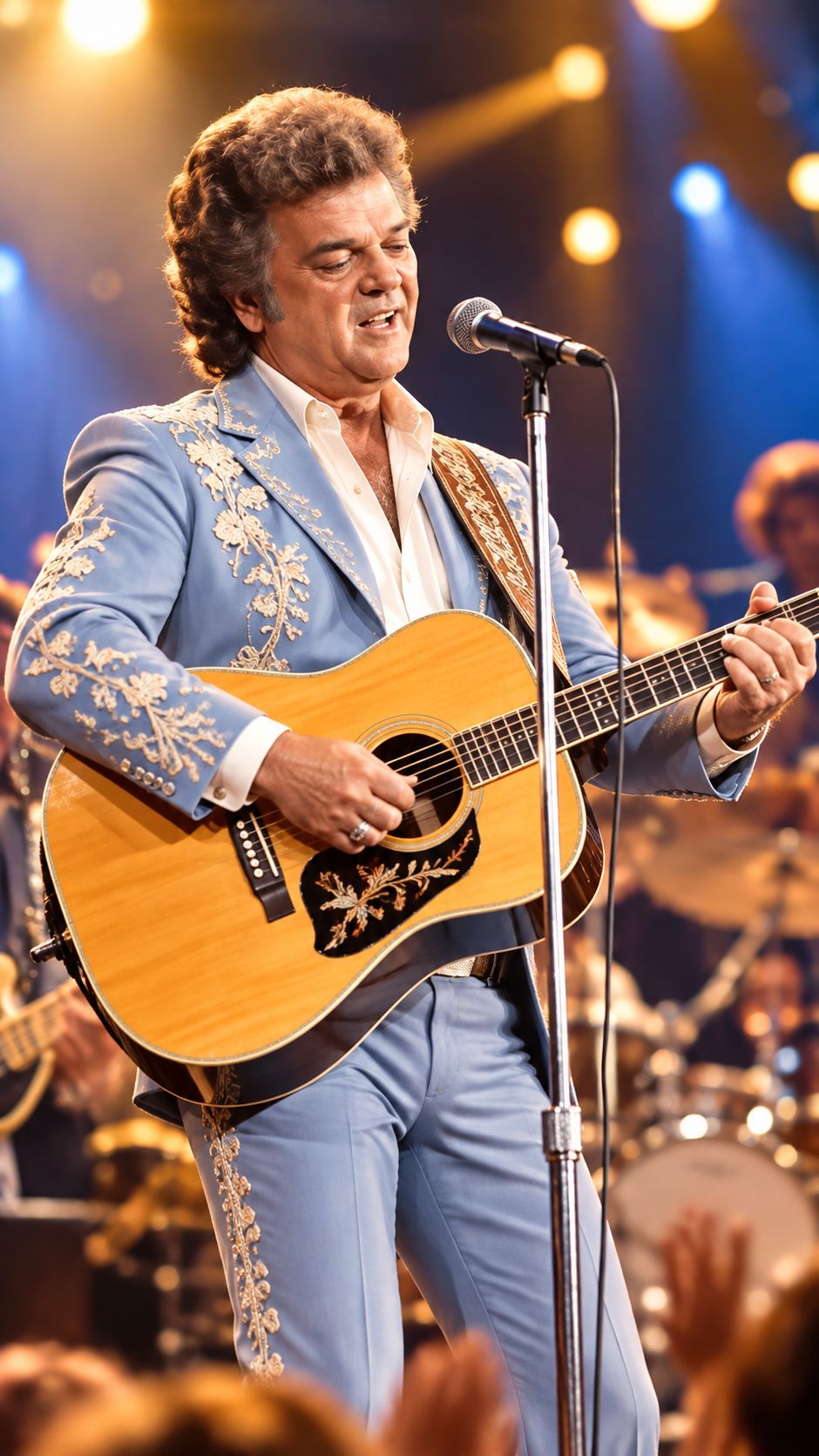
There are legends in music, and then there is Conway Twitty—a man whose voice could make heartbreak feel personal, whose romantic ballads could silence a crowded room, and whose extraordinary journey from rock and roll hopeful to country music superstar remains one of the most remarkable transformations in American music history.
For decades, his name has carried a special meaning for country music fans. Mention Conway Twitty, and listeners remember the rich, unmistakable voice, the emotional delivery, and the songs that seemed to understand every secret sorrow of the human heart. They remember a performer who could sing about love as though he had lived a thousand lifetimes, even when the lyrics described feelings that words alone could never fully explain.
But here is the fascinating part: before Conway became one of country music’s most successful artists, he pursued a very different musical dream. And when his career finally took off, he achieved something that few performers in any genre could imagine.
His name became synonymous with chart-topping success, romantic country storytelling, and one of the most enduring partnerships in the history of country music.
Yet one question continues to intrigue fans across generations: How did a young man who initially chased rock and roll fame become one of country music’s greatest hitmakers—and why does his music continue to resonate long after his passing?
The answer reveals a story about ambition, reinvention, heartbreak, and the extraordinary power of a voice that never stopped reaching for the listener.
The Young Man Who Never Planned to Become a Country Legend


Long before the rhinestone suits, the country radio dominance, and the unforgettable duets, Conway Twitty was known by another name: Harold Lloyd Jenkins.
Born on September 1, 1933, in Friars Point, Mississippi, Jenkins grew up surrounded by the musical traditions of the American South. Country melodies, blues influences, gospel harmonies, and the rhythms of early popular music all helped shape the soundscape of his youth.
Like many ambitious young performers of his generation, he dreamed of making a name for himself through music.
But country music was not initially his primary destination.
During the 1950s, rock and roll was transforming American culture. Young audiences were discovering a new musical language built on rhythm, rebellion, and emotional intensity. Artists who could capture that energy suddenly found themselves at the center of a cultural revolution.
Jenkins wanted to be part of it.
He adopted the stage name Conway Twitty, a name that sounded distinctive, memorable, and ready for the spotlight. Under that identity, he pursued a career in rock and roll, hoping to find the song that would change everything.
Then, in 1958, that opportunity arrived.
His recording of “It’s Only Make Believe” became a massive international success, reaching No. 1 on the Billboard Hot 100 in the United States. The song’s dramatic vocal delivery and emotional intensity introduced audiences to a singer who could communicate longing and vulnerability with remarkable conviction.
Suddenly, Conway Twitty was no longer simply a hopeful performer.
He was a star.
“Sometimes the road to greatness begins with a dream that looks nothing like the destination.”
For Twitty, the success of “It’s Only Make Believe” proved that his voice could reach millions. But the most surprising chapter of his career was still ahead.
The Reinvention That Changed Country Music Forever

Many artists spend their entire careers trying to recreate their first major success. They follow familiar formulas, repeat proven sounds, and resist changes that might alienate their audiences.
Conway Twitty chose a different path.
Although he continued recording rock and pop material after his early breakthrough, he increasingly turned toward country music. By the late 1960s, he was making a decisive transition into the genre that would ultimately define his legacy.
The change was not merely a shift in musical arrangement. It was a transformation in the emotional world of his songs.
Country music offered Twitty an opportunity to explore the complicated realities of adult relationships: marriages under pressure, lovers separated by circumstances, promises broken in moments of weakness, and the painful difference between what people say and what they truly feel.
His voice was ideally suited to those stories.
It possessed a smooth, conversational quality, but it could also carry tremendous emotional weight. He rarely needed to shout to communicate pain. A carefully delivered phrase, a pause between lines, or a slight change in tone could make a familiar lyric feel devastatingly personal.
His first major country breakthrough came with “Next in Line,” which reached No. 1 on the Billboard country chart in 1968. That achievement signaled the beginning of a remarkable new chapter.
Twitty was not simply visiting country music.
He was building a home there.
Throughout the 1970s and 1980s, he became one of the format’s defining male vocalists, delivering hit after hit while maintaining a sound that was unmistakably his own.
And that brings us to the comparison that often surprises music fans.
Did Conway Twitty Really Have More No. 1 Hits Than The Beatles?


The headline sounds almost unbelievable: More No. 1 hits than The Beatles.
How could a country singer possibly rival one of the most successful groups in the history of popular music?
The answer depends on which charts and which definitions of a hit we are comparing.
Conway Twitty earned approximately 40 No. 1 country hits as a solo artist, with the exact total varying according to chart methodology and historical accounting. When collaborations and different chart-counting conventions are included, published totals can differ.
The Beatles, meanwhile, achieved 20 No. 1 singles on the Billboard Hot 100 in the United States, according to the chart’s standard historical count.
Those figures are impressive, but they measure success in different musical markets. Twitty’s country chart achievements cannot automatically be compared directly with The Beatles’ pop chart achievements as though they came from the same competition.
And that distinction makes his accomplishment no less extraordinary.
The Beatles transformed popular music through songwriting, studio experimentation, cultural influence, and a succession of internationally celebrated recordings. Twitty built his legacy through sustained dominance in country music, connecting with audiences through stories of love, regret, loyalty, and desire.
His career was a different kind of triumph.
Rather than dominating every musical conversation, he became a defining voice within a genre whose listeners valued emotional honesty and storytelling.
“A great singer does more than deliver a melody. A great singer makes strangers recognize their own lives in a song.”
That was Conway Twitty’s gift.
His success was not measured only by chart positions. It was measured by the listeners who heard their own marriages, mistakes, dreams, and disappointments reflected in his recordings.
And few artists understood that connection as deeply as he did.
The Secret Behind His Unforgettable Voice
What made Conway Twitty so successful?
It would be easy to credit his appearance, his stage presence, or his ability to choose commercially appealing songs. Those qualities certainly helped. But they do not fully explain why audiences continued returning to his music.
The deeper answer lies in his interpretation.
Twitty had a remarkable ability to make a song sound like a private confession.
Consider “Hello Darlin’,” released in 1970. The song opens with a simple greeting that carries the weight of an entire relationship. There is no elaborate explanation, no lengthy introduction to the characters, and no need to describe every event that led to their separation.
The emotion is already there.
A man encounters someone he once loved, and the smallest exchange brings the past rushing back.
The song became one of his signature recordings and helped establish the intimate, conversational style that would define much of his country career.
Then came songs such as “You’ve Never Been This Far Before,” “Linda on My Mind,” and “Don’t Take It Away.” Each offered a different variation on the emotional territory Twitty understood so well.
He sang about desire without losing sight of vulnerability. He sang about regret without making every character a villain. He understood that people often make painful decisions for reasons they struggle to explain, even to themselves.
His performances gave those contradictions room to breathe.
Listeners did not necessarily have to agree with every character in a Conway Twitty song. They simply had to recognize the feelings.
That distinction helped turn his recordings into lasting companions for people navigating complicated lives.
Conway Twitty and Loretta Lynn: A Partnership That Became Country Music History


If Conway Twitty’s solo career established him as a country superstar, his partnership with Loretta Lynn helped create one of the genre’s most beloved musical legacies.
Their collaboration began in earnest in the early 1970s, bringing together two performers with very different but wonderfully complementary personalities.
Loretta Lynn possessed a direct, earthy vocal style shaped by the experiences of working-class women, marriage, family, and life in rural America. Conway brought a smooth, intimate delivery that could make a romantic exchange sound like a conversation happening just beyond the listener’s reach.
Together, they created musical drama.
Their duets were not simply two famous singers taking turns on a microphone. They often sounded like two people negotiating the emotional complications of a relationship in real time.
In songs such as “After the Fire Is Gone,” “Lead Me On,” and “As Soon as I Hang Up the Phone,” their voices created tension, tenderness, and a sense of shared history.
“After the Fire Is Gone” became a major hit in 1971 and earned them a Grammy Award for Best Country Performance by a Duo or Group with Vocal.
Their partnership continued to produce successful recordings, earning them a reputation as one of country music’s most successful duos.
What made the chemistry so convincing?
Part of the answer was contrast. Loretta’s voice could sound assertive and emotionally exposed, while Conway’s could feel reassuring, persuasive, or quietly wounded. Their differences created the impression of two distinct people with competing needs and shared memories.
Their performances also benefited from the audience’s willingness to become emotionally involved in the stories.
Listeners could imagine the arguments behind the lyrics, the conversations that had never happened, and the reconciliations that might never come.
“When Conway and Loretta sang together, the story mattered as much as the melody—and sometimes the silence between their voices said the most.”
Although fans have often wondered whether their chemistry reflected a deeper romantic relationship, their celebrated musical partnership should not be confused with proof of a romantic affair. Their artistry was powerful enough to create that feeling without requiring such a conclusion.
Their greatest achievement was making fictional relationships feel astonishingly real.
The Human Cost of Becoming a Legend
Behind every long career lies a life that audiences can never fully see.
Conway Twitty spent decades traveling, recording, performing, and meeting the expectations that accompany fame. The public saw the polished performer, the familiar voice, and the man who could deliver another memorable song night after night.
But a career of that scale also required extraordinary endurance.
Success in country music during the 1970s and 1980s demanded constant work. Radio remained a crucial gateway to listeners, touring connected artists with their audiences, and the competition for attention never disappeared.
Twitty continued to evolve while protecting the elements of his sound that fans recognized.
He understood that country music changed with every generation. Production styles shifted, new performers arrived, and listeners developed different expectations. Yet emotional storytelling remained a powerful thread connecting the genre’s past to its future.
His music survived because it was built around experiences that did not disappear when fashions changed.
People still fell in love. They still made mistakes. They still missed someone who had left. They still wondered whether a relationship could be repaired after trust had been damaged.
Twitty gave those experiences melodies.
And for many listeners, those melodies became attached to specific moments in their own lives: a late-night drive, a dance at a wedding, a conversation that ended too soon, or a memory of someone who was no longer there.
That is the part of musical success that statistics cannot adequately measure.
A chart can tell us how many people purchased or played a recording. It cannot tell us how many people turned to that recording when they felt alone.
The Final Chapter: A Voice That Refused to Be Forgotten

On June 5, 1993, Conway Twitty died in Springfield, Missouri, after becoming ill while on tour. He was 59 years old.
His death brought an end to a remarkable career that had crossed musical boundaries and helped shape modern country music.
For fans, the loss was deeply personal.
They had not simply lost a successful recording artist. They had lost a familiar voice that had accompanied them through years of changing circumstances.
There was something especially poignant about his passing. A singer who had spent much of his life giving words to other people’s heartbreak had suddenly become the subject of a heartbreak shared by millions of listeners.
His recordings remained, however, preserving performances that could still be heard whenever someone needed them.
“Hello Darlin'” could still open the door to a memory. “After the Fire Is Gone” could still recreate the complicated tension of a relationship. His many other recordings continued to demonstrate the power of a performer who understood that emotional precision often mattered more than vocal extravagance.
And the country music world continued to evolve around the legacy he left behind.
New generations of singers would explore traditional sounds, modern production, personal songwriting, and the boundaries between country and pop. Yet the fundamental appeal of Twitty’s approach remained relevant: tell the truth of the song, respect the listener’s intelligence, and never underestimate the emotional power of a well-delivered line.
Why Gen Z Is Rediscovering Country Legends

Today’s younger listeners encounter music differently from the generations that first discovered Conway Twitty.
Streaming platforms, short-form videos, online communities, and curated playlists allow old recordings to circulate far beyond the audiences for which they were originally created.
A song recorded decades ago can suddenly find a new audience because someone discovers its lyrics, shares a performance, or recognizes an emotion that feels surprisingly contemporary.
This does not mean that every young listener has embraced classic country music. Nor does it mean that Twitty has experienced a universal revival among Gen Z. But the wider rediscovery of older recordings demonstrates that musical generations are not always separated by the boundaries of their eras.
A young person who has never experienced the country radio landscape of the 1970s can still understand the feeling of missing someone.
A listener who grew up with contemporary pop can still appreciate a voice that communicates vulnerability without elaborate production.
And someone who has never heard of Conway Twitty may discover that his songs offer a kind of emotional storytelling that feels refreshingly direct.
His music does not require listeners to understand the historical context of every recording. It invites them to feel something first.
That may be one of the most enduring qualities of classic country music: its ability to make a listener feel that a song written long ago somehow understands the present.
The Real Meaning of Conway Twitty’s Legacy
So, was Conway Twitty more successful than The Beatles?
The answer depends on the measure being used. Their chart achievements belong to different musical contexts, and comparisons must account for those differences.
But the more meaningful question is this: What does it take for an artist to remain important after the charts have changed, the industry has transformed, and the original audience has grown older?
For Conway Twitty, the answer was a rare combination of reinvention, consistency, musical instinct, and emotional connection.
He began his career pursuing rock and roll success. He discovered a lasting home in country music. He recorded songs that explored the complicated territory between love and loss. He created a legendary partnership with Loretta Lynn. And he left behind a catalog that continues to offer listeners a way to revisit their own memories.
His story is a reminder that greatness does not always follow a straight line.
Sometimes the artist who becomes a legend is the one who discovers that his greatest talent lies somewhere different from where he first imagined.
“Long after the final applause, the songs that matter most are the ones that still make us feel understood.”
That is why Conway Twitty deserves to be remembered—not simply because of his chart achievements, but because of the emotional world he created through music.
His voice carried the ache of unfinished conversations, the warmth of old affection, and the uncertainty of relationships that rarely unfold as neatly as songs suggest.
And somewhere today, a listener may be hearing “Hello Darlin'” for the very first time.
They may not know the full story of Harold Lloyd Jenkins. They may not remember the country charts of the 1970s. They may not understand why generations of fans still speak about Conway Twitty with such affection.
But when that voice enters the room, they may understand something far more important.
They may recognize the feeling.
And in that moment, a country music legend lives again.
What do you think made Conway Twitty unforgettable? Was it his emotional voice, his incredible run of country hits, or the magical chemistry he shared with Loretta Lynn? And which Conway Twitty song still takes you back to a special moment in your life?
Because sometimes, the greatest measure of a music legend isn’t how many No. 1 hits he earned—it’s how many hearts his songs never stopped reaching.