 By admin
 INTRODUCTION:
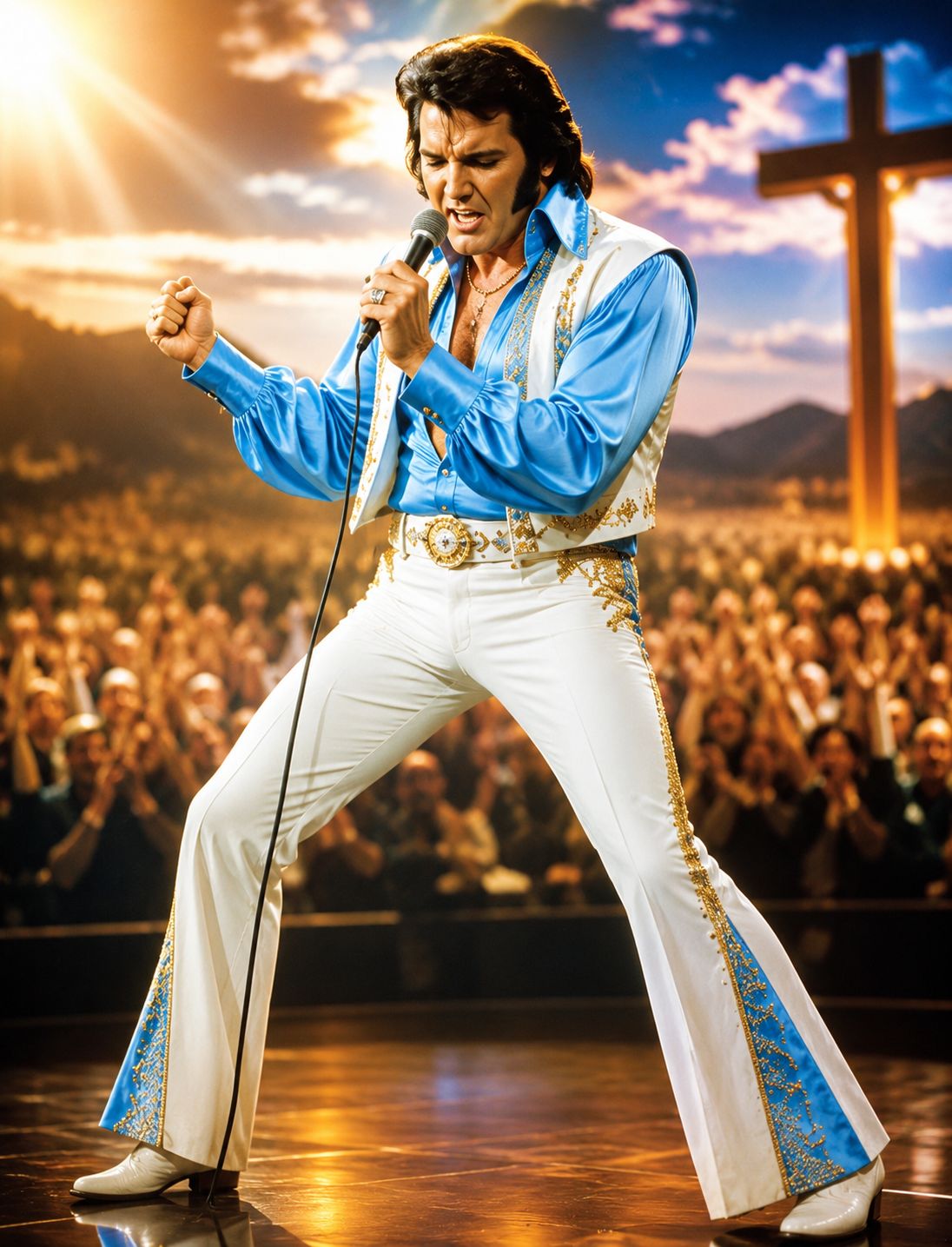
When most people hear the name Elvis Presley, they see the glitter.
They see the rhinestone jumpsuits. The karate poses. The screaming fans. The Vegas lights so bright they could be seen from outer space. They hear the swagger, the hip-shaking, the voice that transformed popular music forever.
But what if the world has remembered the wrong Elvis?
What if beneath the sequined costumes and global fame lived a man engaged in one of the deepest spiritual searches in modern music history?
What if the true revolution of Elvis Presley wasn’t musical at all?
Because long before wellness gurus, spiritual influencers, and self-help movements flooded the world, Elvis Presley was already searching for something greater than fame, money, or applause.
And in many ways, that search defined his life far more than the gold records ever did.
The Boy Raised on Faith
To understand Elvis, we must go back to Tupelo, Mississippi, where poverty shaped every aspect of his childhood.
The Presleys had little money. Sometimes they barely had enough food. Yet one thing was always abundant inside the tiny family home: faith.
Young Elvis grew up attending church multiple times each week. Gospel music wasn’t simply entertainment—it was oxygen.
The sounds of Southern Pentecostal worship entered his soul before he ever stepped onto a stage.
Those emotional church services changed him forever.
Years later, after selling millions of records and becoming the biggest star on Earth, Elvis still insisted:
“Gospel music is the purest thing there is.”
Many fans know that Elvis recorded rock and roll classics. Fewer realize he won three Grammy Awards—and every single one was for gospel recordings.
Not rock.
Not pop.
Gospel.
That fact alone tells us something profound.
Despite all the headlines, Elvis never truly left the church emotionally. He carried it with him everywhere.
Fame Came. Peace Didn’t.
By 1956, Elvis had become a cultural earthquake.
Teenagers worshipped him.
Parents feared him.
Religious leaders criticized him.
Politicians debated him.
No entertainer in modern history had ever experienced such explosive fame so quickly.
But fame brought something unexpected.
Loneliness.
The crowds grew larger, yet Elvis felt increasingly isolated.
Friends who visited Graceland often described a man surrounded by people but desperately searching for meaning.
Colonel Tom Parker built Elvis into a global phenomenon. Yet as the years passed, the machine of fame became a prison.
Elvis could buy airplanes, mansions, cars, jewelry, and anything else imaginable.
What he could not buy was inner peace.
“I’d give a thousand of these things if I could just find peace of mind.”
That search would lead Elvis down an extraordinary spiritual path few people discuss today.
The Secret Library at Graceland
Many visitors imagine Graceland as a palace filled only with luxury.
But hidden among the extravagance was something surprising.
Books.
Hundreds upon hundreds of books.
And not just biographies or novels.
Elvis voraciously consumed works on spirituality, philosophy, religion, mysticism, and metaphysical thought.
Friends estimated he owned thousands of spiritual books during his lifetime.
He studied Christianity deeply but also explored Judaism, Eastern religions, numerology, meditation, and ancient philosophy.
One book changed everything.
In 1965, hairdresser and close confidant Larry Geller introduced Elvis to “The Impersonal Life,” a spiritual text emphasizing the divine presence within every person.
Elvis became fascinated.
He reportedly carried copies with him constantly and gave them away to friends.
According to those closest to him, Elvis often stayed awake until dawn discussing spirituality, God, life after death, and humanity’s purpose.
These weren’t casual conversations.
They were obsessions.
The Spiritual Seeker Behind Closed Doors
As the world watched Elvis become a Las Vegas icon, another story unfolded privately.
Night after night, after performances ended and fans went home, Elvis gathered trusted friends in Graceland’s private rooms.
There, they talked.
For hours.
Sometimes until sunrise.
Subjects included:
- The teachings of Jesus.
- Reincarnation.
- Meditation.
- The meaning of suffering.
- Life beyond physical death.
- Human consciousness.
Friends recalled that Elvis wasn’t searching for novelty.
He was searching for truth.
And perhaps more importantly, he was searching for himself.
One longtime associate said Elvis often asked questions that sounded less like a celebrity and more like a monk:
“Why am I here? What’s my purpose? Why did God choose me?”
Those questions haunted him.
Because Elvis understood something many celebrities discover too late:
Fame answers almost none of life’s deepest questions.
The 1968 Comeback: More Than Entertainment
Most historians describe the famous 1968 television special as Elvis’s artistic rebirth.
They’re right.
But they may also be missing something.
After years trapped in formulaic Hollywood films, Elvis returned to live performance transformed.
The black leather outfit became iconic.
The voice sounded stronger than ever.
Yet there was something else.
Intensity.
Urgency.
Authenticity.
Friends later suggested that Elvis viewed the special as more than a career comeback.
It was a spiritual awakening.
For the first time in years, he wasn’t playing a Hollywood character.
He was simply Elvis.
Raw.
Vulnerable.
Alive.
And audiences felt it instantly.
Millions watching at home weren’t merely witnessing a performer reclaiming his throne.
They were witnessing a man rediscovering his soul.
Why History Forgot This Side of Elvis
So why isn’t this story widely remembered?
Perhaps because spirituality doesn’t fit neatly into popular mythology.
The media prefers symbols.
The white jumpsuit.
The sunglasses.
The sideburns.
The excess.
Those images sell.
Quiet spiritual searching does not.
Modern culture often reduces Elvis to caricature: either the rebellious young rocker or the tragic fallen superstar.
Both versions are incomplete.
Neither fully captures the man who spent countless nights wrestling with God, purpose, mortality, and transcendence.
Historian after historian has focused on the spectacle.
Too few have focused on the seeker.
And yet understanding that seeker changes everything.
It explains his lifelong devotion to gospel music.
It explains his generosity.
It explains his restlessness.
It explains why material success never satisfied him.
Most importantly, it explains why Elvis still resonates nearly fifty years after his death.
Because beneath the fame, Elvis represented something profoundly human.
The search for meaning.
Why Elvis’s Spiritual Revolution Matters Today
Today’s world is louder than ever.
We are connected constantly yet often feel alone.
We chase followers, likes, money, and status, believing fulfillment waits just beyond the next achievement.
Elvis lived that dream.
He reached a level of fame almost unimaginable.
And still, he kept searching.
That may be his greatest legacy.
Not the records.
Not the movies.
Not even the music.
But the reminder that the human spirit longs for something deeper.
Elvis Presley conquered the world, yet spent his life searching for God, purpose, and peace. In that search, he was not a king. He was simply one of us.
Perhaps history forgot this spiritual revolution because it is quieter than screaming fans.
But quiet truths often endure the longest.
And maybe, just maybe, the most revolutionary thing Elvis Presley ever did was refuse to believe that fame alone was enough.
Long after the lights dimmed in Las Vegas, that message still echoes.
And in 2026, it may matter more than ever.
VIDEO: