 By admin
 INTRODUCTION:
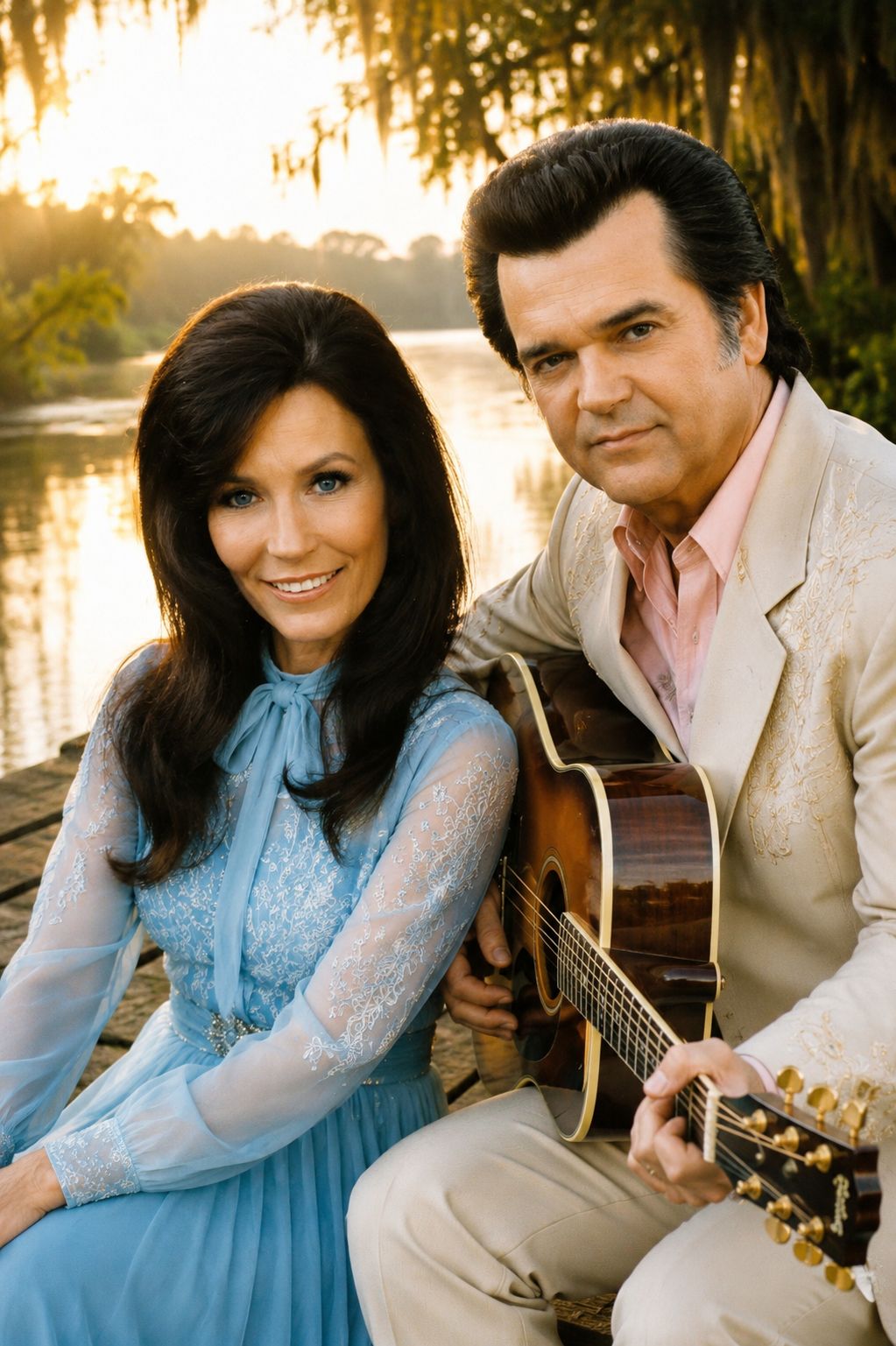
There are country songs you remember because they were hits.
And then there are country songs you remember because, for a few minutes, they make you believe the people singing them are living the story right in front of you.
“Louisiana Woman, Mississippi Man” was one of those songs.
When Conway Twitty and Loretta Lynn released the song in 1973, country music already knew they were something special. Their voices had a natural tension—his deep, smooth delivery against her unmistakable Kentucky twang—that could turn an ordinary duet into something that felt almost cinematic.
But this song was different.
It wasn’t a slow heartbreak ballad. It wasn’t a complicated story about betrayal or regret.
It was joyful.
It was restless.
It was Southern.
And most importantly, it was about two people who refused to let a river stand between them.
Released in May 1973 as the first single and title track from their album Louisiana Woman, Mississippi Man, the song was written by Jim Owen and Becki Bluefield and produced by Owen Bradley. It eventually became the duo’s third No. 1 country hit, reaching the top of the Billboard country chart on August 18, 1973.
It stayed at No. 1 for one week and spent 13 weeks on the country chart overall.
But numbers alone don’t explain why people still remember it.
The River Was the Whole Story
The brilliance of “Louisiana Woman, Mississippi Man” is that its conflict is incredibly simple.
A woman lives in Louisiana.
A man lives in Mississippi.
The Mississippi River stands between them.
That’s it.
No complicated plot.
No elaborate metaphor.
Just distance.
And yet Conway and Loretta made that distance feel enormous—and somehow completely irrelevant at the same time.
The song turns geography into romance.
The river becomes the obstacle.
The lovers become determined to defeat it.
And suddenly, a stretch of Southern landscape becomes a symbol of every relationship that has ever been separated by distance.
That is classic country storytelling at its finest.
“The Mississippi River can’t keep us apart.”
That sentiment is the beating heart of the entire song.
It isn’t about waiting patiently.
It’s about finding a way.
And that’s where Loretta’s performance becomes especially memorable. She doesn’t sound like someone sitting around hoping her man will eventually come home.
She sounds determined.
She sounds ready to cross the river herself if that’s what it takes.
That personality was one of the reasons Loretta Lynn was such a powerful country artist. She could make a character sound vulnerable without ever making her sound weak.
And opposite her was Conway Twitty.
His voice brought something completely different.
Deep.
Confident.
Almost conversational.
Where Loretta sounded like she was ready to act, Conway sounded like he already knew the two of them would find a way.
Together, they created the perfect musical argument.
Conway and Loretta Didn’t Need to Pretend
Part of the magic of Conway Twitty and Loretta Lynn was the way they seemed to communicate with each other through the music.
They weren’t simply taking turns singing.
They were reacting.
One voice pushed.
The other answered.
Then they came together.
That chemistry had already produced major success before “Louisiana Woman, Mississippi Man.” Their earlier No. 1 collaborations included “After the Fire Is Gone” and “Lead Me On,” and the 1973 song became their third chart-topping duet.
Yet this particular recording had a completely different energy.
It moved.
The arrangement carried a lively Southern flavor, blending country instrumentation with an unmistakable Cajun-inspired feel. Contemporary descriptions highlighted its upbeat Cajun sound, electric guitar, pedal steel, fiddle, and energetic production.
You can almost picture the scene.
A jukebox is playing.
Someone is tapping a boot beneath the table.
The fiddle is dancing.
Conway calls out.
Loretta answers.
And suddenly the entire room feels like it has crossed the Mississippi.
That’s why the song never felt like a traditional “duet” in the stiff sense of the word.
It felt like a conversation.
The Story Behind the Song Makes It Even Better
One of the more charming details surrounding the recording involves Loretta’s husband, Mooney Lynn.
According to Entertainment Weekly, the songwriters brought the demo to Loretta’s office, and Mooney heard it first. He reportedly recognized almost immediately that the song would be a perfect fit for Loretta and Conway.
It’s one of those little moments that seems almost insignificant until you understand what happened afterward.
Someone hears a demo.
Someone imagines two voices.
The right artists record it.
Radio catches fire.
And suddenly a song that began as a piece of paper and a melody becomes part of country music history.
That’s how legends are sometimes made—not through some giant Hollywood moment, but through people recognizing the right song at the right time.
Why No. 1 Mattered
By 1973, country music was changing.
The old sounds were still there, but artists were experimenting with production, arrangements, and new ways of telling stories.
Against that backdrop, Conway and Loretta’s song felt both traditional and fresh.
It had the storytelling country fans understood.
But it also had an infectious rhythm that made it impossible to ignore.
The song’s chart success confirmed what fans already knew: when Conway and Loretta walked into a studio together, something happened.
And the No. 1 achievement wasn’t just another statistic.
It was another piece of evidence that their partnership had become one of country music’s defining collaborations.
In fact, their musical legacy would eventually extend far beyond individual singles. Between 1971 and 1988, the pair recorded 11 studio albums together, with four reaching the top of the country album chart.
That is an extraordinary run.
But ask longtime country fans about their favorite moments, and many will still bring up the songs.
Especially this one.
What Made Their Voices So Perfect Together?
The secret wasn’t that Conway and Loretta sounded alike.
They didn’t.
That’s precisely why it worked.
Conway’s voice had weight.
Loretta’s had grit.
Conway could sound almost impossibly smooth.
Loretta could sound like she’d walked straight out of a Kentucky kitchen, stepped onto the stage, and decided she was going to tell you the truth whether you were ready for it or not.
Put those voices together and you got contrast.
And contrast creates drama.
The best duets aren’t always about two singers blending perfectly.
Sometimes they’re about two personalities refusing to disappear into each other.
That’s Conway and Loretta.
He remained Conway.
She remained Loretta.
But when they sang together, something bigger appeared between them.
His voice sounded like the road. Hers sounded like home.
And “Louisiana Woman, Mississippi Man” needed both.
More Than 50 Years Later, the River Still Hasn’t Won
Perhaps the most remarkable thing about this song is that the Mississippi River is still there.
The distance is still there.
The idea of loving someone who is far away is still there.
That’s why the song doesn’t feel trapped in 1973.
Technology has changed.
Music production has changed.
Country radio has changed.
But people haven’t changed nearly as much as we like to think.
People still miss someone.
People still travel long distances for love.
People still believe that the right person is worth the journey.
And that’s the emotional secret hidden inside this energetic old country hit.
Beneath the fiddle, guitars, harmonies, and playful Southern imagery is a very simple message:
If you really love someone, distance doesn’t necessarily get the final word.
And Then There Is the Legacy
Years after Conway Twitty and Loretta Lynn recorded their classic duets, their family legacy continued.
In 2024, their grandchildren Tre Twitty and Tayla Lynn released Cookin’ Up Lovin’, an album that included their own versions of three famous Conway-and-Loretta No. 1 duets, including “Louisiana Woman, Mississippi Man.”
Think about that for a moment.
A song recorded in 1973.
A song about a man and woman separated by a river.
A song sung by two country legends who are no longer here.
And decades later, members of their families are still singing it.
That’s more than nostalgia.
That’s inheritance.
That’s musical DNA.
Conway Twitty died in 1993. Loretta Lynn died in 2022. Their voices, however, remain remarkably alive in the recordings they left behind.
And when “Louisiana Woman, Mississippi Man” starts playing, something strange happens.
For a couple of minutes, the years disappear.
The studio disappears.
The charts disappear.
And you can almost imagine Conway and Loretta standing together again, trading lines, smiling through the performance, and daring the Mississippi River to stop them.
It never could.
And after more than five decades, it still can’t.
Some songs become hits. Some songs become memories. And a very rare few become part of the family history of country music. “Louisiana Woman, Mississippi Man” belongs in that last category.
So the next time you hear Conway Twitty call out to his Louisiana woman and Loretta answer as only Loretta could, don’t just hear an old No. 1.
Hear two legendary voices capturing something country music has always understood better than almost any other genre:
Love can be complicated. Distance can be cruel. But a great song can make the whole world feel a little smaller.
And for Conway Twitty and Loretta Lynn, one river was never going to be enough to keep two unforgettable voices apart.
VIDEO: