 By admin
 INTRODUCTION:
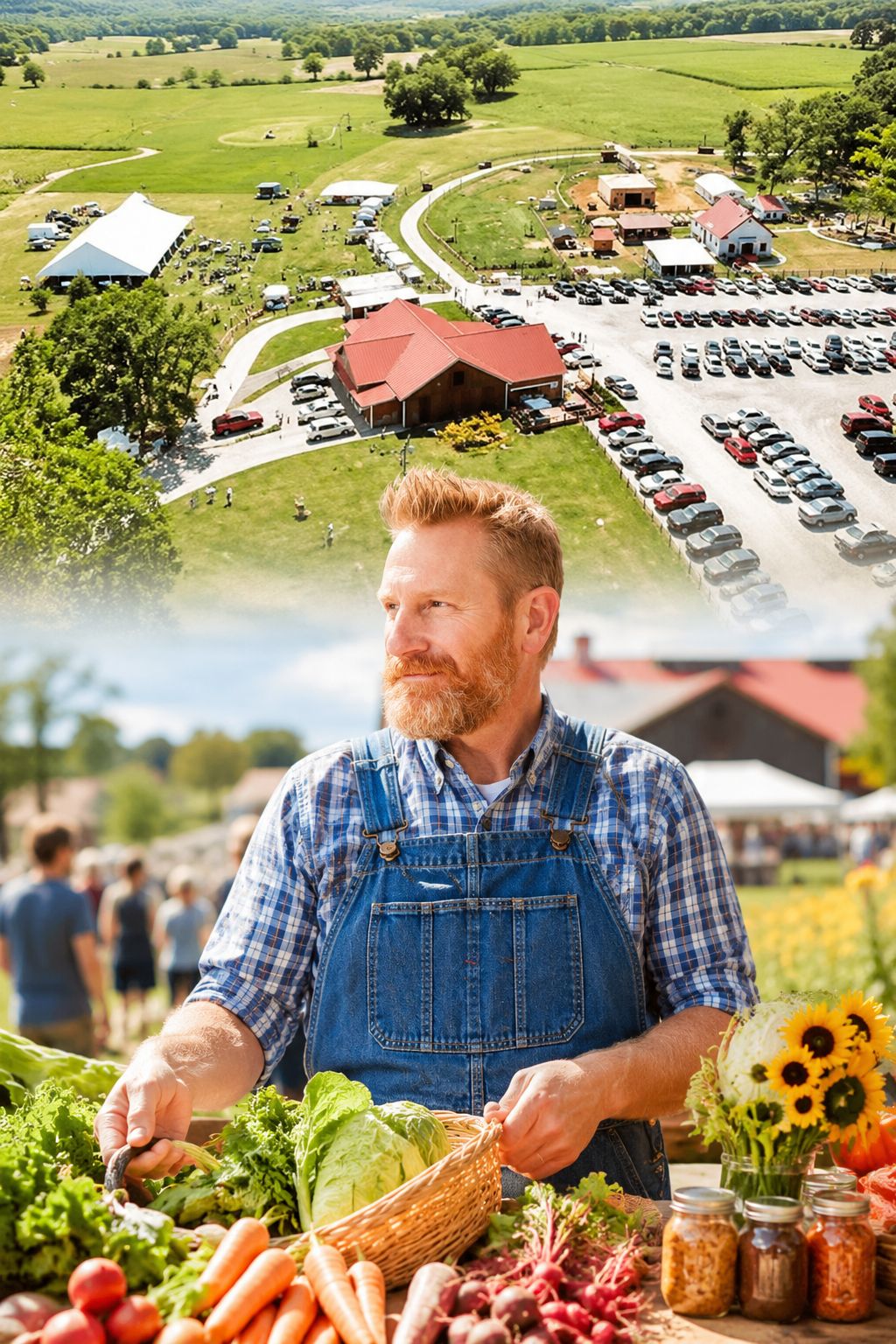
There is something almost poetic about the way Rory Feek has chosen to build his life.
Long after the bright lights of country music stages fade, long after the applause disappears and the microphones are packed away, Feek can still be found where the grass grows, where chickens wander, where gardens need tending, and where the rhythm of life is measured less by a clock than by the seasons.
That philosophy is at the heart of The Homestead Festival, the annual gathering Feek created on his 100-acre historic farm in Columbia, Tennessee. What began as a dream in late 2021 has grown into a major celebration of farming, sustainability, family, music, traditional skills, and what Feek describes as a more meaningful way of living. By 2026, the festival had already welcomed tens of thousands of people from across the country and around the world.
And perhaps that is what makes the festival so compelling.
It isn’t really about escaping modern life.
It is about remembering what modern life can sometimes make us forget.
“Something inside of us wants to simplify.”
That sentiment, expressed by Feek when discussing the festival’s origins, may be the simplest explanation for its extraordinary appeal.
A Festival Born From a Different Kind of Dream
When people hear the words “country music festival,” they may imagine enormous stages, flashing lights, crowds stretching across fields, and a constant stream of entertainment.
The Homestead Festival offers something different.
Yes, there is music. There are celebrated performers. There are food vendors, artisans, demonstrations, speakers and thousands of visitors.
But the music is only one piece of the story.
The real stage is the farm itself.
Feek established the festival as a place where people could learn practical skills while also asking bigger questions about how they want to live. The event brings together educators, farmers, craftspeople, families and musicians in an atmosphere designed around participation rather than spectacle.
In 2026, the festival featured more than 200 vendors, numerous demonstrations, food trucks, speakers and hands-on experiences. Its educational programming covered subjects connected to growing food, farming, animal care, traditional skills and self-sufficiency.
For Feek, this wasn’t simply an event to add another date to a calendar.
It was an extension of the life he was already trying to create.
From Stardom to Soil
There is an important contrast in Rory Feek’s story.
He has spent decades in the entertainment world as a songwriter, performer and storyteller. With Joey Feek, he became half of the beloved country duo Joey + Rory, whose music was celebrated for its warmth, honesty and deeply personal storytelling.
But after years of living within the machinery of the music business, Feek increasingly found meaning in something much quieter.
A garden.
A farmhouse.
A schoolhouse.
A piece of land.
A family gathered around a table.
The Homestead Festival reflects that transition.
One description of Feek’s journey puts it beautifully: he moved from seeking stardom toward seeking a sustainable life.
That doesn’t mean he rejected music.
Quite the opposite.
He brought music with him.
The result is an unusual combination: people can spend the day learning about soil, animals, gardening and traditional crafts, then gather together in the evening for country and gospel music as the sun goes down.
It feels less like a conventional festival and more like a temporary community.
Sustainability Isn’t Just a Buzzword Here
In recent years, sustainability has become a fashionable word.
It appears everywhere—from corporate advertising to political speeches to lifestyle magazines.
But at Feek’s farm, the idea is much more tangible.
It begins with something as ordinary as putting a seed into soil.
The official festival describes the homestead as having grown from those simple beginnings into a source of food, life and connection for Feek’s family and friends.
That philosophy is reflected in the festival’s programming.
Visitors can learn how to grow their own food, raise chickens, preserve what they grow, care for animals, keep bees, create gardens and develop traditional skills that have gradually disappeared from everyday life.
There is something deeply empowering about that message.
You don’t have to become completely self-sufficient overnight.
You don’t have to move to the country.
You don’t need hundreds of acres.
Maybe you start with tomatoes.
Maybe you plant herbs.
Maybe you learn how to preserve food.
Maybe you simply spend more time outside.
The philosophy is not perfection.
It is participation.
The Technology Paradox
One of Feek’s most powerful observations concerns the strange contradiction of modern technology.
We have never been more connected.
Yet many people feel increasingly alone.
We can communicate instantly with someone thousands of miles away, but may barely know the people living next door.
We can follow hundreds—or thousands—of people online, while struggling to create deep relationships in the physical world.
Feek has spoken about this paradox directly, suggesting that technology has created extraordinary connections while also contributing to a sense of disconnection from real communities.
The Homestead Festival becomes an answer to that problem.
People don’t simply watch someone demonstrate a skill on a screen.
They stand together.
They ask questions.
They shake hands.
They eat together.
They listen to music beneath the Tennessee sky.
They watch children experience animals and gardens.
And suddenly, something that seemed old-fashioned begins to feel revolutionary.
Music Still Matters
For a country artist like Rory Feek, it would be impossible to create a gathering this large without music.
But music at the Homestead Festival has a different role than it might at a traditional concert.
It becomes the emotional punctuation at the end of a day.
Feek has welcomed artists from country, gospel and Americana traditions over the years. The inaugural festival in 2022 featured Kevin Costner & Modern West, while subsequent festivals have included artists such as John Anderson, Collin Raye, Terri Clark and The Isaacs.
In 2026, The Isaacs and Lee Greenwood were among the featured performers, with Feek also performing.
Imagine the scene.
The day’s lessons are finished.
The sun begins to fall.
The fields turn golden.
Families settle in.
The conversations become quieter.
Then a guitar begins to play.
For a few minutes, there is no rush.
No notification.
No meeting.
No deadline.
Just music, land and people.
That may be one of the festival’s greatest achievements.
A Place Where Old Skills Become New Again
Perhaps the most fascinating thing about the Homestead Festival is that many of the skills being celebrated aren’t new at all.
They are old.
Growing food.
Canning.
Cooking from scratch.
Working with animals.
Gardening.
Making things by hand.
Teaching children practical skills.
Building relationships with neighbors.
These were once ordinary parts of life.
Now, for many people, they feel almost exotic.
Feek recognized that contradiction early.
He described the resurgence of these skills as a collection of “old skills” becoming new again, and the festival was created partly to make those ideas accessible to people who may never have considered homesteading before.
That last point matters.
The festival isn’t exclusively for experienced homesteaders.
Someone can arrive because they love country music and leave thinking about planting a garden.
A family can come for the entertainment and discover an interest in raising chickens.
A visitor who has never touched a piece of farm equipment can suddenly find themselves asking a farmer how to begin.
That is how movements grow.
Not through perfection.
Through curiosity.
The Legacy of Joey
For many longtime fans, however, there is another emotional layer to everything Feek does on that farm.
The land carries memories of Joey.
Before her death in 2016, Joey Feek shared Rory’s love of home, family and country life. Their public story was filled with music, faith, marriage, parenthood and the ordinary moments that became extraordinary because of how openly they shared them.
The Homestead Festival inevitably carries traces of that legacy.
The garden.
The farmhouse.
The family.
The music.
The belief that a meaningful life isn’t necessarily the loudest one.
Rory’s work on the homestead can therefore be seen not simply as a new chapter, but as part of an ongoing story.
A story about taking what remains after profound loss and choosing to build something life-giving from it.
What the Festival Is Really Selling
Technically, the Homestead Festival sells tickets.
But emotionally, that isn’t what people are buying.
They’re buying possibility.
The possibility that life can be slower.
That food can come from the soil.
That children can learn outside a classroom.
That neighbors can become friends.
That music can be experienced without distraction.
That a person can step away from constant consumption and learn to create something instead.
The festival’s own philosophy describes the goal as learning not only how to grow food, but how to grow a life filled with meaning and purpose.
That distinction is everything.
Because the deeper message isn’t “move to a farm.”
It is:
Pay attention to your life.
Why Rory Feek’s Message Resonates Now
The Homestead Festival arrives at a fascinating moment in American culture.
People are exhausted by speed.
Exhausted by notifications.
Exhausted by endless consumption.
Exhausted by the feeling that every moment must be productive.
Against that backdrop, the sight of someone planting a seed becomes surprisingly powerful.
A homemade meal becomes meaningful.
A conversation on a porch becomes valuable.
A song sung under the evening sky becomes enough.
And that may explain why Rory Feek’s homestead has become more than a private piece of land.
It has become an idea.
An invitation.
A reminder.
You don’t necessarily need a bigger life. You may simply need a deeper one.
That is the emotional heartbeat of the Homestead Festival.
It celebrates sustainability, yes.
It celebrates farming.
It celebrates country music.
It celebrates craftsmanship and family.
But underneath all of those things is something even more timeless:
the longing to come home.
Home to the land.
Home to community.
Home to meaningful work.
Home to music.
Home to family.
And perhaps, most importantly, home to ourselves.
For Rory Feek, the Homestead Festival began with a field behind a farmhouse.
Years later, that field has become a gathering place for thousands of people searching for something they may not have known how to name.
Not more.
Just better.
Not faster.
Just fuller.
Not louder.
Just more meaningful.
And in a world that keeps telling us to want everything, Rory Feek is offering a remarkably countercultural message:
Sometimes, the richest life is the one that teaches us how little we actually need.
VIDEO: