 By admin
INTRODUCTION:
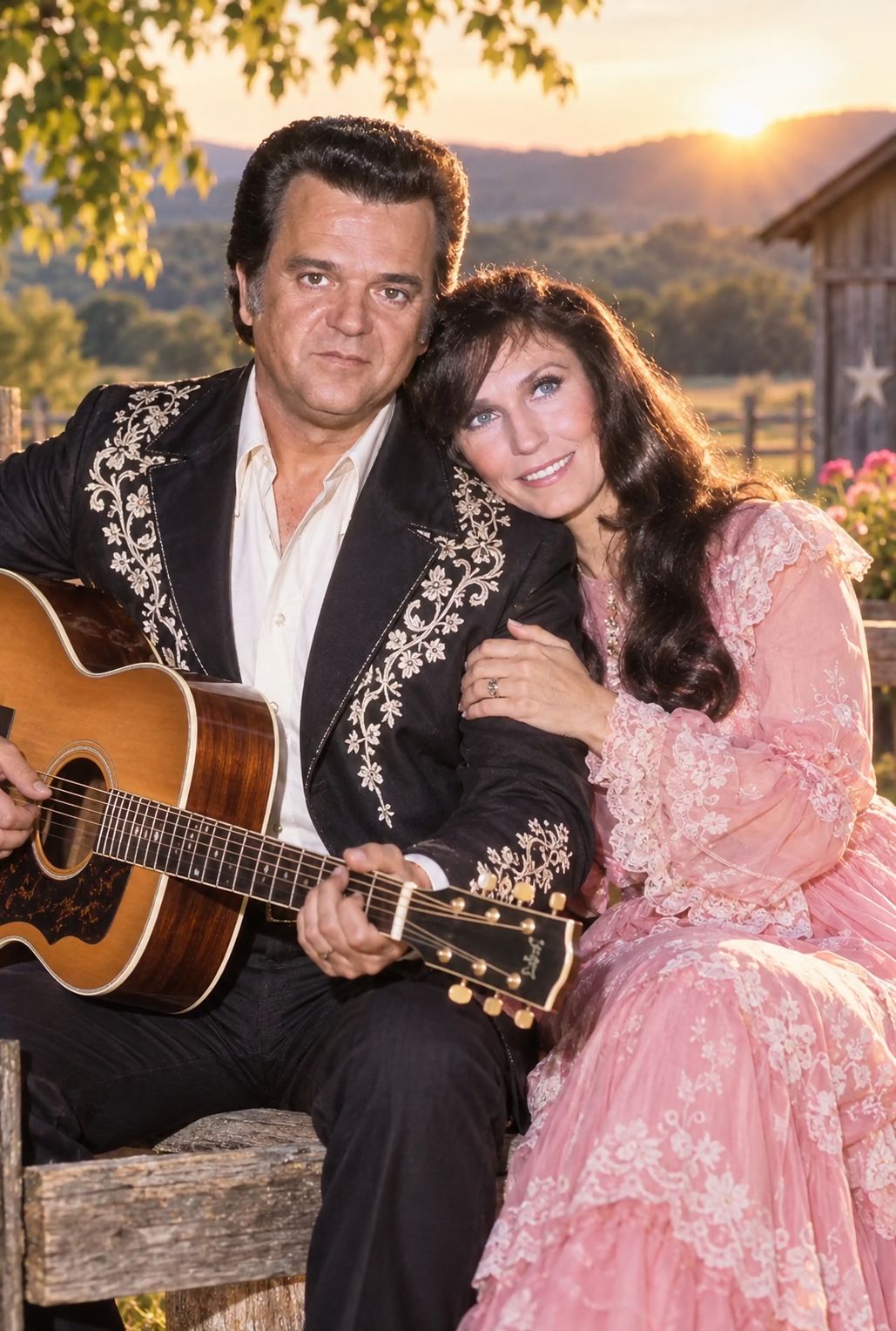
There are some country-music partnerships that sound convincing.
And then there are Conway Twitty and Loretta Lynn.
When their voices met, something happened that was almost impossible to explain. Their songs sounded intimate. Their teasing felt natural. Their arguments sounded like real lovers fighting behind closed doors. Even their silences seemed to carry a history.
For decades, fans watched them perform and wondered the same thing:
Were Conway Twitty and Loretta Lynn simply the greatest country duet partners of all time—or was there something more?
The rumors were understandable.
But the truth, according to the people who knew them and the singers themselves, was both less scandalous and perhaps more beautiful.
They were not secretly lovers.
They were something rarer: two artists who understood exactly how to make audiences believe they were.
The Chemistry That Started It All
The partnership began taking shape in the late 1960s. Twitty was already a major star, while Lynn was rapidly becoming one of country music’s most powerful female voices.
Interestingly, their admiration was mutual long before they became a legendary duo.
Twitty recalled being a Loretta Lynn fan, while Lynn had been a Conway Twitty fan herself. Their first recording sessions eventually led to the partnership that would dominate country radio during the 1970s.
Their first major breakthrough together came with “After the Fire Is Gone.”
The song wasn’t innocent.
It dealt with emotional loneliness, temptation and a relationship in which passion had disappeared. Twitty’s deep voice and Lynn’s unmistakable delivery made the story sound almost painfully personal.
The result was extraordinary.
The song reached No. 1 and earned them a Grammy, beginning a run of success that would establish them as one of the most important male-female partnerships in country music.
And that’s when the speculation really began.
“Everybody Thought Me and Conway Had a Thing”
There was a reason audiences believed the rumors.
Their songs constantly placed them in emotionally complicated situations.
“Lead Me On.”
“Louisiana Woman, Mississippi Man.”
“As Soon as I Hang Up the Phone.”
“Feelins’.”
Again and again, Conway and Loretta sang about desire, temptation, forbidden attraction and relationships that were falling apart.
They didn’t perform those songs like actors reading lines.
They made them feel lived-in.
Loretta would challenge Conway with a look.
Conway would answer with a grin.
Their voices would overlap, separate and come back together as if the two characters couldn’t decide whether to fight or surrender.
That chemistry became so convincing that fans sometimes forgot they were watching performers.
PBS’s American Masters documented just how widespread the speculation became. Loretta herself addressed the rumors directly:
“Everybody thought me and Conway had a thing going. And that’s the farthest from the truth.”
Then she explained that she loved Conway as a friend—and that her husband, Doolittle, respected him as well.
That statement matters.
Because while the rumors became part of their mythology, there is no reliable evidence that Twitty and Lynn had a secret romantic affair.
The Real Secret Was Their Friendship
Perhaps the most fascinating part of their story is that their closeness didn’t need to become romantic.
They genuinely liked one another.
Twitty described Lynn as one of his best friends in the music business and explicitly rejected the idea that there had been anything romantic between them.
That friendship gave their performances something money couldn’t buy.
Trust.
Imagine spending years traveling with another performer, recording emotional songs together, appearing on television together and standing shoulder-to-shoulder in front of thousands of fans.
To make that work, you have to understand the other person almost instinctively.
Conway knew when to push Loretta’s buttons.
Loretta knew how to make Conway uncomfortable—and apparently enjoyed doing it.
Their playful personalities became part of the act.
Behind the scenes, however, the relationship was grounded in professional respect and genuine friendship.
And that may explain why the performances felt so authentic.
They Didn’t Need to Be Lovers to Sound Like Lovers
This is where the genius of Conway Twitty and Loretta Lynn becomes clear.
Great duet singers don’t simply sing at each other.
They listen.
They react.
They create tension.
And Twitty and Lynn were masters of that.
Garth Brooks once described the effect of hearing their voices together as creating something that neither artist could produce alone. Trisha Yearwood similarly emphasized the special energy that can emerge when two voices connect.
That’s exactly what audiences heard.
It wasn’t necessarily romantic chemistry.
It was musical chemistry.
And musical chemistry can be every bit as powerful.
Sometimes even more powerful.
The Songs Made the Rumors Inevitable
Their catalog practically invited speculation.
Consider “Louisiana Woman, Mississippi Man.”
The entire premise revolves around two people separated by geography but determined to be together.
Then there was “After the Fire Is Gone,” which explored emotional and romantic temptation.
These weren’t safe, polite love songs.
They were messy.
Complicated.
Sometimes provocative.
And because Conway and Loretta sang them with such conviction, listeners naturally began wondering where the characters ended and the singers began.
But that confusion was also proof of their talent.
They weren’t merely singing lyrics.
They were creating believable worlds.
By 1975, the duo had won the CMA Vocal Duo of the Year award four consecutive times. They also accumulated five consecutive No. 1 country hits between 1971 and 1975.
Their success wasn’t a temporary novelty.
It was historic.
Why Didn’t They Become a Couple?
That’s perhaps the question fans still ask.
If they had such chemistry, why didn’t they become romantically involved?
The simplest answer is that chemistry doesn’t automatically equal romance.
Loretta had her marriage and family.
Conway had his own family and personal life.
And both artists understood the difference between the emotional world of a song and the reality of their lives.
In fact, their ability to keep that boundary may have protected what made the partnership special.
They could step onto a stage and become forbidden lovers for three minutes.
Then the song would end.
The lights would come up.
And they could return to being Conway and Loretta—the friends, colleagues and musical partners who trusted each other.
The Partnership Became Bigger Than Either Person
Together, they recorded 11 studio albums between 1971 and 1988 and produced five No. 1 songs from five different albums. Their dominance was so remarkable that they were recognized by the CMA as Vocal Duo of the Year from 1972 through 1975.
But eventually, their individual careers demanded more of their time.
The regular Conway-and-Loretta show largely faded after the early 1980s, although they remained friends and occasionally performed together. They reunited musically again in 1988 with “Making Believe.”
Yet something remained.
The memory.
The sound.
The unanswered question.
And then came the most heartbreaking chapter.
The Final Goodbye Wasn’t Planned
In June 1993, Conway Twitty became seriously ill while on tour and was taken to a hospital in Springfield, Missouri.
There was an extraordinary twist of fate.
Loretta Lynn was already at that same hospital, visiting her husband, Doolittle, who was dealing with serious health problems.
Suddenly, after years of performing together, after decades of friendship and after all the rumors, Conway and Loretta were brought together again under the most tragic circumstances imaginable.
Twitty died in 1993 at age 59 following complications from surgery. Loretta was devastated.
In a statement remembered after his death, she described losing not only a singing partner but also a great friend.
And perhaps that tells us more about their relationship than any rumor ever could.
She didn’t describe him as a secret lover.
She described him as a friend.
Soulmates—But Not in the Way Everyone Thought
Maybe the word “soulmate” has been misunderstood.
A soulmate doesn’t necessarily have to be the person you marry.
Sometimes it’s the person who arrives at exactly the right moment in your creative life.
The person whose voice fits yours.
The person who knows when to tease you, when to challenge you and when to let the silence speak.
For Conway Twitty and Loretta Lynn, that connection produced some of the most unforgettable recordings in country music history.
They didn’t need a secret affair to explain it.
They had something that may have been even more enduring:
trust, friendship, respect and an extraordinary musical connection.
Their voices could make millions believe they were madly in love because they understood how to tell a story.
But when the microphones were turned off, the truth was much simpler.
They were friends.
And sometimes, the most powerful love story in music is the one that never became a romance.
“They didn’t have to be lovers to sound like they loved each other.”
That may be the real legacy of Conway Twitty and Loretta Lynn.
Not the rumor.
Not the fantasy.
Not the scandal fans imagined.
But two extraordinary artists who walked onto a stage, looked at each other, and somehow made the entire world believe—if only for a few minutes—that we were witnessing something deeply private.
And perhaps that’s why, decades later, people are still asking the same question:
What exactly was there between Conway Twitty and Loretta Lynn?
The answer may be hiding in every harmony they ever sang.
Not a secret affair.
Something more enduring: a once-in-a-generation musical bond.
VIDEO: