 By admin
 INTRODUCTION:
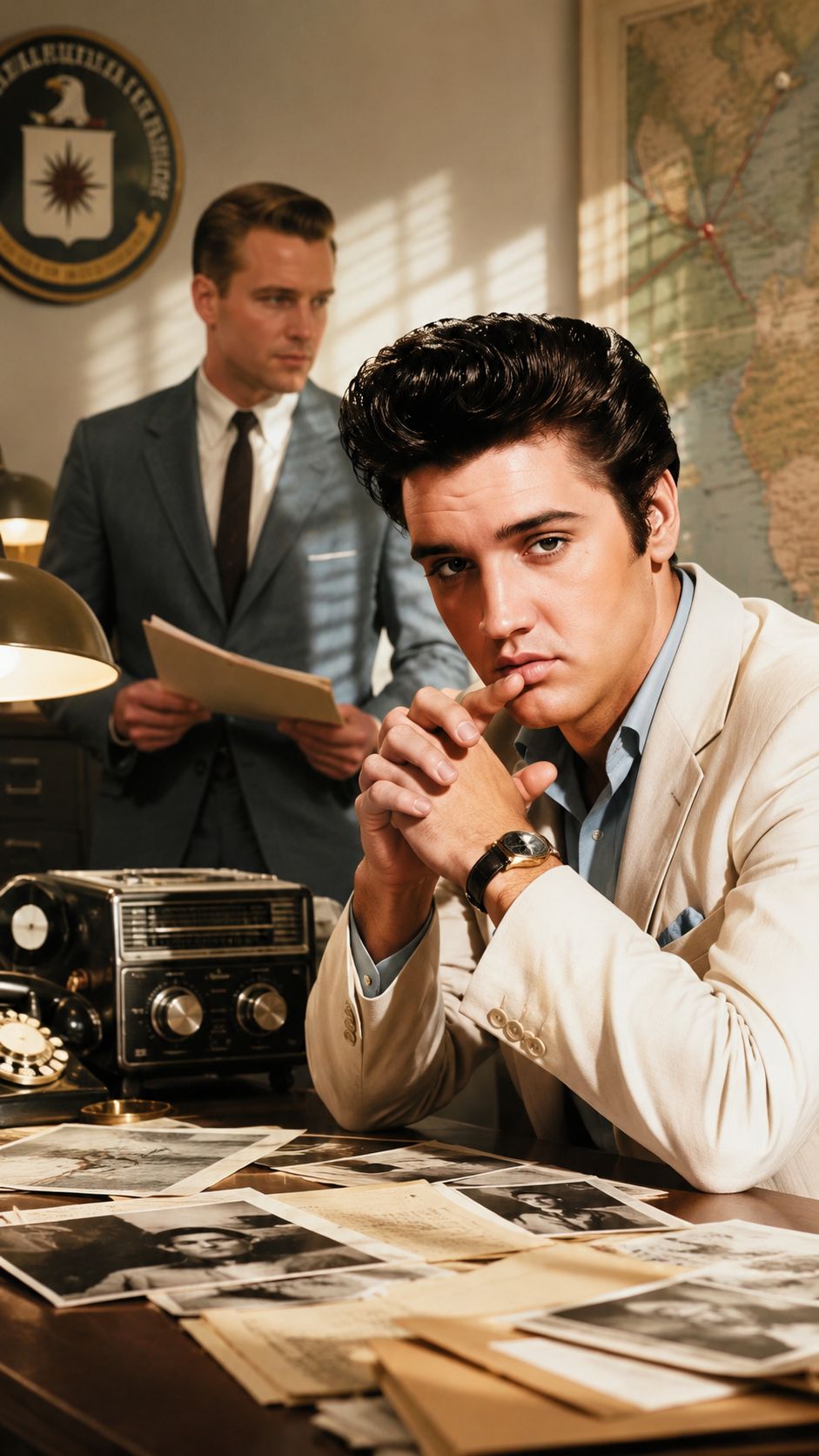
Few figures in American music history have inspired as much fascination, mystery, and speculation as Elvis Presley. Decades after his passing, the King of Rock and Roll remains more than a musician—he is a cultural phenomenon wrapped in layers of legend. From stories about secret sightings to rumors of hidden government ties, the mythology surrounding Elvis Presley continues to captivate generations.
Among the most intriguing theories is one that sounds as though it belongs in a Hollywood thriller: Was Elvis Presley secretly connected to the intelligence world? Did the man who transformed popular music somehow become an undercover source for the FBI—or even maintain indirect ties to the CIA?
The question refuses to disappear because it sits at the crossroads of fame, patriotism, and Cold War America. Elvis Presley was not just a global superstar. He was deeply patriotic, openly supportive of law enforcement, and intensely concerned about what he believed were threats posed by drug culture and anti-establishment movements during the turbulent late 1960s and 1970s.
As government files have gradually become public, historians, music scholars, and conspiracy theorists have searched for clues hidden between the lines. What they discovered paints a portrait far more complex than the simple image of a rock-and-roll icon. The truth may not be what many expect—but it is every bit as fascinating.
The Origins of the Elvis Intelligence Rumor
The story begins during one of the most politically charged periods in American history. The late 1960s were marked by social unrest, anti-war demonstrations, and growing distrust between citizens and government institutions.
Against this backdrop stood Elvis Presley, a performer whose roots were deeply tied to traditional American values. While younger artists increasingly embraced rebellion, Elvis Presley often appeared to align himself with law enforcement and authority.
The rumor of intelligence connections gained momentum because of a remarkable and very real event: his famous meeting with Richard Nixon at the White House in December 1970.
The photograph from that meeting remains one of the most iconic images in American history. Here stood the President of the United States beside the world’s biggest music star.
But the meeting itself was unusual.
Elvis Presley reportedly arrived with a handwritten letter expressing concern about drug abuse, anti-American groups, and radical movements. He offered his assistance in helping the government understand youth culture and requested a federal narcotics badge.
To many observers, this sounded less like a celebrity visit and more like the beginning of a covert relationship.
“The King wanted to help fight what he believed was a growing threat to America.”
That sentiment would become the fuel for decades of speculation.
The FBI Files: What Do They Actually Reveal?
Over the years, declassified FBI records involving Elvis Presley have become publicly available. These documents show that federal agencies maintained files on him, just as they did on countless celebrities, politicians, and public figures.
However, a critical distinction often gets lost in sensational headlines.
Having an FBI file does not automatically mean someone worked for the FBI.
The records indicate that Elvis Presley occasionally communicated concerns about criminal activity, drug issues, and perceived threats to public order. In some instances, information connected to him found its way into government records.
Yet historians who have examined the documents generally conclude that there is no definitive evidence proving Elvis Presley served as a formal undercover FBI informant.
What emerges instead is a portrait of a celebrity eager to cooperate with authorities whenever he felt it could help the country.
This nuance is often overshadowed by the allure of conspiracy theories.
Where the CIA Theory Comes From
The CIA connection is even more controversial.
Unlike the FBI rumors, evidence linking Elvis Presley directly to the CIA is extraordinarily thin.
Most of the speculation stems from circumstantial observations:
- His close relationship with influential political figures.
- His military service in Germany.
- His passionate anti-drug positions.
- His unusual White House access.
- His fascination with law enforcement credentials.
For conspiracy enthusiasts, these elements combine into a compelling narrative.
The theory imagines Elvis Presley as a cultural insider uniquely positioned to provide information about social movements, entertainers, and youth trends during the Cold War era.
The problem is that no credible documentation has surfaced demonstrating a formal CIA role.
Professional historians generally view the CIA theory as speculative rather than evidence-based.
Still, the theory persists because it taps into a larger fascination with hidden histories.
“What if the most famous entertainer in the world was living a secret second life?”
It is a question designed to capture the imagination.
Patriotism, Celebrity, and the Search for Purpose
To understand why these rumors gained traction, one must understand the mindset of Elvis Presley during the later years of his career.
Unlike many stars associated with the counterculture movement, Elvis Presley viewed himself as a patriot first and an entertainer second.
His military service became a defining chapter in his life. While many celebrities might have sought exemptions, he served in the U.S. Army and often spoke proudly about that experience.
The values he carried from that period never fully disappeared.
As social divisions deepened across America, Elvis Presley increasingly saw drug abuse and political extremism as serious dangers.
Some biographers argue that his desire to cooperate with authorities stemmed not from espionage ambitions but from a genuine belief that he could help.
Ironically, this very desire may have fueled later myths.
When a superstar actively seeks relationships with government agencies, speculation naturally follows.
The Contradiction at the Heart of the Story
Perhaps the most fascinating aspect of this mystery is its central contradiction.
Elvis Presley became famous by revolutionizing popular culture. His music challenged social norms and transformed the entertainment industry.
Songs such as “Heartbreak Hotel”, “Hound Dog”, “Jailhouse Rock”, and “Can’t Help Falling in Love” helped define the evolution of Rock and Roll.
Yet later in life, he often positioned himself closer to established institutions than to cultural revolutionaries.
This duality fascinates historians.
How could the man who symbolized youthful rebellion become someone who openly admired government authority?
The answer may be simpler than conspiracy theories suggest.
People evolve.
The young artist who shocked America in the 1950s became a middle-aged global celebrity navigating a vastly different world during the 1970s.
Rather than evidence of secret intelligence work, his actions may reflect a personal search for meaning, influence, and purpose beyond the stage.
Why the Legend Refuses to Die
The enduring appeal of the FBI and CIA theories reveals something profound about the power of celebrity mythology.
Fans do not merely want stars to be talented.
They want them to be larger than life.
For Elvis Presley, ordinary explanations often seem insufficient. His rise was extraordinary. His fame was unprecedented. His influence remains immense.
As a result, stories surrounding him naturally drift toward the extraordinary.
Secret missions.
Government connections.
Hidden identities.
These narratives transform a music icon into a legendary figure who exists somewhere between history and folklore.
Yet the available evidence points toward a more human reality.
Elvis Presley appears not as a covert operative but as a deeply patriotic celebrity who admired law enforcement, sought government recognition, and occasionally shared concerns with authorities.
That truth may be less dramatic than the conspiracy theories.
But it may also be more revealing.
“The real mystery of Elvis was never whether he worked for the government. The real mystery was how one man became so famous that even decades later, the world still searches for secrets hidden behind his legend.”
In the end, the story of Elvis Presley remains one of music, culture, patriotism, and enduring fascination. Whether viewed through the lens of Rock and Roll, the Cold War, or American celebrity culture, his life continues to inspire questions that refuse to fade. And perhaps that is the greatest testament to the King’s legacy: even now, the conversation is far from over.