 By admin
INTRODUCTION:
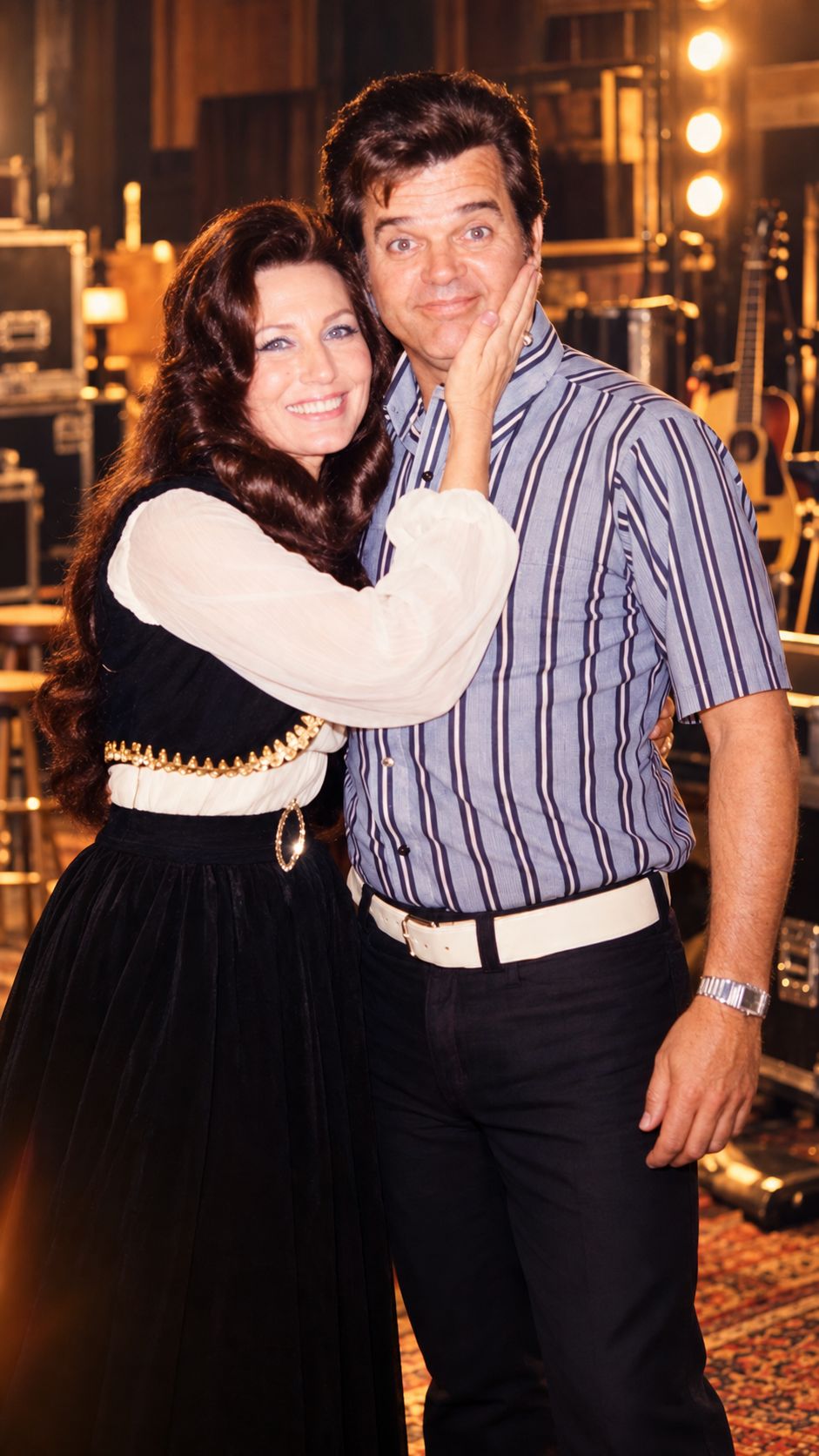
There are moments in country music when a performance becomes so convincing that listeners begin to forget where the song ends and real life begins. Few partnerships created that illusion more powerfully than Conway Twitty and Loretta Lynn. Their voices carried the sound of two people caught between love and regret, temptation and loyalty, tenderness and pain. To millions of fans, they did not simply sing about complicated relationships—they seemed to live inside them.
That extraordinary chemistry came with a price.
For decades, rumors followed Conway Twitty and Loretta Lynn wherever their music took them. Fans wondered whether the emotional tension in songs such as “After the Fire Is Gone” reflected something more personal. Others interpreted their glances, harmonies, stage banter, and dramatic storytelling as clues to a secret relationship.
But fame has a strange way of turning imagination into supposed history.
The deeper truth is both less scandalous and, perhaps, more remarkable. Twitty and Lynn built a professional partnership so emotionally believable that audiences struggled to separate their characters from their real lives. The controversy was not necessarily born from what happened behind the curtain. It was born from what happened in the listener’s imagination.
And that distinction matters.
THE MOMENT THE RUMORS BEGAN TO GROW
When Conway Twitty and Loretta Lynn began recording together, country music was already familiar with male-female duets. But this pairing sounded different.
Their voices created friction.
Twitty possessed a smooth, controlled baritone that could sound confident one moment and vulnerable the next. Lynn, meanwhile, brought a directness that made even the quietest lyric feel confrontational. She did not merely answer him musically. She challenged him.
That contrast became their greatest weapon.
Their first major No. 1 duet, “After the Fire Is Gone,” presented two people trapped in unhappy relationships who find emotional comfort in each other. The subject matter was provocative enough on its own, but when Twitty and Lynn performed it together, the illusion became almost overwhelming. The song’s narrative and their chemistry encouraged audiences to wonder whether the emotions were entirely fictional.
That is where the cost of fame began.
The better they performed, the more people speculated.
The more believable the songs became, the more difficult it was for some listeners to accept that the chemistry was simply part of their artistry.
FACT: THEIR PARTNERSHIP WAS EXTRAORDINARILY SUCCESSFUL
The documented history is impressive enough without adding scandal.
Between 1971 and 1988, Conway Twitty and Loretta Lynn recorded a remarkable body of collaborative music. They released 11 studio albums and placed 12 duet singles in the Billboard country Top 10, with five reaching No. 1. They also won the Country Music Association’s Vocal Duo of the Year award four consecutive times, from 1972 through 1975.
Songs such as “After the Fire Is Gone,” “Lead Me On,” “Louisiana Woman, Mississippi Man,” “As Soon as I Hang Up the Phone,” and “You’re the Reason Our Kids Are Ugly” demonstrated just how flexible their partnership could be.
They could be romantic.
They could be argumentative.
They could be funny.
They could sound wounded.
And sometimes they could make a fictional relationship feel uncomfortably real.
That was not evidence of a secret affair.
It was evidence of two performers who understood dramatic storytelling.
RUMOR: WERE CONWAY AND LORETTA SECRETLY IN LOVE?
This is where the mythology becomes especially powerful.
For years, people assumed that Conway Twitty and Loretta Lynn must have had romantic feelings for each other because their performances sounded so intimate.
But the available historical record does not support turning that rumor into fact.
In an interview preserved by PBS, Loretta Lynn directly addressed the speculation, saying audiences believed she and Conway Twitty “had a thing,” while insisting that this was far from the truth. She described him as a friend and emphasized that her husband, Doo Lynn, also cared deeply about Twitty.
That statement deserves more attention than decades of fan speculation.
Because when the person at the center of the rumor tells us what the relationship meant to her, responsible storytelling should listen.
WHY DID PEOPLE BELIEVE THE RUMOR?
The answer is actually fascinating.
Conway Twitty and Loretta Lynn were performers of extraordinary emotional intelligence.
They understood that a duet was not simply two people singing the same song. It was a conversation.
When Lynn sounded hurt, Twitty knew when to pull back.
When Twitty sounded persuasive, Lynn knew how to challenge him.
When the lyric required hesitation, they allowed silence to become part of the performance.
That created something rare: emotional ambiguity.
The audience was allowed to wonder.
And wondering is one of the strongest forces in entertainment.
The same technique that made their recordings timeless also made rumors almost inevitable.
Their music did not always tell listeners, “These two people are happily in love.”
Instead, it asked more complicated questions:
What happens when marriage becomes empty?
What happens when temptation appears?
What happens when someone wants what they cannot have?
What happens when love and responsibility pull in opposite directions?
Those questions were powerful because they were human.
THE SHADOW OF DOO LYNN
Another reason the rumors became so persistent was the presence of Oliver “Doo” Lynn, Loretta’s husband and longtime manager.
The public knew that Loretta Lynn’s marriage was complicated. Her songs frequently explored the difficult realities of love, marriage, jealousy, betrayal, and forgiveness.
That made it easy for outsiders to connect dots that did not necessarily belong together.
If Loretta sang convincingly about forbidden love with Conway, some listeners assumed the song must somehow reflect her private life.
But country music has never worked that simply.
Artists routinely perform stories they did not personally experience.
Actors play murderers without being murderers. Novelists write about heartbreak without necessarily living every chapter. Singers can inhabit fictional characters with astonishing authenticity.
Twitty and Lynn were doing precisely that.
Their greatest talent was making fiction emotionally believable.
THE MOST IMPORTANT FACT: THEIR FRIENDSHIP SURVIVED THE RUMORS
Perhaps the strongest argument against sensational interpretations is that the professional relationship endured.
The partnership was not destroyed by one mysterious confrontation or a confirmed romantic scandal.
Instead, it evolved across years of recording, touring, awards, and changing musical circumstances.
Historical accounts even show that the rumors themselves became part of the strange world surrounding the duo. A 1980s publicity document noted that speculation about their relationship had persisted for years and included comments from Twitty rejecting the idea that anything romantic had occurred between them.
That tells us something important.
The rumor was not created decades later by modern internet culture.
It existed during their own era.
But so did their denials.
And so did their friendship.
THE CONTROVERSY BECAME PART OF THEIR LEGACY
This is the uncomfortable irony.
The rumors probably helped make Conway Twitty and Loretta Lynn even more fascinating to the public.
Every emotionally charged duet invited another question.
Every glance onstage could be interpreted.
Every romantic lyric could be treated like a confession.
But the controversy also demonstrated how dangerous fame can become.
When audiences become emotionally invested in performers, they sometimes want the fantasy to be true.
They want the chemistry to represent something hidden.
They want the song to be evidence.
And once that narrative takes hold, facts can struggle to compete with imagination.
WHAT THEIR MUSIC ACTUALLY REVEALS
If we put the rumors aside, something much more meaningful emerges.
Conway Twitty and Loretta Lynn understood ordinary human weakness.
Their characters were rarely perfect.
They were jealous.
They were stubborn.
They were lonely.
They made mistakes.
They wanted forgiveness.
They wanted another chance.
Sometimes they wanted someone they should not want.
That honesty was the real secret behind their success.
Their music did not demand that listeners judge the characters. It invited listeners to recognize themselves in them.
That is why “After the Fire Is Gone” still carries emotional weight decades later.
It is not powerful because fans believed Twitty and Lynn were secretly involved.
It is powerful because almost everyone understands what it means to feel emotionally trapped, misunderstood, tempted, or afraid of losing something precious.
THE REAL COST OF FAME
For Conway Twitty and Loretta Lynn, fame created extraordinary opportunities.
It gave them hit records.
Awards.
Television appearances.
Sold-out performances.
A permanent place in country music history.
But fame also took something from them: privacy.
Their friendship could be interpreted as romance.
Their performances could be mistaken for confessions.
Their fictional characters could be confused with their real personalities.
That is the price of becoming so convincing that millions of people feel they know you personally.
The irony is that the very thing that created the rumors—the extraordinary chemistry between Twitty and Lynn—is also what made them legendary.
THE LEGACY THAT OUTLIVED THE CONTROVERSY
When Conway Twitty died in 1993, Loretta Lynn mourned not merely a musical partner but a friend. Contemporary accounts recorded her describing the loss as that of a great singing partner and friend.
That distinction matters.
Because after all the speculation, all the headlines, all the whispered questions, the simplest explanation remains one of the most powerful:
They trusted each other.
They understood each other’s voices.
They knew how to tell complicated stories together.
And they gave audiences something few performers ever achieve—the sensation that they were hearing genuine human emotion unfold in real time.
Perhaps that is why the rumors refuse to disappear.
Not because they were proven true.
But because Conway Twitty and Loretta Lynn were so extraordinarily good at making a song feel like a secret.
And sometimes, the greatest illusion in country music is not a scandal.
It is the ability to make millions of people believe that a fictional love story happened behind the microphone.
That was their gift.
That was their mystery.
And ultimately, that was their legacy.