 By admin
 INTRODUCTION:
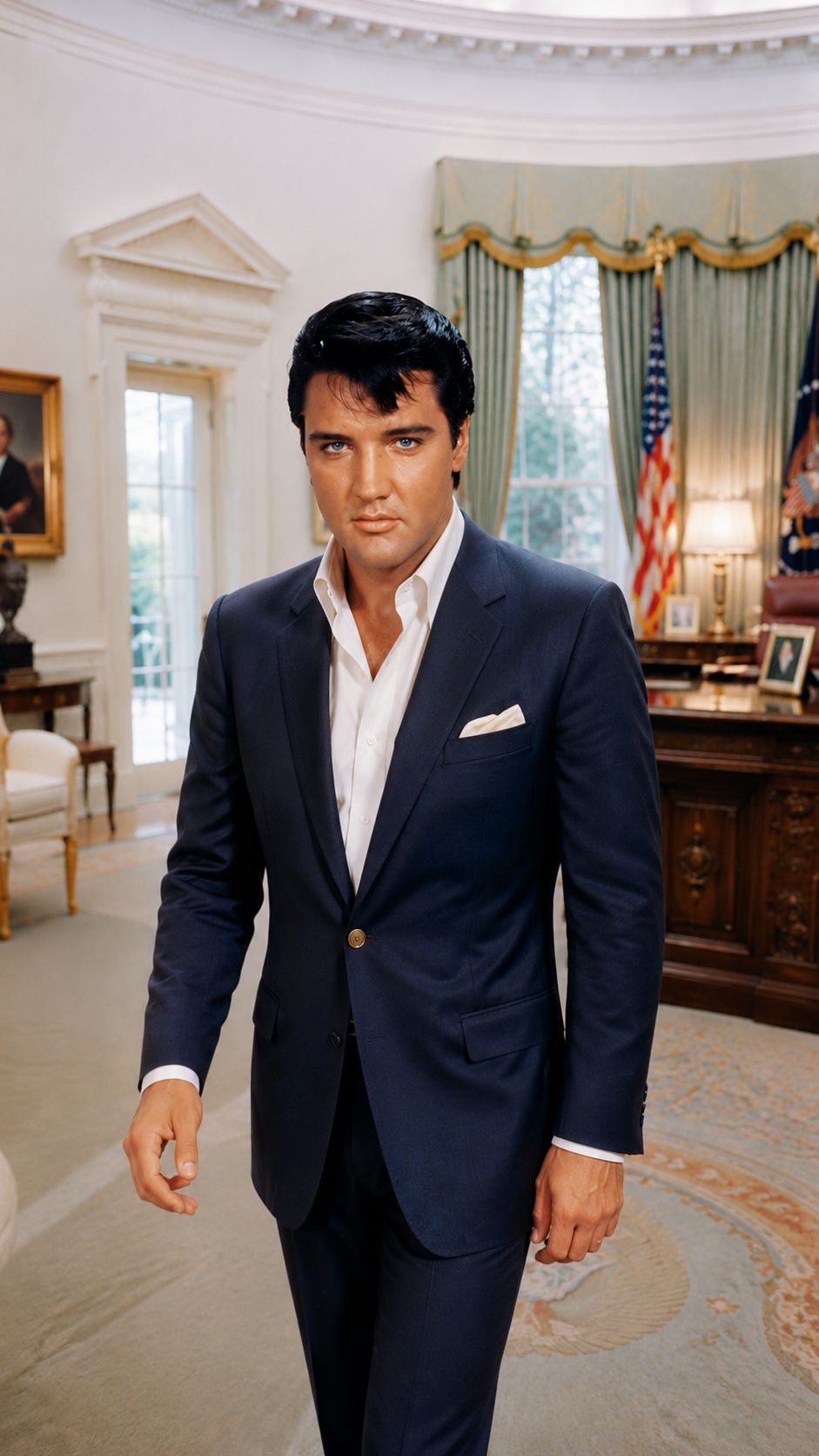
Few moments in American cultural history feel as surreal as the day Elvis Presley walked into the White House unannounced and demanded to meet the President of the United States. It sounds like the opening scene of a Hollywood screenplay—a global music icon arriving at the gates of the nation’s most powerful residence with no appointment, no formal invitation, and a request that seemed almost impossible to grant.
Yet it happened.
By the early 1970s, Elvis Presley was more than a singer. He was a cultural force whose influence stretched far beyond the boundaries of Rock and Roll, touching Country Music, gospel, film, and the very identity of modern American entertainment. At the same time, America was experiencing one of its most turbulent eras. Political distrust was growing, the Vietnam War continued to divide the nation, and a generation gap seemed wider than ever.
Into this atmosphere stepped The King, carrying a handwritten letter and a deeply personal mission.
What followed was one of the strangest and most fascinating encounters ever recorded between a celebrity and a sitting president. It was a story of fame, patriotism, insecurity, power, and a man searching for purpose beyond the stage.
More than fifty years later, the image of Elvis Presley standing beside President Richard Nixon remains one of the most iconic and unexpected photographs in American history.
The Mission Nobody Saw Coming
On December 21, 1970, Elvis Presley arrived in Washington, D.C., after a whirlwind journey that baffled even those closest to him. He carried a handwritten letter addressed directly to President Richard Nixon.
In that letter, Elvis Presley expressed concern about what he viewed as growing threats to American values. He spoke about drug culture, anti-American sentiment, and the social unrest that had spread across the country during the late 1960s.
What made the request extraordinary was that Elvis Presley wanted to become a federal agent.
Not a symbolic ambassador.
Not a celebrity spokesperson.
He wanted an official federal narcotics badge.
The request reflected a complicated side of Elvis Presley that many people never fully understood. Despite his rebellious image as the pioneer of Rock and Roll, he held deeply conservative views on many social issues and believed strongly in law enforcement and patriotic institutions.
The man who once terrified parents with his dancing now saw himself as a defender of traditional America.
For many observers, this contradiction remains one of the most fascinating aspects of his personality.
A Superstar at the White House Gates
Security personnel were understandably stunned.
Imagine being a White House staff member and learning that the world’s most famous entertainer was standing outside requesting an audience with the President.
Normally, such a meeting would require weeks or months of planning. Yet Elvis Presley possessed something few people on Earth had: unmatched cultural influence.
His message quickly moved through White House channels.
Remarkably, President Richard Nixon agreed to see him.
The decision was politically interesting. Nixon was attempting to connect with what he called the “silent majority” of Americans. Elvis Presley, despite being associated with youth culture, represented a bridge between generations. His enormous popularity reached audiences across Country Music, Rock and Roll, and mainstream America.
The meeting suddenly became more than a celebrity encounter.
It became a collision between two of the most recognizable figures in the United States.
Inside the Historic Meeting
When Elvis Presley finally entered the Oval Office, few could have predicted how unusual the conversation would become.
According to accounts from those familiar with the meeting, Elvis Presley spoke passionately about his concerns regarding drug abuse and counterculture movements.
Ironically, history would later reveal a tragic contradiction.
While Elvis Presley was expressing concern about drug problems in America, he was privately struggling with prescription medication use himself. This reality adds a heartbreaking layer to the story and illustrates the complexity of his life during that era.
President Richard Nixon, meanwhile, listened carefully.
The two men found surprising common ground. Both felt disconnected from parts of the rapidly changing culture. Both viewed themselves as defenders of certain traditional American values.
The meeting reportedly developed a warm atmosphere despite its unconventional beginning.
Then came the moment Elvis Presley had been seeking.
He received a federal narcotics badge.
To Elvis Presley, this badge was far more than a souvenir.
It represented legitimacy, purpose, and recognition from the highest level of government.
For a man who had conquered music, movies, and global fame, the badge symbolized something money and applause could never provide: official acceptance.
Why the Photograph Became Legendary
The photograph from that meeting has become one of the most requested images in American archival history.
The image captures an almost impossible scene.
On one side stands Richard Nixon, a president often associated with political power, secrecy, and authority.
On the other stands Elvis Presley, the king of popular music whose influence transformed Rock and Roll, influenced Country Music, and reshaped entertainment forever.
Together, they represent two different forms of American power.
One possessed political authority.
The other possessed cultural authority.
The visual contrast is mesmerizing because neither man seems entirely comfortable in the role history assigned him.
That tension gives the photograph its lasting magic.
The Country Music Connection
Although the story is often told through the lens of Rock and Roll, its significance reaches deeply into Country Music history as well.
By 1970, Elvis Presley had increasingly embraced country influences in his recordings and performances. Songs such as “Kentucky Rain” and his interpretations of traditional country material demonstrated how closely he remained connected to Southern musical roots.
The values that motivated his White House visit—patriotism, tradition, respect for authority, and cultural identity—also resonated strongly with many Country Music audiences of the era.
This helps explain why the story continues to fascinate country fans decades later.
It was not merely a celebrity stunt.
It reflected the emotional and cultural tensions shaping America at the time.
The encounter revealed a side of Elvis Presley that audiences rarely saw: a man wrestling with his place in a changing world.
The Deeper Meaning Behind the Meeting
What makes this story endure is not its absurdity.
It is its humanity.
By 1970, Elvis Presley had already achieved everything an entertainer could dream of achieving. He was wealthy, famous, and beloved across the globe.
Yet his visit to the White House suggests a deeper longing.
He wanted relevance.
He wanted purpose.
He wanted to matter beyond music.
The meeting with Richard Nixon became a symbolic search for identity during a period when Elvis Presley was confronting personal challenges and evolving public expectations.
Behind the gold records, sold-out arenas, and legendary status stood a man still searching for where he belonged.
That search is what makes the story timeless.
The image of Elvis Presley walking into the White House uninvited is more than an amusing historical footnote. It is a powerful reminder that even the most celebrated figures often seek validation, meaning, and connection in unexpected places.
And perhaps that is why the story continues to captivate generations.
Because beneath the spectacle of Rock and Roll, politics, and celebrity lies a profoundly human tale—one that reveals Elvis Presley not merely as The King, but as a man trying to find his place in history.