 By admin
 INTRODUCTION:
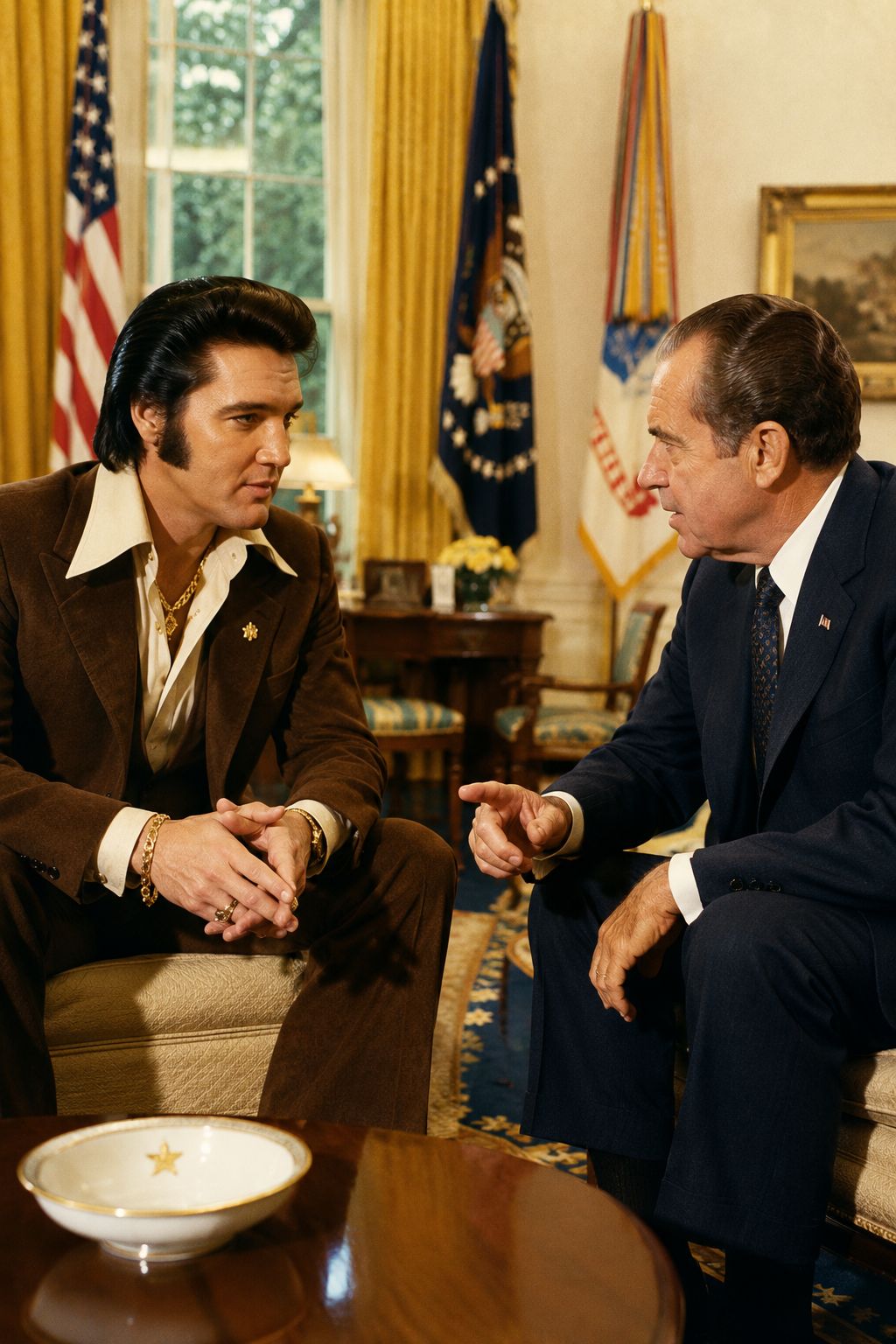
Few photographs in American history have generated as much fascination as the image of the King of Rock ’n’ Roll standing beside the President of the United States.
On December 21, 1970, the impossible became reality when Elvis Presley walked through the gates of the White House and met President Richard Nixon in a private meeting that was never supposed to become legendary.
Yet more than half a century later, Americans are still asking the same question:
What really happened behind those closed doors?
The answer is stranger, more emotional, and more revealing than anyone could have imagined.
A Restless King Searching for Purpose
By late 1970, Elvis Presley was once again on top of the entertainment world.
His triumphant comeback in 1968 had reignited his career. His concerts in Las Vegas were drawing enormous crowds. Millions still adored him.
But beneath the rhinestones, applause, and sold-out performances, Elvis was wrestling with something deeper.
He was restless.
Friends and family later recalled that Elvis often felt disconnected from the rapidly changing America of the late 1960s and early 1970s. The nation was divided by war, social upheaval, political protests, and an exploding counterculture movement.
Elvis had always viewed himself as deeply patriotic.
He loved America.
He loved law enforcement.
And increasingly, he feared that the country he cherished was slipping away.
“Elvis saw himself not merely as an entertainer, but as a guardian of traditional American values.”
Unlike many celebrities of the era, Elvis openly admired police officers and federal agents. He collected law enforcement badges obsessively, believing they symbolized service, honor, and duty.
But there was one badge he desperately wanted above all others.
A federal narcotics badge.
An Unexpected Journey to Washington
In December 1970, seemingly on impulse, Elvis boarded a commercial flight from Memphis to Washington, D.C.
Even those closest to him had little idea what he intended to do.
During the flight, Elvis drafted a handwritten letter addressed directly to President Nixon.
In it, he expressed concern about drug culture, anti-American sentiment, and the growing influence of radical groups.
Elvis insisted he could help.
He believed that because young people trusted celebrities, he could serve as a powerful ally in America’s fight against illegal drugs.
Most astonishingly, Elvis requested to become a “Federal Agent at Large.”
The letter eventually reached aides inside the White House.
At first, staff members were baffled.
Was this serious?
Could the most famous entertainer on Earth really be asking for federal credentials?
Surprisingly, the answer from inside the administration soon became:
Why not?
The Secret Meeting Is Arranged
On the morning of December 21, 1970, Elvis arrived at the White House dressed impeccably.
He wore a striking purple velvet suit, an oversized gold belt, and carried an unusual gift for the President: a Colt .45 pistol displayed in a presentation case.
Security personnel were stunned.
Some reportedly recognized him instantly.
Others simply could not believe what they were seeing.
The King of Rock ‘n’ Roll was standing in line like any other visitor.
“For a brief moment, celebrity, politics, and American mythology collided at the White House gates.”
Inside, aides debated whether the meeting should proceed.
Eventually, the decision was made.
President Nixon would see Elvis.
Face to Face: The King Meets the President
The meeting itself lasted roughly half an hour.
No reporters were present.
No television cameras rolled.
Only a handful of individuals witnessed the extraordinary encounter.
According to White House records and later recollections, Elvis spoke passionately about what he viewed as threats to America.
He criticized drug abuse.
He expressed concern about anti-establishment culture.
He worried about the influence of certain political movements.
Most importantly, he argued that he could communicate with young Americans in ways government officials could not.
Elvis reportedly told Nixon that members of the counterculture would never suspect him of working with federal authorities.
To many observers today, the idea sounds surreal.
Yet those present described Elvis as sincere.
He truly believed he could help.
President Nixon listened attentively.
The two men, despite coming from vastly different worlds, discovered surprising common ground: patriotism, concern about social unrest, and a desire to preserve stability during a turbulent period in American history.
“It was not merely a celebrity photo opportunity. For Elvis, this meeting was deeply personal.”
At some point, Elvis embraced the President.
The image captured afterward would become one of the most requested photographs in the history of the U.S. National Archives.
Neither man could have predicted its lasting cultural impact.
The Badge That Meant Everything
For all the discussion about national problems, Elvis remained focused on one particular objective.
He wanted federal credentials.
Specifically, he wanted a badge from the Bureau of Narcotics and Dangerous Drugs.
To outsiders, this request seemed eccentric.
To Elvis, it represented legitimacy.
He believed a federal badge would grant him authority, mobility, and symbolic recognition as someone serving his country.
Later that day, after conversations involving administration officials and federal authorities, Elvis got what he wanted.
He received the coveted badge.
Witnesses said he was ecstatic.
One aide later remarked that Elvis appeared happier receiving the badge than many entertainers looked when receiving major industry awards.
“In Elvis’s eyes, the badge represented more than power—it represented belonging.”
Why Did Elvis Really Do It?
Historians continue debating Elvis’s true motivations.
Some argue that the meeting reflected his sincere patriotism.
Others suggest it revealed his loneliness.
Still others see it as evidence of a man searching for identity beyond fame.
Perhaps all are true.
By 1970, Elvis had achieved virtually everything imaginable.
Money.
Global fame.
Adoration.
Yet immense success had not erased his inner struggles.
The White House meeting offered something Hollywood never could: a sense of mission.
Elvis was no longer merely an entertainer.
For one remarkable day, he felt like a participant in the destiny of the nation itself.
The Lasting Legacy of an Unforgettable Day
The photograph of Elvis and Nixon remains endlessly fascinating because it captures two towering American icons at an unexpected crossroads.
One represented political power.
The other embodied cultural power.
Together, they created a moment that still feels almost fictional.
Today, historians view the meeting as far more than a curious celebrity anecdote.
It reveals the complexities of Elvis Presley himself—a man of contradictions.
He was rebellious yet traditional.
A global superstar who often felt isolated.
A cultural revolutionary who fiercely loved established institutions.
A King searching for purpose.
And perhaps that is why the story continues to resonate.
Because beneath the headlines, beneath the velvet suit and the famous photograph, stood a man desperately trying to find meaning in a rapidly changing world.
On that cold December morning in 1970, inside the White House, Elvis Presley wasn’t simply meeting a President.
He was searching for a place where he truly belonged.
And for a brief, unforgettable moment, he may have found it.
VIDEO: