 By admin
INTRODUCTION:
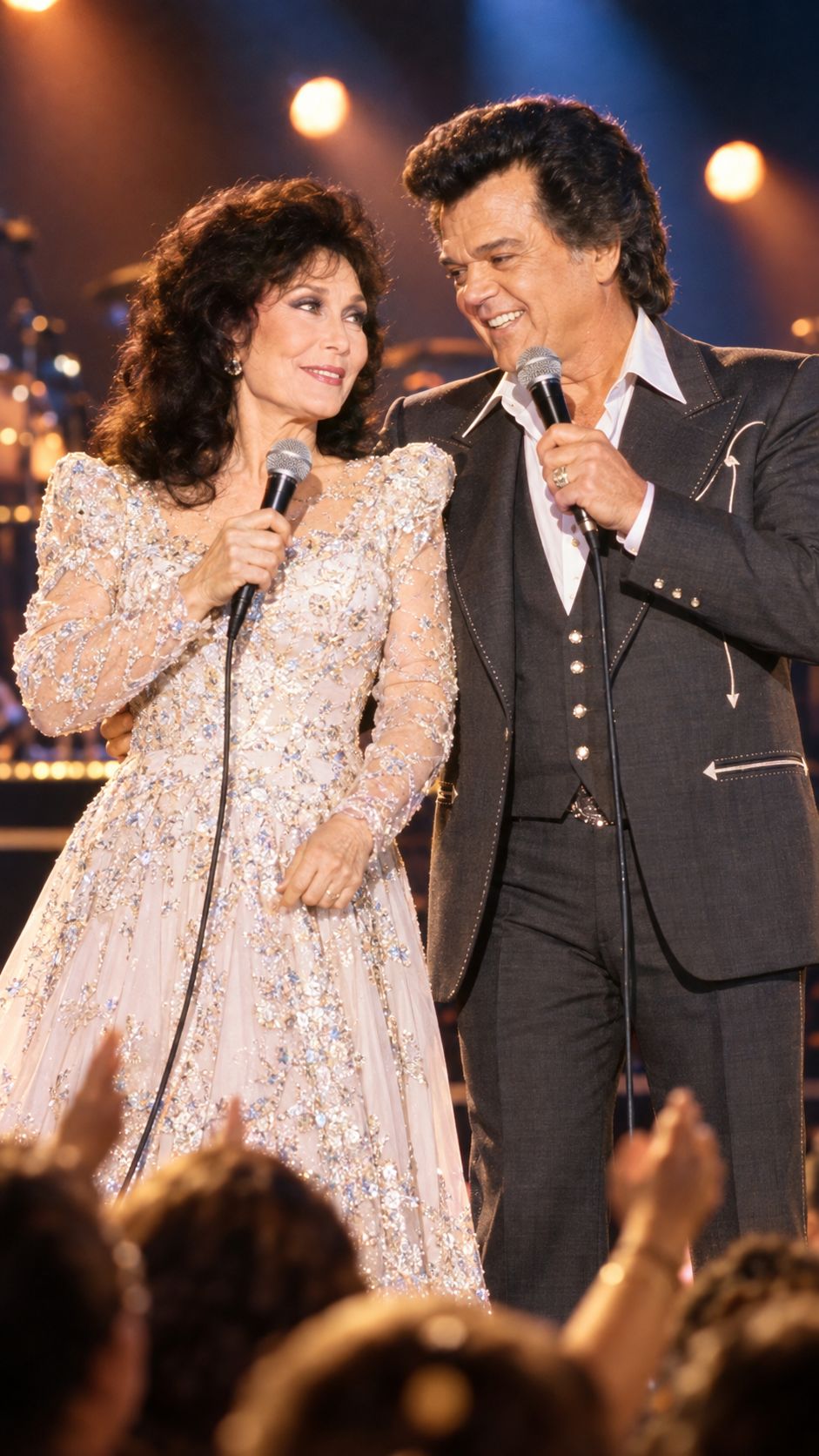
There are songs that entertain us, songs that make us dance, and songs that stay in our hearts long after the final note has disappeared. But every once in a while, two extraordinary voices come together and create something that feels bigger than music itself. That was the magic of Conway Twitty and Loretta Lynn.
When these two country music legends joined forces, they brought something special to the recording studio. It wasn’t simply a combination of a talented male singer and a gifted female vocalist. It was a meeting of two distinct personalities, two remarkable musical journeys, and two voices that seemed to understand each other without needing to explain a single emotion.
Their duets captured the complicated realities of love, heartbreak, temptation, loyalty, and human relationships. They sounded natural, honest, and wonderfully imperfect in all the ways that made classic country music unforgettable.
Among their most important recordings was After the Fire Is Gone, the 1971 duet that helped establish them as one of country music’s greatest vocal partnerships. What might have seemed like another recording session became the beginning of an extraordinary musical legacy.
More than half a century later, listeners still return to that unforgettable combination of voices, wondering how two artists could make a simple song feel so deeply personal.
And perhaps that is the greatest secret of their success: they never sounded like they were trying to make history. They simply sounded like they were telling the truth.
THE UNEXPECTED BEGINNING OF A LEGENDARY PARTNERSHIP
Sometimes the greatest moments in music history happen without elaborate plans or carefully designed strategies. That was certainly true of Conway Twitty and Loretta Lynn.
Before they became one of country music’s most celebrated duos, both artists had already established impressive careers. Conway Twitty had developed a reputation for his smooth, expressive voice and remarkable ability to communicate romantic emotion. His journey from early rock-and-roll success to country music stardom had given him a distinctive musical identity.
Meanwhile, Loretta Lynn had become one of country music’s most recognizable female performers. Her songs spoke directly to ordinary people, particularly women whose experiences were rarely represented honestly in popular music. Through songs such as Coal Miner’s Daughter, she demonstrated that authenticity could be more powerful than perfection.
Interestingly, their partnership did not begin with a grand musical announcement.
In an interview, Loretta Lynn recalled that she and Conway Twitty began singing together in dressing rooms while traveling overseas with other performers. They enjoyed the way their voices sounded together and eventually decided to demonstrate their chemistry to producer Owen Bradley.
His reaction was enthusiastic.
He recognized something worth exploring and encouraged them to enter the recording studio together.
That simple decision opened the door to a partnership that would become an important chapter in country music history.
What started as an experiment between two established performers soon became something neither artist could have fully anticipated.
AFTER THE FIRE IS GONE: THE SONG THAT STARTED EVERYTHING
When After the Fire Is Gone arrived in 1971, it introduced country audiences to a musical partnership that felt remarkably natural.
Written by L.E. White, the song explored a painful and complicated subject: what happens when the emotional excitement disappears from a relationship and two people begin searching for affection somewhere else.
It was not an uncomplicated love song.
Instead, it presented a difficult emotional situation through the voices of two people caught between desire, disappointment, and the consequences of their choices.
That subject matter gave the recording its dramatic power.
Conway Twitty approached the material with his characteristic smoothness. His voice carried a mixture of confidence and vulnerability, allowing listeners to hear the emotional conflict beneath the words.
Loretta Lynn, on the other hand, brought an entirely different dimension. Her delivery was direct, expressive, and emotionally grounded. She did not need elaborate vocal arrangements to make a listener understand the feelings behind the song.
Together, they created a conversation rather than simply singing alternating verses.
That distinction mattered.
Many duets feature two singers performing beautifully alongside each other. However, the most memorable partnerships create the impression that two people are genuinely communicating through music.
After the Fire Is Gone achieved exactly that.
The song reached No. 1 on the country charts, becoming their first chart-topping single together. It also earned them the 1972 Grammy Award for Best Country Vocal Performance by a Duo or Group.
For a first major collaboration, that was an extraordinary achievement.
But the most important result was not simply the award or the chart position. It was the discovery that these two voices could create something neither could quite reproduce alone.
WHY THEIR VOICES FIT TOGETHER SO PERFECTLY
The secret behind Conway Twitty and Loretta Lynn was not that they sounded alike.
In fact, their differences were precisely what made the partnership so compelling.
Conway possessed a rich, warm vocal style. He could make a romantic lyric sound intimate without becoming overly sentimental. His phrasing often suggested that he was speaking directly to one person rather than performing for thousands.
Loretta, meanwhile, possessed a distinctive voice with a natural edge. Her singing could communicate determination, sadness, humor, frustration, and tenderness within a single performance.
When their voices met, the contrast created emotional tension.
His smoother delivery could suggest hesitation or longing, while her stronger, more direct approach brought another perspective into the conversation.
Listeners were not simply hearing a man and a woman singing together. They were hearing two characters with different emotions responding to one another.
This was especially effective in songs involving complicated relationships.
Rather than presenting romance as something perfect and uncomplicated, their music acknowledged that love could involve difficult decisions, conflicting desires, misunderstandings, and moments of vulnerability.
That emotional honesty was one of the defining characteristics of traditional country music.
And these two artists understood it exceptionally well.
THE MAGIC OF OWEN BRADLEY AND THE NASHVILLE SOUND
Behind the success of their recordings was another important figure: producer Owen Bradley.
Bradley was one of the influential architects of the Nashville Sound, a musical approach that brought polished arrangements and carefully controlled production into country recordings.
His work helped shape the careers of numerous country performers, including Patsy Cline and Loretta Lynn.
With Conway Twitty and Loretta Lynn, the production had to accomplish something particularly important: preserve the personalities of both singers while allowing their voices to complement one another.
The arrangements never needed to overpower the emotional message.
Gentle instrumentation, thoughtful pacing, and carefully balanced vocals allowed the storytelling to remain at the center of the recording.
The steel guitar could add a feeling of sadness. The rhythm section could provide movement without distracting from the lyrics. The instrumental passages created space for the emotional tension to develop.
Everything served the song.
That was one of the reasons their recordings have remained appealing to generations of country listeners.
They were polished enough for mainstream radio but retained the emotional character that made traditional country music so powerful.
FROM ONE HIT TO AN EXTRAORDINARY MUSICAL LEGACY
After the success of After the Fire Is Gone, the partnership continued to grow.
Their next recordings demonstrated that the first hit had not been a lucky accident.
Songs such as Lead Me On, Louisiana Woman, Mississippi Man, As Soon as I Hang Up the Phone, and Feelins’ helped establish their reputation as one of country music’s most successful vocal partnerships.
Each recording brought a different emotional situation to life.
Lead Me On explored temptation and emotional surrender.
Louisiana Woman, Mississippi Man introduced a more playful musical exchange, celebrating the attraction between two people from different backgrounds.
As Soon as I Hang Up the Phone took storytelling in a particularly theatrical direction, using a telephone conversation to create an emotional scene between the two singers.
And Feelins’ demonstrated how effectively they could communicate romantic chemistry through a performance.
Their versatility was remarkable.
They could move from heartbreak to humor, from romantic tension to affectionate storytelling, without losing the distinctive character of their partnership.
Between 1971 and 1988, they recorded 11 studio albums together and achieved five No. 1 country hits.
Their success was also recognized by the industry.
They won the Country Music Association’s Vocal Duo of the Year award four consecutive times, from 1972 through 1975.
Those achievements confirmed something fans had already understood: this was not simply a successful collaboration between two famous singers.
It was a genuine musical partnership.
THE CHEMISTRY THAT FANS COULD FEEL
One of the most fascinating aspects of Conway Twitty and Loretta Lynn’s partnership was how convincingly they portrayed romantic relationships.
Their performances sometimes sounded so intimate that audiences wondered whether the emotions extended beyond the recording studio.
In reality, Loretta Lynn explained that the two were friends, not lovers. Their ability to communicate romantic tension was part of their musical artistry.
That distinction makes their performances even more impressive.
They could portray complicated relationships without needing to experience every situation personally.
Their chemistry came from musical understanding, timing, trust, and the ability to respond naturally to one another’s voices.
Think about what happens when listeners hear one of their classic duets.
A line from Conway establishes an emotion. Loretta responds with a different perspective. Suddenly, the song becomes a miniature drama.
There is anticipation in the pauses, meaning in the changes of vocal intensity, and personality in every exchange.
They understood that a duet should not feel like two separate solo performances placed next to each other.
It should feel like a shared story.
That understanding helped distinguish them from many other successful musical partnerships of their generation.
WHY THEIR MUSIC STILL MATTERS TO OLDER COUNTRY FANS
For listeners who grew up during the golden years of country music, hearing Conway Twitty and Loretta Lynn can bring back memories that go far beyond the songs themselves.
Their recordings are connected to family road trips, old radios, country dance halls, weekend gatherings, and evenings when music provided the perfect soundtrack to everyday life.
But nostalgia alone does not explain their lasting popularity.
Their songs continue to resonate because the emotions they explored are universal.
Relationships still experience uncertainty. People still struggle with forgiveness. Love still brings happiness and disappointment. And sometimes, the most meaningful conversations are the ones that are hardest to have.
Their music understood these realities.
Unlike recordings built entirely around fashionable production techniques, their greatest duets placed storytelling first.
The lyrics mattered. The voices mattered. The emotional relationship between the singers mattered.
That approach gave their recordings a timeless quality.
Younger listeners discovering their music today can still recognize the honesty in their performances, even if they never experienced the era in which those recordings first became popular.
That is the difference between a song that becomes temporarily successful and a song that becomes part of a musical legacy.
THE HEARTBREAKING REALITY OF A PARTNERSHIP THAT COULD NOT LAST FOREVER
In June 1993, Conway Twitty passed away at the age of 59.
His death marked the end of an extraordinary musical journey and left a significant absence in country music.
For fans who had followed his career, it was difficult to imagine country music without his unmistakable voice.
For Loretta Lynn, the loss also meant saying goodbye to a longtime friend and musical partner.
Their collaboration had produced some of the most memorable recordings of her career. The songs remained, but the opportunity to create new musical conversations together was gone.
Loretta Lynn continued performing and recording, building upon the remarkable legacy she had established over decades.
She passed away in October 2022, leaving behind a body of work that continues to influence country music.
Today, their recordings offer something particularly precious: the opportunity to hear two extraordinary artists sharing a musical moment that can never be recreated in quite the same way.
Their voices remain together on those recordings, preserving a partnership that once brought happiness to millions of listeners.
And perhaps that is why their music feels especially emotional today.
Every familiar melody carries a reminder of an era, two remarkable personalities, and a friendship that helped shape the sound of country music.
THE REAL SECRET BEHIND THEIR UNFORGETTABLE DUETS
What made Conway Twitty and Loretta Lynn different was never just their extraordinary vocal ability.
It was their understanding of what country music was supposed to accomplish.
They understood that a song did not need complicated language to communicate a complicated emotion.
It did not need extravagant production to make an audience feel something.
And it certainly did not need two singers competing to prove who had the better voice.
Instead, they allowed each other to shine.
Conway brought his warmth, restraint, and romantic expression. Loretta brought her strength, personality, and unmistakable honesty.
Together, they created a musical language that belonged uniquely to them.
Their first major collaboration, After the Fire Is Gone, became the foundation of that legacy. Its success opened the door to years of unforgettable recordings, awards, chart-topping singles, and performances that country music fans still treasure.
The greatest partnerships are not always the ones that last the longest. They are the ones that leave something meaningful behind.
And that is exactly what these two legends accomplished.
More than fifty years after their first major duet success, their music continues to remind us why traditional country music has such a powerful place in American culture.
Some voices become legends on their own. But when the right two voices come together, they can create something that belongs to generations.
Conway Twitty and Loretta Lynn did not simply record country songs together. They created musical memories that time could never take away.
ONE FINAL QUESTION FOR COUNTRY MUSIC FANS
If you could listen to only ONE Conway Twitty and Loretta Lynn duet for the rest of your life, which would you choose?
-
After the Fire Is Gone
-
Lead Me On
-
Louisiana Woman, Mississippi Man
-
As Soon as I Hang Up the Phone
-
Feelins’
Because sometimes, the greatest country music memories are not just about the songs we remember.
They are about the people, the moments, and the feelings those songs bring back.
VIDEO: