 By admin
 INTRODUCTION:
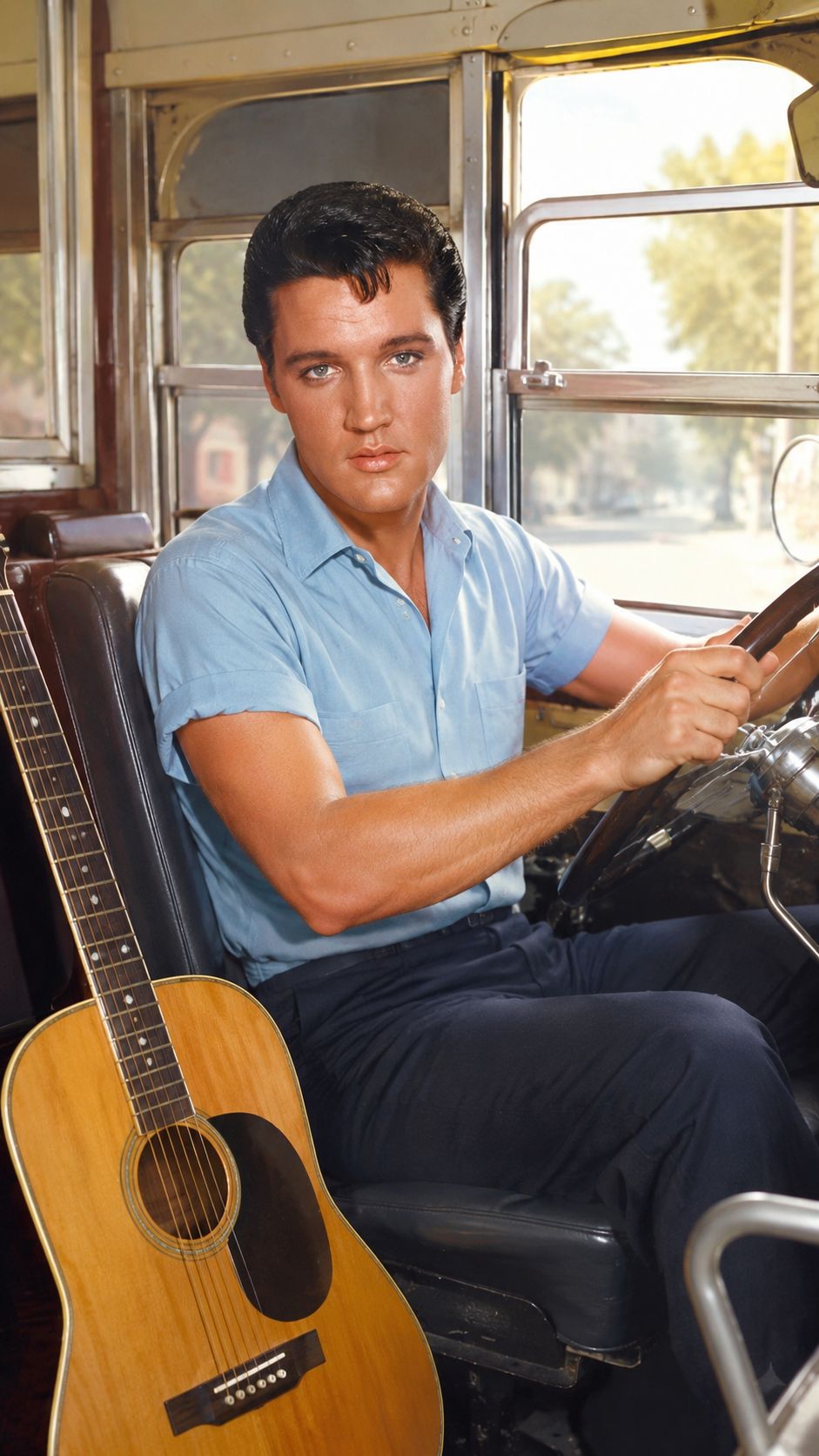
History often celebrates its heroes from the moment they step into the spotlight. We imagine greatness arriving with certainty—a carefully planned ascent toward fame, wealth, and influence. Yet some of the most transformative moments in human history begin so quietly that no one notices them at all.
One such moment unfolded during the summer of 1953 in Memphis, when an unknown eighteen-year-old named Elvis Presley walked through the doors of Sun Records carrying four dollars and a dream that was far more personal than professional. He was not chasing stardom. He was not seeking a recording contract. He was not plotting to revolutionize popular music.
He simply wanted to give his mother a gift.
At the time, Elvis Presley was working as a truck driver, living with his family in modest circumstances, and searching for his place in the world. Like millions of young Americans, he carried hopes that seemed far bigger than his reality. Yet unlike most young men his age, he possessed a voice that blended the emotional depth of gospel, the storytelling spirit of country music, and the raw energy that would soon redefine modern entertainment.
What happened inside Sun Records that day appeared insignificant. A young man paid a small fee to record a pair of songs onto an acetate disc. Nothing more.
But hidden within that simple act of love was the spark that would ignite Rock and Roll, transform popular culture, and change music forever.
The Boy Before the King
Today, it is almost impossible to separate Elvis Presley from his legendary status. He is remembered as the King of Rock and Roll, a cultural icon whose influence extends across generations, continents, and musical genres.
Yet before the fame, before the screaming fans, before the gold records and sold-out arenas, there was simply Elvis—the shy boy from Mississippi.
Friends often described young Elvis Presley as quiet and deeply sensitive. Unlike the larger-than-life performer who would later dominate stages around the world, teenage Elvis frequently struggled with self-confidence. He felt different from many of his peers and often found comfort in music rather than social circles.
His upbringing was shaped by economic hardship. Raised in modest circumstances, first in Mississippi and later in Memphis, Elvis witnessed firsthand the challenges of working-class life. These experiences gave him an emotional authenticity that audiences would later connect with on a profound level.
At the center of his world stood one person above all others: his mother, Gladys Presley.
For Elvis, success was never originally about fame. It was about making his mother proud.
The bond between Elvis Presley and Gladys Presley remains one of the most powerful parent-child relationships in entertainment history. She believed in him long before the world did. She saw possibility where others saw only a shy teenager with unusual dreams.
That emotional connection would ultimately become the catalyst for one of music’s greatest turning points.
Four Dollars and a Dream
When Elvis Presley entered Sun Records in 1953, the studio was not yet the historic landmark it would become. Founded by visionary producer Sam Phillips, the recording studio had become known for discovering unique voices and capturing sounds that mainstream record companies often overlooked.
Elvis paid approximately four dollars to create a personal recording.
The songs he chose were heartfelt ballads intended as a keepsake for Gladys Presley. The recording was not designed to attract industry attention. It was not a professional demo in the modern sense. It was simply a son expressing love through music.
Yet fate often hides within ordinary moments.
During the session, employees at Sun Records noticed something unusual. His voice carried qualities that were difficult to categorize. It wasn’t purely country. It wasn’t purely gospel. It wasn’t rhythm and blues.
It was something new.
History rarely announces itself. Sometimes it whispers through a studio microphone.
The recording itself may have seemed unremarkable at first glance, but it placed Elvis inside a system where opportunity could eventually find him.
And opportunity was about to arrive.
The Vision of Sam Phillips
Few figures in music history deserve more credit than Sam Phillips.
The founder of Sun Records possessed an extraordinary ability to recognize talent that others overlooked. He believed American music was ready for something different—a sound capable of bridging cultural and musical divides.
Months after Elvis’s initial visit, Phillips remembered the young man with the unusual voice.
When an opportunity arose to experiment with new material, he invited Elvis Presley back to the studio.
At first, nothing magical happened.
Session after session produced little excitement. Musicians searched unsuccessfully for the right sound. Expectations remained low.
Then came a moment that would become legendary.
During a break, Elvis began casually performing Arthur Crudup’s blues song “That’s All Right.”
Something clicked.
The performance felt spontaneous, energetic, and unlike anything dominating American radio at the time.
Phillips immediately recognized that he was hearing the future.
The Birth of Rock and Roll
Music historians often debate where Rock and Roll truly began. Many artists contributed to its development, drawing from Blues, Country Music, Gospel, and Rhythm and Blues traditions.
Yet the recording of “That’s All Right” by Elvis Presley remains one of the defining moments in the genre’s evolution.
What made Elvis revolutionary was not simply his voice.
It was his ability to unite musical traditions that had previously existed in separate worlds.
His performances carried the emotional intensity of Gospel Music, the narrative heart of Country Music, and the rhythmic drive of Rhythm and Blues. This fusion created something fresh, exciting, and impossible to ignore.
Young listeners immediately recognized the difference.
Older audiences often found it shocking.
The result was a cultural earthquake.
America wasn’t just hearing new music. It was witnessing the birth of a new identity.
The impact extended far beyond entertainment. Rock and Roll became a symbol of youth, freedom, rebellion, and social change. The genre would influence fashion, film, politics, and global culture for decades to come.
And it all traced back to a young truck driver who never intended to start a revolution.
Why This Story Still Matters Today
The story of Elvis Presley entering Sun Records with four dollars resonates because it challenges our assumptions about destiny.
Modern culture often portrays success as a carefully engineered process. We celebrate strategic decisions, calculated risks, and master plans.
But Elvis’s journey reminds us that life rarely follows a script.
His visit to the studio was motivated by love, not ambition.
He wasn’t trying to become the King of Rock and Roll.
He wasn’t trying to reshape the music industry.
He wasn’t trying to make history.
He was trying to give his mother a gift.
That simple act created a chain reaction that transformed global culture. Without that recording session, the world might never have discovered Elvis Presley in the same way. Without Elvis, the evolution of Rock and Roll might have followed a completely different path.
His story remains one of the most powerful examples of how seemingly small decisions can generate unimaginable consequences.
The lesson reaches beyond music.
Sometimes the moments that define history are not grand public events. They are quiet acts of kindness, love, and courage that occur far from the spotlight.
In the summer of 1953, an unknown teenager walked into a recording studio carrying four dollars and devotion for his mother.
He walked out carrying the future.
And music would never be the same again.