 By admin
 INTRODUCTION:
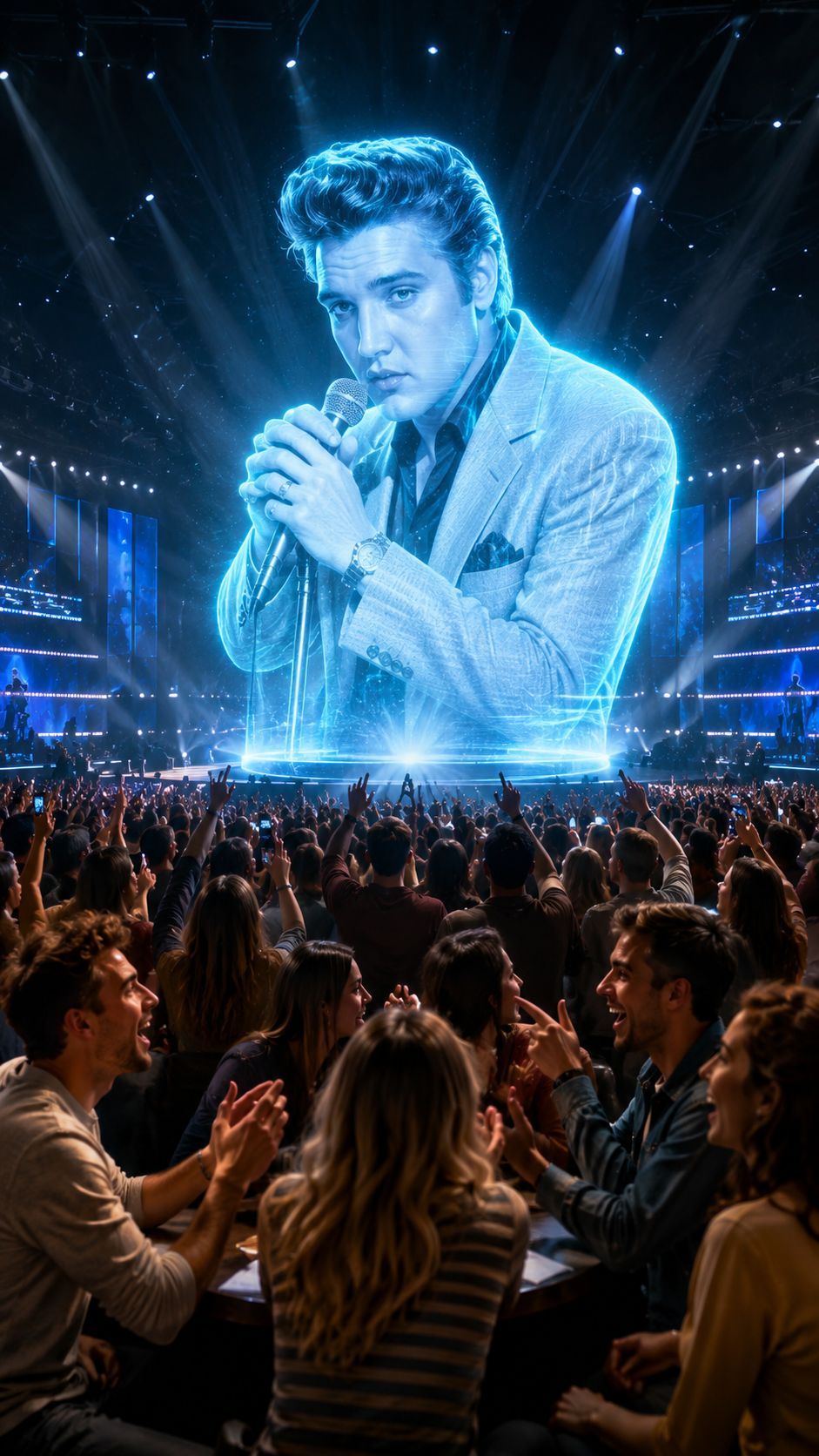
There is a moment at every great concert when time seems to stop.
The lights dim. The crowd roars. A familiar voice fills the arena. For a few precious minutes, the distance between past and present disappears. Music becomes memory, and memory becomes something almost tangible.
But what happens when the artist is no longer alive?
Imagine sitting in a packed arena as a holographic Johnny Cash walks onto the stage. The audience erupts. He adjusts his guitar. The opening notes of Ring of Fire begin to play. Every movement looks real. Every expression feels authentic. Yet everyone in the building knows the truth: the man standing before them passed away decades ago.
This is no longer science fiction.
Advances in holographic technology and artificial intelligence are bringing deceased performers back to the stage in ways that would have seemed impossible just a generation ago. From pop icons to rock legends, the entertainment industry is exploring a future where death may no longer mark the end of a live performance career.
For fans of Country Music, the question cuts especially deep. This genre has always been built on authenticity, storytelling, and genuine human connection. Can technology recreate that magic? Or are holographic concerts crossing an emotional line that should remain untouched?
The answer may reveal not only the future of live music, but also how we choose to remember our legends.
The Emotional Power of Seeing a Legend Again
The appeal is obvious.
Millions of music fans never had the chance to see legends like Johnny Cash, George Jones, Patsy Cline, Hank Williams, or Merle Haggard perform live. For younger generations, these artists exist only through recordings, documentaries, and stories told by parents and grandparents.
A holographic concert promises something extraordinary: the closest experience possible to witnessing history firsthand.
For some fans, it is not about technology. It is about closure, nostalgia, and a chance to stand in the same emotional space as a musical hero.
When people attend tribute shows, visit museums, or watch restored concert footage, they are already engaging with versions of the past. Holographic performances simply take that desire to a new level.
Imagine hearing Crazy performed by a virtual Patsy Cline accompanied by a live orchestra. Imagine seeing He Stopped Loving Her Today delivered by a digital George Jones before thousands of emotional fans. The emotional impact could be profound.
For many attendees, the experience would feel less like a concert and more like a celebration of legacy.
Why Country Music Faces a Unique Challenge
Unlike many genres, Country Music has always placed enormous value on authenticity.
Fans are not merely listening to songs. They are connecting with real stories, real pain, real joy, and real lives.
Artists such as Johnny Cash, Dolly Parton, Willie Nelson, and Loretta Lynn built careers on sincerity. Their voices carried imperfections that made them human. Their performances felt alive precisely because they were unpredictable.
This creates a dilemma.
A hologram can reproduce movements. Artificial intelligence can reconstruct vocals. Sophisticated production can recreate a concert atmosphere. But can any technology truly replicate the soul of a performer?
Many country fans argue that it cannot.
The slight crack in a voice. The unexpected laugh between songs. The spontaneous interaction with the crowd. These moments cannot be programmed perfectly because they emerge from genuine human presence.
The greatest country performances were never just about the songs. They were about the humanity behind them.
That humanity is difficult to digitize.
The Business Opportunity Is Enormous
From an industry perspective, holographic concerts represent a potentially massive market.
Live music has become one of the most profitable sectors of entertainment. Stadium tours generate hundreds of millions of dollars annually. Yet the catalogues of deceased artists continue to attract listeners worldwide.
A holographic tour featuring a legend such as Johnny Cash could potentially sell out venues across multiple countries. Fans would purchase tickets not merely for a show but for an experience that cannot be found anywhere else.
The economics are tempting.
Unlike living artists, holographic performers do not face scheduling conflicts, physical limitations, or touring exhaustion. Productions can be refined, replicated, and scaled globally.
This raises an uncomfortable question:
Are these events preserving artistic legacies—or monetizing grief?
Critics argue that there is a fine line between honoring an artist and exploiting their memory for profit.
The answer often depends on execution.
If the artist’s family, estate, and creative collaborators are deeply involved, audiences may view the project as a respectful tribute. If the production feels like a corporate cash grab, fan backlash can be swift and severe.
The Eerie Factor Nobody Can Ignore
Even supporters admit there is something unsettling about the concept.
Humans have a natural relationship with mortality. Death gives meaning to legacy. Part of what makes legendary performances so powerful is knowing they can never happen again.
Holograms challenge that understanding.
When technology creates the illusion that a deceased artist is still performing, audiences can experience a strange emotional conflict. The performance may look real, sound real, and feel real—yet everyone knows it is not.
This phenomenon sits within what psychologists often call the “uncanny valley,” where something appears almost human but not quite.
The closer technology gets to recreating life, the more aware we become of what is missing.
For some fans, that missing element is impossible to ignore.
Rather than feeling inspired, they may feel uncomfortable. Instead of celebrating a legacy, they may feel they are witnessing a digital ghost.
The reaction often depends on personal perspective. Some viewers find comfort in the experience. Others find it deeply unsettling.
Artificial Intelligence Changes Everything
The next chapter extends far beyond holograms.
Artificial intelligence is already capable of recreating voices with astonishing accuracy. Future systems may generate entirely new performances, conversations, and even songs based on an artist’s historical style.
Imagine hearing a newly created Johnny Cash song decades after his passing.
Would it still be a Johnny Cash song?
Or would it simply be an algorithm wearing his voice?
This debate is becoming one of the defining cultural questions of the digital era.
The issue is not technological capability. The issue is artistic identity.
Fans develop relationships with artists because they represent unique human experiences. When artificial intelligence begins creating new content in their likeness, the boundary between tribute and imitation becomes increasingly blurred.
So, Would Fans Actually Pay?
Many already would.
The success of tribute acts, museum exhibitions, restored concert films, and immersive entertainment experiences demonstrates a powerful appetite for nostalgia.
A carefully produced holographic concert featuring beloved legends from the Classic Country era would almost certainly attract large audiences.
But attendance does not necessarily equal acceptance.
Many fans would buy tickets out of curiosity. Others would attend out of love. Some would leave feeling inspired. Others might leave feeling conflicted.
That tension is exactly why the debate remains so fascinating.
The technology offers something extraordinary: a chance to reconnect with musical history in a way previous generations could never imagine.
Yet it also forces us to confront uncomfortable questions about memory, authenticity, and mortality.
The Future of Live Music—or a Line Best Left Uncrossed?
Holographic concerts are unlikely to disappear.
As technology improves, digital performances will become more realistic, more immersive, and more emotionally convincing. Future audiences may view them as a normal part of the entertainment landscape.
Yet Country Music has always been more than entertainment. It is a genre built on truth, vulnerability, and lived experience.
That is why holographic performances provoke such strong reactions.
For some, they represent a beautiful way to preserve the voices that shaped generations.
For others, they feel like an attempt to recreate something that should remain sacred in memory.
Perhaps the most honest answer is that both reactions can be true.
A holographic Johnny Cash singing Ring of Fire may move an audience to tears. It may also remind them that the real magic came from a man who stood on a stage, lived a complicated life, and connected with listeners through genuine human experience.
Technology can recreate the image.
It can recreate the sound.
But whether it can ever recreate the soul remains the question that will define the future of live music.