 By admin
INTRODUCTION:
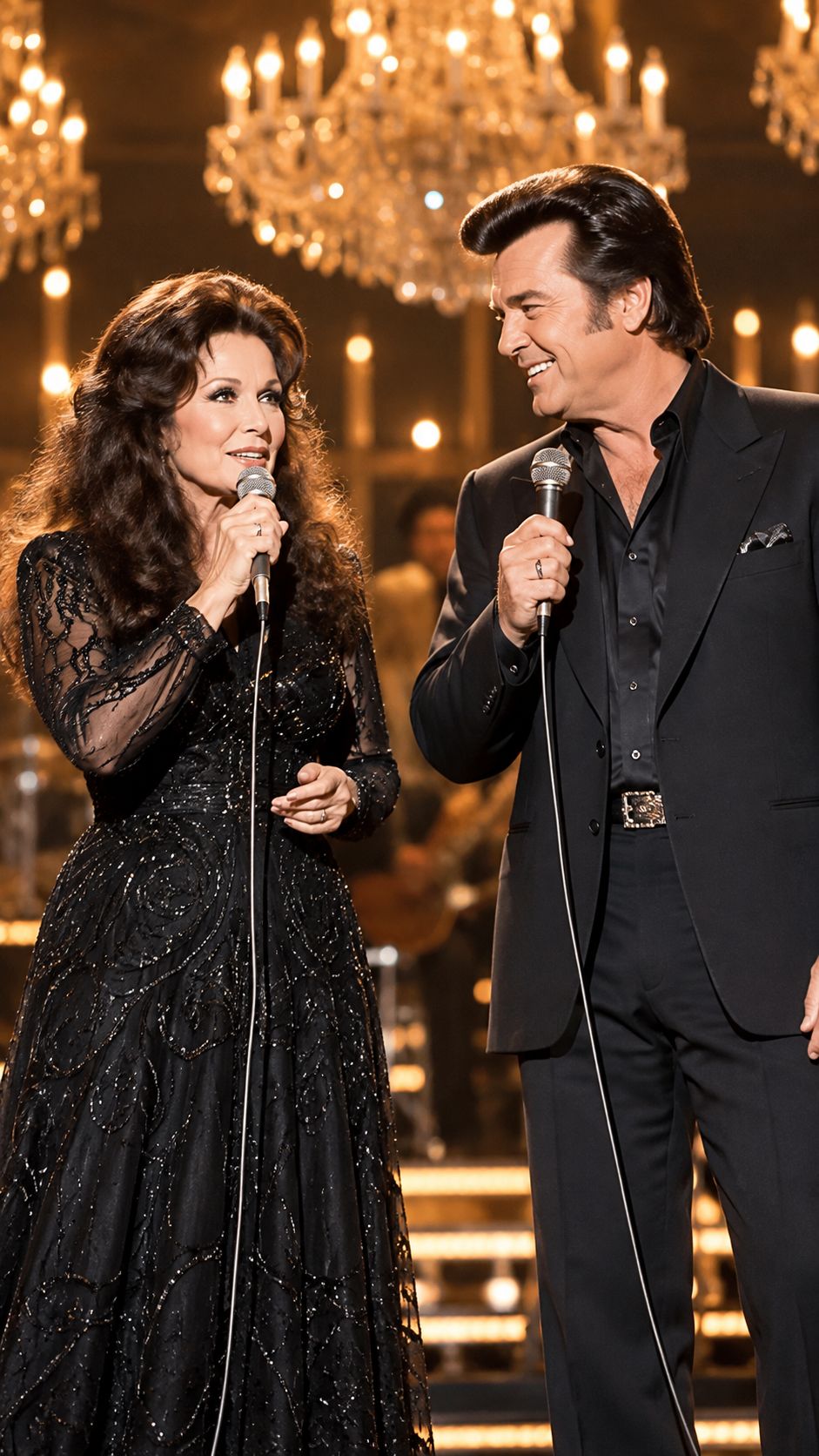
Some love songs entertain us for a moment, while others stay with us for a lifetime. They become the soundtrack to our first romances, our happiest anniversaries, our most painful goodbyes, and the memories we carry long after the people we love are gone. Few country music partnerships understood this emotional truth as beautifully as Conway Twitty and Loretta Lynn.
Together, these two legendary voices created something that reached far beyond the boundaries of ordinary country music. Their performances captured the complicated beauty of love: the excitement of falling for someone, the comfort of finding a lifelong companion, the heartbreak of misunderstanding, and the quiet sorrow of realizing that some moments can never be relived.
What made their music so unforgettable was not simply the richness of their voices. It was the conversation between them. Conway Twitty brought a smooth, intimate warmth that made every confession feel personal, while Loretta Lynn answered with a powerful, honest voice that could express tenderness and determination in the same breath.
Their greatest duets never needed extravagant production or elaborate storytelling. A meaningful lyric, a familiar melody, and two voices that seemed to understand one another were enough to make listeners feel as though their own lives were unfolding inside the song.
Decades later, their music continues to find new listeners because love has not changed nearly as much as the world around us. We still fall in love, make mistakes, hold on to memories, and sometimes lose the people who once made everything feel possible.
And that is why these songs still matter.
1. After the Fire Is Gone — When Love Becomes a Dangerous Secret
Few songs demonstrate the dramatic power of Conway Twitty and Loretta Lynn more effectively than After the Fire Is Gone. Released in 1971, the duet became one of the defining recordings of their partnership, reaching the top of the country charts and earning major recognition within the country music industry.
The song tells the story of two people caught in an emotionally complicated relationship. Rather than presenting love as something simple and innocent, it explores the consequences of seeking affection when existing commitments have already created painful boundaries.
That honesty is precisely what makes the recording so compelling.
Conway Twitty delivers his lines with a measured, almost conversational tenderness. His voice suggests a man attempting to explain feelings that he knows cannot easily be justified. Loretta Lynn, meanwhile, brings a directness that gives the exchange its emotional tension. She does not sound like a passive character in someone else’s story. She sounds like a woman who understands the attraction, recognizes the danger, and knows that emotions rarely follow convenient rules.
Their voices create the feeling of two people revealing thoughts they might never dare to express in public.
The brilliance of the performance lies in its refusal to make difficult emotions comfortable. The song invites listeners to recognize the difference between desire and lasting commitment, between the excitement of a secret and the consequences that follow when the excitement fades.
For some listeners, the duet recalls a relationship they wish they had never entered. For others, it serves as a reminder of a time when loneliness made the wrong choice seem like the only available comfort.
Sometimes the most powerful love songs are not about finding happiness. They are about discovering what happiness costs when the heart chooses a complicated path.
That emotional ambiguity helped establish the song as one of the most memorable recordings in classic country music. It also demonstrated why Conway and Loretta were so effective together: neither voice overwhelmed the other, and both allowed the story to remain human.
2. Louisiana Woman, Mississippi Man — When Love Refuses to Recognize Boundaries
If After the Fire Is Gone explores the shadows of romance, Louisiana Woman, Mississippi Man celebrates the irresistible energy of two people determined to be together.
Released in 1973, the song became another major country hit for Conway Twitty and Loretta Lynn, reaching No. 1 on the Billboard country chart.
Its appeal begins with a wonderfully simple idea: two lovers belong to different places, but geography cannot diminish their attraction.
The song turns that distance into a playful battle between desire and circumstance. Rather than treating separation as an unbearable tragedy, it presents the lovers as spirited individuals who refuse to let a state line determine their future.
Loretta Lynn gives the Louisiana woman a lively personality, full of confidence and determination. Conway Twitty responds with the relaxed charm of a man who is equally convinced that their connection is worth pursuing.
Their contrasting vocal styles make the duet feel spontaneous. The exchanges sound less like a carefully arranged studio performance and more like two people teasing one another while revealing just how much they care.
This is one of the reasons the song remains so enjoyable decades later. It captures a stage of love when obstacles seem temporary, attraction feels exciting, and every journey toward the person you want becomes an adventure.
For couples who once traveled long distances to see one another, the song can evoke memories of late-night drives, hurried goodbyes, and the anticipation of hearing a familiar voice on the telephone.
For older listeners, it may recall a time when romance required patience and effort rather than an instant message.
The recording also reminds us that great country music does not always need heartbreak to communicate something meaningful. Sometimes the most moving message is simply that two people have found one another and are unwilling to surrender their happiness without a fight.
Its enduring charm comes from that combination of humor, affection, and determination.
Love may cross state lines in this song, but its deeper message reaches much farther: when a relationship matters, the distance between two people is measured by more than miles.
3. Lead Me On — The Tenderness of Wanting Someone to Stay
Among the memorable recordings associated with Conway Twitty and Loretta Lynn, Lead Me On offers a particularly revealing look at their ability to create intimacy through restraint.
The song belongs to the tradition of country storytelling in which emotional tension matters more than dramatic declarations. Its appeal rests on the uncertainty between two people who recognize their attraction but must navigate the feelings and circumstances surrounding it.
Rather than presenting romance as an uncomplicated fairy tale, the performance draws listeners into a more delicate emotional space. There is longing, hesitation, and the awareness that allowing someone closer can bring both comfort and pain.
Conway Twitty had an exceptional ability to make a lyric sound like a private confession. His smooth delivery often suggested that he was speaking directly to one person rather than performing for an audience. Loretta Lynn complemented that quality with a voice that carried unmistakable personality and emotional conviction.
Together, they created a musical dialogue in which the smallest changes in tone could communicate uncertainty, hope, or vulnerability.
That quality is particularly important in songs about relationships that have not yet reached a clear destination. Sometimes the most difficult part of love is not losing someone. It is deciding whether to let yourself believe that the relationship could become something lasting.
The emotional world of Lead Me On connects with anyone who has experienced that uncertainty: the nervous anticipation before a first kiss, the unspoken question of whether feelings are mutual, or the moment when a casual friendship begins to feel like something more.
It also reminds us that vulnerability is not weakness. Opening the heart requires courage precisely because no one can guarantee the outcome.
The song’s enduring appeal lies in its recognition that love is often a process of taking small emotional risks. We move closer, wait for an answer, and hope the other person will meet us halfway.
That hope is one of country music’s most universal subjects.
4. As Soon as I Hang Up the Phone — When a Conversation Becomes a Heartbreak
Few classic country performances capture the emotional power of a telephone conversation as memorably as As Soon as I Hang Up the Phone.
Released in 1974, the recording became one of the signature duets associated with Conway Twitty and Loretta Lynn. Its distinctive dramatic structure makes it stand apart from conventional love songs.
Instead of relying solely on two singers exchanging verses, the performance unfolds like a conversation between people facing an emotional turning point.
The telephone becomes more than a prop. It represents distance, uncertainty, and the fragile connection between two people who may no longer understand each other.
Loretta Lynn’s performance is central to the song’s emotional force. Her expressive delivery gives the conversation a sense of immediacy, making the listener feel like an invisible witness to a private moment. Conway Twitty’s contribution provides the musical and emotional framework that allows the story to develop with remarkable dramatic tension.
What makes this kind of storytelling so effective is its familiarity.
Almost everyone understands the strange silence that can follow a difficult conversation. We know the feeling of staring at a telephone after a call ends, replaying every sentence and wondering whether something could have been said differently.
Sometimes a relationship does not end with a dramatic confrontation. Sometimes it changes through a conversation that sounds ordinary until we realize that nothing will be quite the same afterward.
The song captures that emotional transition with unusual precision.
For listeners who have experienced separation, the recording can awaken memories of words left unsaid, apologies that arrived too late, or the final conversation that divided life into before and after.
Yet the song is not powerful simply because it is sad. It is powerful because it makes sadness recognizable.
The characters feel less like distant figures in a fictional story and more like people we might know—or people we once were.
That is the enduring strength of Conway and Loretta’s partnership. Their performances turn individual stories into shared emotional experiences, allowing listeners to revisit painful memories while recognizing that they are not alone in having them.
5. Feelins’ — The Emotions We Cannot Easily Explain
In country music, some of the most revealing songs are built around a feeling that the characters cannot completely understand.
Feelins’, recorded by Conway Twitty and Loretta Lynn in 1975, explores the complicated emotional territory between friendship, attraction, and the possibility of a deeper connection.
The title itself suggests something difficult to define. Feelings can arrive before we understand them, grow stronger while we attempt to ignore them, and remain long after we have convinced ourselves that they should disappear.
That uncertainty gives the duet its appeal.
Conway Twitty’s relaxed vocal style creates a sense of intimacy, while Loretta Lynn’s unmistakable voice brings strength and character to the exchange. Neither performer needs to overstate the emotional stakes. Their chemistry allows the tension to emerge naturally from the conversation between them.
The recording also demonstrates an important feature of classic country music: its willingness to explore relationships through ordinary language.
Instead of hiding behind elaborate metaphors, the song centers on recognizable emotions. Listeners do not need to decode a complicated narrative to understand the characters’ dilemma.
They simply need to remember a time when someone began to mean more than expected.
Perhaps it was a friendship that gradually changed. Perhaps it was an old romance that unexpectedly resurfaced. Or perhaps it was a relationship that remained undefined because neither person wanted to risk changing what already existed.
These are the moments when feelings can become both beautiful and frightening.
The duet captures that emotional contradiction without pretending that every attraction leads to a happy ending.
For listeners who grew up with classic country radio, Feelins’ can evoke a period when songs often told stories about everyday people confronting recognizable emotional problems. Its strength lies in that directness.
Love does not always announce itself clearly. Sometimes it begins as a question, becomes an uncomfortable possibility, and eventually develops into something impossible to ignore.
That is the human truth at the heart of this performance.
6. I Can’t Love You Enough — The Joy of Finding Someone Who Understands
Not every unforgettable love song needs to explore betrayal, separation, or regret. Some of the most enduring recordings celebrate the simple happiness of loving another person.
I Can’t Love You Enough, associated with Conway Twitty and Loretta Lynn, represents the warmer, more affectionate side of their musical partnership.
The sentiment at the heart of the song is one of abundance: love is not something that must be rationed, measured, or carefully withheld. It is something that can be expressed repeatedly through small gestures, familiar words, and the reassuring presence of another person.
That message might sound simple, but its emotional significance becomes clearer with time.
When we are young, romance is often associated with excitement and discovery. We remember the first date, the first kiss, and the feeling that every ordinary moment has become extraordinary.
As life progresses, love often reveals another side of itself. It becomes the person who knows how we take our coffee, the partner who recognizes our worries before we explain them, and the familiar voice that makes a difficult day feel manageable.
The most enduring relationships are frequently built from these seemingly insignificant moments.
The contrast between Conway Twitty’s warm vocal delivery and Loretta Lynn’s confident, expressive style helps communicate the appeal of affection that is freely given rather than reluctantly offered.
Their musical partnership reminds listeners that tenderness can be just as compelling as heartbreak.
There is also something deeply comforting about hearing a love song that does not insist on tragedy to prove its emotional worth. Happiness deserves to be celebrated on its own terms.
For couples who have shared decades together, songs about lasting affection can become reminders of everything they have survived and built. For those who have lost a partner, the same music may evoke gratitude for a love that once made life feel complete.
Sometimes the greatest love songs are not about the fear of losing someone.
They are about the privilege of having loved them at all.
7. The Greatest Love Songs Are Also Songs About Loss
To understand why Conway Twitty and Loretta Lynn remain so important to country music, it is necessary to look beyond individual hits and consider the emotional tradition they helped bring to life.
Their duets belong to a musical world where love is rarely presented as a perfect, uninterrupted journey. Relationships are complicated. People make mistakes. Circumstances interfere. Feelings change, and sometimes two people who care deeply about one another discover that caring is not enough to solve every problem.
That realism is one reason their music continues to resonate across generations.
In many modern love songs, romance can be presented as a moment of overwhelming intensity. Classic country duets often take a broader view. They allow the listener to imagine what happens after the excitement, when everyday responsibilities begin to shape a relationship and personal choices carry consequences.
Conway Twitty understood the emotional power of a restrained performance. His voice could suggest affection without becoming sentimental and regret without turning every lyric into a dramatic outburst.
Loretta Lynn brought a complementary strength. Her performances frequently conveyed the perspective of a woman with her own feelings, convictions, and understanding of the world. She could be tender without sounding helpless and vulnerable without surrendering her identity.
Together, they created a musical partnership that depended on contrast as much as harmony.
Their songs also recognize something people often learn only after experiencing profound loss: memories do not disappear simply because circumstances change.
A familiar melody can return us to a kitchen where our parents danced, a car ride with someone we loved, or an evening when we believed the future would unfold exactly as we imagined.
For some listeners, those memories are joyful. For others, they carry a bittersweet ache.
Yet music gives those feelings somewhere to go. It allows us to revisit the past without needing to explain every emotion it brings back.
That is why the best classic country love songs can feel almost timeless. They are not tied exclusively to one generation, fashion, or cultural moment. They speak to experiences that remain part of being human.
The voices may come from another era, but the feelings are unmistakably familiar.
8. Why Conway Twitty and Loretta Lynn’s Duets Still Matter Today
The enduring appeal of Conway Twitty and Loretta Lynn is not simply a matter of nostalgia. Nostalgia may bring listeners back to their recordings, but emotional honesty is what encourages them to stay.
Their partnership demonstrated that two distinctive performers could create something greater than the sum of their individual talents.
Conway Twitty possessed a smooth, intimate vocal style that made emotional confession sound natural. Loretta Lynn brought a distinctive country voice, a strong sense of character, and the ability to communicate complicated feelings without losing the directness that made her so beloved.
Neither needed to dominate every moment. Their finest recordings allowed each voice to respond to the other, creating the impression of a real relationship unfolding through music.
That approach remains a lesson for singers and songwriters today.
A memorable duet is not merely two voices sharing a recording. It is a story in which each person brings a different perspective, and the space between those perspectives becomes part of the music.
The legacy of Conway and Loretta also reminds us that emotional complexity can be more compelling than perfection. Their repertoire includes playful romance, deep affection, temptation, and the consequences of difficult decisions. Those different shades of feeling make their partnership richer than any single definition of a love song could capture.
Their music can accompany a wedding anniversary, a lonely evening, a long drive through the countryside, or a quiet moment spent remembering someone who is no longer here.
The same song may even mean something different to the same person at different stages of life.
A duet that once sounded like an exciting romance might later reveal the fragility of relationships. A song that once seemed unbearably sad may eventually become a comforting reminder of a love that was real.
That changing relationship between music and memory is part of what gives classic country its extraordinary staying power.
The world moves forward, but the heart continues to recognize certain melodies.
CONCLUSION: Some Love Stories Never Really End
The greatest love songs performed by Conway Twitty and Loretta Lynn endure because they tell the truth about relationships without pretending that every story has a perfect ending.
Through songs such as After the Fire Is Gone, Louisiana Woman, Mississippi Man, As Soon as I Hang Up the Phone, Feelins’, and Lead Me On, their partnership explored the excitement of attraction, the difficulty of difficult choices, the tenderness of affection, and the pain that can accompany love.
Their voices created more than memorable recordings. They created spaces where listeners could recognize their own experiences.
Perhaps you remember dancing with someone who became the center of your world. Perhaps you remember the person who left, the conversation you wish you could have again, or the years you spent building a life with someone who understood you better than anyone else.
Maybe you simply remember sitting beside a radio while these songs played, never imagining that their lyrics would become more meaningful as you grew older.
Whatever your story, the music offers a familiar reminder: love leaves its mark on us, even when circumstances change.
Conway Twitty and Loretta Lynn may belong to country music’s golden era, but the emotions they expressed never belonged to one generation alone.
Their songs continue to remind us that love can be complicated, memories can be painful, and goodbyes can change our lives. Yet they also remind us that the moments we share with the people who matter are worth remembering.
And perhaps that is the greatest gift a love song can offer.
Not the promise that we will never lose anyone, but the understanding that the people we have loved remain part of our stories long after the music fades.
Which Conway Twitty and Loretta Lynn duet brings back the strongest memories for you? Is it After the Fire Is Gone, Louisiana Woman, Mississippi Man, or another classic that still touches your heart?
Share your favorite song and the memory attached to it. Somewhere, another country music fan may be remembering the very same melody—and the very same kind of love.
VIDEO: