 By admin
INTRODUCTION:
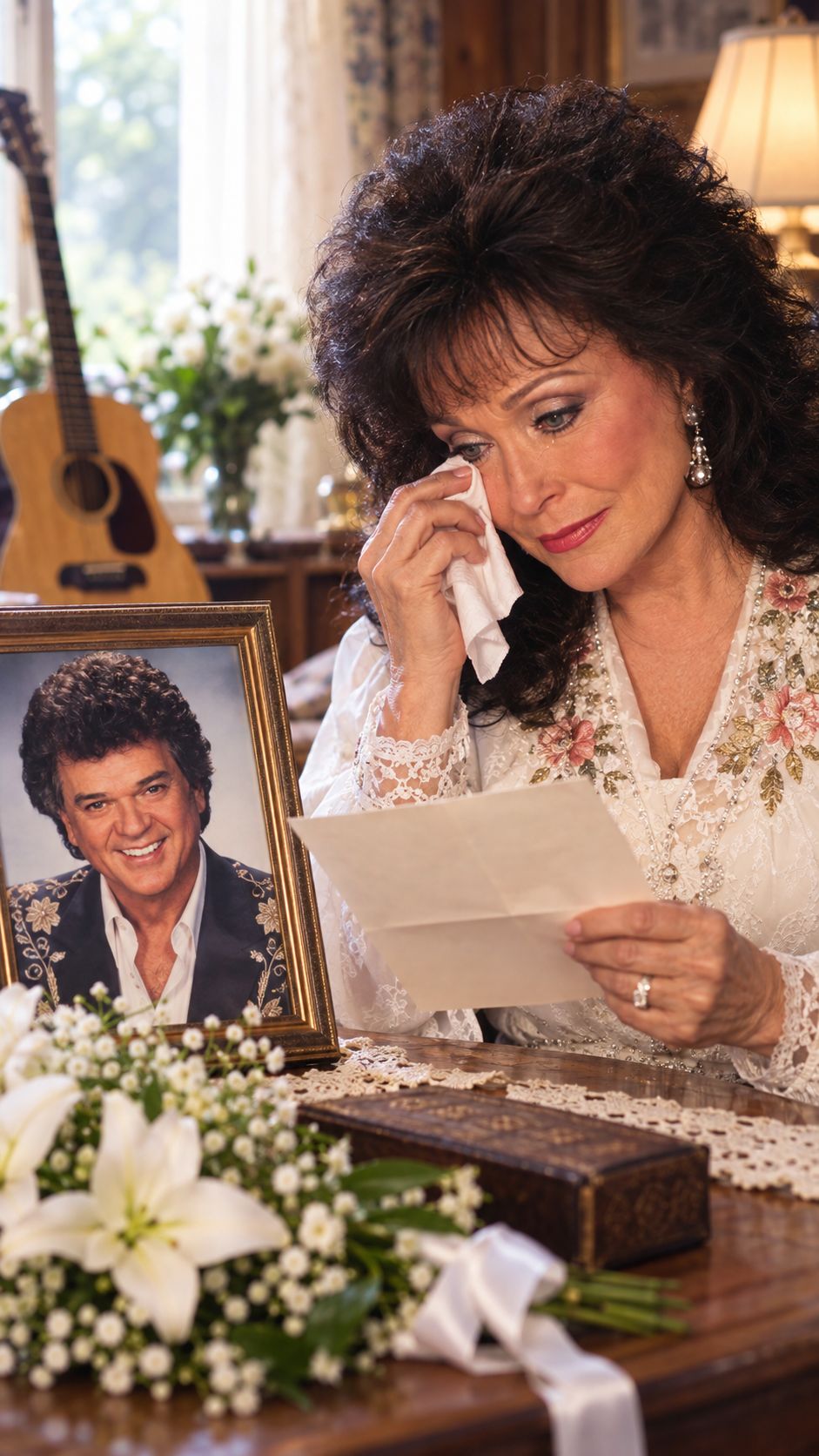
There are moments in country music history when a song suddenly becomes more than a song. A familiar voice becomes a memory. A harmony that once sounded effortless becomes almost unbearable to hear.
For Loretta Lynn, one of those moments came on June 5, 1993, when Conway Twitty died unexpectedly at just 59 years old.
The tragedy was made even more painful by an extraordinary twist of fate: Loretta was already at the same Springfield, Missouri, hospital where Conway was brought after collapsing. She had been there because her husband, Oliver “Doo” Lynn, was receiving medical treatment. What should have been an ordinary hospital visit suddenly placed Loretta within moments of one of the greatest losses of her musical life.
And although the exact private sequence of everything Loretta felt in those hours cannot be reconstructed completely, the surviving accounts reveal something profound: Conway’s final hours brought two longtime musical partners unexpectedly close together again.
The Partnership That Seemed Almost Impossible to Explain
Long before that devastating day, Loretta Lynn and Conway Twitty had created one of the most recognizable partnerships in country music.
Their collaboration began in the early 1970s and produced a remarkable run of recordings, including “After the Fire Is Gone,” “Lead Me On,” “Louisiana Woman, Mississippi Man,” and “Feelins’.”
Their voices seemed to fit together naturally.
Loretta’s direct, emotionally expressive delivery could sound both vulnerable and fearless. Conway brought a smoother, deeper vocal presence. Put them together, and their records often sounded like conversations between two people who knew exactly where the other was going.
PBS’s American Masters notes that the pair recorded 11 studio albums together and won the CMA Vocal Duo of the Year award four consecutive times, from 1972 through 1975. Their first No. 1 duet, “After the Fire Is Gone,” also earned them a Grammy.
But their chemistry created something else: speculation.
Listeners sometimes wondered whether the emotional tension in their songs reflected real feelings.
Loretta eventually made her position clear.
“I loved Conway as a friend, and my husband loved him.”
She also explained that people who believed there was a romantic relationship between them were mistaken.
That distinction matters when looking back at Conway’s death. Their story was powerful not because there was a secret romance hiding behind the microphones, but because two gifted performers developed an extraordinary artistic trust.
Then Came the Night Everything Changed
On June 4, 1993, Conway Twitty was performing in Branson, Missouri.
He was still doing what he had done for decades: traveling, performing and giving audiences the songs they had come to expect from him.
But after the performance, something went terribly wrong.
Twitty collapsed aboard his tour bus while traveling home toward Hendersonville, Tennessee. He was taken to Cox Medical Center-South in Springfield, where doctors performed emergency surgery after an abdominal aneurysm ruptured. He died the following day, June 5, at age 59.
The speed of the tragedy is difficult to comprehend.
One night he was performing.
The next morning, the country music world had lost one of its biggest stars.
The Country Music Hall of Fame records that Twitty’s career had stretched across five decades and that he had achieved an extraordinary number of No. 1 records.
But for Loretta, this wasn’t simply the death of another country singer.
This was the loss of the man whose voice had become permanently intertwined with hers.
The Cruel Twist of Fate
Perhaps the most heartbreaking part of the story is that Loretta wasn’t thousands of miles away when Conway became critically ill.
She was already in the hospital.
Her husband, Doo, was there receiving treatment, and according to later accounts, Loretta was present when Conway was brought in.
Imagine that scene.
A hospital corridor.
Doctors moving quickly.
Families waiting anxiously.
And somewhere inside the same building was a man whose voice Loretta had shared with millions of listeners.
There was no concert stage.
No spotlight.
No microphone.
No carefully rehearsed harmony.
Just two country music legends brought together by circumstance during an unimaginably painful moment.
According to an account recalling Loretta’s later interview with Ralph Emery, she remembered the shock of seeing Conway arrive at the hospital.
That detail gives the tragedy a haunting quality.
Their last connection wasn’t created by a record label or a booking agent.
It happened because life placed them in the same hospital at precisely the wrong time.
“He Was Like a Brother to Me”
Years later, Loretta’s words about Conway revealed how deeply she continued to value their friendship.
In 2020, she remembered him publicly on the anniversary of his death, describing him as one of the best men she had known and emphasizing his love for his family and music.
That remembrance is important because it strips away the mythology surrounding their partnership.
For decades, fans had listened to their songs and imagined the stories behind them.
But Loretta’s own memories pointed somewhere simpler.
Friendship.
Respect.
Music.
And loss.
“I can’t believe it’s been 27 years today since we lost Conway.”
That sentiment captures something about grief that statistics cannot.
Twenty-seven years can pass.
Thirty years can pass.
A lifetime can pass.
And yet the voice of someone you loved can still make the loss feel immediate.
The Songs Became Memories
After Conway’s death, every familiar duet carried a different weight.
“After the Fire Is Gone” was no longer simply a Grammy-winning hit.
“Louisiana Woman, Mississippi Man” was no longer merely an energetic country classic.
“Lead Me On” became another piece of a musical history that could never be recreated in exactly the same way.
The official Conway Twitty site describes his partnership with Loretta as one of the most successful male-female duet partnerships in country music history, highlighting songs such as “After the Fire Is Gone,” “Lead Me On,” and “Louisiana Woman, Mississippi Man.”
Their full-time touring partnership eventually ended in 1981, although they remained connected professionally and personally. Their musical association was not simply erased when the regular touring schedule ended.
That is why Conway’s death felt like the closing of an unfinished chapter.
There was still music ahead.
There could have been another reunion.
Another television appearance.
Another recording.
Another moment when those two voices found each other again.
But history does not always provide a final performance.
Sometimes, it simply stops.
What Makes Their Story So Heartbreaking
The saddest part isn’t necessarily that Loretta lost a duet partner.
It is that she lost someone who had become part of the fabric of her professional life.
Country music is filled with collaborations, but some partnerships become larger than the records themselves.
Loretta Lynn and Conway Twitty were one of those partnerships.
They knew how to make fictional stories sound emotionally real. They knew how to create tension without crossing the boundaries of their personal lives. They knew how to turn a microphone into a conversation.
And because they were so convincing, audiences sometimes confused performance with reality.
Loretta never needed that mythology.
Their friendship was enough.
Their music was enough.
Their history was enough.
Two voices can create a hit. But two people can create a legacy.
That may be the most enduring lesson from their story.
The Final Echo
When Conway Twitty died in 1993, country music lost a monumental performer. Contemporary reports described the shock throughout the industry, while fellow musicians remembered his extraordinary voice and decades of work.
For Loretta Lynn, however, the loss was personal.
She had known the man behind the voice.
She had stood beside him on countless stages.
She had recorded hit after hit with him.
She had watched audiences react when their harmonies filled a room.
And on that terrible day, fate placed her in the same hospital as Conway during his final hours.
There is something almost unbearably poetic about that.
The woman whose voice had answered Conway’s so many times was nearby when his voice was silenced forever.
No grand farewell song was prepared.
No cameras captured the moment.
No audience stood to applaud.
There was only a hospital, an unexpected reunion, and a goodbye that country music never got to hear.
And perhaps that is why their recordings remain so powerful decades later.
When Loretta’s voice meets Conway’s on an old recording, listeners aren’t simply hearing two singers.
They are hearing a friendship preserved in sound.
They are hearing an era of country music that can never return.
And they are hearing the echo of a man Loretta Lynn never stopped remembering.
Conway Twitty may have left the stage in 1993, but every time his voice joins Loretta Lynn’s again, for a few precious minutes, they are together once more.
VIDEO:
https://youtu.be/2Gd0tgGVPB0?si=4DquAu0eqJm_DWKD