 By admin
INTRODUCTION:
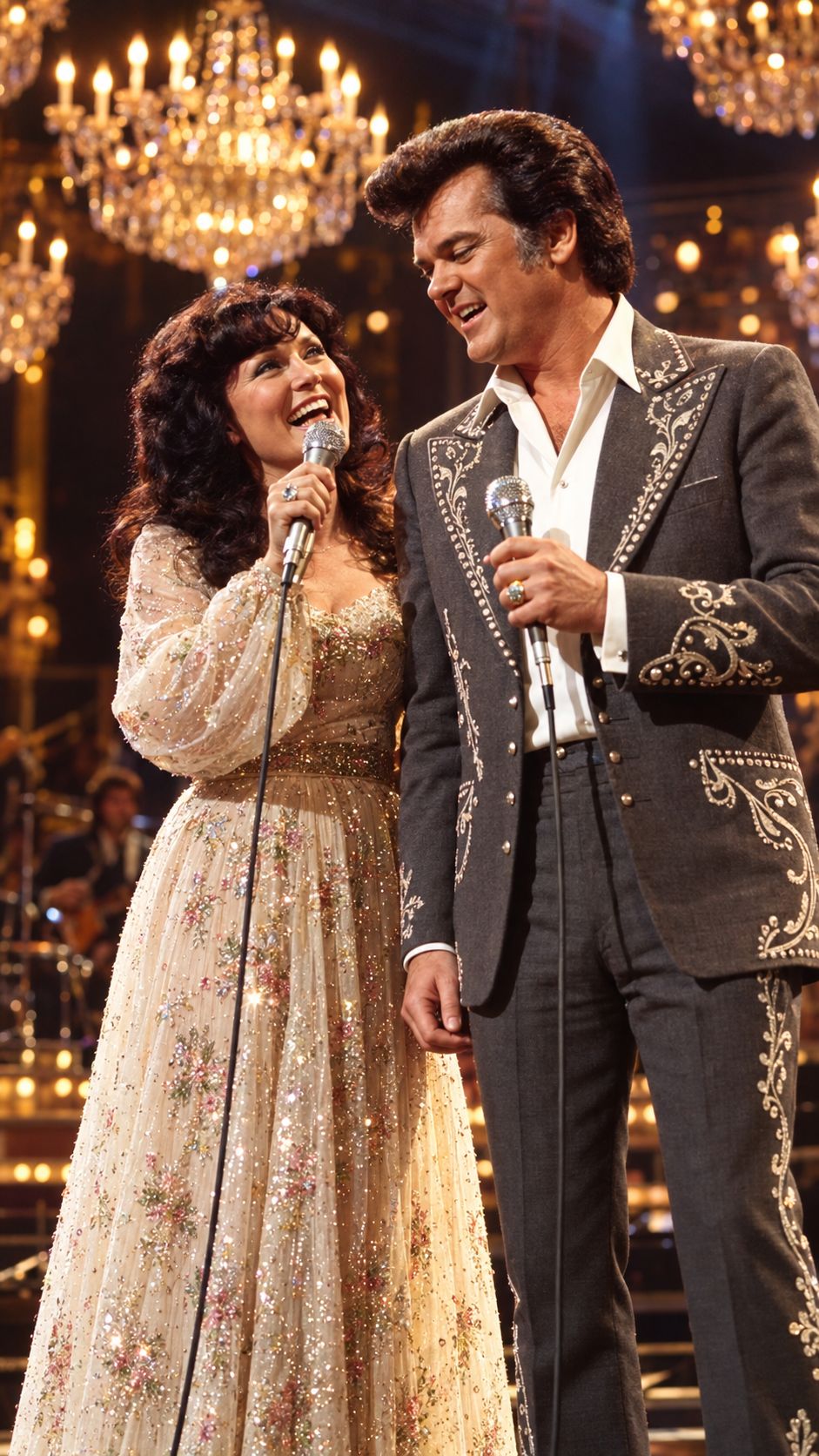
There was something undeniably special about the moments when Conway Twitty and Loretta Lynn stood together beneath the lights, their voices meeting in a way that seemed to tell a story far deeper than the lyrics alone. They were two extraordinary artists who understood the delicate art of turning a song into an emotional experience, making listeners feel as though they had stumbled into a private conversation between two hearts struggling to say what words could never fully express.
A glance across the stage, a slight smile, a pause before the next line, or the subtle warmth in their harmonies could transform an ordinary country duet into something unforgettable. Their performances carried the tension of love stories filled with longing, temptation, regret, and impossible choices. Even when the songs were carefully rehearsed, the emotions they conveyed felt wonderfully spontaneous.
For generations of country music fans, Conway Twitty and Loretta Lynn became the kind of musical partnership that inspired endless questions. How could two voices create such intimacy? Why did their songs sometimes feel like secret confessions? And what made audiences believe they were witnessing something more personal than a simple performance?
The answer lies in the remarkable combination of storytelling, vocal chemistry, stage presence, and emotional honesty that defined their collaborations. Their duets did not need scandalous revelations or dramatic declarations to capture the imagination. They simply needed a song, two unmistakable voices, and the courage to make complicated human feelings sound real.
And that is precisely why their music continues to fascinate listeners today.
1. THE LOOKS THAT SPOKE LOUDER THAN WORDS
When Conway Twitty and Loretta Lynn performed together, their greatest strength was not simply the beauty of their voices. It was their ability to communicate emotion without explaining every feeling.
In country music, a glance can become part of the storytelling. A singer looking toward a duet partner at precisely the right moment can make a lyric feel personal, as though it is being delivered to one specific person rather than to thousands of people in an auditorium.
That quality was particularly compelling in the performances of Conway and Loretta.
Conway possessed a smooth, intimate vocal style that could make even a restrained phrase sound like a private confession. Loretta, meanwhile, brought a directness and expressive strength that made her characters feel independent, vulnerable, and emotionally complicated. When their voices met, they created a compelling contrast between tenderness and determination.
Imagine a song about two people who know their circumstances are complicated. One voice expresses desire, while the other responds with uncertainty. Neither character needs to explain the entire situation. Their hesitation, their answers, and the emotional distance between their words allow the audience to imagine the rest.
That is the magic of effective duet performance.
Their stage chemistry encouraged listeners to participate in the storytelling. Fans could interpret a smile as affection, a pause as hesitation, or a particularly tender harmony as a moment of emotional surrender.
Of course, a powerful performance does not prove a private romance. What made their partnership fascinating was that they could communicate the feeling of intimacy without requiring audiences to believe that the story was literally happening in their own lives.
The looks became part of the music, and the music became a window into the human heart.
2. WHY THEIR LYRICS FELT LIKE FORBIDDEN LOVE STORIES
The phrase forbidden love carries a powerful emotional charge because it suggests a conflict between what people feel and what circumstances allow them to do.
Country music has always excelled at exploring that conflict.
Its greatest love songs rarely present relationships as uncomplicated fairy tales. Instead, they examine jealousy, loneliness, temptation, loyalty, regret, and the consequences of choices that cannot easily be undone.
Conway Twitty and Loretta Lynn understood how to inhabit those complicated emotions.
Their celebrated duet As Soon as I Hang Up the Phone provides a particularly striking example of dramatic storytelling. The song unfolds through a telephone conversation between lovers, using dialogue and emotional revelation to create the feeling of overhearing a deeply personal exchange.
The format itself is brilliant. Rather than simply describing a relationship, the song allows listeners to experience the conversation as it develops. Every response matters. Every emotional shift changes the meaning of what came before.
The listener becomes an invisible witness to an intimate moment.
That is one reason the performance can feel so cinematic. It resembles a scene from a romantic drama in which two characters struggle to communicate feelings that are too painful, complicated, or consequential to express easily.
Their other celebrated duet, After the Fire Is Gone, explores a different but equally complicated emotional landscape. The song examines a relationship in which passion and emotional fulfillment exist alongside questions of loyalty and the consequences of seeking happiness outside an existing commitment.
Its power comes from the tension between desire and responsibility.
Rather than offering an easy answer, the song invites listeners to consider the emotional costs of the situation. Is the relationship an escape from loneliness? Is it a search for something missing? Can intense feelings justify decisions that hurt other people?
Those questions give the music its dramatic weight.
The important distinction is that the songs portray complicated romantic situations; they do not establish that Conway and Loretta personally lived out those situations together. Their artistic achievement was making fictional or dramatic narratives feel emotionally believable.
And that is why listeners could hear a forbidden love story even when they were simply listening to two professional performers interpret a song.
3. TWO DISTINCT VOICES THAT COMPLETED EACH OTHER
The musical foundation of their unmistakable chemistry

Conway Twitty: The Voice of Quiet Intensity
Conway’s signature style was built around warmth, smooth phrasing, and emotional restraint. He could communicate longing without sounding desperate and tenderness without sacrificing confidence. His delivery often made a lyric feel as though it were being shared with one person in a quiet room.

Loretta Lynn: The Voice of Strength and Honesty
Loretta brought clarity, conviction, and unmistakable personality to her performances. Her voice could express affection while preserving a character’s independence, allowing vulnerability and determination to exist side by side. She made emotional conflict sound human rather than theatrical.
Together, they created a musical balance that made their collaborations distinctive.
Conway’s smooth phrasing gave their songs a sense of intimacy. Loretta’s expressive delivery introduced an answering force, ensuring that the conversation never felt one-sided.
This balance is especially important in a duet built around romantic tension. If both singers deliver every line with identical intensity, the performance can become predictable. If one singer offers a restrained confession and the other responds with a different emotional color, the song begins to feel like a genuine exchange.
The listener starts anticipating the next line.
Will the second singer agree? Will there be hesitation? Will the harmony suggest reconciliation, or will it underline the distance between the characters?
Those questions keep the audience emotionally engaged.
Their voices also worked because neither artist needed to disappear into the other. Conway Twitty remained unmistakably Conway, and Loretta Lynn remained unmistakably Loretta. Their individuality made their shared moments more persuasive.
The chemistry emerged not from sameness, but from contrast.
4. THE SILENCE, THE PAUSES, AND THE POWER OF WHAT WAS LEFT UNSAID
Some of the most powerful moments in music occur between the words.
A brief pause can create anticipation. A breath before a difficult line can suggest hesitation. A singer’s decision to soften a phrase can communicate uncertainty more effectively than a dramatic vocal outburst.
These details matter because listeners do not experience songs as collections of lyrics alone. They respond to timing, tone, melody, rhythm, and the emotional atmosphere created by the performers.
In a Conway Twitty and Loretta Lynn duet, a carefully timed exchange could make a familiar story feel unexpectedly personal.
Consider the dramatic possibilities of a song about a relationship that cannot be easily explained. One singer expresses a feeling, while the other leaves a small space before responding. That silence gives the listener time to imagine the character’s internal struggle.
The response then becomes more meaningful because it arrives after a moment of uncertainty.
This technique is central to dramatic storytelling in music. It allows the audience to supply emotions that the performers never explicitly describe.
The same principle applies to harmony.
When two voices blend, listeners can experience a sense of unity. When the singers separate into distinct melodic lines, the music can suggest disagreement, independence, or emotional distance. The arrangement becomes part of the story.
Their duets were especially effective when these musical choices supported the subject matter.
The result was not simply a pair of singers performing simultaneously. It was a conversation shaped by sound.
And because country music places such importance on recognizable human experiences, audiences could connect those moments to their own memories of love, heartbreak, and difficult decisions.
Sometimes, the most memorable part of a love story is the sentence that never gets spoken.
5. WHY FANS COULD NOT STOP WONDERING ABOUT THEIR CHEMISTRY
Great musical partnerships often inspire audiences to look beyond the stage.
When performers appear comfortable together, respond naturally to one another, and create an unusually convincing emotional atmosphere, listeners begin asking questions. Is that connection rehearsed? Does it come from years of friendship? Are the performers simply exceptional at understanding each other’s artistic instincts?
With Conway Twitty and Loretta Lynn, the fascination was amplified by the romantic themes of their repertoire.
Their songs gave audiences a ready-made emotional narrative. Their voices supplied the characters. Their performances added expressions and gestures that made those characters seem even more vivid.
It was easy to become absorbed in the illusion.
Yet the distinction between artistic chemistry and romantic involvement is essential. A believable performance does not establish that two singers were secretly in love, and there is no need to invent a scandal to explain why their music resonated.
In fact, the professional explanation is impressive enough.
Both artists were accomplished storytellers who understood the emotional demands of country music. They knew how to interpret a lyric, respond to a musical partner, and create an atmosphere that allowed audiences to suspend disbelief.
Their partnership also benefited from the expectations surrounding country duets. Listeners often approached these songs with an understanding that the singers were portraying characters, even when the performances felt intensely personal.
That combination of awareness and emotional immersion is part of the genre’s enduring appeal.
Fans can know that they are watching a performance while still feeling every moment as though it were real.
Perhaps that is the most intriguing aspect of their chemistry: the audience does not have to believe in a secret romance to experience the emotional force of one.
The music does the work.
6. BEYOND ROMANCE: THE TRUST THAT MADE THE MUSIC WORK
Romantic tension may have attracted attention, but lasting musical partnerships depend on much more than suggestive lyrics or expressive glances.
They require trust.
Each singer must understand when to take the lead, when to step back, and how to support the other person’s interpretation. The arrangement must leave room for both voices, while the performers must maintain enough individuality to keep the music interesting.
Conway Twitty and Loretta Lynn developed a celebrated collaboration during a period when country duets were an important part of the genre’s popular appeal.
Their partnership produced multiple successful recordings and earned them recognition as one of country music’s defining vocal pairings. Their work demonstrated that a duet could be more than a promotional novelty or a pleasant combination of two famous voices.
It could become a dramatic form of storytelling in its own right.
A well-executed duet asks each singer to surrender some control without losing personal identity. The performers must listen to one another, respond to musical cues, and understand how their individual interpretations contribute to the whole.
That is especially important when the lyrics involve emotional conflict.
A singer cannot convincingly portray hesitation if the performance ignores the partner’s preceding line. A declaration of affection loses its impact if the musical response does not support its emotional meaning.
The singers must make the exchange feel connected.
Their recordings illustrate why compatibility matters so much in country music. Each artist brought a recognizable voice and perspective, but the collaboration created something neither could have produced in quite the same way alone.
That shared achievement is more substantial than speculation about what might have happened away from the stage.
It is evidence of artistry, preparation, and an understanding of how people communicate through music.
7. WHY THEIR DUETS STILL RESONATE WITH NEW GENERATIONS
Music changes as generations change, but the emotions at the center of a great love song remain remarkably familiar.
People still struggle with commitment. They still wonder whether they have made the right decisions. They still experience attraction at inconvenient moments, miss people they cannot reach, and search for words to explain feelings that seem impossible to organize.
That is why the storytelling of Conway Twitty and Loretta Lynn continues to offer so much to listeners.
Their duets are rooted in a tradition that values narrative clarity and emotional consequences. The songs establish a situation, introduce a conflict, and allow the characters’ words and voices to reveal the stakes.
There is little need for elaborate production when the story itself is compelling.
A melody, a carefully delivered lyric, and the contrast between two voices can create an emotional world that listeners understand immediately.
For older fans, these recordings may bring back memories of a particular era in country music, family gatherings, long drives, or evenings spent listening to the radio. For younger listeners discovering the songs today, the appeal may lie in their directness and their willingness to explore relationships that are messy rather than perfect.
Both groups can appreciate the same essential qualities.
The songs take feelings seriously. They recognize that love does not always arrive at convenient times or produce easy answers. They allow characters to be conflicted, imperfect, and uncertain.
That emotional honesty gives the music its staying power.
The performances also remind contemporary audiences that musical chemistry does not depend on elaborate visual effects or constant spectacle. Sometimes, two artists who understand the emotional purpose of a song can create a more lasting impression than an entire stage filled with distractions.
Their voices remain the center of attention.
And that is a powerful legacy for any musical partnership.
8. THE REAL SECRET: THEY MADE LISTENERS FEEL LIKE WITNESSES TO A PRIVATE MOMENT
Ultimately, the enduring fascination with Conway Twitty and Loretta Lynn comes down to a remarkable artistic achievement: they made public performances feel personal.
Their duets invited audiences into emotionally complicated situations without telling them exactly what to think. They allowed listeners to experience longing without insisting that longing was always justified, and they explored desire without pretending that desire erased responsibility.
Their greatest performances left room for interpretation.
One listener might hear After the Fire Is Gone as a painful story about unmet needs. Another might focus on the consequences of infidelity. Someone else might simply appreciate the way the voices fit together and the melody carries the emotional weight of the lyrics.
All those responses can coexist.
That openness is one reason great songs remain alive long after their original release. They are not limited to a single interpretation or a single generation. Each listener brings personal experiences to the music and discovers something slightly different.
The title of a song may establish the subject, but the performance gives it a human face.
Conway Twitty supplied warmth and understated intensity. Loretta Lynn supplied conviction and emotional clarity. Together, they created a space in which fictional relationships could feel achingly real.
Their legacy is not that they proved a forbidden romance existed behind the scenes. It is that they made the emotional possibility of such a story believable enough to capture the imagination.
That is a far more enduring accomplishment.
CONCLUSION: THE MAGIC WAS NEVER JUST IN THE LOOKS
The extraordinary appeal of Conway Twitty and Loretta Lynn cannot be reduced to a glance, a lyric, or a single unforgettable harmony. It emerged from the combination of two distinctive voices, an instinct for storytelling, and a willingness to explore the complicated territory between desire and responsibility.
Their celebrated duets transformed romantic conflict into musical drama. They made audiences lean closer, listen more carefully, and wonder what the characters might say next.
The songs could feel like forbidden love stories because they explored emotions that people recognize but do not always know how to express.
And perhaps that is why their music continues to invite discussion decades later.
The performances offered romance without requiring proof of a real-life affair, intimacy without revealing private secrets, and emotional intensity without sacrificing musical craftsmanship.
Conway Twitty and Loretta Lynn understood something fundamental about country music: the most powerful love songs are not always about perfect relationships. Sometimes, they are about difficult choices, unspoken feelings, and the fragile moments when two people reveal more than they intended.
Their voices made those moments unforgettable.
Now, decades later, their duets still invite the same question: was it the lyrics, the chemistry, or the emotion that made their performances so extraordinary?
Perhaps the real answer is that all three worked together.
And when the music stopped, the story stayed with us.
VIDEO: