 By admin
 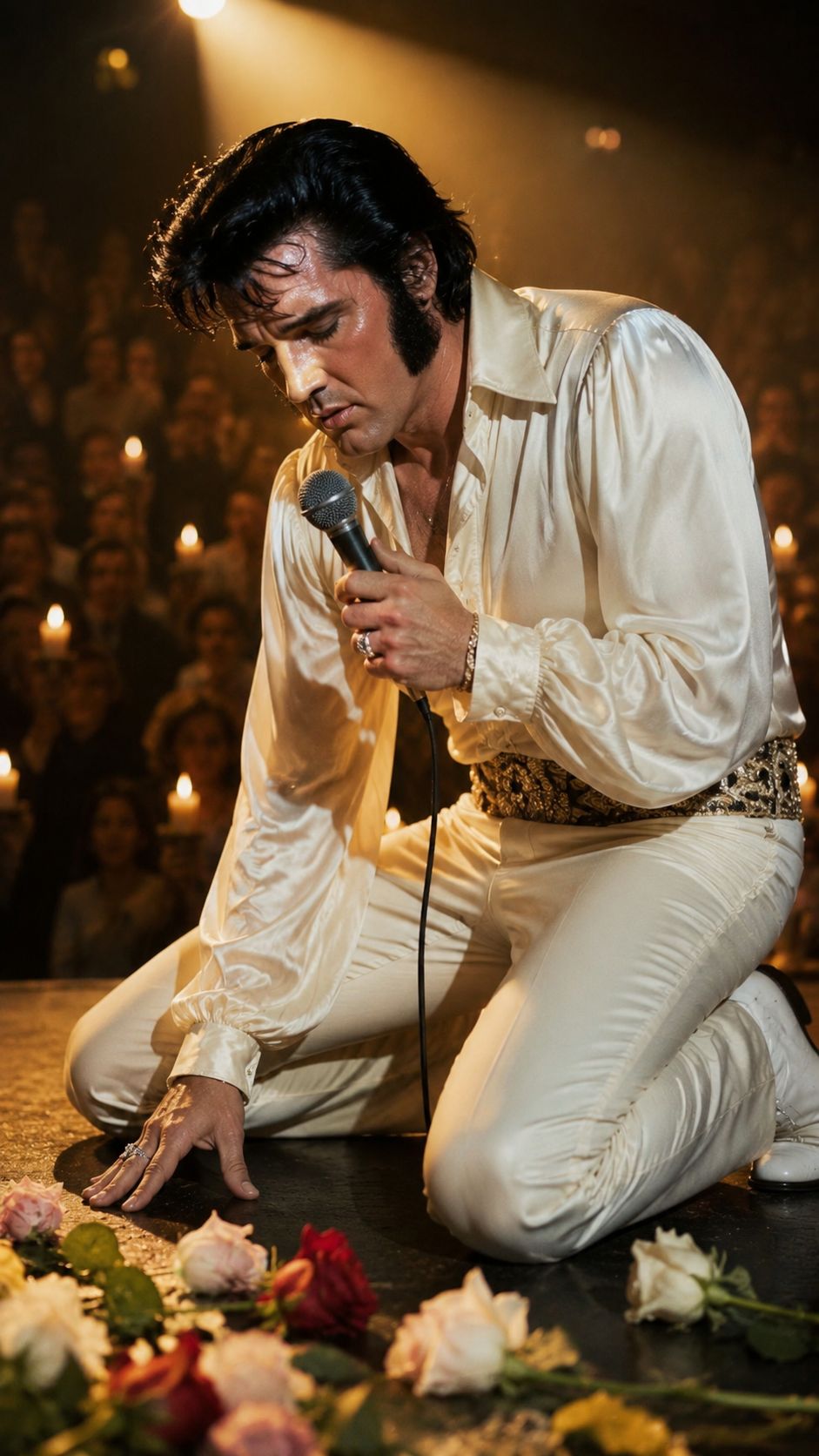 INTRODUCTION:
There are performances.
And then there are confessions.
For most of his career, Elvis Presley wasn’t merely a singer. He was an earthquake wrapped in rhinestones, a cultural revolution dressed in leather and later in dazzling jumpsuits. He was The King—the untouchable icon whose voice could send millions into hysteria and whose presence alone could stop time.
But one night, something extraordinary happened.
For a few unforgettable moments, Elvis stopped being a legend.
He stopped being the symbol, the superstar, the myth.
And he simply became a man.
A wounded, vulnerable, deeply human man standing beneath the spotlight, singing not to an audience—but perhaps to himself.
That night, the world didn’t just hear Elvis Presley.
The world saw his soul.
The Weight of a Crown
By the early 1970s, Elvis had already achieved what most artists could scarcely imagine.
He had changed music forever.
He had conquered radio, television, film, and live performance. Millions adored him. His records sold in staggering numbers. Crowds screamed his name with religious devotion.
Yet behind the glittering success, a storm was quietly gathering.
Fame had become both a blessing and a prison.
The young rebel who had electrified America in 1956 was no longer simply a performer. He had become an institution—a global symbol expected to be larger than life every second of every day.
The burden was enormous.
Friends close to Elvis often described a man who felt profoundly lonely despite being surrounded by people.
He longed for authenticity.
He searched for meaning.
And increasingly, he poured those emotions into music.
“Music was the one place where Elvis could remove the mask.”
Night after night, audiences came expecting the King.
Sometimes, what they unknowingly received was a glimpse of the man behind the crown.
A Song That Changed Everything
Many longtime fans point to one particular performance as the moment Elvis laid himself bare: his emotionally devastating rendition of “Bridge Over Troubled Water.”
Originally recorded by Simon & Garfunkel, the song already carried immense emotional power. But when Elvis sang it live during the early 1970s—especially in Las Vegas and on tour—it transformed into something altogether different.
This was not a polished pop performance.
This was testimony.
As the orchestra swelled and the audience fell silent, Elvis would stand nearly motionless, eyes often closed, completely immersed in every lyric.
“When you’re weary, feeling small…”
The words seemed less like lines in a song and more like fragments of his own heart.
Fans frequently described witnessing tears in his eyes.
Some recalled seeing him visibly shaken by the final notes.
Others said the arena became eerily quiet—as though thousands collectively realized they were witnessing something sacred.
“He wasn’t performing the song. He was living it.”
For perhaps the first time on such a grand stage, Elvis appeared vulnerable.
And vulnerability, paradoxically, made him even greater.
The Humanity Behind the Myth
For decades, popular culture often portrayed Elvis as superhuman.
The swiveling hips.
The dazzling charisma.
The impossible fame.
Yet those who knew him best spoke of a sensitive, deeply spiritual individual who wrestled with doubt, loneliness, and enormous emotional pressures.
He loved intensely.
He hurt deeply.
He gave generously.
And he often struggled privately.
By the 1970s, the pressures had multiplied.
His marriage to Priscilla Presley had ended.
Relentless touring schedules exhausted him.
Physical health challenges increasingly affected his daily life.
Still, he continued to walk onto stages night after night.
Why?
Because performing remained his refuge.
Music allowed Elvis to communicate feelings that words alone could never fully express.
“Onstage was the only place Elvis could truly be free.”
Perhaps that is why certain performances resonate so profoundly decades later.
People don’t remember perfection.
They remember truth.
And Elvis, in those moments, offered exactly that.
The Las Vegas Nights No One Forgot
Las Vegas became both Elvis’ resurrection and his sanctuary.
His triumphant 1969 return to live performance at the International Hotel remains one of entertainment history’s greatest comebacks.
But as the years passed, Vegas audiences witnessed something even more remarkable.
They watched Elvis evolve.
The youthful fire remained.
The charisma remained.
But maturity introduced something new: emotional honesty.
Songs like “You Gave Me a Mountain,” “How Great Thou Art,” “Hurt,” and “Unchained Melody” revealed an artist no longer concerned merely with entertaining.
He wanted to connect.
He wanted to feel.
And perhaps, most importantly, he wanted to be understood.
One particularly unforgettable moment often cited by fans occurred during performances of “Hurt.”
The sheer intensity of his delivery was staggering.
As Elvis pushed his voice toward impossible heights, audiences sat stunned.
The final note wasn’t simply sung.
It was wrestled from somewhere deep inside him.
“When Elvis sang ‘Hurt,’ it sounded like every joy, regret, triumph, and heartbreak of his life existed in a single note.”
Few artists have ever exposed themselves so completely before an audience.
Why Fans Still Return to These Performances
Decades after his passing, millions continue discovering Elvis.
Younger generations who never saw him live still find themselves mesmerized by these deeply emotional performances.
Why?
Because authenticity never ages.
Technology changes.
Musical trends come and go.
But genuine emotion remains timeless.
Modern audiences, perhaps more than ever, crave honesty from artists.
They seek connection.
They long to know that even legends struggle, doubt, suffer, and persevere.
Elvis gave them that.
Not intentionally.
Not strategically.
Simply by being human.
And in doing so, he transcended celebrity.
The Night the Mask Slipped
Every legendary artist eventually reaches a crossroads.
A moment when image no longer matters.
A moment when only truth remains.
For Elvis Presley, there were several such nights.
Maybe it happened during “Bridge Over Troubled Water.”
Maybe during “Hurt.”
Maybe during “Unchained Melody” just weeks before his death.
The specific song matters less than what audiences felt.
Because for a brief, unforgettable moment, the dazzling superstar disappeared.
The costume disappeared.
The mythology disappeared.
Standing beneath the spotlight was simply Elvis Aaron Presley—a son, a father, a dreamer, a believer, a flawed and beautiful human being.
And audiences loved him even more for it.
“The greatest thing Elvis Presley ever gave the world wasn’t his fame. It was his humanity.”
A Legacy Beyond Stardom
Today, Elvis is remembered as the King of Rock and Roll.
The title is deserved.
His influence on music remains immeasurable.
But perhaps his most enduring legacy lies elsewhere.
It lives in those rare performances where he allowed audiences to see beyond the icon.
Where pain became music.
Where vulnerability became strength.
Where a legend revealed his soul.
Because history remembers stars.
But hearts remember honesty.
And on those unforgettable nights, Elvis Presley was not merely a legend.
He was one of us.
And that may be why the world still cannot let him go.
VIDEO: