 By admin
 INTRODUCTION:
There are performances that entertain.
There are performances that make headlines.
And then, once in a generation, there are performances so powerful that they transcend music itself and become part of a nation’s soul.
For Elvis Presley, that night came in 1968.
It was the moment when The King of Rock and Roll stopped being merely a global superstar and became something far greater: America’s symbol of hope.
Millions would watch him sing.
But what they truly witnessed was a man reclaiming himself.
And in doing so, he helped an entire country believe in second chances again.
America Was Changing — And So Was Elvis
By 1968, America was hurting.
The nation was deeply divided. The Vietnam War dominated headlines. Protests filled the streets. Beloved leaders had been assassinated. Families sat around their televisions each night absorbing wave after wave of heartbreak, uncertainty, and fear.
The optimism of the early 1960s had faded.
Americans desperately needed something—or someone—to remind them who they were.
Ironically, Elvis Presley was facing his own crisis.
Just a decade earlier, Elvis had seemed unstoppable. From Heartbreak Hotel to Jailhouse Rock, he had revolutionized popular music and transformed American culture forever.
Yet by the late 1960s, many critics believed the King’s reign had ended.
Hollywood had consumed him.
For years, Elvis had been trapped in an endless cycle of lightweight films and forgettable soundtrack albums. Younger audiences were embracing new musical movements. The British Invasion had changed the landscape. Bands like The Beatles and The Rolling Stones dominated conversations.
Some openly wondered if Elvis had become yesterday’s news.
Even Elvis himself felt it.
Behind the walls of Graceland, he was restless.
He missed performing.
He missed connecting.
Most of all, he missed being Elvis.
“I wasn’t happy making movies anymore,” Elvis later admitted. “I wanted to sing.”
Few understood how desperately he needed redemption.
The Gamble That Could Have Ended Everything
When NBC proposed a television special featuring Elvis, expectations were modest.
Network executives envisioned a safe Christmas program.
They wanted Elvis in a tuxedo, singing holiday songs.
Simple.
Predictable.
Harmless.
But producer Steve Binder had a different vision.
Binder sensed that America did not need a polished movie star.
America needed the raw, authentic Elvis Presley—the rebellious young man who had once shaken the world.
Convincing Elvis was not easy.
Years away from live audiences had eroded his confidence.
What if he failed?
What if critics laughed?
What if the world had already moved on?
Those close to him recalled genuine fear.
For perhaps the first time since becoming famous, Elvis was terrified.
The stakes couldn’t have been higher.
Because this wasn’t merely a television appearance.
It was a fight for his identity.
The Night Everything Changed
On June 27, 1968, inside NBC Studios in Burbank, California, history quietly began unfolding.
The atmosphere backstage was electric.
No one knew exactly what would happen.
Then Elvis walked onto the set.
Dressed entirely in black leather.
Slim.
Focused.
Determined.
The audience erupted instantly.
But the most unforgettable moment came almost unexpectedly.
During an informal segment, Elvis sat surrounded by fellow musicians in what would later become known simply as the “Sit-Down Sessions.”
There were no elaborate sets.
No movie props.
No scripted dialogue.
Just musicians.
Just stories.
Just music.
And suddenly, something extraordinary happened.
The years disappeared.
The uncertainty vanished.
The old magic returned.
Elvis laughed.
He joked.
He improvised.
He sweated.
He sang with a hunger the world had not seen in years.
Songs like Heartbreak Hotel, Lawdy Miss Clawdy, and Baby, What You Want Me to Do exploded with energy.
Viewers weren’t watching a manufactured celebrity.
They were witnessing an artist rediscover his soul.
“It felt less like a television show and more like watching a man come back to life.”
The authenticity was overwhelming.
Even those in the studio sensed they were witnessing something historic.
“If I Can Dream” — A Nation Finds Its Voice
Yet one performance elevated the special from entertainment to immortality.
“If I Can Dream.”
Inspired by the assassinations of Martin Luther King Jr. and Robert F. Kennedy, songwriter Walter Earl Brown crafted lyrics that reflected the pain and longing consuming America.
Initially, Elvis had reservations.
But once he understood the song’s message, he committed completely.
As cameras rolled, the studio grew silent.
Elvis stood alone.
No leather suit.
No playful banter.
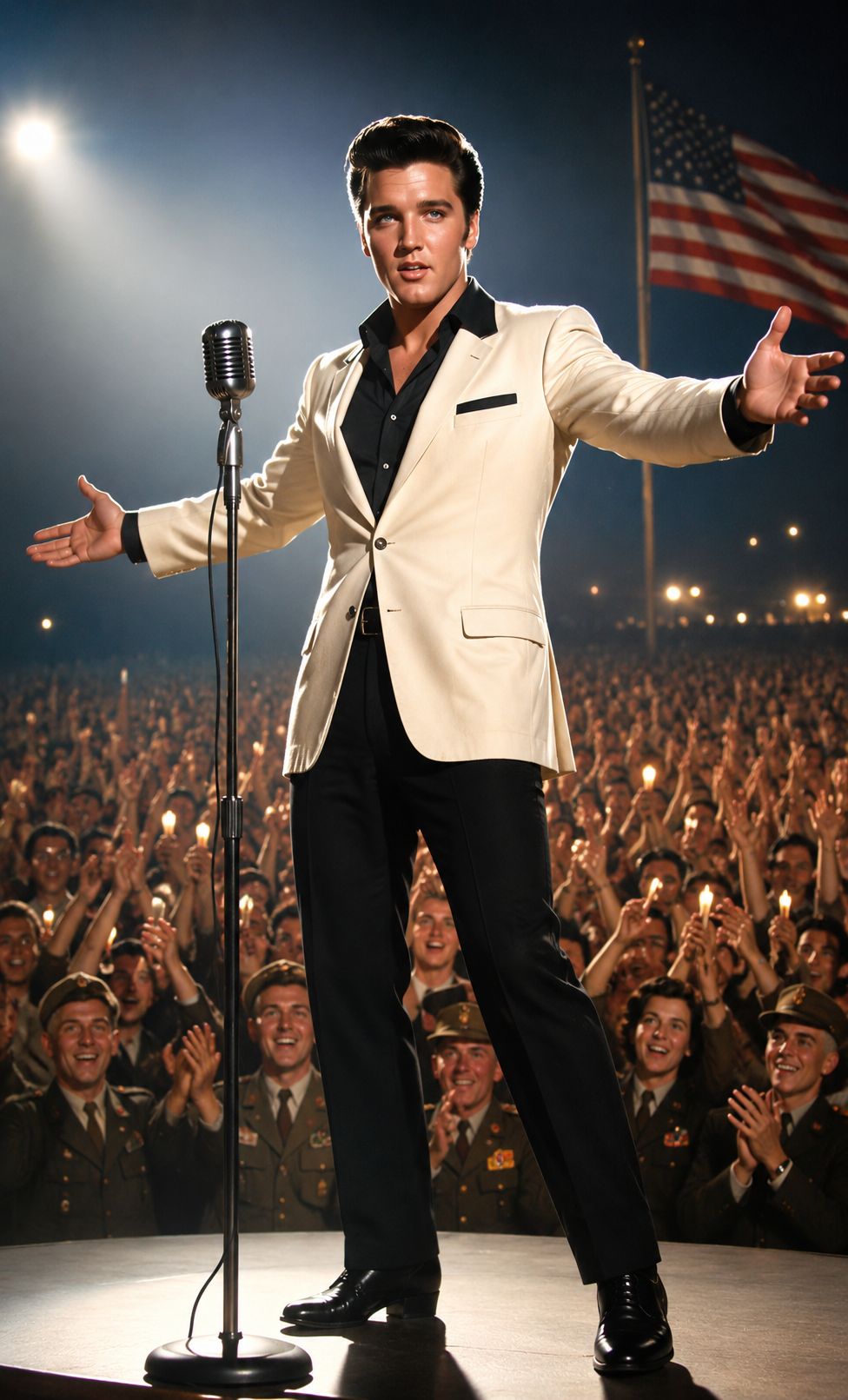
Only a white suit, a microphone, and an aching conviction.
Then he sang.
“There must be lights burning brighter somewhere…”
His voice trembled with emotion.
As the song intensified, so did Elvis.
Every line seemed deeply personal.
Every note carried urgency.
By the final chorus, he was no longer simply performing.
He was pleading.
Pleading for unity.
For understanding.
For hope.
“We’re trapped in a world that’s troubled with pain… But as long as a man has the strength to dream, he can redeem his soul and fly.”
When Elvis reached the final note, the audience erupted.
Many were crying.
Crew members stood frozen.
Some later admitted they had never witnessed anything like it.
Producer Steve Binder would later say that Elvis refused to leave the stage until he had delivered the performance exactly as he felt it should be.
And when he finally did, everyone knew.
Something profound had happened.
More Than A Comeback
The special aired on December 3, 1968.
An estimated 42 percent of the American viewing audience tuned in.
The response was immediate.
Overnight, Elvis Presley was reborn.
Critics celebrated him.
Fans rediscovered him.
A new generation embraced him.
But the true significance extended far beyond ratings.
America had seen one of its greatest icons admit vulnerability, confront failure, and rise again.
At a moment when the country desperately needed healing, Elvis offered something precious:
Hope.
His comeback reminded people that decline was not permanent.
That mistakes did not define a person.
That redemption was always possible.
And perhaps that’s why the performance still resonates nearly six decades later.
Because everyone, at some point, needs a comeback.
Everyone needs to believe that their best days are not behind them.
Elvis gave America that belief.
The Legacy Lives On
Today, historians often refer to the 1968 special as one of the greatest television performances ever broadcast.
But statistics alone cannot explain its enduring power.
The real legacy lies in what people felt.
For one unforgettable night, millions of Americans stopped worrying about politics, division, and uncertainty.
Instead, they watched a man rediscover himself.
And in his triumph, they found hope for themselves as well.
That is why the night of the 1968 Comeback Special remains far more than a chapter in music history.
It was the night Elvis Presley stopped being just a star and became America’s symbol of hope.
And nearly sixty years later, the dream he sang about still echoes.
Because as long as people believe in second chances, Elvis will never truly leave the stage.
VIDEO: