 By admin
INTRODUCTION:
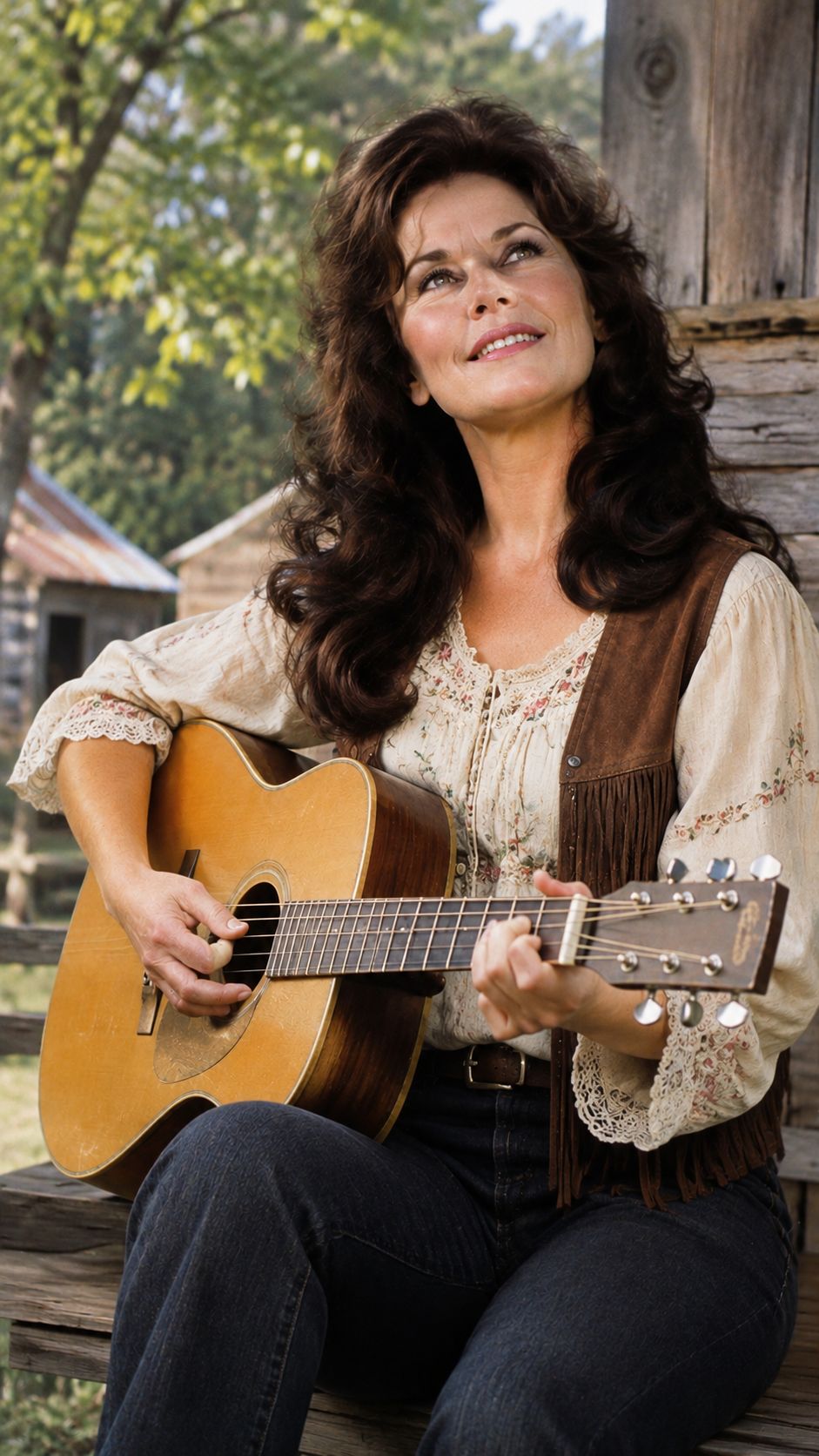
Deep in the hills of eastern Kentucky, where winding dirt roads crossed the mountains and dreams often seemed too distant to reach, a little girl was born into a world that offered her very few advantages. Her name was Loretta Lynn, and her childhood in Butcher Hollow was a far cry from the glittering stages, recording studios, and millions of devoted fans that would eventually define her life.
She didn’t grow up surrounded by wealth, influential connections, or professional music teachers. She grew up in a modest coal-mining family, where hard work was a necessity, money was scarce, and every day brought another reminder of how difficult life could be. Yet something inside that young girl refused to accept that her circumstances would determine her future.
Years later, Loretta Lynn would become one of the most influential women in country music history. But her greatest achievement wasn’t simply selling records or collecting awards. It was finding a way to make millions of ordinary people feel that somebody finally understood their lives.
She didn’t conquer Nashville by pretending to be someone else. She challenged its expectations by being unapologetically herself.
And perhaps that is the most remarkable part of her story: the girl who came from almost nothing became a voice that the entire world could recognize.
1. BUTCHER HOLLOW: THE PLACE THAT GAVE LORETTA HER VOICE
To understand how Loretta Lynn became a country music legend, we must first return to the mountains of Kentucky.
Born on April 14, 1932, Loretta grew up in Butcher Hollow, a small rural community in Johnson County. She was the second of eight children born to Melvin “Ted” Webb and Clara Marie Webb.
Her father worked as a coal miner, doing exhausting work to provide for his family. Their household was far from comfortable, and the family understood the meaning of sacrifice long before Loretta understood the meaning of fame.
But poverty also gave her something that money could never purchase: an intimate understanding of ordinary people.
She knew what it meant to stretch a small amount of money. She understood the worries of working families, the sacrifices of mothers, and the emotional complications that came with marriage and responsibility.
Those experiences would eventually become the foundation of her songwriting.
Unlike many performers who developed their musical identities through formal training, Loretta learned by listening to the sounds around her. Traditional country music, Appalachian melodies, family singing, and the voices of artists she admired shaped her musical imagination.
She particularly loved The Carter Family and Kitty Wells, whose music demonstrated that country songs could tell deeply personal stories.
But Loretta’s future was not yet connected to a recording studio.
At that point, she was simply a young woman growing up in the mountains, with no guarantee that her circumstances would ever change.
And Nashville was still a world away.
2. MARRIAGE, MOTHERHOOD, AND A LIFE THAT LOOKED NOTHING LIKE FAME
At just 15 years old, Loretta married Oliver “Doolittle” Lynn, commonly known as Doolittle.
The marriage marked the beginning of a complicated chapter that would profoundly influence her music.
The young couple eventually moved from Kentucky to Washington State, where Doolittle sought better employment opportunities. Loretta entered adulthood quickly, becoming a mother while still very young.
She raised a growing family, managed household responsibilities, and experienced the everyday challenges familiar to countless women of her generation.
There were no glamorous backstage dressing rooms or cheering audiences waiting for her.
There were children to care for, bills to worry about, and a husband whose working life often kept him away.
Yet music never completely disappeared from her imagination.
She sang at home, entertained family members, and gradually discovered that her voice had the power to hold people’s attention.
Doolittle eventually recognized that his wife possessed something special. He encouraged her musical ambitions and helped her take the first steps toward performing professionally.
One particularly important turning point came when he bought her a guitar.
It was a modest gesture, but it opened a door that would change the course of country music.
Loretta began learning songs, developing her performance skills, and appearing at local venues.
What started as a personal passion slowly became something much bigger.
Her experiences as a wife and mother would later provide the emotional material for songs that millions of listeners recognized as reflections of their own lives.
3. SHE DIDN’T WAIT FOR NASHVILLE TO DISCOVER HER
One of the most fascinating aspects of Loretta Lynn’s rise was her determination to create opportunities rather than wait for someone important to offer them.
She didn’t have the luxury of entering the music business through wealthy connections or established industry relationships.
Instead, she began performing wherever opportunities appeared.
She and Doolittle worked to build her career from the ground up. She performed locally, developed her confidence, and recorded music with the support of people who believed in her potential.
In 1960, she recorded I’m a Honky Tonk Girl, a song that became an important breakthrough.
The record was released through Zero Records, a small independent label.
Rather than relying entirely on an established promotional machine, Loretta and Doolittle personally traveled to radio stations, promoting the record and asking DJs to give it a chance.
Imagine that journey.
A young mother, traveling with her husband, trying to persuade radio personalities to play a song recorded by an unfamiliar country singer.
There was no guarantee of success.
There were no promises that the record would become a hit.
But Loretta had something that many aspiring artists lacked: persistence.
The strategy worked.
The song began receiving attention, helping her establish a foothold in the country music industry.
Eventually, she moved closer to the center of the country music world, joining the Grand Ole Opry in 1962.
Her journey demonstrated an important lesson: sometimes the biggest breakthrough begins when someone refuses to wait for permission.
4. THE SECRET WEAPON: SHE SANG ABOUT THINGS OTHER ARTISTS WERE AFRAID TO DISCUSS
If determination helped Loretta Lynn enter Nashville, honesty helped her stay there.
The country music industry already had talented singers, accomplished songwriters, and established stars.
What it didn’t have enough of was a woman willing to discuss difficult subjects with such directness.
Loretta understood that audiences didn’t necessarily need perfect stories.
They needed recognizable ones.
She wrote and performed songs about marriage, jealousy, motherhood, loneliness, economic hardship, family disagreements, and women’s independence.
Her lyrics often reflected conversations that people were having privately but rarely heard expressed so openly in popular music.
This became her greatest artistic advantage.
Consider Don’t Come Home A-Drinkin’ (With Lovin’ on Your Mind).
Released in 1966, the song addressed frustration within marriage with an unusually direct perspective.
It was not simply another country song about romantic disappointment. It presented a woman’s feelings without asking permission or apologizing for them.
Then came Fist City, another memorable example of Loretta’s fearless personality.
The song was playful, confrontational, and unmistakably confident.
She wasn’t presenting herself as a helpless character waiting for someone else to solve her problems.
She was speaking for herself.
And audiences responded.
Loretta had discovered something that would become central to her career: authenticity could be more powerful than perfection.
She didn’t need to imitate the voices or personalities of established male country stars.
She could build an entirely different relationship with listeners by telling stories from a woman’s perspective.
5. COAL MINER’S DAUGHTER: THE SONG THAT TURNED HER LIFE INTO A NATIONAL STORY
<escape> </escape>There is perhaps no song more closely associated with Loretta Lynn than Coal Miner’s Daughter.
Released in 1970, the autobiographical song became one of the defining recordings of her career.
It was more than a successful country single.
It was a declaration of identity.
In the song, Loretta revisited the childhood she had left behind, remembering her parents, the difficult circumstances of her family’s life, and the modest world of Butcher Hollow.
She didn’t attempt to disguise her background.
She didn’t transform her childhood into a glamorous fantasy.
Instead, she celebrated the people and experiences that shaped her.
That decision was extraordinary.
At a time when entertainers were often encouraged to cultivate polished public images, Loretta made her humble origins central to her identity.
The song connected with listeners because it represented something universal: the emotional attachment people feel toward the places and families that raised them.
For many fans, it was not simply Loretta’s childhood they heard in the song.
They heard their own parents, grandparents, childhood homes, and memories of difficult but meaningful years.
Coal Miner’s Daughter became a signature recording and eventually inspired her autobiography and the acclaimed 1980 film of the same name, starring Sissy Spacek.
Spacek’s portrayal earned her the Academy Award for Best Actress.
The film introduced Loretta’s remarkable story to an even wider audience.
Suddenly, the girl from Butcher Hollow was no longer just a country music star.
She had become an American cultural icon.
6. SHE CHALLENGED THE RULES OF A MALE-DOMINATED MUSIC INDUSTRY
To appreciate Loretta’s accomplishments, it is important to understand the environment in which she built her career.
During much of the 1960s and 1970s, country music remained heavily influenced by male performers, producers, executives, and songwriters.
Women certainly had successful careers, but they often faced expectations about what they should sing, how they should behave, and which subjects were considered appropriate.
Loretta Lynn challenged those expectations repeatedly.
Her songs were sometimes controversial because they addressed issues that made audiences uncomfortable.
The Pill, released in 1975, became one of her most discussed recordings.
The song approached birth control and women’s reproductive choices through humor and direct language.
It generated controversy and faced resistance from some radio stations.
Yet its popularity also demonstrated how powerfully Loretta could connect with listeners by addressing subjects that were rarely discussed so openly in mainstream country music.
Another important recording was Rated “X”, which explored the social judgment faced by divorced women.
Rather than accepting society’s assumptions, Loretta used her music to question them.
Her willingness to address these topics was not merely a marketing strategy.
It reflected the perspective of a woman who had spent years observing the complicated realities of family life.
She understood that women’s experiences deserved to be heard.
And she refused to make those experiences smaller simply because they were uncomfortable.
7. CONWAY TWITTY, UNFORGETTABLE DUETS, AND ANOTHER SIDE OF LORETTA
Although Loretta built an extraordinary solo career, her partnership with Conway Twitty revealed another dimension of her musical talent.
Their collaboration became one of the most successful partnerships in country music history.
Beginning in the early 1970s, the two artists developed a remarkable musical chemistry.
Their voices complemented each other beautifully.
Conway’s smooth, expressive baritone contrasted with Loretta’s distinctive, conversational delivery.
Together, they created recordings that sounded like intimate conversations between two people navigating love, conflict, and heartbreak.
Among their most memorable duets were:
- After the Fire Is Gone
- Lead Me On
- Louisiana Woman, Mississippi Man
- As Soon as I Hang Up the Phone
- Feelins’
Their chemistry was one of the defining features of these recordings.
They didn’t simply sing alongside each other.
They created characters, emotions, and believable musical conversations.
Their work earned multiple awards and helped establish them as one of country music’s most beloved duet partnerships.
The collaboration also demonstrated Loretta’s versatility.
She could deliver a fearless solo performance, tell an autobiographical story, or become one half of a beautifully balanced musical partnership.
Her talent was never limited to one format.
8. THE INDUSTRY COULDN’T IGNORE HER SUCCESS
By the 1970s, Loretta Lynn had become one of the biggest names in country music.
Her career was filled with chart successes, major awards, television appearances, and sold-out performances.
She received numerous honors from the Country Music Association and the Academy of Country Music.
In 1972, she became the first woman to win the Country Music Association’s Entertainer of the Year award.
That achievement carried enormous significance.
It demonstrated that a woman who had started her career with limited resources could reach the highest levels of recognition in country music.
She wasn’t simply being celebrated as a promising female performer.
She was being recognized as one of the genre’s leading entertainers.
In 1988, she was inducted into the Country Music Hall of Fame, securing her place among the most important figures in American country music.
Her influence continued across generations.
Artists who came after her could see that a woman didn’t have to fit a narrow industry image to succeed.
She could write her own material, speak honestly, challenge expectations, and still build an enormous audience.
That legacy was perhaps more important than any individual award.
9. THE GIRL FROM KENTUCKY NEVER FORGOT WHERE SHE CAME FROM
Fame can change people.
It can create distance between performers and the communities that first supported them.
But Loretta Lynn maintained a powerful connection to her Appalachian roots.
Her identity as a coal miner’s daughter remained central to her public image throughout her life.
She continued celebrating the traditions, stories, and musical heritage of the mountains that raised her.
Her connection to home was reflected in her music, her public appearances, and the way she spoke about her childhood.
For fans, this was part of her appeal.
They didn’t see someone who had escaped poverty and decided to forget it.
They saw someone who had transformed difficult beginnings into something meaningful.
Her life reminded audiences that success does not require rejecting one’s origins.
Sometimes the most powerful thing an artist can do is carry those origins into every room they enter.
Loretta’s story became especially meaningful to people from rural communities, working-class families, and generations who understood the sacrifices involved in building a better future.
She represented the possibility that a voice from a small mountain community could eventually be heard around the world.
10. HER LEGACY BECAME BIGGER THAN HER RECORD SALES
Loretta Lynn passed away on October 4, 2022, at the age of 90.
Her death marked the end of an extraordinary life, but it did not end the influence of her music.
Her songs continue to reach listeners who may have been born decades after their original release.
Her autobiography, Coal Miner’s Daughter, remains an important part of American music history.
Her recordings continue to introduce new audiences to the emotional honesty and storytelling that made her famous.
Her influence can also be seen in artists who followed her path.
Dolly Parton, Reba McEntire, Miranda Lambert, and countless other women in country music have worked in an industry that was changed by pioneers like Loretta.
Each artist has developed a different identity, but Loretta helped demonstrate that female country singers could be commercially successful without abandoning their individuality.
Her influence was not simply about making room for more women on country radio.
It was about expanding what women were allowed to say through country music.
And that is a legacy that cannot be measured by record sales alone.
11. HOW LORETTA LYNN OUTSMARTED THE MUSIC INDUSTRY WITHOUT LOSING HERSELF
So, how did a poor girl from Butcher Hollow accomplish something that so many aspiring musicians could only dream about?
The answer wasn’t one secret trick or a single lucky opportunity.
It was a combination of qualities that made her almost impossible to replace.
First, she understood her audience.
She knew the concerns of working families because she had experienced many of those concerns herself. Her songs reflected real emotions rather than manufactured stories.
Second, she understood the importance of individuality.
She never needed to sound exactly like another singer. Her distinctive voice and direct delivery became her greatest trademarks.
Third, she was willing to take creative risks.
Songs such as The Pill, Rated “X”, and Fist City demonstrated that she wasn’t afraid to challenge expectations.
Fourth, she understood the power of storytelling.
Her music created emotional connections that extended far beyond the recording itself. Listeners remembered the characters, situations, and feelings within her songs.
Finally, she never forgot her beginnings.
Instead of hiding her background, she transformed it into the heart of her artistic identity.
In that sense, Loretta’s greatest achievement was not that she learned to play Nashville’s game.
It was that she helped change the game itself.
She entered an industry with limited resources and few guarantees, but she brought something that no executive could manufacture: a genuine connection to the lives of ordinary people.
And that connection became priceless.
CONCLUSION: THE MOUNTAIN GIRL WHO BECAME A COUNTRY MUSIC LEGEND
There are many ways to measure a successful music career.
Some people count awards. Others count records sold, chart positions, concert tickets, or years spent in the spotlight.
But the story of Loretta Lynn suggests another measurement.
How many people heard her songs and felt understood?
How many women recognized their own struggles in her lyrics?
How many young artists realized that they didn’t have to hide their backgrounds, soften their personalities, or imitate someone else to deserve a place in country music?
The little girl from Butcher Hollow began with very little.
She didn’t inherit a music empire. She didn’t enter Nashville as an established celebrity. She built her reputation through determination, songwriting, unforgettable performances, and an extraordinary willingness to tell the truth.
She gave country music songs that were sometimes funny, sometimes heartbreaking, sometimes controversial, but always unmistakably hers.
And perhaps that is why her story continues to matter.
Loretta Lynn didn’t become a legend because she escaped the mountains.
She became a legend because she carried the mountains with her.
The world may have discovered her voice, but it was the people and experiences of Butcher Hollow that gave that voice its power.
And no matter how many years pass, the coal miner’s daughter will always have a place in the heart of country music.
VIDEO: