 By admin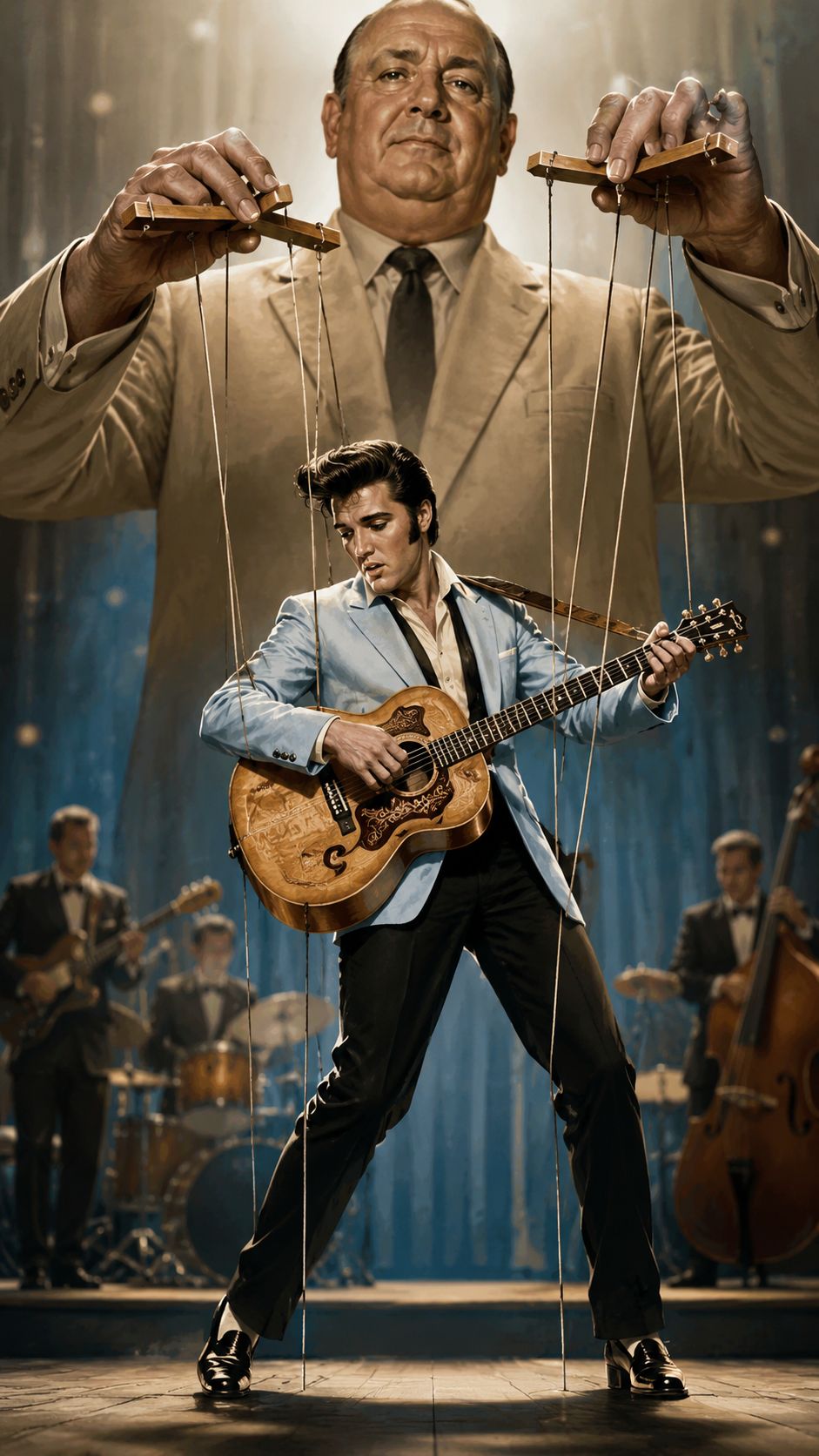
INTRODUCTION:
Few stories in the history of American music are as fascinating, heartbreaking, and controversial as the relationship between Elvis Presley and Colonel Tom Parker. To millions of fans, Elvis Presley was the undisputed King of Rock and Roll, a revolutionary performer whose voice, charisma, and cultural impact changed music forever. Yet behind the dazzling stage lights, screaming crowds, and record-breaking success stood a mysterious figure pulling the strings from the shadows.
Colonel Tom Parker was not a musician. He was not a songwriter. He was not a visionary artist. He was a master promoter, a relentless businessman, and perhaps the most influential manager in entertainment history. To some, he was the genius who transformed a poor Southern singer into a global icon. To others, he was the architect of a system that trapped Elvis Presley inside a golden cage.
Their partnership became one of the most successful—and most destructive—relationships ever seen in popular music. While Elvis earned fame beyond imagination, Parker accumulated extraordinary power over nearly every aspect of the star’s career. Decisions involving tours, films, finances, and artistic direction often flowed through Parker’s hands first.
Decades after Elvis Presley’s death, historians, music critics, and fans continue to ask the same haunting question: Did Colonel Tom Parker create the King, or did he ultimately contribute to his downfall?
The story of Elvis Presley and Colonel Tom Parker is not simply about management. It is a story about ambition, control, loyalty, fear, and the hidden cost of superstardom.
When Parker first encountered Elvis Presley in the mid-1950s, he immediately recognized something extraordinary. America was changing. Youth culture was emerging as a powerful force, and Rock and Roll was beginning to challenge traditional entertainment. Elvis represented everything new, exciting, and unpredictable.
Parker saw an opportunity unlike any he had ever witnessed.
At the time, many managers would have focused on nurturing artistic growth. Parker focused on building an empire. Through aggressive marketing, strategic media appearances, merchandising deals, and relentless promotion, he turned Elvis Presley into more than a singer. He transformed him into a brand.
The results were astonishing.
Within a few years, Elvis Presley became one of the most recognizable figures on Earth. Hits such as Heartbreak Hotel, Hound Dog, Don’t Be Cruel, and Jailhouse Rock dominated charts and reshaped popular music. Young fans idolized him. Critics debated him. The world could not look away.
Yet Parker’s influence extended far beyond promotion.
One of the most controversial aspects of Parker’s management involved movies. During the 1960s, Elvis Presley starred in a long series of Hollywood films. While commercially successful, many lacked artistic depth and repeated the same formula. Critics increasingly argued that these projects distracted Elvis from his true gift as a musician.
Many observers believe Parker prioritized guaranteed profits over artistic evolution.
“The King was making money, but was he making history?”
As artists like The Beatles, Bob Dylan, and The Rolling Stones pushed creative boundaries, Elvis Presley often found himself trapped in predictable film productions and soundtrack recordings. What could have been a decade of musical experimentation became, in many respects, a period of stagnation.
Perhaps the most shocking revelation concerns international touring.
Unlike many global superstars, Elvis Presley never performed concerts outside North America after becoming famous. Fans in Europe, Asia, and Australia waited for opportunities that never came.
The reason remained hidden for years.
Parker himself was the obstacle.
Born as Andreas Cornelis van Kuijk in the Netherlands, Parker had entered the United States under circumstances that remain controversial. Questions about his immigration status haunted him throughout his life. Many researchers believe he feared leaving America because international travel could expose his past and potentially create legal complications.
As a result, the world’s biggest performer remained largely confined to the United States.
The financial consequences were enormous. More importantly, the artistic consequences may have been even greater. Imagine Elvis Presley performing worldwide during the cultural explosion of the 1960s and 1970s. Imagine the influence, collaborations, and creative renewal that might have emerged.
Those possibilities never became reality.
The tension between artist and manager reached new levels in 1968.
The legendary ’68 Comeback Special marked a turning point in Elvis Presley’s career. After years of formulaic movies, the television event reintroduced audiences to the raw, powerful performer who had electrified America in the 1950s.
Reports suggest Parker initially preferred a safer Christmas-themed program. Instead, Elvis pushed for something more authentic and daring.
The result became one of the greatest comeback stories in entertainment history.
For a brief moment, the puppet seemed ready to cut the strings.
The special reminded audiences that beneath the commercial machine was a genuine artist hungry for expression.
Yet even after this triumph, Parker’s control remained powerful.
When Elvis Presley began his residency in Las Vegas, it generated extraordinary revenue. Night after night, crowds packed venues to witness the King perform. Financially, the arrangement was brilliant.
Artistically, however, some critics argue it accelerated his isolation.
The endless cycle of performances, combined with mounting personal struggles, physical exhaustion, and prescription drug dependency, created an increasingly fragile situation. While responsibility for these issues cannot be placed solely on Parker, many historians question whether the manager’s business priorities outweighed concern for the star’s well-being.
Another source of controversy involved money.
Parker famously negotiated contracts that granted him unusually large commissions. In some arrangements, he reportedly received percentages that far exceeded industry norms. Defenders argue that his promotional genius justified these earnings. Critics counter that no manager should wield such financial influence over an artist.
The truth likely exists somewhere between those extremes.
Without Parker, Elvis Presley may never have achieved such unprecedented commercial success. Without Parker, the world might never have witnessed the rise of a cultural phenomenon capable of transforming music, fashion, and popular culture.
But without Parker, Elvis may also have enjoyed greater freedom.
That contradiction lies at the heart of the mystery.
The relationship between Elvis Presley and Colonel Tom Parker endured until Elvis’s death in 1977. Despite disagreements, frustrations, and criticism, the bond never completely broke. Whether that loyalty reflected gratitude, dependence, manipulation, or some combination of all three remains one of music history’s most compelling questions.
Today, the legacy of Elvis Presley continues to grow. His influence can be heard across Country Music, Rock and Roll, Rockabilly, Pop Music, and countless other genres. New generations discover his recordings and witness the extraordinary talent that changed entertainment forever.
Meanwhile, the shadow of Colonel Tom Parker still lingers over the story.
Was he a brilliant architect of fame?
Was he a ruthless opportunist?
Or was he both?
Perhaps the darkest truth is that the rise and fall of Elvis Presley cannot be separated from the man who guided him. The puppet master and the superstar became so intertwined that history can no longer tell one story without the other.
And that is why, decades later, the tale remains endlessly fascinating—a reminder that behind every legend, there may be someone unseen holding the strings.