 By admin
INTRODUCTION:
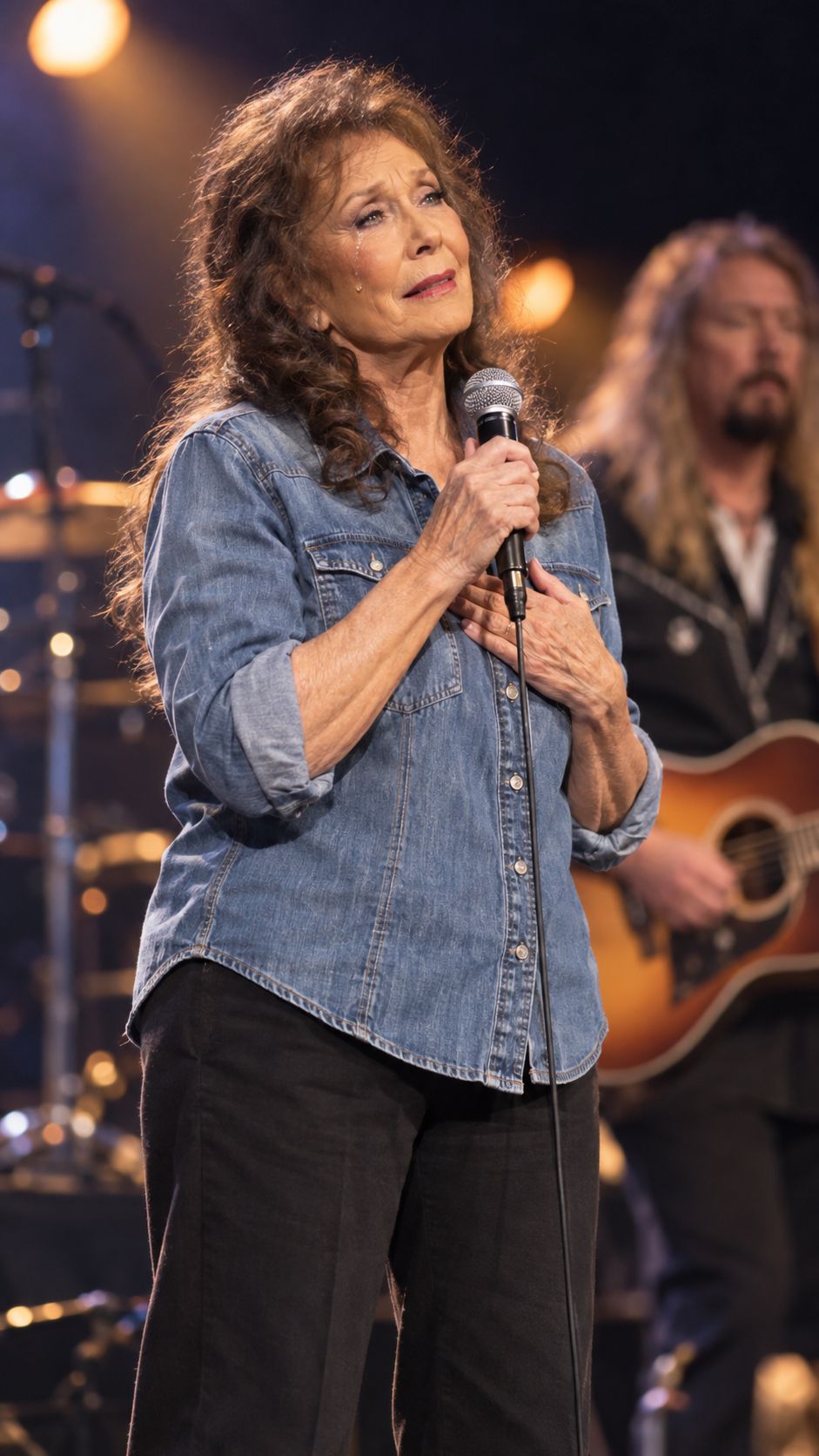
Some voices do more than sing. They tell the truth about life, carry the weight of heartbreak, and remind us that even the strongest people have moments when their hearts feel too heavy to bear. Loretta Lynn possessed one of those rare voices. With her unmistakable Kentucky accent, fearless honesty, and deeply human understanding of love and loss, she became much more than a country music superstar. She became a voice for generations of ordinary people whose struggles rarely made headlines but whose feelings deserved to be heard.
Behind the bright stage lights, standing ovations, and countless musical achievements was a woman whose life was shaped by sacrifice, complicated relationships, family responsibilities, and the determination to keep moving forward. Her story was never simply about fame. It was about growing up with limited opportunities, finding her place in a demanding world, and discovering that the most powerful songs often emerge from the experiences that hurt us the most.
When fans remember Loretta Lynn, they remember the music, but they also remember the emotions hidden between the notes. They remember a woman who could turn personal struggles into unforgettable melodies and make listeners feel as though she understood their lives.
Her quiet tears were never merely symbols of sadness. They represented endurance, compassion, and the courage to tell difficult truths. Through every chapter of her remarkable journey, Loretta demonstrated that vulnerability and strength can exist in the same heart—and that a song born from one woman’s experience can become a source of comfort for millions.
1. FROM BUTCHER HOLLER TO THE HEARTS OF MILLIONS
To understand the emotional power of Loretta Lynn, we must begin far from the glamorous stages of Nashville, in the Appalachian hills of Butcher Holler, Kentucky.
Born on April 14, 1932, Loretta Webb grew up in a family shaped by hard work, modest means, and the close bonds of a large household. Her father worked as a coal miner, and the realities of working-class life became part of the foundation of her identity. She was one of eight children, raised in an environment where music could offer comfort even when money and opportunities were scarce.
Those early years would eventually become the emotional center of her greatest songs.
When people hear Loretta sing about her childhood, they hear more than a nostalgic portrait of rural America. They hear the pride of someone who never forgot where she came from. She did not need to invent a dramatic backstory to make her music compelling. The details of her own life supplied everything she needed: family responsibilities, difficult choices, simple pleasures, and the determination to build something better.
Her journey into adulthood came early. She married Oliver “Doolittle” Lynn as a teenager, moved away from Kentucky, and soon found herself balancing motherhood with the demands of everyday survival.
The transition was enormous. A young woman who had grown up surrounded by familiar mountains and family traditions suddenly had to establish a home in an unfamiliar place while raising children and navigating the complicated realities of marriage.
Yet somewhere within those responsibilities, a musical voice began to emerge.
Her husband recognized her talent and encouraged her to pursue singing, buying her a guitar and helping her find opportunities to perform. Loretta taught herself to play and gradually began turning the experiences around her into songs.
What makes this chapter so moving is that her ambition did not emerge from a comfortable life. Music became a path toward independence, identity, and a future she could help shape herself.
Her early struggles also explain why her songs felt different from those of many performers of her generation. She understood the pressures faced by women who worked tirelessly at home, raised children, and often had little control over their circumstances.
She sang from inside that world.
And listeners recognized the truth.
2. THE QUIET TEARS HIDDEN INSIDE HER SONGS
The title of Loretta Lynn’s story speaks of quiet tears, but her emotional legacy cannot be reduced to sadness alone. Her music captured the complicated mixture of hurt, anger, humor, pride, and hope that makes human relationships so difficult to explain.
Loretta Lynn understood that heartbreak rarely arrives with dramatic music playing in the background. Sometimes it appears in a conversation at the kitchen table. Sometimes it comes after another disappointing promise. Sometimes it grows slowly through years of feeling unheard.
Her songwriting gave these experiences a voice.
One of her defining achievements was her willingness to address the realities of marriage without disguising every uncomfortable detail. In songs about jealousy, betrayal, drinking, and domestic frustration, she presented women as people with opinions, boundaries, and the right to speak for themselves.
That was a significant departure from the expectation that a female country singer should simply stand beside her husband, accept her circumstances, and smile through her troubles.
Loretta could be tender, but she could also be sharp. She could sing about disappointment one moment and deliver a humorous warning the next.
This emotional range made her relatable.
A listener who had endured a painful relationship did not necessarily need a song that promised everything would be perfect. Sometimes that listener needed a song that acknowledged the truth: life could be unfair, love could hurt, and a person could still find the strength to stand up again.
Her music offered precisely that kind of recognition.
Sometimes the most comforting song is not the one that takes away your pain, but the one that reminds you that someone else understands it.
This is one reason her work continues to resonate across generations. Her songs did not demand that listeners hide their disappointments. They allowed those feelings to exist openly, often with enough humor to make the burden a little easier to carry.
The quiet tears associated with her legacy are therefore not simply tears of grief. They are also tears of recognition—the emotional response that comes when a listener discovers that an experience once believed to be private has been expressed in a song.
3. COAL MINER’S DAUGHTER: THE SONG THAT BECAME HER LIFE STORY
Few songs in country music have become as closely associated with an artist’s identity as Coal Miner’s Daughter.
Released in 1970, the autobiographical song told the story of Loretta’s upbringing with remarkable simplicity. Instead of presenting her childhood as something to escape or conceal, she transformed it into the defining narrative of her career.
The song celebrated a family that possessed little wealth but remained rich in its own traditions and affection. Its power came from the absence of pretension. Loretta did not present herself as someone who had always been destined for greatness. She remembered herself as a girl from a small Kentucky community whose family worked hard and made the most of what they had.
That honesty was extraordinary.
As her career expanded, she could have distanced herself from the life she had once known. Instead, she carried it onto the biggest stages in country music.
The song also challenged a familiar idea about success: that a person must become someone entirely different to achieve something remarkable.
Loretta’s story suggested the opposite. Her roots were not obstacles to her achievement. They were part of what made that achievement meaningful.
In 1976, she published her autobiography, also titled Coal Miner’s Daughter. Four years later, the story reached an even wider audience through the acclaimed film starring Sissy Spacek, whose portrayal earned an Academy Award for Best Actress.
The film introduced Loretta’s journey to people who might never have followed country music closely. It presented the difficult early years, the complicated marriage, the musical ambition, and the determination that carried her forward.
But the deeper significance of Coal Miner’s Daughter lies in its message.
A person’s beginnings do not have to determine the limits of their future.
For fans who grew up in small towns, working families, or communities far removed from the centers of power, Loretta’s success represented something personal. It showed that their stories were worth telling, too.
And when she sang about her childhood, she was not merely remembering the past. She was preserving a piece of American working-class history through music.
4. THE COURAGE TO SING WHAT OTHERS WOULD NOT SAY
If Coal Miner’s Daughter revealed Loretta Lynn’s roots, songs such as Don’t Come Home A-Drinkin’ (With Lovin’ on Your Mind) and You Ain’t Woman Enough (To Take My Man) revealed her fearless personality.
These songs placed women’s frustrations at the center of the story.
In an industry where women often had to navigate expectations about how they should behave, Loretta established a distinctive identity by writing and recording material that was direct, humorous, and unapologetically personal.
Don’t Come Home A-Drinkin’, which became a major country hit in 1967, confronted the tension that alcohol and irresponsible behavior could bring into a relationship. Rather than treating a wife’s frustration as something to be endured quietly, the song allowed her to express it.
You Ain’t Woman Enough, released in 1966, approached romantic rivalry with confidence and a memorable sense of defiance.
The women in Loretta’s songs were not always gentle or forgiving. They could be angry, witty, proud, and fiercely protective of their dignity.
That was part of the point.
Her characters possessed personalities rather than existing merely to support someone else’s story.
Then came The Pill, a song recorded in the early 1970s and released in 1975. Its frank treatment of birth control and women’s changing expectations provoked controversy, and some radio stations refused to play it.
Yet the controversy also demonstrated how closely Loretta’s music was connected to real social changes.
She was not writing abstract arguments. She was singing about how decisions concerning family, marriage, and women’s lives affected ordinary people.
Her approach did not require every listener to agree with every lyric. Its importance lay in her willingness to address subjects that other performers might avoid.
In that sense, Loretta’s courage was not simply a matter of being outspoken. It was a commitment to telling stories that reflected the lives of women whose experiences were often overlooked.
Her songs helped expand the emotional and social boundaries of country music.
5. PATSY CLINE: A FRIENDSHIP THAT LEFT A LASTING MARK
Behind Loretta Lynn’s public confidence was also a woman who valued friendship and the people who helped her find her footing.
One of the most meaningful relationships in her early career was her friendship with Patsy Cline, the celebrated country singer whose powerful voice and commanding stage presence had already made her a star.
As Loretta began finding success in Nashville, Patsy offered encouragement and guidance. Their connection became an important part of Loretta’s story because it revealed the supportive side of an industry that could be competitive and unforgiving.
Patsy understood the challenges of being a woman in country music. She had experienced the demands of the business and could recognize the potential in the young singer from Kentucky.
For Loretta, that friendship offered reassurance during a period of enormous change.
Then tragedy struck.
Patsy Cline died in a plane crash in March 1963, leaving the country music community devastated. For Loretta, the loss was particularly painful because she had lost not only a musical contemporary but also a friend who had helped her navigate an unfamiliar world.
The grief surrounding Patsy’s death became part of the emotional history of Loretta’s career.
Not every meaningful relationship produces a famous song. Not every loss becomes a public performance. Sometimes its importance is visible only in the way a person remembers someone who made a difficult journey easier.
Patsy’s influence on Loretta’s life reminds us that success is rarely achieved entirely alone. Behind a celebrated artist are often people who offer encouragement before the wider world recognizes that artist’s potential.
Their friendship also reflected a broader truth about women in music: one woman’s success does not have to diminish another’s.
Support, kindness, and shared understanding can be powerful forces in an industry built around competition.
6. LOVE, MARRIAGE, AND THE COMPLICATED REALITIES BEHIND THE SPOTLIGHT
The story of Loretta Lynn would be incomplete without acknowledging the complexity of her marriage to Oliver Lynn, known as Doolittle or Doo.
Their relationship lasted nearly five decades, but it was not a simple fairy tale. Loretta’s own accounts described a marriage marked by deep attachment as well as serious difficulties, including infidelity and conflict.
It is important not to turn those experiences into a romantic myth. The reality of a long relationship can contain affection, disappointment, loyalty, resentment, and memories that are difficult to reconcile.
Loretta’s music often reflected precisely that complexity.
She did not present love as a magical solution to every problem. Instead, she explored the ways people remain connected even when their relationships become painful or complicated.
Her honesty was part of what made her songwriting compelling. Listeners could hear the tension between wanting to preserve a relationship and refusing to accept every hurtful behavior.
That tension was especially significant for women who had grown up believing that marital difficulties should remain private.
Loretta brought some of those realities into public conversation through her songs and autobiographical writing.
Her experiences should not be interpreted as proof that suffering is necessary for lasting love. Rather, they demonstrate why her work resonated with people who understood that family life is often more complicated than the stories presented in popular entertainment.
When Doolittle died in 1996, Loretta lost the person who had been part of her life since adolescence. Whatever the difficulties they had experienced, their shared history represented an enormous portion of her life.
Grief after a long marriage can be complicated. It may involve mourning the person who has died, the years spent together, the dreams that were fulfilled, and the ones that remained unresolved.
Loretta’s later years carried that history with them.
Her story reminds us that people cannot always be understood through a single description of their relationships. They are shaped by years of shared experiences, changing circumstances, and memories that resist easy conclusions.
7. THE HEARTBREAK OF LOSING FAMILY AND THE STRENGTH TO CONTINUE
For all her professional achievements, Loretta Lynn experienced profound personal losses.
Her son Jack Benny Lynn died in 1984 after an accident involving a river and a horse. Her eldest daughter, Betty Sue Lynn, died in 2013 from complications associated with emphysema.
These losses represented a different kind of pain from the disappointments explored in her songs. The death of a child is not something that can be neatly resolved by determination or explained away through a triumphant ending.
For a mother, such grief can change the meaning of everything that follows.
It is essential to speak about these tragedies with care rather than turning them into sensational stories. Their significance lies not in the shock of the events but in the deeply personal losses experienced by a family.
Loretta continued to have a relationship with music through the years that followed. Her career did not erase her grief, and her public strength should not be mistaken for an absence of sorrow.
Sometimes continuing to work, sing, or spend time with loved ones is simply one way of moving through a life that has changed permanently.
Her experience also explains why many listeners connected with her beyond the boundaries of country music. She was not an untouchable celebrity who existed outside the difficulties experienced by ordinary families.
She was a mother, a wife, a daughter, and a woman who knew that some chapters of life bring pain that words cannot fully capture.
Her legacy does not depend on claiming that she overcame every hardship. It rests partly on the fact that she continued to create, perform, and connect with audiences while carrying the experiences that had shaped her.
That is a more honest and more meaningful kind of strength.
8. CONWAY TWITTY AND THE MAGIC OF A MUSICAL PARTNERSHIP
Another important chapter in Loretta Lynn’s legacy was her celebrated partnership with Conway Twitty.
Together, they became one of country music’s most successful vocal duos, combining their distinctive voices in songs that explored love, longing, temptation, and emotional conflict.
Their 1971 hit After the Fire Is Gone helped establish the partnership, which went on to produce memorable recordings including Lead Me On, Louisiana Woman, Mississippi Man, and Feelins’.
What made their collaborations so effective was the sense of conversation between their voices.
Loretta could deliver a line with a mixture of tenderness and resolve, while Conway brought a rich, steady vocal presence. Their contrasting styles allowed their songs to unfold like dramatic scenes, with each singer contributing a different perspective.
The listener was not simply hearing two famous voices. The listener was hearing two characters negotiating the complicated territory of human relationships.
Their partnership also demonstrated Loretta’s versatility. She could deliver an assertive solo performance, tell a deeply personal story, or share a song in which emotional meaning depended on the interplay between two singers.
The duo earned major industry recognition, including four consecutive Country Music Association Vocal Duo of the Year awards from 1972 through 1975.
Their work remains an important part of classic country music because it balanced strong melodies with stories that felt immediate and recognizable.
For many fans, hearing Loretta and Conway together brings back memories of family gatherings, long drives, favorite radio stations, and a time when a song could become a lasting companion.
The emotions may have been fictionalized or dramatized for a particular recording, but the feelings at their center were familiar.
That is the enduring power of a great musical partnership: two voices can make a story feel larger than either performer could make it alone.
9. VAN LEAR ROSE: PROVING THAT GREAT ARTISTS CAN KEEP GROWING
One of the most remarkable chapters in Loretta Lynn’s later career arrived in 2004 with Van Lear Rose, an album produced by Jack White.
By then, Loretta had already spent decades establishing herself as a country music icon. She could have relied entirely on her classic recordings and the affection of longtime fans.
Instead, she embraced a new creative partnership.
The album paired Loretta’s unmistakable voice and songwriting instincts with a production approach that introduced her to a younger and more diverse audience. Its sound respected her roots while allowing her music to move into unfamiliar territory.
The result was a major artistic achievement.
Van Lear Rose received widespread acclaim and won two Grammy Awards, including Best Country Album. It also demonstrated that Loretta’s talents were not limited to the era in which she first became famous.
Her voice carried the authority of experience. Her writing retained its directness. And her willingness to collaborate showed that artistic curiosity need not disappear with age.
The album’s significance reaches beyond awards or commercial success.
It challenged the assumption that older performers must become monuments to their own pasts. Loretta remained an active creative presence, capable of exploring new possibilities without abandoning the qualities that had made her distinctive.
That is a particularly powerful message for artists and audiences alike.
A meaningful career is not necessarily a straight line from discovery to fame to retirement. It can include reinvention, experimentation, and unexpected moments of renewed inspiration.
For listeners who discovered Loretta through Van Lear Rose, the album offered an entry point into a much larger musical history.
For longtime fans, it provided another reason to appreciate the woman whose honesty had sustained her career for so many years.
10. WHY LORETTA LYNN’S STORY STILL TOUCHES GENERATIONS
Loretta Lynn died on October 4, 2022, at the age of 90, but her music continues to speak to listeners who were not yet born when many of her biggest hits first appeared.
The reason is not simply nostalgia.
Her songs endure because they explore experiences that remain part of human life: growing up with limited opportunities, raising a family, struggling within relationships, grieving loved ones, and finding the courage to speak honestly about difficult circumstances.
Her impact on country music can also be measured by the recognition she received. She became the first woman to win the Country Music Association’s Entertainer of the Year award in 1972 and was inducted into the Country Music Hall of Fame in 1988. Her achievements helped establish a broader place for women as songwriters, storytellers, and defining voices within the genre.
But awards alone cannot explain why audiences still care.
The deeper connection comes from the way Loretta made her listeners feel seen.
She sang for people who had worked long days, worried about their families, endured disappointment, and continued to hope for something better. Her characters were not always perfect, and their choices did not always lead to happy endings. They were recognizably human.
That humanity gave her songs their staying power.
Her influence can be heard in later generations of country artists who write openly about their backgrounds, complicated relationships, and personal convictions. Her career helped demonstrate that a woman could build a lasting musical identity by telling stories in her own voice rather than conforming to someone else’s expectations.
And her work continues to invite new listeners to ask an important question: What happens when a person refuses to be ashamed of where they came from or what they have experienced?
Loretta’s answer was a lifetime of music.
CONCLUSION: THE TEARS FADE, BUT THE SONGS REMAIN
The story of Loretta Lynn is not a story of uninterrupted happiness. It is a story of beginnings that were difficult, relationships that were complicated, achievements that required determination, and losses that no amount of fame could make painless.
Her quiet tears belong to the same story as her laughter, her sharp wit, her fearless songwriting, and her unmistakable voice.
She never needed to present herself as a flawless heroine. Her music became powerful precisely because it acknowledged the imperfections of ordinary life.
From Butcher Holler to the greatest stages in country music, Loretta carried the memories of her family, the realities of her upbringing, and the experiences that shaped her understanding of the world. She transformed those experiences into songs that helped listeners find words for emotions they had struggled to express.
That is why her legacy reaches beyond charts, trophies, and record sales.
A song can outlive the moment in which it was written. It can return to someone decades later and bring back a beloved parent, a childhood home, a lost relationship, or a memory that had almost faded.
For generations of fans, Loretta Lynn’s music has done exactly that.
Her life reminds us that strength does not mean never crying, and courage does not mean never being afraid. Sometimes strength means telling the truth. Sometimes courage means continuing to create. And sometimes the greatest legacy a person can leave is the feeling that, somewhere in the world, another human being understands.
Loretta Lynn may be gone, but the woman behind the songs remains present whenever her voice fills a room and someone pauses to listen.
And perhaps that is the most beautiful part of her story: the tears may belong to the past, but the music continues to bring people together in the present.
VIDEO: