 By admin
INTRODUCTION:
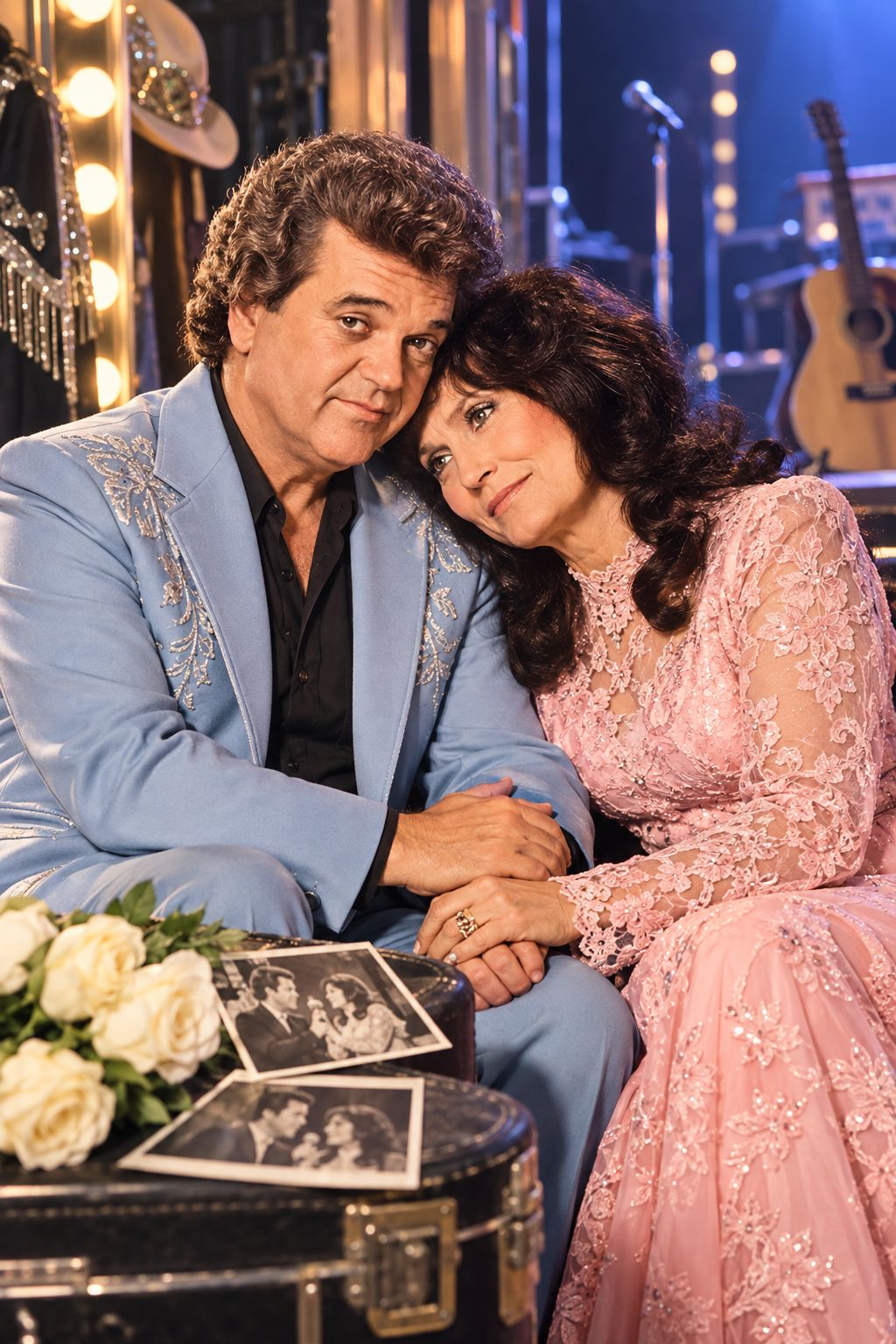
There are country music partnerships that sound good together.
And then there are partnerships that make millions of people believe they are witnessing something far more personal.
Conway Twitty and Loretta Lynn belonged to the second category.
When their voices met, something happened that neither artist could quite create alone. His deep, velvet-toned delivery seemed to pull against her unmistakable Kentucky twang. His restraint met her fire. His mystery met her openness.
Together, they didn’t simply sing about love.
They made audiences feel it.
And that was precisely the problem.
For years, fans wondered whether there was something more between Conway Twitty and Loretta Lynn. Their performances could be playful, intimate, teasing and emotionally charged. Their songs were filled with longing, temptation, jealousy and desire.
To an audience watching from the darkness of a concert hall, it could look almost impossible that such chemistry was merely professional.
But Loretta herself eventually made the truth unmistakably clear.
“Everybody thought me and Conway had a thing going. And that’s the farthest from the truth.”
According to Lynn, the relationship was friendship—not romance. She also emphasized that her husband, Oliver “Doolittle” Lynn, genuinely liked Conway.
That revelation makes their story even more fascinating.
Because perhaps the tragedy wasn’t that Conway and Loretta secretly loved each other.
Perhaps the tragedy was that two people who could create such convincing musical intimacy were never meant to become the couple their audiences imagined.
Two Completely Different Lives, One Extraordinary Sound
By the time Conway Twitty and Loretta Lynn became a recording team, both had already traveled remarkable roads.
Loretta had risen from the poverty of Butcher Holler, Kentucky, to become one of country music’s defining voices. Her songs drew heavily from real-life experiences, relationships, family and the complicated realities faced by women of her generation.
Conway’s path was almost the opposite.
Born Harold Lloyd Jenkins in Mississippi, he first became famous as a rock-and-roll and pop performer. His 1958 recording “It’s Only Make Believe” became a million-selling hit. But Twitty eventually moved toward country music and became one of the genre’s most successful male stars, ultimately recording forty No. 1 Billboard country hits.
They were different.
And perhaps that’s exactly why they worked.
When Loretta sang, there was often a sense that she was telling you something she had actually lived.
When Conway sang, there was a controlled intensity—a voice that could make even a simple sentence sound like a confession.
Put those voices together, and the effect was explosive.
Then Came “After the Fire Is Gone”
Their partnership truly caught fire in 1971 with “After the Fire Is Gone.”
The song became their first No. 1 hit together and launched one of the most celebrated male-female partnerships in country music history.
Suddenly, the public wasn’t simply hearing two stars.
They were hearing a conversation.
A dangerous one.
The songs often placed Conway and Loretta in emotionally complicated situations. Their characters sounded like two people standing dangerously close to crossing a line.
And the closer they sounded, the more audiences blurred the distinction between the performers and the characters they were portraying.
That misunderstanding followed them.
Their chemistry was so convincing that even decades later, people continued to ask whether something had happened behind the scenes.
But there is an important distinction that sometimes disappears in sensational retellings:
The intensity was real. The romance was not.
Their emotional connection belonged to the music.
The Husband Who Wasn’t Threatened
One of the most revealing parts of their story involves Loretta’s husband, Doo.
If Conway and Loretta’s relationship had truly been the secret scandal some imagined, Doo’s reaction would have been an important piece of the story.
Instead, Loretta remembered something very different.
She said Conway was essentially the only person in the music business whom Doo genuinely cared about.
That detail changes the entire picture.
Rather than a secret love triangle, there was a professional partnership built around mutual respect—and a friendship that apparently extended beyond the stage.
And perhaps that’s why the partnership endured.
There was no need to turn their chemistry into a forbidden romance.
They could simply allow the songs to do the pretending.
Five No. 1 Duets and a Legacy That Refused to Fade
The numbers tell only part of the story.
Twitty and Lynn recorded eleven studio albums together between 1971 and 1988. Their collaboration produced five No. 1 songs, including “After the Fire Is Gone,” “Lead Me On,” “Louisiana Woman, Mississippi Man,” “As Soon as I Hang Up the Phone,” and “Feelin’s.”
They also dominated the CMA Vocal Duo of the Year category, winning from 1972 through 1975.
Their success wasn’t an accident.
Listen closely to the recordings and you can hear why.
Conway often sounded like the calm center of the storm.
Loretta sounded like the storm.
He could make a line feel restrained.
She could make the same line feel wounded.
He leaned into the spaces between words.
She attacked the emotion head-on.
And somewhere between those two approaches, they created a third voice.
Their combined voice.
Garth Brooks later described the power of their voices joining as something that created a dimension neither could produce alone. That may be the simplest explanation for why their performances felt almost magical.
The Cruel Timing of Fate
Then came the part nobody could rewrite.
Conway Twitty died suddenly on June 5, 1993, after suffering a stomach aneurysm while traveling from a show in Branson, Missouri, toward Nashville for Fan Fair. He was only 59.
For a man whose career had survived multiple musical eras, his ending was brutally abrupt.
There was no long farewell tour.
No carefully planned final chapter.
No opportunity to stand beside Loretta one last time and sing the songs that had defined so much of both their careers.
Loretta continued.
She would live for nearly three more decades, eventually dying on October 4, 2022, at the age of 90.
And that makes their recordings increasingly poignant.
Every time the two voices appear together now, listeners know something the original audiences didn’t:
There would never be another Conway and Loretta.
What Fans Thought They Saw
Maybe audiences weren’t completely wrong when they sensed a special connection.
They were simply wrong about what kind of connection it was.
There was intimacy.
There was trust.
There was musical affection.
There was an almost telepathic understanding of timing.
But intimacy doesn’t always mean romance.
Sometimes two artists simply understand how to bring out something in one another that neither can access alone.
That may have been Conway and Loretta’s greatest gift to each other.
He gave her a musical counterpart who could match her emotional force.
She gave him a partner whose voice could challenge his restraint.
Together, they created stories that felt so real that millions forgot they were listening to actors inside a song.
“I loved Conway as a friend,” Loretta said.
Those words may be less scandalous than the rumors.
But they are arguably more beautiful.
Because friendship was what survived when the lights went out.
The Love Story Was the Music
The temptation today is to turn every legendary partnership into a secret affair.
It makes the headline bigger.
It makes the story easier to sell.
But Conway Twitty and Loretta Lynn don’t need a fabricated romance to become legendary.
Their real story is already extraordinary.
Two people from dramatically different musical backgrounds found a way to make their voices inseparable.
They sang about forbidden love without necessarily living it.
They portrayed heartbreak without needing to share the same heartbreak.
They created passion without having to cross the boundary their audiences imagined.
And perhaps that is why their recordings remain so powerful.
Because the chemistry wasn’t built on a secret.
It was built on music.
Conway died before he could see the full distance his legacy would travel.
Loretta lived long enough to become a living monument to country music itself.
But whenever their voices meet on an old recording, time seems to disappear.
For a few minutes, Conway is still there.
Loretta is still there.
The old stage lights are still glowing.
And the audience is still wondering whether what they are hearing could possibly be acting.
Maybe that’s the ultimate irony.
They spent years convincing the world that their fictional love was real.
And in the end, the only thing they ever truly needed to prove was that their music was.
Conway Twitty and Loretta Lynn weren’t the lovers everyone imagined.
They were something rarer:
two once-in-a-generation voices that found their perfect musical match—and never found another one quite like it.
VIDEO: