 By admin
INTRODUCTION:
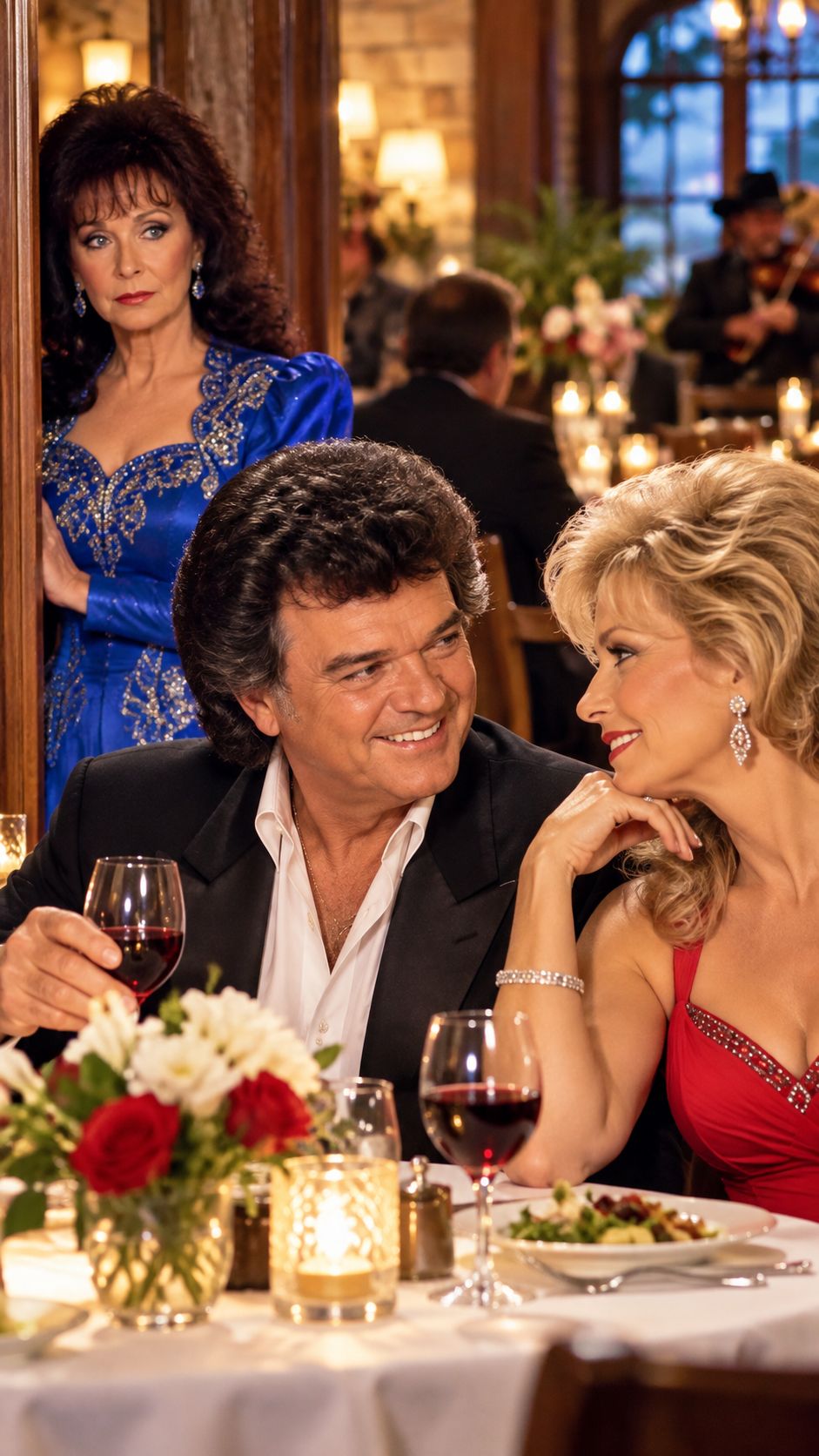
There are some stories in country music that survive not because every detail has been proven, but because the emotional question at their center refuses to disappear.
Loretta Lynn and Conway Twitty had that kind of story.
They were never husband and wife. They repeatedly denied being lovers. In fact, Loretta later said plainly that she and Conway were friends, not lovers. Conway himself described Loretta as one of his closest friends in the music business.
And yet, for decades, audiences watched them perform together and wondered whether there was something deeper hiding behind those perfectly blended voices.
That is why the story of Loretta supposedly becoming uncomfortable—or jealous—when she saw Conway having dinner with another woman has remained so irresistible to fans.
But there is an important distinction between documented history and the mythology that grew around their partnership.
There is no reliable primary-source evidence establishing a specific dinner confrontation in which Loretta confronted Conway over another woman. What is documented is something perhaps even more fascinating: the extraordinary closeness of their friendship, the rumors their music created, and the fact that their chemistry was so convincing that audiences routinely mistook performance for real-life romance.
And sometimes, that ambiguity was enough to create a legend.
The Friendship That Looked Like Something More
The story began long before the rumors.
Loretta Lynn had admired Conway Twitty before they ever became recording partners. Billboard reported that she had been a Conway fan since hearing his music, while Conway recalled that he was already a Loretta fan when they met. Their first musical connection developed during a European tour in 1969, when they began singing together backstage.
What happened afterward changed country music.
Their voices seemed almost suspiciously natural together.
Loretta brought a conversational toughness and emotional vulnerability. Conway brought his smooth, dramatic delivery. When the two sang about forbidden attraction, marital problems, temptation, loneliness, or regret, they didn’t sound like two performers reading lyrics.
They sounded like two people who knew each other’s secrets.
That was precisely the problem.
Fans began asking the obvious question:
Were Loretta and Conway secretly in love?
Loretta eventually answered that question herself.
“Everybody thought me and Conway had a thing going.”
But she insisted that was not the truth.
“Me and Conway were friends. We wasn’t lovers.”
Those words matter because they came directly from Loretta.
Still, the human imagination has always had trouble accepting a relationship that feels emotionally intimate without being romantic.
Then Came the Songs
If you want to understand why the rumors became so powerful, don’t start with gossip.
Start with the records.
“After the Fire Is Gone” was perhaps the ultimate example.
The song was about two people who find comfort in each other after love has disappeared from their homes. It was emotionally dangerous territory, and Loretta and Conway sang it with such conviction that listeners could easily forget they were acting out a story. The recording became a No. 1 country hit.
Then there were songs such as “Lead Me On”, where the emotional tension became even more intense.
Their records weren’t simply duets.
They were miniature dramas.
Two voices. Two characters. One emotional battlefield.
And when audiences watched Loretta and Conway perform together, their physical ease reinforced the illusion.
They teased each other.
They laughed.
They stood close.
They anticipated each other’s phrasing.
They sounded as if they had spent years finishing each other’s sentences.
As one later observer explained, the connection between their voices created an energy that neither could produce alone.
That chemistry made the audience wonder.
And once an audience starts wondering, rumors rarely need much help.
The Dinner Story Is More Legend Than Proven History
This is where the dramatic version of the story needs to be handled carefully.
The idea that Loretta caught Conway having dinner with another woman—and couldn’t hide her jealousy—is exactly the kind of anecdote that feels perfectly suited to their complicated public image.
It sounds like something that could have happened.
But sounding believable is not the same as being documented.
There is no strong primary source confirming that exact confrontation.
And that’s important because the most compelling version of the story turns Loretta’s reaction into proof that she secretly wanted Conway.
The historical record doesn’t establish that.
In fact, much of the documented evidence points in another direction.
Loretta spoke warmly about Conway’s friendship with her husband, Oliver “Doolittle” Lynn. She remembered Conway visiting Doo in the hospital and described the two men as close. When Conway died in 1993, Loretta recalled how devastated she was—and how deeply the loss affected her husband as well.
That is a very different picture from a secret romance.
It is the picture of a friendship that became extraordinarily important to both families.
But Could Loretta Still Have Felt Jealous?
This is where the story becomes emotionally interesting.
Because denying romance does not mean a person cannot feel possessive, protective, surprised, or even jealous.
Human relationships aren’t always organized into neat categories.
You can love someone deeply without wanting to marry them.
You can become accustomed to being someone’s closest creative partner.
You can spend years traveling, recording, laughing, arguing, performing and sharing private jokes with another person—and still insist that the relationship isn’t romantic.
That is precisely what made Loretta and Conway so fascinating.
They occupied a space somewhere between ordinary friendship and the kind of artistic partnership that becomes part of a person’s identity.
And if Loretta ever felt a pang when another woman received Conway’s attention, that emotion would not automatically prove a hidden love affair.
It could simply have been the natural vulnerability that comes with caring deeply about someone.
That distinction is often lost in sensational retellings.
Loretta Had Her Own Marriage—and Conway Knew It
Another reason the romantic interpretation becomes complicated is Doolittle Lynn.
Loretta’s marriage was not merely a footnote in her story.
It was central to her life, her family and much of her songwriting.
And Conway apparently respected that.
In one documented account, Conway spoke affectionately about Doolittle and described him as someone he loved. Loretta likewise emphasized that her husband cared deeply about Conway.
That makes the supposed love triangle far less straightforward than the headlines suggest.
There wasn’t simply Loretta and Conway standing on one side and Doolittle standing on the other.
There was a friendship involving all three.
And perhaps that is what makes their story more beautiful than the rumor.
Why Fans Still Want There to Be a Secret
Because their music made people believe.
That’s the simplest answer.
When Loretta and Conway sang together, they didn’t sound emotionally distant.
They sounded vulnerable.
When they sang about temptation, audiences heard desire.
When they sang about heartbreak, audiences heard history.
When they teased each other onstage, people saw intimacy.
And when Loretta looked at Conway during a performance, fans naturally searched her expression for clues.
Was she acting?
Was Conway acting?
Or were they simply so good at understanding one another that the distinction disappeared?
PBS’s American Masters captured exactly this phenomenon: commentators explained that the chemistry in their performances was so powerful that audiences assumed they were married or having an affair, while Loretta herself firmly rejected that interpretation.
That contradiction is the heart of the entire story.
The Real Jealousy May Have Belonged to the Audience
Perhaps the most fascinating twist is this:
Maybe the jealousy wasn’t Loretta’s.
Maybe it belonged to the fans.
Fans didn’t want to share the fantasy.
They wanted Loretta and Conway to belong together because the music had convinced them that they did.
Every time Conway sang with another woman, audiences could compare the chemistry.
Every time Loretta performed with another male singer, listeners could wonder whether anyone could replace Conway.
But nobody really could.
Not because they were secretly lovers.
Because they had created something musically unique.
Their partnership had its own language.
Its own rhythm.
Its own emotional temperature.
And that is extraordinarily difficult to reproduce.
A Friendship Strong Enough to Survive the Rumors
The irony is that Loretta Lynn and Conway Twitty never needed a secret romance to become one of country music’s most unforgettable partnerships.
Their friendship was already remarkable.
They recorded together for years. They toured together. They won major recognition as a duo. Their songs became classics. And Loretta continued to speak about Conway with genuine affection long after his death.
When Conway died in 1993, the loss wasn’t simply that of a former duet partner.
For Loretta, it was the loss of a friend.
Someone who had shared a major chapter of her professional life.
Someone whose voice had become inseparable from hers in the minds of millions.
They didn’t have to be married for the bond to matter.
And perhaps that is the part fans sometimes overlook.
The Mystery Will Probably Never Disappear
Did Loretta ever feel a flash of jealousy when Conway gave another woman attention?
It is possible in the broad human sense—but the specific dinner story remains unverified, and there is not enough reliable evidence to present it as established fact.
What is established is more compelling.
Loretta Lynn and Conway Twitty created a partnership so emotionally convincing that generations of listeners struggled to believe it was only friendship.
Loretta herself repeatedly pushed back against the romantic interpretation.
Conway did the same.
And yet their music continued to tell stories that sounded like forbidden love.
That contradiction became part of their legend.
Maybe that’s why fans still talk about them today.
Because some relationships are difficult to define.
Some friendships become deeper than labels.
And some musical partnerships become so convincing that the audience begins writing its own story around them.
In the end, perhaps Loretta and Conway’s greatest mystery isn’t whether they secretly loved each other.
It is how two people who insisted they were only friends could make millions of listeners feel the ache, danger, tenderness and jealousy of a love story they never actually lived.
And that may be the greatest testament of all to what they created together.
VIDEO: