 By admin
INTRODUCTION:
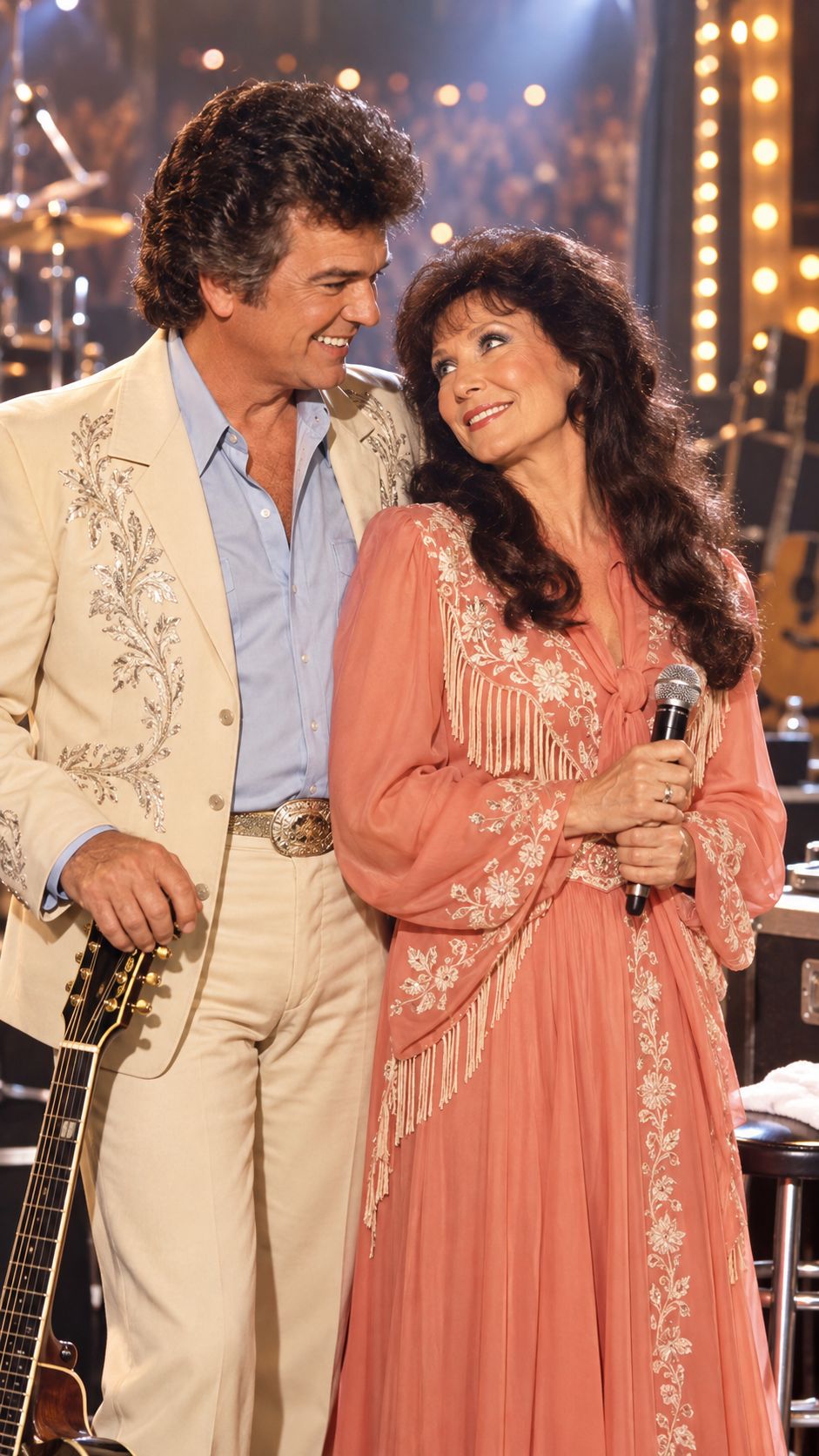
There are country music partnerships that succeed because two voices sound good together.
And then there are partnerships that seem to reveal something deeper—something almost impossible to explain.
Conway Twitty and Loretta Lynn belonged to the second category.
When the two stepped onto a stage together, audiences didn’t simply hear a male and female country singer trading verses. They witnessed a conversation. A teasing glance could feel like a confession. A pause could sound more intimate than a love song. And when their voices came together, there was a strange emotional tension that made millions of listeners wonder the same thing:
Was there something more between Conway Twitty and Loretta Lynn than music?
The question has survived for decades.
But the truth is more complicated—and, in some ways, more beautiful.
Their legendary bond was built on extraordinary musical chemistry, deep professional trust, friendship, humor, and an ability to portray romantic emotion so convincingly that audiences sometimes blurred the line between performance and reality.
And perhaps that was the greatest secret of all.
Two Completely Different Stars
Conway Twitty did not begin his career as a traditional country singer.
Born Harold Jenkins, he initially pursued rock ‘n’ roll and achieved major success before eventually becoming one of country music’s defining voices. By the time he established himself as a country superstar, he had developed a remarkably distinctive vocal style: smooth, low, controlled, and emotionally restrained.
Loretta Lynn came from an entirely different world.
She was born into poverty in rural Kentucky and transformed her experiences of marriage, motherhood, hardship, ambition, and womanhood into songs that spoke directly to working-class America.
On paper, they could hardly have been more different.
Yet when they began recording together, the contrast became an advantage.
Conway’s deep voice created a natural counterpoint to Loretta’s bright, unmistakably Appalachian-influenced vocal style.
Together, they sounded like two people having a conversation.
And country music listeners couldn’t get enough of it.
Their partnership produced a string of successful recordings, including songs such as “After the Fire Is Gone,” “Lead Me On,” “Louisiana Woman, Mississippi Man,” and “As Soon as I Hang Up the Phone.”
The records weren’t merely commercially successful.
They created characters.
They created stories.
They created the illusion of a complicated relationship unfolding in real time.
“When Conway and Loretta sang together, you didn’t feel like you were listening to two singers. You felt like you were eavesdropping on two people who knew each other’s secrets.”
That perception would become central to their legend.
The Chemistry Was Real—But That Doesn’t Mean the Rumors Were
This is where the story becomes particularly fascinating.
The chemistry between Conway and Loretta was unquestionably powerful.
But powerful chemistry between performers does not automatically mean a secret romance existed behind the scenes.
There is no solid historical basis for presenting their professional relationship as a confirmed clandestine affair.
Yet that distinction didn’t stop audiences from wondering.
Why?
Because Conway and Loretta were extraordinarily convincing.
Their duets often revolved around desire, jealousy, separation, temptation, marriage, arguments, and reconciliation. The songs frequently sounded like intimate conversations between two people whose relationship was complicated.
The performances reinforced the illusion.
A look across the stage could appear flirtatious. A laugh could feel spontaneous. A harmony could sound almost painfully personal.
For fans sitting in the audience, the emotional boundary between fiction and reality became very thin.
But that was precisely what great entertainers do.
They make you believe.
The Unspoken Language Between Them
One of the most remarkable elements of Conway and Loretta’s partnership was their timing.
They seemed to understand instinctively when the other singer needed to push forward, pull back, soften a phrase, or leave a little silence.
That kind of chemistry cannot be manufactured entirely in a recording studio.
It comes from familiarity.
They knew each other’s voices.
They knew each other’s personalities.
And they understood how to make the other person better.
Loretta could bring warmth and vulnerability to Conway’s controlled baritone. Conway could give Loretta’s emotional delivery a darker, more grounded counterbalance.
It was almost theatrical.
The songs became miniature dramas.
Loretta wasn’t simply singing to Conway.
She was responding to him.
Conway wasn’t simply harmonizing with Loretta.
He was answering her.
And audiences became emotionally invested in the conversation.
“Louisiana Woman, Mississippi Man” and the Art of Storytelling
Few songs demonstrate their chemistry better than “Louisiana Woman, Mississippi Man.”
The premise itself is classic country storytelling: two people separated by geography but drawn irresistibly toward each other.
The magic was in the contrast.
Loretta sounded determined.
Conway sounded confident.
Neither vocalist completely surrendered the emotional ground.
Instead, they pushed against each other.
That tension gave the song energy.
It also demonstrated why their partnership mattered beyond romance.
Conway and Loretta understood something fundamental about country music:
A great duet isn’t simply about singing together. It’s about giving each singer something to fight for.
The listener needs conflict.
They need anticipation.
They need emotional stakes.
Conway and Loretta understood that instinctively.
The Songs Were Intimate Because Life Was Complicated
Another reason their partnership resonated so strongly was the honesty embedded in the material.
Country music has always been fascinated by imperfect relationships.
Unlike sanitized pop love songs, country duets often acknowledge that love can be messy.
People argue.
People leave.
People return.
People make mistakes.
People want what they shouldn’t want.
People remain loyal even when life becomes difficult.
Conway and Loretta lived inside that emotional world during their performances.
That made their music feel authentic even when the story itself was fictional.
And authenticity was something Loretta understood better than almost anyone.
Her career had been built around transforming real experiences into songs.
Conway had his own gift for turning romantic vulnerability into something sophisticated and emotionally charged.
Together, those qualities became explosive.
Why People Wanted to Believe There Was a Secret
There’s another layer to the Conway-Loretta mythology.
Fans don’t simply remember musical partnerships.
They create stories around them.
When two performers demonstrate extraordinary chemistry, audiences naturally begin asking what happened when the cameras stopped rolling.
It is the same fascination people have with movie stars who play lovers convincingly.
The fantasy becomes:
“They couldn’t possibly have been that convincing without feeling something themselves.”
But performers can create emotional intensity without crossing personal boundaries.
In fact, the best performers often do exactly that.
They take an emotion, magnify it, and transform it into art.
Conway and Loretta didn’t need a secret affair to explain their chemistry.
Their artistry was explanation enough.
“The mystery wasn’t necessarily what happened between them offstage. The mystery was how two people could make millions of strangers feel as though they were witnessing something deeply private.”
Respect Was the Foundation
Behind the teasing and romantic lyrics was something much less sensational—and much more important.
Respect.
Conway and Loretta respected one another as artists.
That mattered.
Loretta was not simply a female voice added to Conway’s records.
Conway was not merely a male counterpart for Loretta.
They were two established stars who understood what each brought to the partnership.
That balance helped prevent their duets from becoming predictable.
There was no obvious “lead” singer all the time.
Sometimes Loretta drove the emotion.
Sometimes Conway did.
Sometimes the power came from their voices colliding in harmony.
Their partnership worked because neither needed to overpower the other.
The Humor Behind the Legend
The public often remembers the romantic side of their duets, but there was another ingredient that helped sustain their relationship: humor.
Country music can become overly sentimental if performers take every love song completely seriously.
Conway and Loretta understood the importance of playfulness.
That quality helped them navigate songs that might otherwise have felt melodramatic.
They could flirt with the audience without necessarily flirting with each other.
They could portray jealousy without being jealous.
They could sing about forbidden love without suggesting that their own lives were forbidden.
That distinction is crucial.
They were performers.
And they were exceptionally good ones.
What Their Legacy Really Tells Us
The most enduring lesson of Conway Twitty and Loretta Lynn isn’t that they may have hidden a secret from the world.
It is that they created something the world desperately wanted to believe in.
Their duets offered a fantasy of two people who understood each other completely.
They argued.
They teased.
They desired.
They hurt.
They reconciled.
And through it all, their voices remained connected.
That’s why their recordings still feel remarkably intimate.
Country music has changed dramatically since their greatest duet years. Production styles have evolved. Radio has changed. The way artists collaborate has changed.
But emotional chemistry never goes out of style.
And Conway and Loretta had it in abundance.
The Final Truth Behind the Legend
So, were Conway Twitty and Loretta Lynn secretly in love?
The responsible answer is that the enduring evidence supports a deep friendship and extraordinary professional partnership—not a confirmed secret romance.
But perhaps that answer makes their story more meaningful rather than less.
Because their connection didn’t need scandal.
It didn’t need a hidden affair.
It didn’t need a forbidden relationship waiting to be exposed.
They created something rarer.
They created trust strong enough to make fiction feel like truth.
They created music powerful enough to make strangers believe they were witnessing private moments.
And they demonstrated that two artists can stand inches apart beneath the lights, sing about desire and heartbreak, and create an emotional world that disappears the moment the final note fades.
That is the magic of performance.
And that is why the Conway Twitty and Loretta Lynn partnership remains legendary.
“Some partnerships become history because of what happened behind the scenes. Conway and Loretta became history because of what they could make the world feel onstage.”
Perhaps that’s the unspoken truth fans have been searching for all along.
The secret wasn’t necessarily hidden between Conway and Loretta.
The secret was in the music.
Every harmony carried it.
Every glance seemed to suggest it.
Every duet invited listeners to wonder about it.
And decades later, the question still lingers whenever their voices meet again through an old recording:
How could two singers make pretend love sound so heartbreakingly real?
The answer may be the simplest one.
They were masters of their craft.
And for a few unforgettable minutes at a time, Conway Twitty and Loretta Lynn didn’t merely sing country music.
They made people believe they were living it.
VIDEO: