 By admin
 INTRODUCTION:
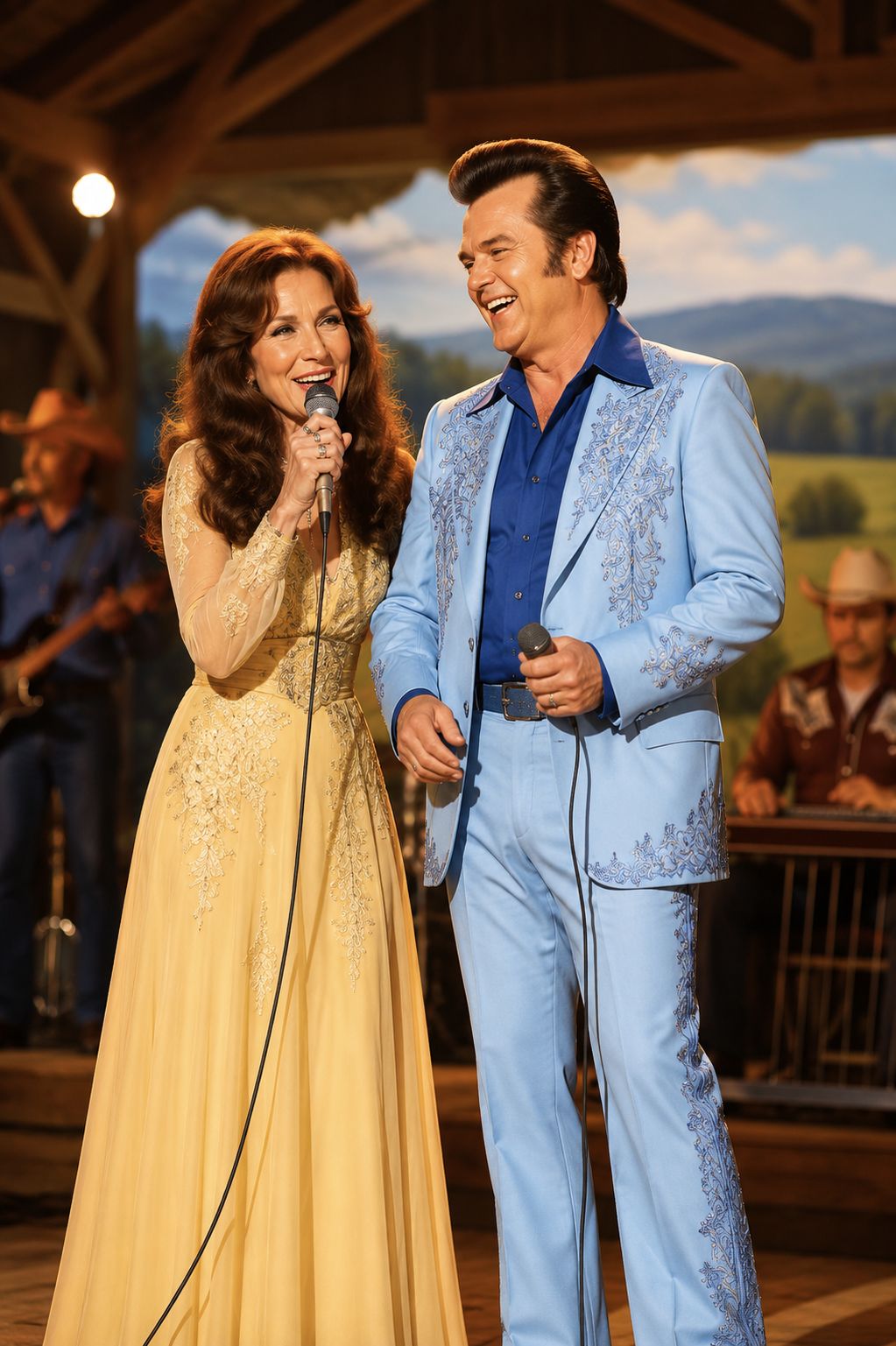
There are successful duos. There are legendary duos. And then there was Conway Twitty and Loretta Lynn — two voices so perfectly matched that, more than half a century later, their partnership still feels almost impossible to recreate.
When Conway Twitty and Loretta Lynn began recording together in 1971, neither artist desperately needed the other.
That is precisely what made the partnership so extraordinary.
Loretta was already the fearless Coal Miner’s Daughter, a woman who had turned the complicated realities of marriage, motherhood, jealousy, poverty, and female independence into some of country music’s most unforgettable songs.
Conway, meanwhile, possessed one of the most recognizable voices in Nashville — deep, intimate, controlled, and capable of turning a simple lyric into something that sounded like a confession.
Individually, they were stars.
Together, they became something bigger.
Conway and Loretta didn’t simply sing duets. They created conversations — and millions of listeners felt as though they were overhearing something deeply personal.
THE MOMENT EVERYTHING CHANGED
Their recorded partnership exploded in 1971 with “After the Fire Is Gone.”
Listen to that record today and something remarkable happens.
It doesn’t sound like two celebrities taking turns singing.
It sounds like two people caught inside an emotional situation neither one can easily escape.
Loretta brings vulnerability and steel. Conway answers with that unmistakable smoothness, never overpowering her voice and never disappearing behind it.
The chemistry is immediate.
And audiences responded.
“After the Fire Is Gone” became a major country hit, reaching No. 1 on the country chart and establishing Conway and Loretta as a formidable new partnership. It also earned them a Grammy Award for Best Country Vocal Performance by a Duo or Group.
But the real significance of the song wasn’t merely the trophy.
It proved that this wasn’t going to be a one-record novelty.
Something special had happened.
And Nashville knew it.
THEN CAME THE STREAK
After “After the Fire Is Gone,” Conway and Loretta kept going.
And going.
And going.
Their early run produced an astonishing sequence of chart-topping country duets, including “Lead Me On,” “Louisiana Woman, Mississippi Man,” “As Soon as I Hang Up the Phone,” and “Feelins’.”
Those songs helped establish one of the defining achievements of their partnership: five consecutive No. 1 country singles as a duo during the first half of the 1970s.
Think about how difficult that is.
A duet has to satisfy two fan bases. Two voices must complement each other. The material has to feel believable coming from both singers. And once audiences have heard the formula several times, the artists must somehow keep the emotional tension alive.
Conway and Loretta did exactly that.
They didn’t just return to No. 1.
They made listeners want to hear the next chapter.
Their greatest achievement wasn’t simply reaching the top of the chart. It was convincing America that every new duet mattered.
That five-song No. 1 streak became a signature part of their legacy and helped make them one of the most commercially powerful male-female partnerships country music had ever seen.
WHY DID THEIR CHEMISTRY FEEL SO REAL?
This is where numbers stop explaining the phenomenon.
To understand Conway Twitty and Loretta Lynn, you have to listen to the space between the lyrics.
They understood restraint.
Conway could sing a romantic line without turning it into melodrama. Loretta could answer him with humor, frustration, tenderness, or defiance.
They sounded like equals.
That mattered enormously.
Many traditional country duets were constructed around harmony. Conway and Loretta certainly had harmony, but their greatest recordings often operated more like miniature dramas.
Take “Louisiana Woman, Mississippi Man.”
The song practically races forward with excitement. Their voices bounce against one another, transforming geographical distance into romantic urgency.
Then listen to “As Soon as I Hang Up the Phone.”
The atmosphere changes completely.
Suddenly, we’re inside a painful telephone conversation.
Loretta’s voice sounds vulnerable. Conway’s presence becomes restrained and devastating. Instead of a flashy performance, listeners receive something resembling a private breakup unfolding in real time.
That was their gift.
One song could make you smile.
The next could make you uncomfortable because it felt almost too personal.
THEY WERE NEVER MARRIED — BUT THEY COULD MAKE YOU BELIEVE THE SONG
One of the enduring fascinations surrounding Conway and Loretta is the extraordinary romantic chemistry they projected onstage and on record.
Fans sometimes wondered whether there was more behind it.
But the power of the partnership came from performance, friendship, musical trust, and an instinctive understanding of storytelling.
They could look at one another across a stage and make a lyric feel newly discovered.
That is an art.
And it is increasingly rare.
The secret wasn’t that Conway and Loretta were living every story they sang. The secret was that they knew how to make the audience feel as though they were.
Loretta’s public image was rooted in honesty. She sang about subjects many women recognized immediately but rarely heard addressed so directly on country radio.
Conway approached romantic material differently. His voice could communicate desire, regret, devotion, and heartbreak without sounding forced.
Put those qualities together and you had emotional dynamite.
Loretta supplied the fire.
Conway supplied the velvet.
Neither swallowed the other.
MORE THAN HIT RECORDS
Their success wasn’t confined to individual singles.
Throughout the 1970s, Conway and Loretta released a remarkable collection of duet albums, beginning with We Only Make Believe in 1971.
Their partnership became so popular that the country music establishment repeatedly recognized them as the genre’s premier vocal duo.
They won the CMA Vocal Duo of the Year award four consecutive times, from 1972 through 1975.
The Academy of Country Music also repeatedly honored their partnership.
This matters because it demonstrates something deeper than nostalgia.
Conway and Loretta weren’t retroactively declared legendary decades later.
They were recognized as dominant while it was happening.
Their contemporaries knew.
The industry knew.
Most importantly, the fans knew.
TWO SUPERSTARS WHO NEVER NEEDED TO SHRINK
Another reason the partnership worked was that neither artist had to sacrifice an individual identity.
Loretta remained unmistakably Loretta.
Conway remained unmistakably Conway.
That sounds obvious, but successful duos often develop a combined identity so strong that separating the performers becomes difficult.
Conway and Loretta managed something more complicated.
They maintained huge solo careers while simultaneously creating a separate musical universe together.
Loretta could sing “Coal Miner’s Daughter” and embody her own extraordinary American story.
Conway could deliver “Hello Darlin’” and instantly command a room.
Then they could walk onto the same stage together and become Conway & Loretta.
Three identities existed at once:
Conway the solo star.
Loretta the solo star.
And Conway and Loretta, the duo.
Few partnerships achieve that balance.
THEIR MUSIC WAS BUILT AROUND HUMAN IMPERFECTION
Perhaps the biggest reason their recordings have survived is that the stories weren’t about perfect people.
Their characters argued.
They wanted things they shouldn’t want.
They became jealous.
They made mistakes.
They stayed when leaving might have been easier.
They left when staying hurt too much.
In other words, they behaved like human beings.
Country music has always been strongest when it gives ordinary emotions extraordinary weight, and Conway and Loretta understood that instinctively.
Their songs weren’t polished fantasies about flawless romance.
They were about what happens after the fire, during the phone call, across the distance, and inside relationships complicated by pride and desire.
That emotional messiness gave their music permanence.
WHEN CONWAY WAS GONE
The story gained another layer of poignancy after Conway Twitty died unexpectedly in 1993.
Suddenly, one of country music’s most familiar musical conversations could never truly happen again.
Loretta continued performing, recording, writing, and carrying her own enormous legacy.
But Conway’s absence changed the meaning of those old duets.
Songs once filled with playful tension became time capsules.
Old television performances became precious documents.
A glance between them suddenly meant more because audiences knew there would never be another new Conway-and-Loretta moment.
Loretta herself died in 2022, closing another chapter in country music history.
Yet put on one of their classic records and something strange happens.
Neither voice sounds gone.
That’s the beautiful cruelty of a great recording: time can take the singers from us, but it cannot make them stop singing.
WHY COUNTRY MUSIC STILL HASN’T REPLACED THEM
There have been magnificent country duos since Conway and Loretta.
There will be more.
But recreating their particular combination is almost impossible because their success depended on more than vocal compatibility.
It required timing.
Personality.
Material.
Trust.
Individual star power.
And, perhaps most importantly, believability.
Modern production can make two voices sound technically perfect together.
Technology can repair pitch and polish imperfections.
But technology cannot manufacture history between two performers.
It cannot manufacture that tiny hesitation before a response.
It cannot manufacture the feeling that two singers understand exactly how far to push a lyric before pulling back.
Conway and Loretta possessed those instincts naturally.
55 YEARS LATER, THE NUMBERS ARE ONLY PART OF THE STORY
More than five decades after their partnership began, it’s tempting to measure Conway Twitty and Loretta Lynn entirely through statistics: No. 1 singles, awards, albums, chart runs, and that remarkable streak of five consecutive chart-topping duets.
Those achievements matter.
They tell us how enormous Conway and Loretta were.
But they don’t fully explain why people still care.
For that, you have to hear them.
Play “After the Fire Is Gone.”
Then “Lead Me On.”
Then “Louisiana Woman, Mississippi Man.”
Then sit quietly with “As Soon as I Hang Up the Phone.”
The statistics disappear.
What remains are two voices telling stories about people who love, fight, regret, forgive, and occasionally break each other’s hearts.
And perhaps that’s the real record Conway Twitty and Loretta Lynn left behind.
Not simply that they dominated country music.
Not simply that they collected No. 1 records.
But that 55 years later, listeners can still hear those first notes and immediately believe the story.
Conway Twitty and Loretta Lynn didn’t need to be a real-life couple to become one of country music’s greatest love stories. They only needed a microphone, the right song, and each other.
And for one unforgettable era, that was more than enough.
VIDEO: