 By admin
 INTRODUCTION:
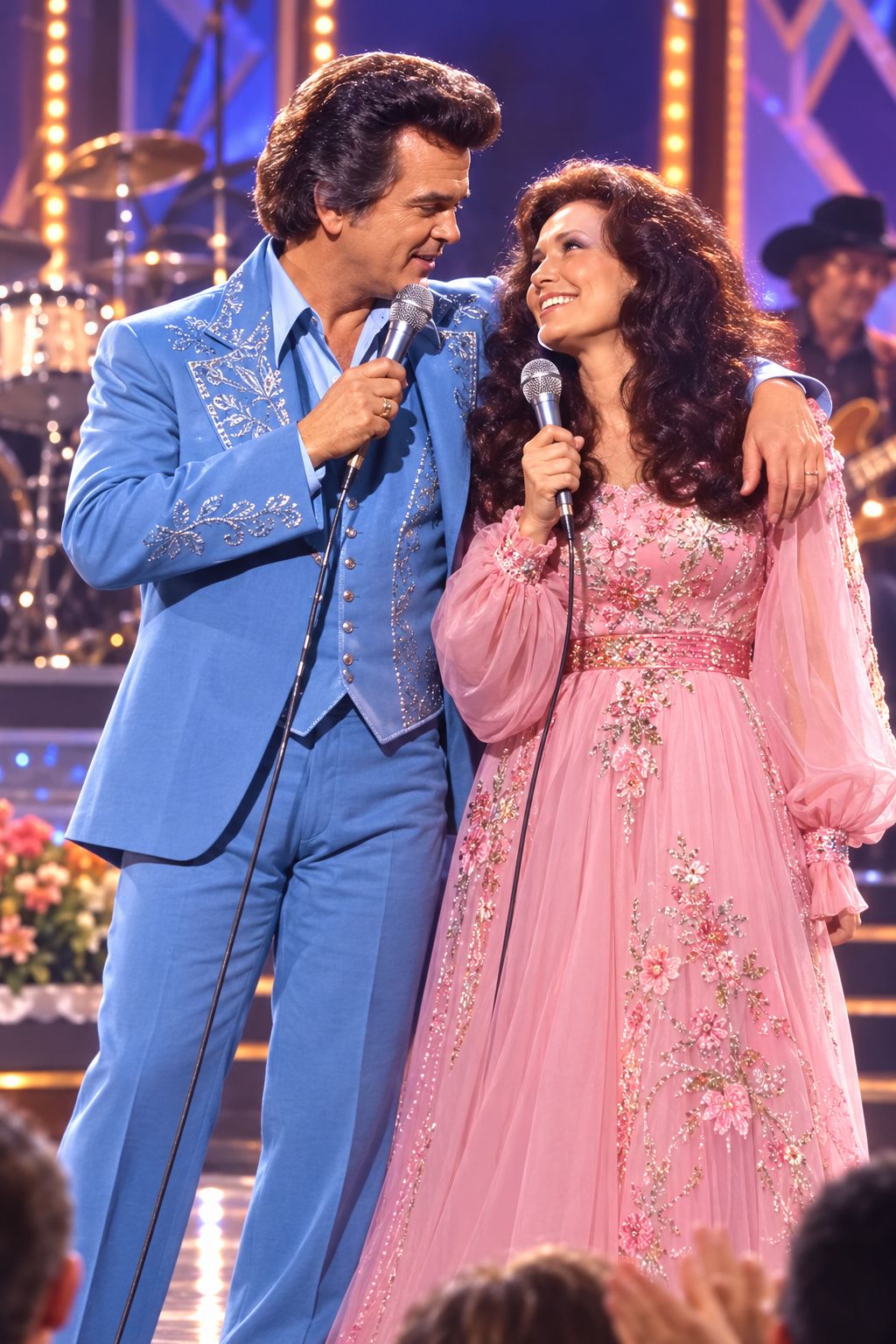
There have been thousands of famous duos in music history.
Some had extraordinary voices. Some had undeniable chemistry. Some recorded songs that became classics. And some simply happened to be in the right place at the right time.
But Conway Twitty and Loretta Lynn were different.
When their voices met, something happened that could not be manufactured in a studio, rehearsed into existence, or duplicated by another pair of singers.
It sounded like two people who had lived the story they were singing.
That is why, decades after their greatest records were released, their duets still feel strangely alive.
You hear the opening notes of “After the Fire Is Gone” and suddenly you’re no longer listening to an old country record. You’re standing inside a complicated relationship, caught between desire, regret, loyalty, loneliness, and the painful realization that sometimes love doesn’t arrive in the places where it is supposed to.
Then comes “Louisiana Woman, Mississippi Man,” and the mood changes completely.
Now they sound playful, passionate, stubborn, and completely convinced that nothing—not distance, geography, or common sense—is going to keep them apart.
That ability to move from heartbreak to humor, from temptation to tenderness, from argument to affection, was at the heart of their extraordinary partnership.
And perhaps that is exactly why nobody has ever truly replicated it.
It Wasn’t Just Two Great Voices
The easiest explanation is that Conway had one of the most recognizable voices in country music while Loretta possessed one of its most distinctive emotional deliveries.
But great voices alone don’t create magic.
The Country Music Hall of Fame notes that their first major recording together, “After the Fire Is Gone,” topped the country chart in 1971 and launched one of the most successful duet teams in country music history. The pair went on to become CMA Vocal Duo of the Year from 1972 through 1975.
Their success was not a one-song accident.
It was a pattern.
Again and again, Conway and Loretta found ways to make each other sound better.
Conway brought the smooth, controlled, almost conversational confidence.
Loretta brought the emotional spark.
He could sound restrained while she sounded ready to explode.
He could suggest.
She could challenge.
He could whisper a confession.
She could answer with the truth.
And somehow, between those two approaches, a complete relationship appeared.
They didn’t simply sing the same song. They sounded like two people having a conversation.
That distinction matters.
Many duets sound like two singers sharing a microphone.
Conway and Loretta sounded like two characters sharing a life.
Loretta Was Never Afraid of the Truth
Part of the magic came from who Loretta Lynn already was before Conway entered the picture.
Loretta’s songwriting and performances were rooted in real experiences, working-class life, marriage, family, jealousy, hardship, temptation, and the complicated realities faced by women.
The Country Music Hall of Fame describes her career as one built around telling her own truth, drawing on a difficult childhood and experiences that made her one of country music’s most important storytellers.
That honesty became incredibly powerful when she stepped into a duet.
Loretta didn’t sing like she was trying to impress Conway.
She sang like she was answering him.
That’s an enormous difference.
Listen to their exchanges and you can almost imagine the characters standing across a kitchen table, sitting in a parked car, arguing in a hallway, or trying to explain something they know they probably shouldn’t be explaining.
There was tension.
There was vulnerability.
And there was humor.
Most importantly, there was imperfection.
And country music has always understood that imperfect people often make the most unforgettable songs.
Then Came Conway Twitty
Conway Twitty had already lived several musical lives before his partnership with Loretta became one of his defining achievements.
Born Harold Lloyd Jenkins, he first pursued success in rock and roll before eventually becoming one of country music’s biggest stars. The Country Music Hall of Fame credits him with an extraordinary forty No. 1 Billboard country hits during his career.
His voice carried a particular kind of emotional authority.
He didn’t have to shout.
He could almost speak a line and make it sound dangerous.
That restraint became the perfect counterweight to Loretta.
Where another singer might have competed with her, Conway gave her space.
Where another vocalist might have tried to overpower him, Loretta gave him something to respond to.
They understood the oldest rule of great duet singing:
Listen.
Not just sing.
Listen.
And they listened to each other.
“After the Fire Is Gone” Changed Everything
Their partnership truly announced itself with “After the Fire Is Gone.”
The song wasn’t a simple love story.
It was messy.
It dealt with two people finding emotional warmth outside relationships that had already gone cold.
That was precisely the kind of complicated territory where Conway and Loretta were most convincing.
The song reached No. 1 in 1971 and earned them a Grammy, while their collaboration would eventually produce five No. 1 country duets during the 1971–75 period.
But the statistics don’t explain why the recording still works.
The statistics tell us that people bought it.
The recording tells us why.
There is a tension between Conway’s calm delivery and Loretta’s emotional urgency that makes the song feel almost uncomfortable.
And that’s a compliment.
Great country music isn’t always supposed to make you comfortable.
Sometimes it is supposed to make you recognize yourself.
They Could Make a Scandalous Story Sound Human
One reason their music survived changing generations is that they didn’t present their characters as cartoons.
There was rarely a simple villain.
There were people.
Flawed people.
People who made mistakes.
People who wanted something.
People who were lonely.
People who loved somebody they probably shouldn’t.
People who knew better and did it anyway.
That emotional complexity is one reason “Louisiana Woman, Mississippi Man” became such an enduring favorite.
Suddenly, the seriousness disappeared.
The song became playful, energetic, and almost cinematic.
The Mississippi River itself becomes part of the story.
Loretta and Conway aren’t simply singing about romance.
They’re acting it out.
You can hear the smile in the performance.
And that is another secret of their chemistry:
They knew when not to take themselves too seriously.
Their Voices Were Opposites—And That’s Why They Worked
Think about the architecture of their voices.
Conway was smooth.
Loretta was earthy.
Conway could sound sophisticated.
Loretta could sound completely unfiltered.
Conway often approached a lyric like a man trying to keep his emotions under control.
Loretta often sounded like a woman who had already decided she was going to tell you exactly what she thought.
Put those personalities together and you get electricity.
Conway gave the song its shadow. Loretta gave it its fire.
That balance is extraordinarily difficult to reproduce.
If both singers are too polished, the song loses its humanity.
If both are too emotional, the song becomes overwhelming.
If both are too similar, there is no tension.
Conway and Loretta had contrast.
And contrast creates drama.
“As Soon as I Hang Up the Phone” Proved They Could Go Even Further
Perhaps one of the clearest examples of their theatrical instinct was “As Soon As I Hang Up the Phone.”
The 1974 recording unfolds almost like a miniature radio drama, with Conway and Loretta talking to each other through a telephone conversation as their relationship falls apart. The song was written by Conway and released on the album Country Partners.
It is almost impossible to listen without imagining the scene.
The telephone rings.
The conversation begins.
Hope appears.
Then reality arrives.
And suddenly, the song isn’t merely being sung.
It is happening.
That’s what Conway and Loretta understood better than almost anyone:
A duet can be a piece of theater.
They didn’t need elaborate production.
They needed believable emotion.
They Were Also Friends Outside the Microphone
Their relationship was more complicated than the image presented by their romantic duets.
Loretta maintained that Conway was a good friend not only to her but also to her husband, Oliver “Doolittle” Lynn. Their professional relationship eventually extended beyond recording, with the three becoming connected through business interests as well.
That context makes their performances even more fascinating.
The chemistry was real—but that doesn’t mean the romantic stories in their songs represented their private lives.
They were performers.
They understood the difference between character and reality.
And perhaps because they trusted each other, they could explore those fictional worlds without losing control of the performance.
Four CMA Awards Tell Only Part of the Story
From 1972 through 1975, Conway Twitty and Loretta Lynn won the CMA Vocal Duo of the Year award four consecutive times.
They also produced a remarkable string of hits, including:
- “After the Fire Is Gone”
- “Lead Me On”
- “Louisiana Woman, Mississippi Man”
- “As Soon as I Hang Up the Phone”
- “Feelins’”
The Songwriters Hall of Fame notes that the pair had five No. 1 country singles together and fourteen charting singles as a duo.
But awards eventually become numbers on a plaque.
Songs become memories.
And memories don’t care about statistics.
They care about moments.
The Real Secret Was Timing
There was something else nobody could reproduce.
The era.
Conway and Loretta emerged at a time when country music still had an unusually strong connection to storytelling, character, regional identity, and emotional directness.
Their records weren’t built around trying to sound perfect.
They were built around trying to sound believable.
That distinction is enormous.
Today, singers can access extraordinary technology.
Modern production can correct pitch, layer vocals, create massive arrangements, and polish recordings until every detail is immaculate.
But technology cannot manufacture history.
It cannot manufacture the particular lives Conway and Loretta had lived.
It cannot recreate the Nashville they inhabited.
It cannot reproduce the cultural moment that made those songs feel so immediate.
And it certainly cannot recreate two artists who had already developed such powerful identities before they ever stood together behind a microphone.
Their Legacy Is Still Growing
Perhaps the strongest proof that their magic cannot be duplicated is what happened after them.
Their descendants have even carried the family tradition forward.
Conway’s grandson Tre Twitty and Loretta’s granddaughter Tayla Lynn later formed Twitty & Lynn, recording new music and performing some of the classic songs associated with their grandparents. Their work demonstrates just how powerful the original legacy remains.
But even when the songs are performed by family members, listeners inevitably hear echoes of Conway and Loretta.
That’s the point.
You can honor the sound.
You can reinterpret the songs.
You can preserve the tradition.
But you cannot recreate the exact moment when those two original voices met.
Why Nobody Could Ever Be Conway and Loretta Again
Maybe the answer is simpler than we think.
Nobody can replicate them because nobody else can be them.
There will be great country duets.
There will be incredible male-female vocal partnerships.
There will be new songs that become classics.
There will be artists with voices more technically powerful than either Conway or Loretta.
But the magic wasn’t technical.
It was human.
It was Conway’s restraint meeting Loretta’s honesty.
It was his smoothness meeting her grit.
It was his quiet confidence meeting her emotional fearlessness.
It was two legendary artists understanding that the best duet isn’t about proving which singer is better.
It’s about making the listener believe something happened between them.
And Conway Twitty and Loretta Lynn made millions of listeners believe.
They made us believe in the argument.
The temptation.
The heartbreak.
The laughter.
The impossible romance.
The goodbye.
The second chance.
And maybe that’s why, all these years later, their records still feel like they are happening right now.
You don’t listen to Conway Twitty and Loretta Lynn because they sound like yesterday. You listen because, somehow, they still sound like your life.
That is the kind of chemistry music history rarely produces.
And once it is gone, no amount of technology, money, promotion, or studio perfection can bring it back.
You can copy the songs.
You can copy the arrangements.
You can sing the harmonies.
You can stand under the same lights.
But you cannot copy the moment.
Conway Twitty and Loretta Lynn didn’t just make country music together.
They created a musical language of their own.
And more than half a century later, the world is still trying to speak it.
VIDEO: