 By admin
INTRODUCTION:
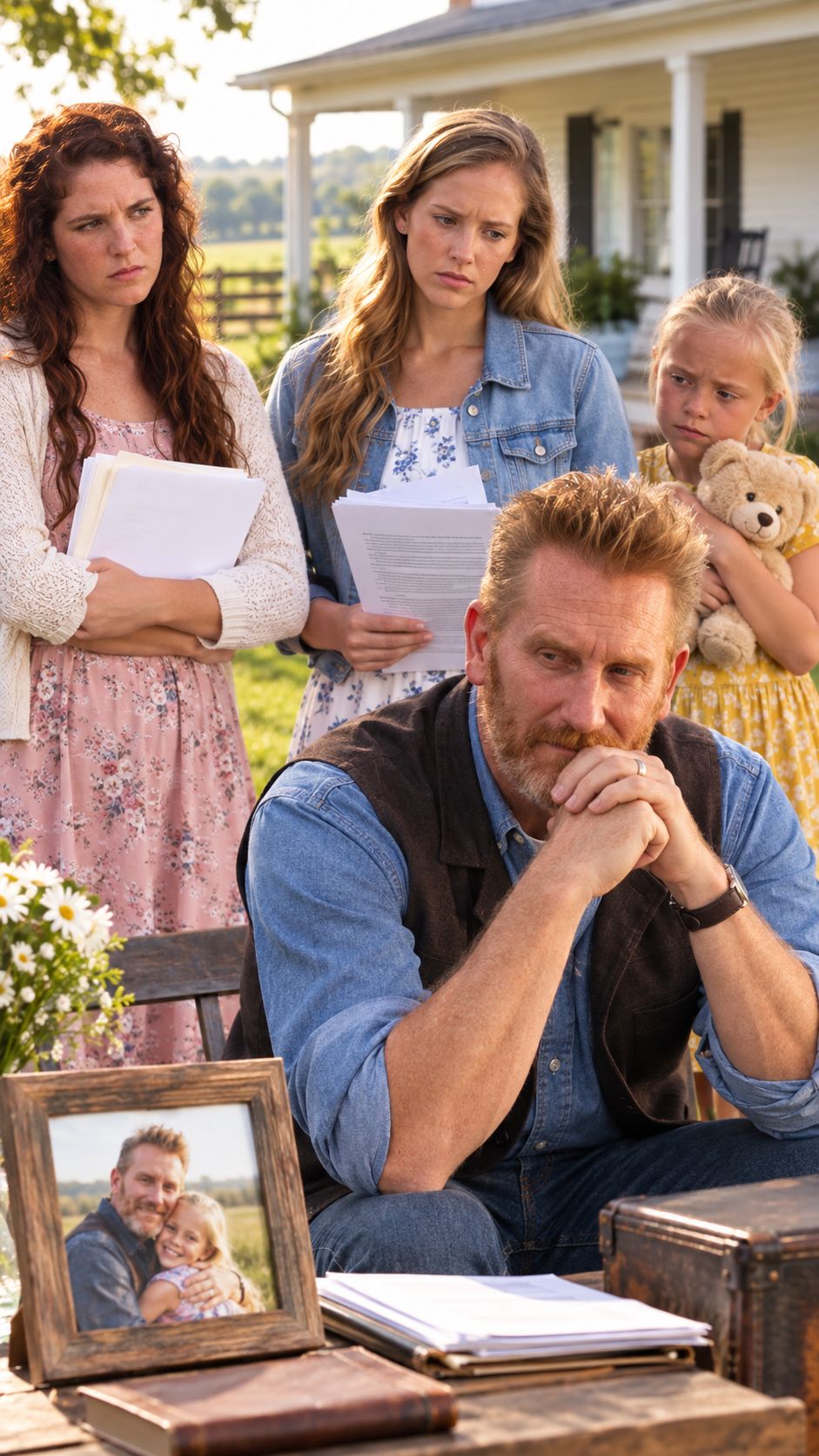
For years, Rory Feek was known to country fans as the quiet storyteller—the songwriter who built his life around faith, family, rural simplicity, and the memory of his late wife, Joey Feek. His public image was never really about scandal. It was about home, music, motherhood, fatherhood, and the belief that even heartbreak could eventually become something beautiful.
That is what makes the conflict involving his daughters so difficult for fans to understand.
Behind the peaceful images of farm life and country music lies a deeply fractured family relationship involving Rory’s two older daughters, Heidi Feek and Hopie Feek, and their much younger sister, Indiana Feek.
In 2024, Heidi and Hopie took legal action involving their father and their relationship with Indiana. Public reporting says they alleged that Rory had restricted their contact with their younger sister and raised concerns about Indiana’s safety and care. Because Indiana is a minor, many details of the legal proceedings have remained private. The case has continued to attract attention, while both sides have presented dramatically different versions of what happened.
And that is where this story becomes much bigger than a celebrity family feud.
It becomes a story about two sisters fighting to remain part of a little girl’s life—and a father insisting that he is protecting his daughter.
The Family Rift Did Not Begin in a Courtroom
The legal action may have shocked country fans, but according to accounts from both sides, the conflict had been developing for years.
Rory has described the breakdown as beginning around 2022, when Heidi expressed deep unhappiness with him. He says conversations and attempts at reconciliation failed, trust deteriorated, and communication eventually stopped.
According to Rory’s own account, the dispute later affected Indiana’s visits with her older sisters. He says that because of growing distrust and accusations involving Indiana’s welfare, he decided not to allow her to continue spending nights with Heidi and Hopie in Alabama. He also says Child Protective Services contacted him after a report concerning Indiana’s welfare.
Heidi and Hopie, however, have described the situation very differently.
They have said their contact with Indiana gradually disappeared. In an interview with Taste of Country, Hopie alleged that communication moved from regular FaceTime calls to increasingly limited contact, until the sisters could no longer speak with Indiana normally.
That difference is crucial.
Because from Rory’s perspective, he was making decisions as a parent.
From his daughters’ perspective, they were being separated from their little sister.
One father saw protection. Two daughters saw separation. And somewhere in the middle was a little girl who loved them all.
That emotional contradiction sits at the center of the entire dispute.
Why Did Heidi and Hopie Go to Court?
The sisters have publicly expressed concerns about Indiana’s safety and well-being, while also objecting to what they describe as their father’s decision to restrict their relationship with her.
Heidi stated in 2024 that she and Hopie no longer believed Indiana was safe under their father’s care. Their concerns extended beyond simply wanting visitation; they questioned aspects of Indiana’s environment and the people around her.
There were also allegations concerning Rory’s connections to Homestead Heritage, a religious community with which he has been associated. Heidi raised concerns about the environment and past abuse allegations involving individuals connected to the community.
Those are serious allegations—but they should not be confused with established facts. Rory has rejected the characterization that Indiana is unsafe and has defended the environment around his daughter. A spokesperson for Homestead Heritage has also disputed Heidi’s characterization of the organization’s history.
That distinction matters.
This is not a simple story where one side can automatically be labeled the villain.
The public has heard allegations, denials, competing accounts, and personal memories—but many of the underlying legal details remain confidential.
The Most Painful Part: Indiana Is Caught in the Middle
Perhaps the most heartbreaking element isn’t the courtroom.
It is Indiana herself.
Indiana was born in 2014 to Rory and Joey. After Joey’s death in 2016, Rory became her primary parent. Heidi and Hopie, meanwhile, had already been part of Indiana’s life as older sisters.
For Indiana, they weren’t political opponents.
They weren’t legal adversaries.
They were simply her sisters.
And that makes the estrangement particularly painful.
Reports have indicated that Heidi and Hopie have not seen Indiana for an extended period during the dispute. Rory has acknowledged that Indiana misses her sisters, while maintaining that the family conflict made continued contact difficult.
Imagine being a child and hearing that people you love cannot see each other.
Imagine knowing that one person says the separation is necessary while another says the separation itself is causing harm.
That is the emotional tragedy underneath the headlines.
Rory Feek’s Defense: “I Am Not a Perfect Father”
Rory has never claimed to have been a flawless parent.
In his public writings, he has acknowledged that mistakes were made and that the relationship with his older daughters became deeply damaged.
But he rejects the suggestion that he is deliberately harming Indiana.
He has repeatedly insisted that his youngest daughter is loved, cared for, and safe.
In one account, Rory wrote that he had tried to reconcile with Heidi and Hopie and even traveled to Alabama hoping to sit down with them. According to his account, the meeting did not happen, and he was told that future conversations should occur with a therapist or attorney present.
Rory saw that requirement as another barrier between himself and his daughters.
Heidi saw it differently.
She has said that communication had become so difficult that she and Hopie did not feel comfortable handling the situation without a third party.
That is a devastating point of disagreement.
Because when a family reaches the stage where father and daughters need lawyers or therapists simply to sit in the same room, the legal conflict is really only the visible surface of something much deeper.
Then Came the Fight Over Indiana’s Future
Rory’s later account reveals just how serious the dispute became.
In a post discussing the legal proceedings, he described a trial concerning Indiana’s future. He said the conflict had grown from a family disagreement into legal proceedings involving allegations about his parenting and the environment surrounding Indiana.
Most significantly, Rory said that Heidi wanted a legal agreement providing her with shared custody and parental rights concerning Indiana.
That changes the meaning of the dispute.
This was no longer simply:
“Let me see my sister.”
It had become:
“I believe I should have a legally protected role in my sister’s life.”
And that is an extraordinary step for any family.
It explains why emotions have become so intense on both sides.
The Wounds Go Back Even Further
Another reason this conflict is so complicated is that Heidi and Hopie have described painful experiences from their childhood.
In 2024, Heidi spoke publicly about incidents she remembers as neglectful or traumatic, including an injury she says was not treated promptly. Rory has offered a different explanation of that particular incident in his memoir, saying he sought medical guidance and was told that emergency treatment might not be necessary at the time.
These competing memories demonstrate why the dispute cannot simply be reduced to one disagreement about Indiana.
For Heidi and Hopie, the present appears to be connected to unresolved wounds from the past.
For Rory, however, the conflict seems to represent a painful breakdown between a father and daughters he says he still loves deeply.
And then there is Indiana.
The child who never asked for any of this.
The 2026 Chapter Made Everything More Emotional
The controversy returned to the spotlight dramatically in 2026 after Indiana underwent open-heart surgery.
Rory publicly shared updates about her medical crisis, including the frightening period after she was initially discharged and later hospitalized again. He described the situation as one in which the family feared they might lose her.
But instead of bringing the family together, the crisis reopened old wounds.
Heidi criticized Rory for publicly documenting Indiana’s vulnerable moments, accusing him of what she called the “ongoing exploitation” of her younger sister.
Hopie similarly questioned why photographs were being taken and shared during such a frightening medical emergency.
Their anger wasn’t simply about social media.
It was about trust.
They were saying, in essence, that they wanted to know what was happening to their sister directly—not discover it through their father’s public posts.
Rory’s supporters, on the other hand, can interpret those posts as a grieving and frightened father documenting his daughter’s fight for her life.
Again, two completely different emotional realities collide.
The Question Fans Can’t Stop Asking
At the heart of this story is a question that has no easy answer:
What happens when a father believes he is protecting his child, while his other children believe that protection is separating their family?
There is no viral headline big enough to contain that question.
There is no Facebook comment section capable of resolving it.
And there is certainly no easy villain.
What makes the story particularly painful is that both sides have spoken about love.
Hopie has said she loves her father and always will, while also saying that mistakes were made during her childhood and that she wants things to be different for Indiana.
Rory, meanwhile, has repeatedly expressed love for his daughters and a desire for reconciliation.
That is perhaps the saddest irony of all.
Sometimes families don’t fall apart because love disappears. Sometimes they fall apart because love becomes buried beneath hurt, mistrust, fear, and years of unresolved pain.
This Is Bigger Than Rory Feek
Country music has always been fascinated by family stories.
Songs about fathers.
Mothers.
Sisters.
Home.
Forgiveness.
Second chances.
But real life doesn’t always resolve itself in three verses and a final chorus.
The Feek family story is still unfolding. Public reports in 2026 indicate that the legal proceedings connected to the dispute have remained ongoing, while many details are unavailable because Indiana is a minor.
That means fans should be careful about declaring one side completely right or the other completely wrong.
The allegations made by Heidi and Hopie deserve to be distinguished from proven findings.
Rory’s denials and explanations deserve the same distinction.
And most importantly, Indiana deserves to be remembered as more than the center of a headline.
She is a daughter.
She is a sister.
She is a child who has already experienced enormous loss after the death of her mother, Joey Feek.
Whatever ultimately happens in court, the most meaningful victory would not be one side defeating the other.
It would be the possibility of a family finding its way back to one another.
Because behind the lawyers, accusations, social-media posts, and public statements are people who once sat around the same table.
People who once laughed together.
People who loved the same little girl.
And perhaps that is why this story hurts country fans so deeply.
The real tragedy isn’t that a family ended up in court. It’s that people who once called each other family reached a point where the courtroom became the only place left to be heard.
For now, the legal battle remains only one chapter in a much longer story.
And whether that story ends in permanent estrangement—or an extraordinary reconciliation—is something no headline can predict.
VIDEO: