 By admin
 INTRODUCTION:
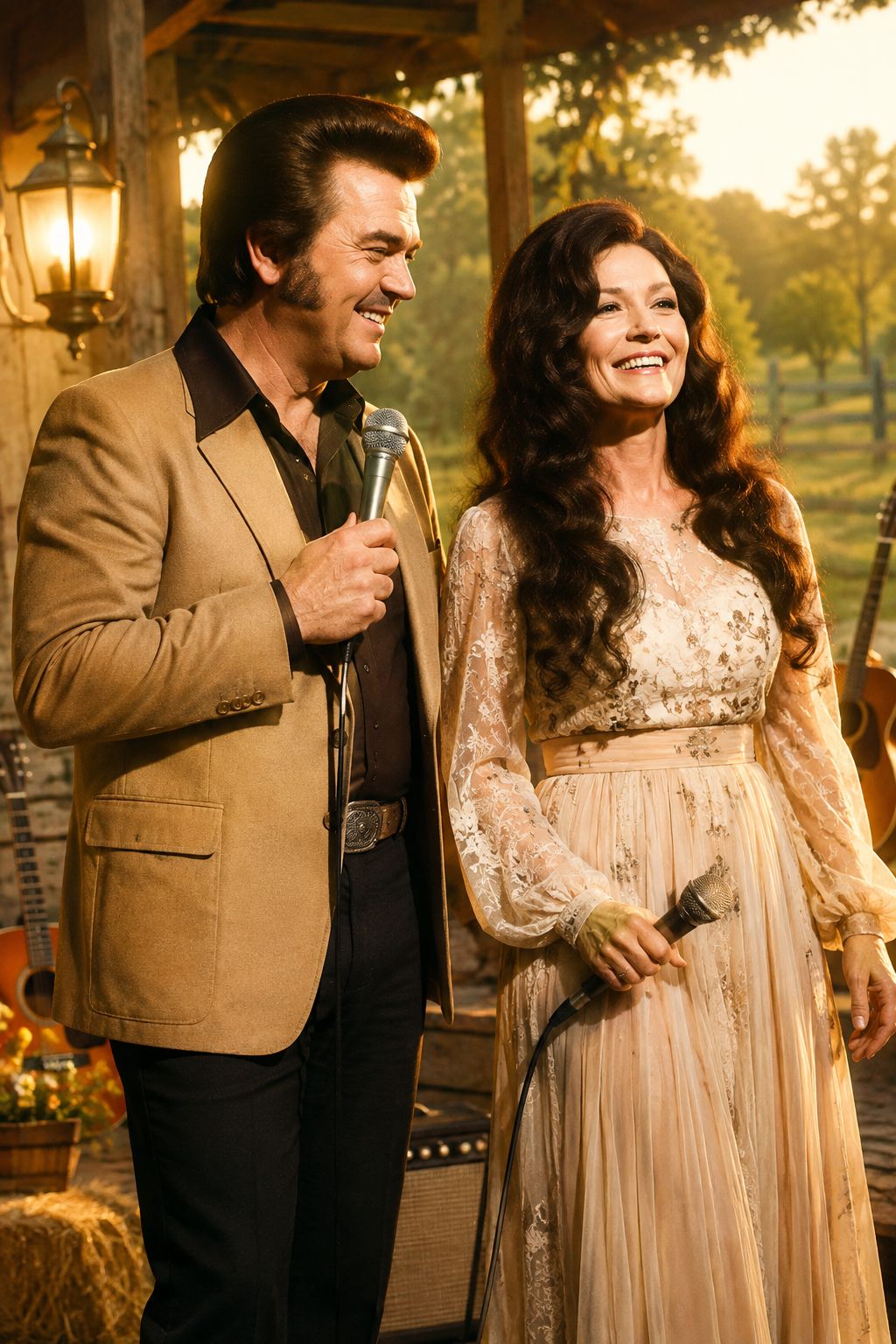
There are country music partnerships that become successful because the singers sound good together.
And then there are partnerships that become something much harder to explain.
Conway Twitty and Loretta Lynn belonged to the second category.
When their voices met, something happened that neither artist could quite create alone. Conway brought his deep, almost conversational intensity. Loretta brought a voice that could sound vulnerable one second and fearless the next. Together, they could turn a three-minute country song into what sounded like a private conversation overheard through a half-open door.
Their partnership produced one of the most celebrated male-female duos in country music history. The Country Music Hall of Fame notes that their first duet, “After the Fire Is Gone,” reached No. 1 in 1971 and launched a remarkable run that included four consecutive CMA Vocal Duo of the Year awards from 1972 through 1975.
But numbers only tell part of the story.
More than half a century later, fans still debate what made Conway and Loretta so extraordinary. Was it their voices? Their personalities? Their stage chemistry? Or was there something deeper hiding beneath the music?
Here are three lesser-known mysteries and overlooked truths that make their story even more fascinating.
Mystery No. 1: Their “chemistry” was powerful precisely because it was never completely explained
Listen to “After the Fire Is Gone.”
The song does not sound like two stars simply sharing a microphone. It sounds like two people having a conversation they probably should not be having.
That distinction mattered.
Conway and Loretta were exceptionally good at making fictional characters feel real. Their songs frequently dealt with complicated relationships, loneliness, temptation, separation, regret, and desire. Yet the emotional realism of those recordings sometimes encouraged listeners to blur the line between the performers and the characters they portrayed.
That is one of the enduring mysteries surrounding the duo.
Were Conway and Loretta really that emotionally connected?
The evidence points to a close professional and personal friendship, but the dramatic intensity audiences heard in the records should not automatically be interpreted as evidence of a secret romance. In fact, Loretta’s relationship with Conway was part of a larger musical and personal circle that included her husband, Mooney “Doo” Lynn. Entertainment Weekly has noted that Loretta regarded Conway as a very good friend of both herself and her husband.
That makes their story more interesting—not less.
They did not need a real-life romance to create believable romantic drama.
They needed trust.
The mystery was never whether Conway and Loretta were secretly lovers. The real mystery was how two friends could make fictional heartbreak sound so devastatingly real.
Their ability to inhabit the emotional world of a song was extraordinary. Conway understood how to hold back just enough emotion to make every word feel heavier. Loretta could answer him with a mixture of toughness and vulnerability.
That contrast became their secret weapon.
And perhaps that is why generations of listeners still hear something intimate in those recordings.
They weren’t necessarily hearing a confession.
They were hearing two masters of storytelling.
Mystery No. 2: Loretta’s husband was closer to the Conway-Loretta story than many fans realize
This is one of the most overlooked details in the history of the duo.
When people talk about Conway and Loretta, they often imagine a partnership that existed in its own little universe.
But it didn’t.
Loretta’s husband, Mooney “Doo” Lynn, was deeply connected to her career and, according to Entertainment Weekly’s account, was even involved in the story behind one of the duo’s biggest hits.
Consider “Louisiana Woman, Mississippi Man.”
The song became one of the defining recordings of the Conway-Loretta partnership, turning geography itself into a romantic obstacle. But according to Entertainment Weekly, Doo helped recognize that the song was right for the pair and predicted that Conway and Loretta could do it justice.
That changes the way the story feels.
Behind the famous chemistry wasn’t simply Conway and Loretta.
There were spouses, musicians, managers, songwriters, producers, road crews, and an entire Nashville ecosystem helping shape what audiences eventually heard.
The partnership was never merely an accidental collision of two voices.
It was a carefully developed artistic relationship.
And that helps explain another fascinating fact: Conway and Loretta were able to create songs that sounded emotionally dangerous without allowing their professional relationship to collapse under the weight of the material.
They understood the difference between performance and real life.
That boundary is easy to underestimate today.
Imagine performing a song about two people whose relationship is falling apart—and then walking offstage together as friends.
Imagine singing lyrics that suggest betrayal, longing, and forbidden affection in front of thousands of people while knowing that the audience may wonder how much of it is real.
That required enormous confidence.
And enormous discipline.
Mystery No. 3: The partnership survived because Conway never stopped being Conway—and Loretta never stopped being Loretta
There is a temptation to remember legendary duos as if they were inseparable personalities.
But Conway and Loretta were remarkably different artists.
Conway had already built a major solo career before the partnership became famous. His official biography describes a career that moved from early rock-and-roll success into country superstardom, eventually producing an extraordinary run of No. 1 hits.
Loretta, meanwhile, had become one of the most important female voices in country music, breaking barriers with songs drawn from women’s real-life experiences and perspectives. The Country Music Hall of Fame describes her as an artist who “broke new ground for women in country music.”
They did not need each other to become famous.
That may be exactly why they worked so well together.
Conway could disappear into the role of the wounded man without losing his identity as a solo superstar.
Loretta could become the fiery, vulnerable, stubborn woman in the story without surrendering her own artistic identity.
Their partnership enhanced both careers rather than replacing either one.
And the results were extraordinary.
The Country Music Hall of Fame records that Conway and Loretta won four CMA Vocal Duo of the Year awards, while their recordings included “After the Fire Is Gone,” “Lead Me On,” “Louisiana Woman, Mississippi Man,” and “Feelins’.” Their first No. 1 duet also earned them a Grammy.
That is not simply a successful collaboration.
That is a musical institution.
The final mystery: Why does their music still feel so alive?
Perhaps the greatest mystery isn’t hidden in some backstage scandal.
It is hidden in the recordings themselves.
Country music has changed dramatically since Conway and Loretta ruled the charts. Production techniques have changed. Radio has changed. The music business has changed.
But put on “After the Fire Is Gone” today, and the emotional tension remains.
Play “Lead Me On,” and the conversation still feels immediate.
Play “Louisiana Woman, Mississippi Man,” and the personalities still jump out of the speakers.
That is the mark of great country music.
It does not require you to understand every detail of the performers’ private lives.
It simply makes you feel something.
And perhaps that is why the Conway Twitty and Loretta Lynn story has survived for so long.
They weren’t simply a man and a woman singing duets.
They represented two sides of country music itself: heartbreak and hope, toughness and tenderness, humor and pain, independence and connection.
Their voices worked because their differences worked.
Their stories worked because they understood how to make fictional characters believable.
And their legacy endured because the emotions they captured were not tied to one decade.
More than fifty years after “After the Fire Is Gone” reached No. 1, the song still sounds like somebody’s secret.
That may be the greatest mystery of all.
Conway Twitty and Loretta Lynn didn’t need a secret romance to become unforgettable. Their real secret was knowing how to make millions of strangers believe, for three minutes, that they were listening to something deeply personal.
That is why the legend refuses to disappear.
And that is why, even after all these years, we may still not know everything about Conway Twitty and Loretta Lynn.
Maybe we never will.
But perhaps that is exactly how a great country story is supposed to end—with one last unanswered question, one final chord, and the feeling that somewhere between the first note and the last, these two legends told us more about love, loneliness, and human nature than any biography ever could.
VIDEO: