 By admin
INTRODUCTION:
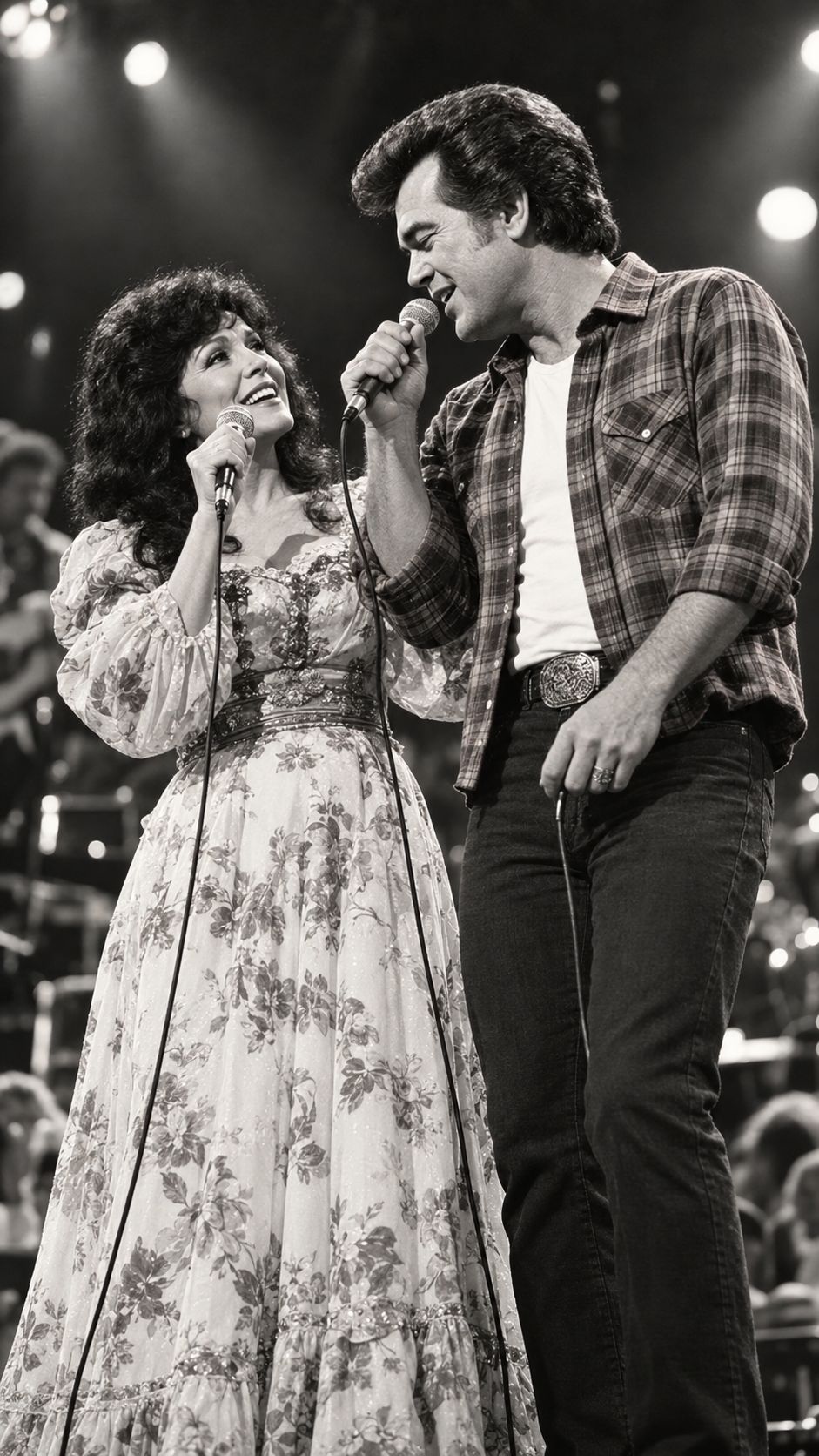
There are certain songs that do more than entertain us. They reach into the deepest corners of our hearts, awaken memories we thought we had forgotten, and remind us of the people, promises, and painful goodbyes that shaped our lives. For generations of country music fans, the unforgettable recordings of Conway Twitty and Loretta Lynn have carried precisely that kind of emotional power.
When these two legendary voices came together, something extraordinary happened. Conway Twitty, with his rich, tender delivery and remarkable ability to communicate vulnerability, met Loretta Lynn, whose unmistakable voice carried the strength, honesty, and hard-earned wisdom of a woman who understood life’s complicated truths. Together, they created musical moments that felt less like performances and more like private conversations between two people standing at the crossroads of love and heartbreak.
Their songs spoke of longing, difficult choices, broken promises, and the fragile hope that keeps people holding on even when everything seems lost. The magic was never simply about beautiful harmonies. It was about the emotions hidden between the lyrics, the hesitation in a phrase, and the way one voice seemed to understand what the other could not quite say.
Decades later, their music continues to resonate with listeners of different ages. For some, it brings back memories of a first love. For others, it recalls a marriage that survived hardship or a goodbye that never truly stopped hurting.
And perhaps that is the greatest secret behind their enduring legacy: Conway and Loretta did not merely sing about human emotions. They made listeners feel understood.
1. The Secret Was Never Just Their Voices — It Was the Truth Behind Every Word
The extraordinary partnership between Conway Twitty and Loretta Lynn began to take shape in the early 1970s, when both artists had already established themselves as formidable performers. Neither needed another singer to define a career. Yet when their voices came together, they discovered a musical connection that would become one of the most recognizable partnerships in country music.
Their collaboration worked because they brought different emotional qualities to the same story.
Conway Twitty possessed a smooth, expressive baritone that could communicate tenderness without sounding weak. He understood the power of restraint. Sometimes, the quieter his delivery became, the more deeply a lyric seemed to hurt.
Loretta Lynn, meanwhile, sang with a directness that made complicated emotions feel immediate. Her voice could be warm one moment and painfully honest the next. She did not need to exaggerate sadness to make listeners believe it.
When the two performed together, their differences became their greatest strength.
Conway often sounded like a man wrestling with feelings he could barely admit. Loretta could sound like a woman who already understood the consequences but still needed to speak her truth.
That contrast created tension, and tension is at the heart of great storytelling.
Consider what happens when two people sing about a love that cannot survive, a relationship that has lost its warmth, or a decision that will hurt someone regardless of the outcome. A solo performance can express one person’s perspective. A duet can reveal the emotional conflict between two people at the same time.
That is what Conway and Loretta did so effectively.
Their performances made listeners feel as though they were overhearing private conversations that had somehow found their way onto a record.
The audience was not simply listening for a beautiful melody. It was waiting to discover what would happen next.
And when the final note faded, the emotional story often continued in the listener’s imagination.
2. After the Fire Is Gone: When Love Survives but Happiness Disappears

Few recordings better demonstrate the emotional power of this partnership than After the Fire Is Gone, the duet that gave Conway Twitty and Loretta Lynn their first No. 1 country hit together in 1971.
The song explores a difficult and deeply human situation: two people who feel emotionally neglected in their existing relationships and find themselves drawn toward one another.
Its subject is uncomfortable because it refuses to offer an easy answer.
What happens when affection disappears from a marriage? What happens when someone who once felt like home becomes a stranger? And what should a person do when emotional comfort appears somewhere it should not?
These are questions that cannot be resolved simply by declaring someone right or wrong.
The song’s strength lies in the tension between desire and conscience. The characters recognize that their choices carry consequences, yet their loneliness remains real.
Conway’s restrained delivery gives the story a sense of quiet resignation. He sounds like someone who understands that a situation has become complicated beyond repair. Loretta’s expressive voice brings another dimension, making the emotional cost impossible to ignore.
Together, they transform a controversial subject into a story about human vulnerability.
Sometimes, the saddest part of a relationship is not the moment love ends. It is the long period when two people realize that something precious has already disappeared.
That is the emotional territory the song occupies.
Listeners who have experienced loneliness inside a relationship may hear their own memories reflected in its story. Others may remember watching someone they loved struggle with a painful decision.
The song does not require listeners to approve of its characters. It asks them to recognize the feelings that make the situation difficult.
That distinction is part of what makes the recording endure.
The success of After the Fire Is Gone also demonstrated that country music could address complicated adult relationships without abandoning the genre’s traditional emphasis on storytelling. The recording became a landmark in the duo’s career and earned them a Grammy Award.
Yet its lasting significance goes beyond awards.
It reminds us that a song can be emotionally honest without pretending that life is simple.
3. As Soon as I Hang Up the Phone: The Heartbreaking Moment Denial Becomes Reality

If After the Fire Is Gone explores the slow erosion of emotional happiness, As Soon as I Hang Up the Phone captures a more immediate kind of heartbreak: the moment someone realizes that the relationship they desperately want to save may already be over.
Released in 1974, the song uses an unusual musical structure. Conway Twitty delivers his side largely through spoken dialogue, while Loretta Lynn responds through song.
That creative decision makes the recording feel remarkably intimate.
Instead of presenting two polished voices singing parallel verses, the performance resembles a telephone conversation between two people who are no longer experiencing the same reality.
At first, Loretta’s character struggles to accept what she is hearing. She attempts to maintain hope, responding as though the situation might still be misunderstood or repaired.
Conway’s character, however, appears to be moving toward a final goodbye.
The emotional imbalance is devastating.
One person is still searching for a way to keep the relationship alive. The other seems determined to leave.
Anyone who has experienced an unexpected breakup may recognize that painful difference. Sometimes, the end of a relationship arrives at different times for the two people involved. One has been preparing for it privately, while the other is only beginning to understand what is happening.
The person delivering the news may have spent weeks or months thinking about the decision. The person receiving it may feel as though the entire future has collapsed in a single conversation.
As Soon as I Hang Up the Phone makes that difference the center of its drama.
Loretta’s performance is particularly effective because her character’s emotions change as the conversation progresses. The hope that initially sustains her becomes increasingly difficult to maintain.
Conway’s spoken delivery adds a different kind of pain. His words do not need the full force of a sung melody to communicate finality. Their ordinary, conversational quality makes the situation feel almost unbearably real.
There are goodbyes that happen in a single conversation, but the heart can spend years trying to understand them.
That is why the song remains so memorable.
It captures the helplessness of waiting for words that might change everything, only to discover that no words can restore what has already been lost.
For listeners who have ever stared at a silent telephone, waited for a call that never came, or replayed a final conversation in their minds, the song offers a familiar kind of sadness.
It does not promise that heartbreak will make sense.
It simply allows the feeling to exist.
4. Lead Me On: The Dangerous Comfort of Wanting What You Should Resist

Another important recording in the duo’s catalog is Lead Me On, a song that explores the complicated space between attraction, uncertainty, and personal responsibility.
The title itself carries an uncomfortable question.
When someone asks another person to lead them on, are they surrendering control? Are they asking for permission to ignore their better judgment? Or are they admitting that the desire is already stronger than their resistance?
The emotional appeal of the song comes from that uncertainty.
Great country music has always understood that people do not make every decision with a perfectly clear conscience. They can recognize the risks of a situation and still feel drawn toward it. They can understand the difference between what they want and what they believe they should do.
That contradiction creates powerful storytelling.
Loretta Lynn brought a sense of emotional immediacy to such material. Her performances often made a character’s uncertainty feel understandable rather than abstract.
Conway Twitty, with his measured phrasing, could communicate the pull of temptation without making it sound like a simple declaration of romance.
Together, they created a dialogue in which the listener could sense the characters negotiating with themselves as much as with each other.
This is one of the defining strengths of their duet partnership: neither singer had to explain every feeling outright. The tension between their voices often communicated what the lyrics left unsaid.
In real life, difficult emotional decisions rarely arrive with a clear soundtrack or a narrator explaining the consequences. They develop through small moments, private doubts, and conversations that seem harmless until they are no longer harmless.
Lead Me On turns that gradual process into music.
Its emotional impact comes from recognizing how easily a person can become entangled in a situation that began with a seemingly simple attraction.
And that is why the song’s subject continues to feel relevant. The details of relationships may change across generations, but the struggle between desire and responsibility remains familiar.
5. Louisiana Woman, Mississippi Man: The Other Side of Their Musical Magic

Not every memorable Conway and Loretta recording depends on heartbreak. One reason their partnership remained so compelling was their ability to move between emotional extremes.
Louisiana Woman, Mississippi Man, released in 1973, showcases the lively, playful side of their musical chemistry.
Rather than focusing on a relationship falling apart, the song celebrates two strong personalities separated by geography but connected by attraction and determination.
The energy is immediate. Their voices respond to one another with a sense of movement, as though each singer is challenging the other to keep up.
Loretta brings spirited confidence, while Conway adds his characteristic smoothness and charm. Their exchanges give the song a conversational rhythm that feels spontaneous and entertaining.
This difference matters because emotional storytelling is not limited to sadness.
Joy, excitement, stubbornness, flirtation, and humor can reveal just as much about human relationships as grief does. A partnership that can communicate only one emotion eventually becomes predictable. A partnership that can move between tenderness and playfulness feels alive.
Louisiana Woman, Mississippi Man demonstrates that range.
It also highlights an important feature of their appeal: the singers never seemed to disappear into one another. Both retained their individual personalities, and those personalities created the spark.
Their musical interaction was not simply a matter of blending two voices into a harmonious sound. It was an exchange between two recognizable characters.
That is why the song remains such a natural choice for fans revisiting the duo’s catalog. It offers a reminder that their legacy is not built exclusively on tears.
It is also built on laughter, energy, and the thrill of hearing two seasoned performers genuinely complement each other.
And when listeners move from this lively recording back to a heartbreaking ballad, the contrast makes the emotional depth of their partnership even clearer.
6. Feelins’: When the Heart Speaks Before the Mind Can Explain

With Feelins’, the emotional focus shifts toward the powerful, sometimes confusing experience of attraction itself.
The title suggests something immediate and instinctive. Feelings can emerge before a person has decided what to do about them. They can complicate an otherwise ordinary conversation, turn a familiar friendship into something uncertain, and make even the simplest interaction seem full of possibility.
That is fertile ground for a duet.
The presence of two voices allows attraction to become an exchange rather than a solitary confession. Each singer contributes a different perspective, and the listener becomes aware of the emotional space between them.
The recording also illustrates the flexibility of Conway Twitty and Loretta Lynn as interpreters. Their chemistry did not depend entirely on tragic material. They could explore romantic tension with a lighter touch while maintaining the unmistakable character of their individual voices.
Their partnership worked because the singers understood timing, phrasing, and the importance of reacting to one another.
A successful duet requires more than two people singing in tune. It requires listening. One performer must leave room for the other to respond, and each must understand how a change in tone can alter the meaning of a line.
That responsiveness made their recordings feel like conversations rather than carefully arranged vocal exercises.
In Feelins’, the emotional appeal lies in the familiar experience of trying to understand an attraction that refuses to remain neatly defined.
Many listeners can remember a moment when a feeling changed the meaning of a friendship or when an unspoken possibility made an ordinary encounter feel extraordinary.
Country music has always excelled at turning such moments into stories, and this recording demonstrates why Conway and Loretta were so effective at bringing those stories to life.
7. The Friendship Behind the Performances — And Why the Rumors Never Told the Whole Story
The emotional intensity of the duo’s recordings was so convincing that audiences sometimes wondered whether their musical connection reflected a secret romance.
That speculation became part of the mythology surrounding Conway Twitty and Loretta Lynn.
But the distinction between performance and private life is important.
Loretta Lynn publicly described the pair as friends rather than lovers. Their ability to convey romantic tension was a testament to their interpretive skills, not proof that the stories in their songs described their personal relationship.
This is an essential part of understanding their legacy.
Actors can portray heartbreak without experiencing the exact events of a character’s life. Novelists can describe grief without reproducing a single personal memory. Great singers, too, can communicate emotions that belong to a fictional story while drawing on their broader understanding of human experience.
Conway and Loretta possessed that gift.
They knew how to make a lyric feel personal without requiring the audience to believe every word was autobiographical.
Their friendship also gave the partnership a foundation of familiarity. They could anticipate one another’s phrasing, recognize the right moment to respond, and allow a performance to develop naturally.
The result was a convincing musical dialogue that often felt more intimate than a conventional duet.
The public fascination surrounding their chemistry demonstrates how powerfully listeners respond when a performance feels authentic. People want to believe that the emotion they hear must come from a real-life story.
Sometimes, however, the truth is just as remarkable: two talented artists understand a song so deeply that they can make millions of strangers feel as though they have lived it themselves.
That is not a lesser form of authenticity.
It is the essence of interpretation.
8. Why Their Songs Still Make Listeners Cry Decades Later

The continued appeal of Conway Twitty and Loretta Lynn is not simply a matter of nostalgia.
Nostalgia certainly plays a role. A familiar melody can transport a listener to another time, bringing back a childhood home, a long drive through the countryside, or an evening spent listening to the radio with someone who is no longer there.
But nostalgia alone cannot explain why younger listeners continue to discover these recordings.
The deeper reason is that their songs deal with emotional experiences that remain recognizable across generations.
They understood that love is rarely simple
The characters in their songs do not always make the right decisions. They struggle with temptation, loneliness, uncertainty, and regret.
That complexity gives the music its emotional credibility.
Real relationships are not always neat stories with clear heroes and villains. People can love one another and still cause pain. They can recognize a mistake and still struggle to change course. They can want to leave and simultaneously fear the consequences of leaving.
Songs that acknowledge these contradictions often remain meaningful long after their original release.
They trusted the power of the human voice
Modern recordings can use elaborate production to create atmosphere, but Conway and Loretta demonstrated how much emotional information a voice can carry on its own.
A pause can suggest hesitation. A restrained phrase can communicate regret. A change in emphasis can reveal that a character has understood something they did not understand a moment earlier.
Their vocal performances rewarded close listening.
Listeners could return to the same recording years later and discover a new detail because their own experiences had changed.
They gave sadness room to breathe
The best country heartbreak songs do not rush to resolve every feeling.
They allow the listener to remain with uncertainty, to recognize the sadness of an ending, and to acknowledge that some experiences never become entirely painless.
There is comfort in that honesty.
A person grieving a relationship may not need a song that promises everything will work out. Sometimes, they need a song that admits the situation hurts.
The music of Conway Twitty and Loretta Lynn often provides precisely that kind of companionship.
They made personal stories feel universal
Their songs may begin with specific characters and circumstances, but the emotions reach beyond those details.
The listener supplies their own memories. The song becomes connected to a personal history that the artists could never have known.
For one person, a particular duet may recall a first love. For another, it may bring back the difficult final months of a marriage. For someone else, it may simply evoke a beloved parent who played country records every Sunday afternoon.
The recording remains the same.
The meaning changes with the listener.
And that is how a song becomes part of a family’s emotional inheritance.
9. Conway Twitty’s Passing Made Their Shared Musical History Even More Precious
When Conway Twitty died on June 5, 1993, the country music world lost one of its most recognizable voices.
For listeners who had followed his partnership with Loretta Lynn, his death also changed the experience of hearing their duets.
Recordings that once captured two living performers exchanging lines became lasting documents of a musical relationship that could no longer continue in the same way.
There is something particularly moving about listening to a duet after one of its singers has passed away.
A voice that once seemed present in the room now arrives from another time. Its warmth remains, but the circumstances surrounding it have changed.
The lyrics may not have been written as farewells, yet listeners can hear them differently after learning that the person singing one part is gone.
A line about separation may suddenly carry another meaning. A tender harmony may feel like a reminder of how briefly people share the same moment. Even a playful exchange can become precious because it preserves a connection that once existed beyond the recording studio.
For Loretta Lynn, Conway was a longtime musical partner and friend whose voice had become a familiar part of her professional life.
Their recorded work allowed that partnership to remain accessible to future generations.
This does not mean every song should be interpreted as a memorial. Their catalog includes too much humor, energy, and variety for such a narrow reading.
But time inevitably adds new layers to familiar music.
A recording can preserve not only a melody but also the sound of a person at a particular moment in history. Long after the performance ends, that sound remains available to anyone willing to listen.
Perhaps that is one of music’s most extraordinary gifts: it allows the past to speak without pretending that the past can return.
10. The Greatest Legacy of Conway and Loretta Is the Emotion They Left Behind
The remarkable story of Conway Twitty and Loretta Lynn is often told through awards, chart-topping singles, memorable performances, and speculation about their chemistry.
Those achievements matter. Their partnership helped define an important period in country music, and their recordings remain among the genre’s most recognizable duets.
Yet the deepest measure of their success is harder to quantify.
It lives in the listener who hears After the Fire Is Gone and thinks about a relationship that slowly lost its warmth.
It lives in the person who hears As Soon as I Hang Up the Phone and remembers the moment a difficult truth finally became impossible to deny.
It lives in the smile that appears when Louisiana Woman, Mississippi Man begins playing, bringing back the excitement of a simpler afternoon.
And it lives in the quiet recognition that a song recorded decades ago can still describe a feeling that seems to belong entirely to the present.
Conway Twitty brought tenderness, restraint, and a distinctive vocal warmth to the partnership. Loretta Lynn brought honesty, strength, and an unmistakable emotional directness. Neither singer needed to imitate the other. Their differences were what made their shared recordings so compelling.
Together, they demonstrated that country music’s greatest power often comes from its willingness to confront the feelings people struggle to express in ordinary conversation.
They sang about imperfect relationships without pretending that every question had an easy answer. They made room for longing, regret, affection, humor, and hope. Most importantly, they trusted their listeners to recognize themselves in the stories.
That trust is one reason their music continues to matter.
The world has changed dramatically since their greatest duets first reached country radio. The ways people communicate have changed. Relationships have changed. Entire generations have grown up and discovered their own favorite artists.
But the emotions at the heart of these songs remain familiar.
People still fall in love. They still make mistakes. They still struggle to say goodbye. They still search for music that can give a voice to feelings they cannot quite explain.
And somewhere, a familiar melody begins playing.
For a few minutes, the years seem to fall away. Two unmistakable voices meet again, and the listener is reminded of someone, something, or some part of life that will always matter.
That is the enduring magic of Conway Twitty and Loretta Lynn.
Their greatest songs did not promise that love would always be easy or that heartbreak would always heal. They offered something more honest: the recognition that human feelings are complicated, that memories can be painful and beautiful at the same time, and that music can help us carry both.
Some songs become hits. Others become memories. The greatest Conway Twitty and Loretta Lynn duets became both.
VIDEO: