 By admin
INTRODUCTION:
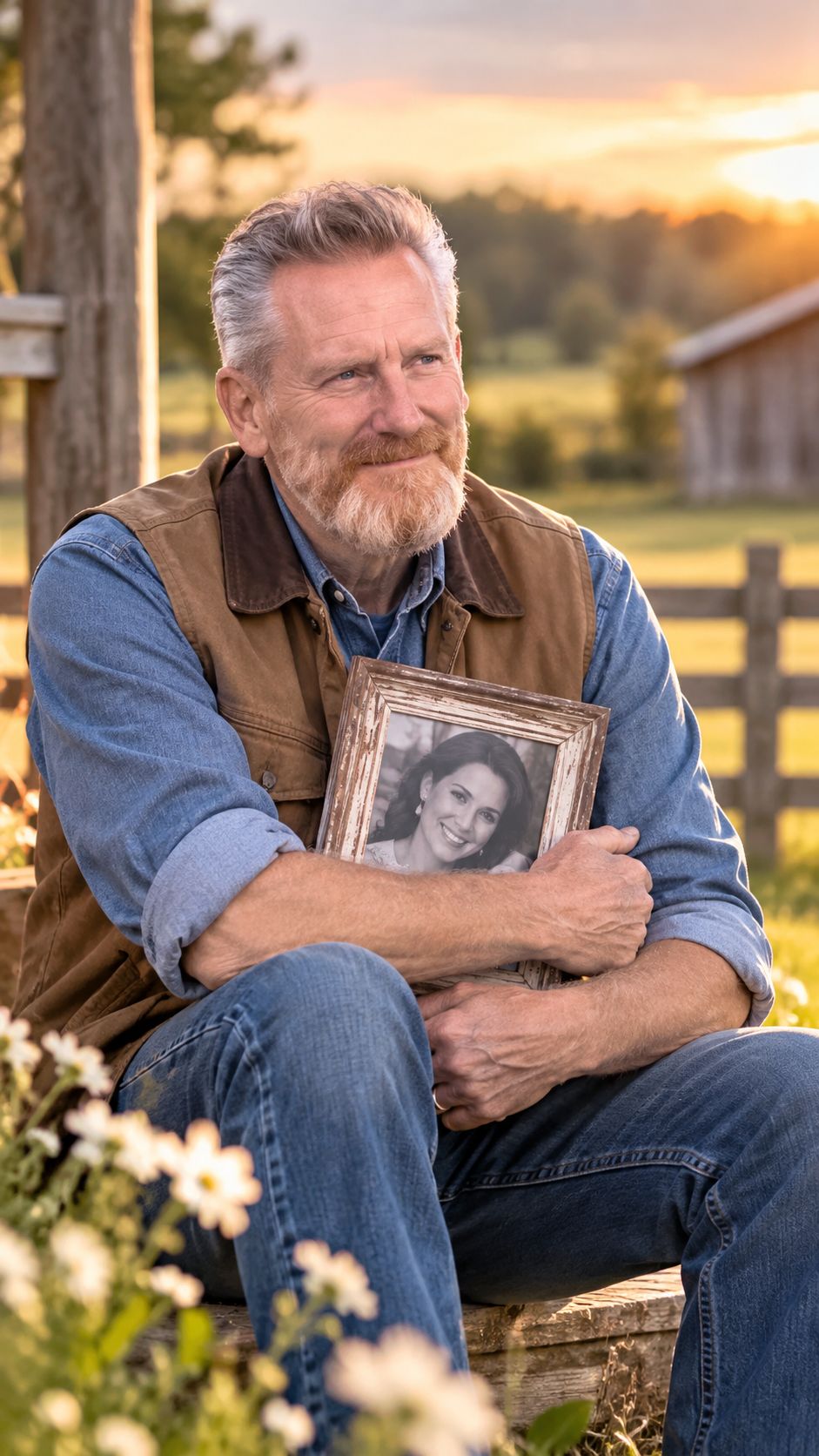
There are some smiles in country music that seem to carry an entire lifetime inside them.
Rory Feek’s has always been one of those smiles.
Warm. Quiet. Almost disarmingly simple.
For years, fans saw the songwriter and performer as the bearded country storyteller in boots and overalls—the man who could turn an ordinary farm, an old guitar, or a family moment into something deeply moving. Alongside Joey Feek, he built a musical partnership that felt refreshingly human in an industry often dominated by spectacle.
But behind that gentle smile was a story that became one of country music’s most painful modern chapters.
It was a story about love, faith, a young mother, a little daughter, and a husband forced to imagine a future he never wanted.
And long after the applause stopped, Rory was left carrying the memories alone.


The Love Story That Looked Almost Too Simple to Be True
Before tragedy changed everything, Rory and Joey Feek represented something rare in country music.
They weren’t simply musical partners. They were husband and wife who seemed to bring their private life onto the stage without turning it into a performance.
They married in 2002, and eventually became known professionally as Joey + Rory. Their music was rooted in traditional country, gospel, family, faith, and the small details of rural life.
Their rise was remarkable.
After appearing on the television competition Can You Duet?, the couple found a growing audience and eventually earned major recognition, including an ACM Award and a Grammy for their gospel album Hymns That Are Important to Us.
Yet the story that made millions of people feel connected to them wasn’t really about awards.
It was about how ordinary their happiness seemed.
They lived on a farm in Tennessee. They performed together. They raised a family. They laughed together.
And then everything changed.
The Diagnosis That Turned Their World Upside Down
In 2014, shortly after the birth of their daughter Indiana, doctors discovered that Joey had cervical cancer.
The diagnosis came only weeks after Indiana was born. Suddenly, the couple’s dreams for their growing family collided with an illness neither of them could simply sing their way through.
Joey underwent treatment, and for a time there was reason to hope.
But the cancer returned.
What followed was not a single dramatic moment, but a long, painful season in which Rory watched the woman he loved fight for every additional day with their daughter.
And that is where his gentle smile becomes difficult to understand.
Because sometimes a person doesn’t smile because life is easy.
Sometimes they smile because love has taught them how to keep going.
“Nothing prepares you for this.”
Those words, reported by CBS, captured the contradiction at the center of Rory’s experience. They had time to understand what might happen, but understanding something intellectually is very different from accepting it emotionally.
Joey Was Fighting for More Than Herself
One of the most heartbreaking elements of Joey’s final chapter was her determination to remain a mother for as long as possible.
Even while battling cancer, she and Rory continued working on music.
Their final album together, Hymns That Are Important to Us, became something much bigger than a collection of songs.
It became a time capsule.
Joey recorded vocals while undergoing treatment, sometimes singing from hotel rooms or from home when she felt well enough. Rory later described those sessions as moments he would never forget.
Imagine that.
A woman facing an illness that was taking her strength, still finding enough energy to sing.
Not because she didn’t understand what was happening.
But because she did.
The album eventually became a major success, and Joey lived long enough to see its release and the enormous response from fans.
In retrospect, every harmony between them sounds different.
Every lyric feels heavier.
Every photograph becomes more precious.
Then Came the Moment Rory Could Never Prepare For
Joey’s condition eventually became terminal.
She entered hospice care, and the family returned home.
Rory later described the emotional reality with remarkable honesty. He had believed he was preparing himself for Joey’s death, but when the moment actually approached, preparation suddenly seemed meaningless.
“I think she knew I was ready. I wasn’t!”
That confession may explain Rory Feek more than any song ever could.
He wasn’t trying to present himself as the invincible husband.
He wasn’t pretending he had everything under control.
He was simply a man who loved his wife and didn’t want to lose her.
Joey died on March 4, 2016, at the age of 40 after her battle with cancer.
She left behind Rory and their young daughter, Indiana.
And Rory’s life entered a completely different chapter.
The Little Girl Who Still Had Her Father’s Hand to Hold
Perhaps the most heartbreaking part wasn’t only losing Joey.
It was knowing that Indiana was still so young.
She was only two years old when her mother died.
Rory suddenly had to navigate fatherhood without the person who had shared every ordinary responsibility and every extraordinary dream with him.
In an interview after Joey’s death, Rory spoke about how music helped him keep her memory alive.
He and Indiana would listen to Hymns That Are Important to Us together. Sometimes the music made them smile. Other times, Rory found himself emotional while doing something as ordinary as making breakfast.
That detail says everything.
Grief doesn’t always arrive during funerals.
Sometimes it arrives while you’re making eggs.
Sometimes it’s sitting quietly in the passenger seat.
Sometimes it is a song coming through the speakers when you least expect it.
And sometimes it looks exactly like a gentle smile.
“Hearing the music, she’s still alive.”
Rory’s words revealed the role music had begun to play in his grieving process. Rather than completely running away from the memories, he chose to keep Joey present through recordings, photographs, stories, and the life they had built together.
The Stage Was Never the Same Without Her
For a while, Rory couldn’t imagine performing alone.
That makes sense.
For years, the audience hadn’t simply been watching Rory.
They had been watching Rory and Joey.
The silence left by one person can sometimes feel louder than an entire arena.
When Rory eventually began performing again, he described the experience as surreal and strange. He had to discover who he was as an artist without the woman who had become inseparable from his musical identity.
Yet he continued.
Not because the loss disappeared.
Because life continued.
And perhaps that distinction is the heart of Rory Feek’s story.
He didn’t “move on” in the simplistic sense.
He moved forward while carrying someone with him.
Why Gentle Man Feels So Different
Years after Joey’s death, Rory released his solo album Gentle Man.
The title itself feels almost symbolic.
Here was a man who had experienced profound loss, yet his response wasn’t to become bitter or loud.
He returned to storytelling.
To acoustic country.
To the quiet emotional territory where he had always seemed most comfortable.
The album included collaborations with artists such as Dolly Parton, Vince Gill, Lee Ann Womack, and Ricky Skaggs, and Rory described the songs as deeply personal.
He also believed Joey would have appreciated the project.
That matters.
Because the album wasn’t simply Rory proving that he could continue without her.
It was Rory continuing with the memory of her woven into the music.
The Smile Became Part of the Survival
Perhaps this is why Rory’s public image can be so easily misunderstood.
A photograph may show him smiling.
A performance may show him laughing.
A song may sound peaceful.
But none of those things erase what came before.
Grief doesn’t always look like tears.
Sometimes grief looks like tending a farm.
Sometimes it looks like raising a child.
Sometimes it looks like stepping onto a stage again after swearing you never would.
Sometimes it looks like telling an old story for the hundredth time because telling it means the person you lost is still part of the conversation.
And sometimes it looks like smiling.
The deepest grief isn’t always the grief we can see. Sometimes it is the life someone quietly learns to carry.
A Story That Still Resonates With Country Fans
The story of Rory and Joey Feek continues to resonate because it was never simply a celebrity tragedy.
It was painfully recognizable.
A husband lost his wife.
A child lost her mother.
A family had to redefine itself.
A musician had to discover how to make music after losing the person who had made those songs feel complete.
And yet, through all of it, Rory continued telling stories.
The Country Music Hall of Fame and Museum has highlighted Rory’s reflections on Joey, their marriage, his writing, and the grieving process, underscoring how deeply those experiences became part of his creative life.
That may be the greatest legacy of all.
Not that Rory escaped tragedy.
He didn’t.
Not that time erased the pain.
It didn’t.
But he found a way to carry love and loss in the same heart.
And maybe that’s why his smile still affects people.
Because when fans see Rory Feek smiling today, they aren’t necessarily seeing a man who forgot the past.
They may be seeing someone who learned that remembering can be its own form of love.
Behind that quiet smile is a woman whose voice still lives inside recordings.
A daughter who grew up surrounded by her mother’s memory.
A farm filled with stories.
A songwriter who learned that some of life’s most painful chapters can become the songs that outlive us.
And somewhere beneath every gentle smile is the same truth that country music has always understood better than most:
The people we love may leave the room, but the songs, memories, and love they gave us can stay forever.
VIDEO: