 By admin
INTRODUCTION:
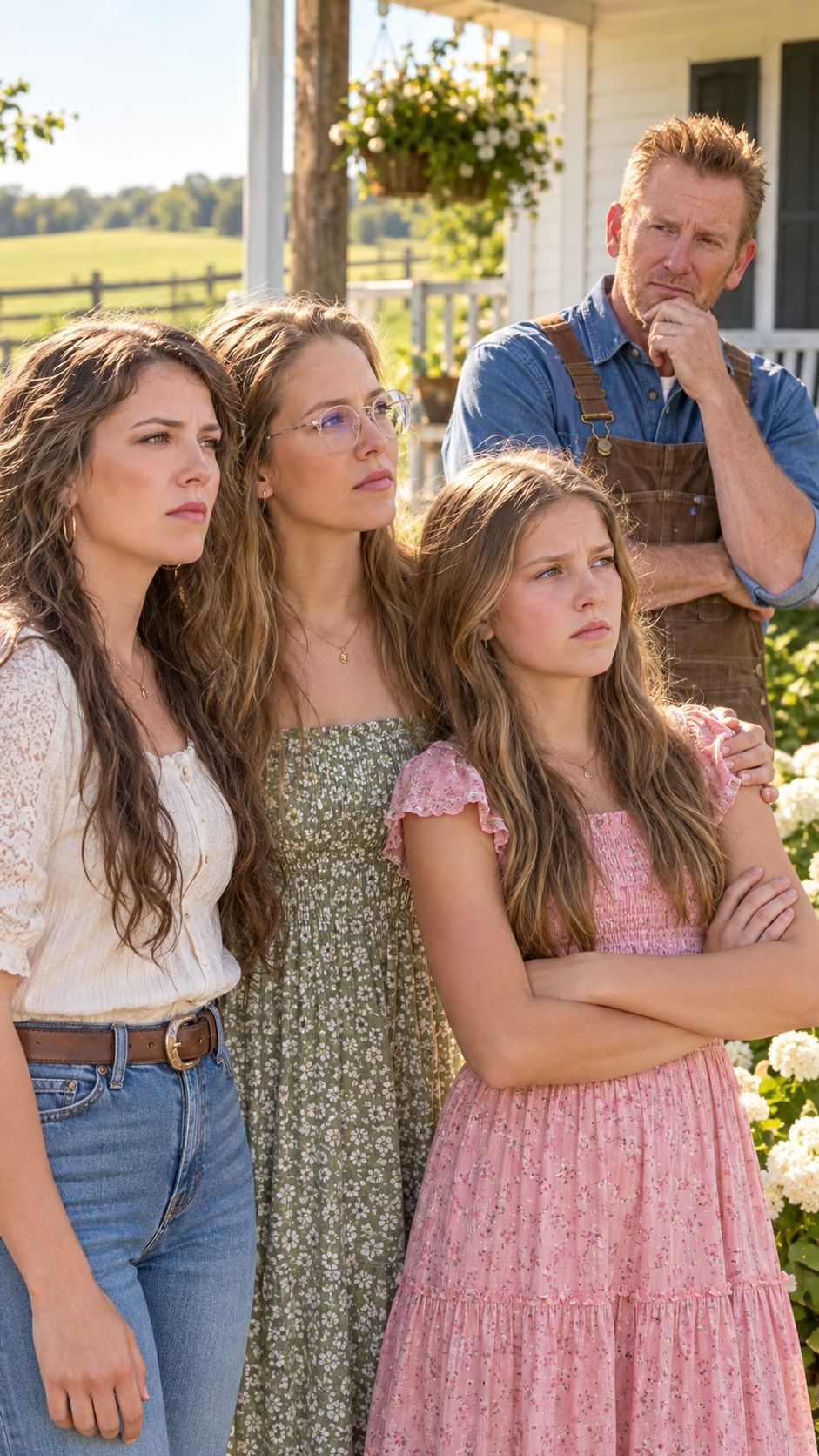
For years, the story of Rory Feek was one of the most familiar and deeply emotional stories in modern country music.
There was Joey + Rory, the farmhouse, the songs, the little schoolhouse, the Tennessee countryside, and a family life that seemed almost deliberately removed from the machinery of celebrity.
Then came tragedy.
Joey Feek died from cervical cancer in 2016, leaving Rory to raise their daughter, Indiana, alone. The little girl who had arrived into their family just two years earlier became the center of Rory’s life and, in many ways, the living continuation of Joey’s legacy.
But Rory had two older daughters, Heidi and Hopie, from his previous marriage.
And over time, the relationship between the older daughters and their father became increasingly strained.
What began as a private family disagreement eventually became public, emotional, and legal.
The most difficult part is that there is no simple villain in this story.
There are competing accounts, painful memories, allegations, denials, and people who appear to believe they are fighting for the same thing: family.
That is precisely why the story has become so difficult for country music fans to understand.
A Family Legacy Is More Than Songs and Property
When people hear the word “legacy,” they often think about music.
They think about recordings, photographs, the Feek farm, the songs Joey and Rory left behind, Rory’s writing, and the stories that have been preserved for fans.
But for the Feek family, legacy is something much more personal.
It is Indiana knowing her mother.
It is Heidi and Hopie remembering their childhood.
It is the relationship between three sisters.
It is the meaning of the Feek name.
And it is the question of what parts of a family’s history should be preserved, shared, challenged, or left private.
That distinction matters.
Heidi and Hopie have argued publicly that their relationship with Indiana was an important part of her life and that their access to their younger sister had been progressively restricted. In 2024, they announced that they were pursuing legal action concerning Indiana’s welfare. Their concerns were reported alongside allegations about Rory’s parenting and the environment in which Indiana was being raised. Those allegations were disputed by Rory, who said Indiana was loved and well cared for.
So when fans ask why the older daughters “stood their ground,” the answer cannot simply be reduced to rebellion against their father.
For them, according to their public statements, the issue was also about their sister.
And that changes everything.
Sometimes standing your ground isn’t about winning an argument. It’s about refusing to remain silent when someone you love is at the center of a conflict.
Indiana Became the Heart of the Dispute
Indiana occupies an extraordinary place in the Feek family story.
She was born in 2014, and her arrival changed everything for Joey and Rory. Joey’s illness followed, and after Joey’s death, Rory devoted himself to raising their daughter.
Rory has repeatedly described Indiana as a treasured gift and defended his decisions about how she should be raised.
His older daughters saw the situation differently.
According to reporting from PEOPLE, Heidi and Hopie said their relationship with Indiana had once been close and that she had frequently stayed with them. They expressed concern about losing that relationship. Rory, meanwhile, said he had reasons for changing the arrangements and insisted that his decisions were based on what he believed was best for Indiana.
This is where the dispute becomes more heartbreaking than a conventional family feud.
Because nobody is merely fighting over an abstract principle.
They are fighting over a little sister.
And every side appears to attach enormous emotional meaning to that relationship.
Heidi and Hopie have emphasized their bond with Indiana.
Rory has emphasized his responsibility as her father.
Those two ideas do not necessarily have to be enemies.
But when trust disappears, even love can become difficult to recognize.
Rory’s Version of the Story Is Also Deeply Emotional
Rory has never presented himself as someone who believes he has handled every part of fatherhood perfectly.
In his own writing, however, he has strongly rejected the idea that Indiana is unsafe or neglected.
He has also described the pain of becoming estranged from his older daughters.
In one account published on his personal blog, Rory described the conflict beginning years earlier and said disagreements with Heidi eventually led to communication breaking down. He said he later restricted Indiana’s overnight visits because of a loss of trust, after which legal accusations followed.
His account is important because it reveals something that headlines often miss.
To Rory, this was not simply a battle over control.
It was also a father watching his relationship with his older daughters deteriorate.
He has repeatedly expressed love for them even while disagreeing with their actions.
“The wound inside of all of us is not something that any courtroom, or lawyer, or any judge or jury is ever going to be able to fix.”
That sentiment captures the tragedy of the Feek dispute better than almost any headline could.
A court can determine legal questions.
It cannot repair a broken father-daughter relationship.
And Then There Was Hopie’s DNA Revelation
The family’s tensions became even more complicated in 2025 when Hopie learned through DNA testing that Rory was not her biological father.
The revelation was extraordinary because Rory had nevertheless raised her as his daughter.
Rory wrote that the news did not change his love for Hopie and that he would always consider her his daughter.
But Hopie publicly expressed frustration with how the information was shared and discussed her concerns about the way personal aspects of her life had previously been presented publicly.
Suddenly, the idea of “family legacy” became even more complicated.
What defines a parent?
Blood?
Years of raising a child?
Shared memories?
Love?
A surname?
A lifetime of experiences?
For many families, these questions are private.
For the Feeks, they unfolded in front of a country music audience.
And that makes every disagreement feel larger than it might inside an ordinary family.
Why Heidi and Hopie Refused to Simply Walk Away
This may be the most important part of the story.
Walking away would have been easier in some ways.
They could have allowed the relationship with their father to fade quietly.
They could have stopped discussing Indiana.
They could have allowed the public to remember only the happy photographs of three sisters together.
Instead, they continued speaking.
That decision brought criticism.
It also exposed them to public judgment from people who knew only fragments of the story.
But according to their public statements, they believed remaining silent would mean abandoning their concerns about Indiana and their relationship with her.
In 2024, Heidi told Taste of Country that she and Hopie believed Indiana was no longer safe under their father’s care. The sisters also described their concern about losing contact with her. These were allegations and concerns from the daughters, not findings that should be treated as established fact; Rory publicly disputed their characterization and defended his parenting.
That distinction is crucial.
The Feek family’s story contains competing claims.
It should not be turned into a simplistic story where one side is automatically right and the other automatically wrong.
But their willingness to speak does reveal something significant:
They believed the stakes were too high to remain silent.
The Most Painful Question: What Would Joey Have Wanted?
This question has hovered over the family story because Joey remains the emotional center of the Feek legacy.
She is gone.
But her presence is everywhere.
In the music.
In the photographs.
In Indiana.
In the farm.
In the memories shared by her husband and daughters.
And perhaps most painfully, in the absence felt when the family is divided.
It is tempting for outsiders to imagine what Joey would have done.
But nobody outside the family can know.
What can be observed is that the older sisters’ relationship with Indiana was deeply important to them, while Rory has consistently presented himself as a father trying to protect and raise his youngest daughter according to his convictions.
Those two realities can exist simultaneously.
And perhaps that is the most heartbreaking truth of all.
The Legacy May Ultimately Be About Reconciliation
In his later writing, Rory described attempts at reconciliation, including a family gathering in December where he said he, Rebecca, Heidi, Hopie, and others spent time together. He described the reunion as meaningful and said Indiana was especially happy to see her sisters. He also said the dispute remained unresolved afterward.
That detail matters.
Because beneath the accusations, lawsuits, social-media posts, and competing narratives is something much quieter:
They still miss one another.
That is what makes the story so painful.
If these people truly felt nothing for one another, there would be no reason for any of this to hurt so much.
The anger exists because there was once love.
The disappointment exists because there were once expectations.
The silence exists because there was once conversation.
And the fight over Indiana exists because she means something extraordinary to all of them.
The Legacy of Joey + Rory Should Not Become a Trophy
Perhaps the greatest danger is allowing the legacy of Joey + Rory to become another battlefield.
Their music was built around authenticity, family, faith, sacrifice, and ordinary moments.
Their greatest songs did not depend on perfection.
They depended on vulnerability.
That is why the current family conflict feels so jarring to fans.
The people who once seemed to represent a peaceful country life are now navigating one of the most painful realities a family can experience: estrangement.
But a legacy is not necessarily destroyed by conflict.
Sometimes it is defined by what people do after the conflict.
Whether they forgive.
Whether they listen.
Whether they stop trying to win and start trying to understand.
Whether sisters can find their way back to one another.
Whether a father and his daughters can eventually sit at the same table without lawyers, accusations, or old wounds between them.
The greatest legacy may not be the farm, the songs, the photographs, or the stories. It may simply be whether the family can find its way home to one another.
A Story Still Being Written
As of 2026, the Feek family story remains complicated and deeply personal. The conflict has continued to generate public statements, including renewed disagreement over Rory’s public sharing of updates about Indiana after her 2026 heart surgery. Heidi criticized what she described as the “ongoing exploitation” of Indiana, while Rory has continued to share his perspective about his daughter’s health and their family life.
Again, the public is seeing only pieces.
And that is why the story deserves something more thoughtful than a simple “good side versus bad side” headline.
Heidi and Hopie have their memories.
Rory has his.
Indiana has her own life and future.
Joey’s memory belongs to all of them.
And somewhere between those competing realities is a family legacy that remains unfinished.
Perhaps that is why so many country fans continue to follow this story.
They are not merely watching a celebrity dispute.
They are watching something painfully familiar.
A family struggling to decide what love looks like when trust has been broken.
A father trying to hold on.
Daughters refusing to disappear.
A younger sister caught in the middle.
And the memory of a woman whose life still connects them all.
The final chapter has not been written.
And perhaps the most meaningful ending would not be one side defeating another.
It would be three sisters finding their way back to each other—and a father discovering that sometimes protecting a family means making room for everyone inside it.
Because when all the headlines disappear, when the cameras stop, and when the country songs fade into silence, the question that remains is remarkably simple:
Can a family that has been hurt this deeply still find its way back to love?
VIDEO: