 By admin
 INTRODUCTION:
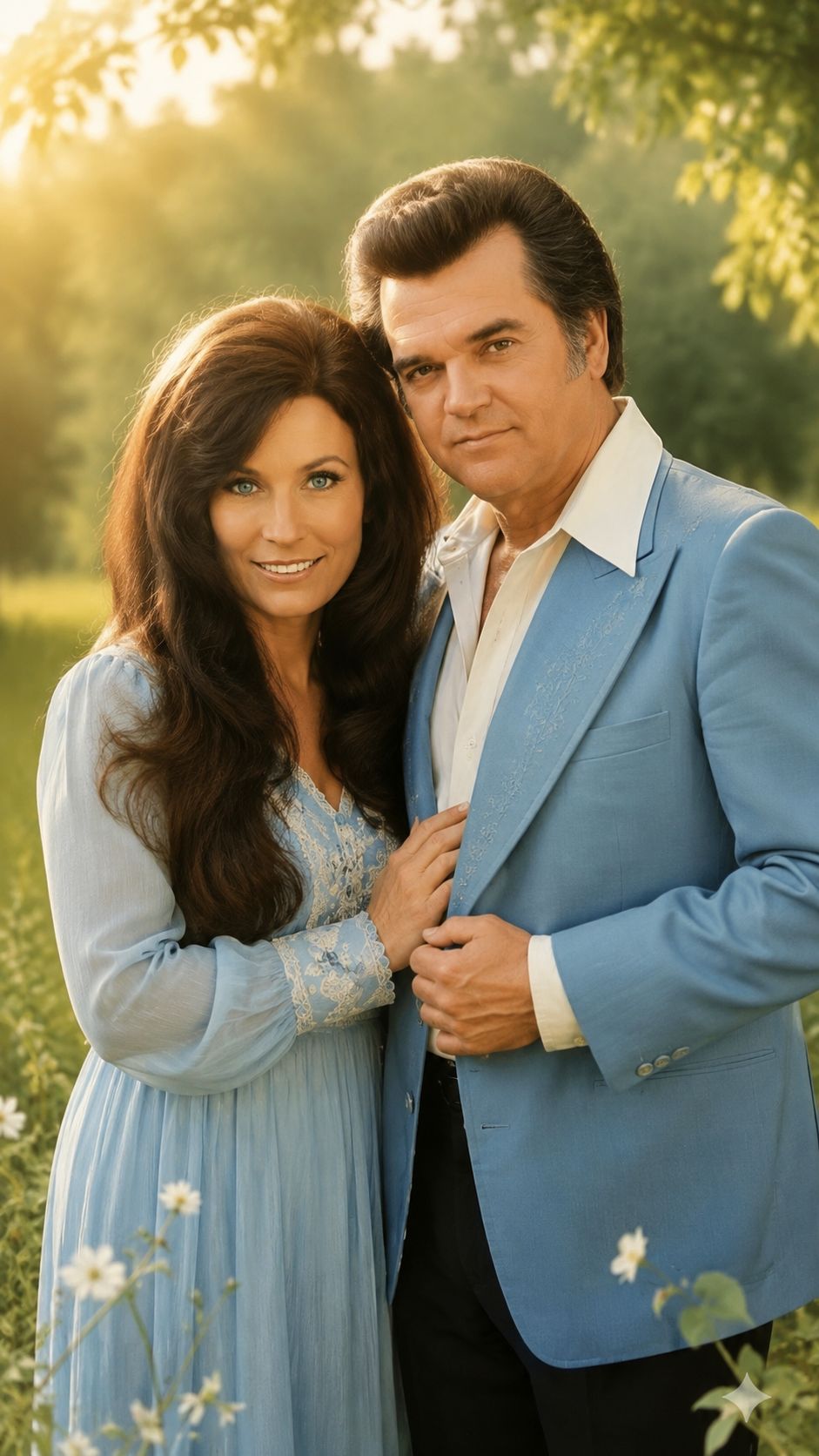
There are country songs about falling in love, songs about losing love, and songs about trying desperately to hold on to something that may already be slipping away. But every once in a while, two voices come together and make a love song feel less like a performance and more like a private conversation.
That is exactly what Conway Twitty and Loretta Lynn accomplished with “Feelins’.”
Released in 1975 as the title track of their fifth collaborative studio album, “Feelins’” became the duo’s fifth and final No. 1 single on the Billboard Hot Country Singles chart. The song spent 13 weeks on the chart and one week at No. 1, while the album itself reached No. 1 on the U.S. country albums chart.
But statistics only tell part of the story.
The real magic was in the voices.
Conway brought the smooth, intimate baritone that had become one of the defining sounds of 1970s country music. Loretta brought something different: a voice capable of sounding strong, vulnerable, playful, wounded, and completely sincere within the same song.
Put them together, and romantic love suddenly sounded complicated.
And perhaps that was precisely why millions of country listeners believed them.
Two Voices That Understood the Complicated Side of Love
By the time “Feelins’” arrived, Conway and Loretta were no strangers to musical success together.
Their partnership had begun earlier in the 1970s, after producer Owen Bradley helped bring the two stars together. Both were already successful solo artists, but their voices proved remarkably compatible. Their first major success as a duo helped establish a partnership that would eventually produce numerous Top 10 hits and multiple award-winning recordings.
Their collaboration worked because neither singer overwhelmed the other.
Conway didn’t try to outshine Loretta.
Loretta didn’t try to overpower Conway.
Instead, they created space for each other.
That balance became one of the defining characteristics of their duet recordings.
And “Feelins’” may be one of the clearest examples.
The song, written by Troy Seals, Will Jennings, and Don Goodman, approaches romantic love not as something perfectly controlled, but as an emotional force that can pull two people forward before they completely understand where they are going.
That idea feels remarkably human.
Because isn’t that what love often is?
You feel it before you can explain it.
You follow it before you know where it will lead.
And sometimes, the most powerful relationships are the ones where two people simply allow themselves to experience the moment.
“Feelins’” captures the uncertainty of love without making that uncertainty feel frightening.
Instead, it makes uncertainty feel beautiful.
The Magic Was in the Contrast
One of the most fascinating things about Conway Twitty and Loretta Lynn was how different their vocal personalities could be.
Conway’s voice often carried a sense of calm confidence.
Loretta’s voice could sound more emotionally exposed.
That contrast created tension—and tension is exactly what great romantic duets need.
Imagine two people standing across a room.
One speaks softly.
The other answers with warmth.
Neither has to say everything.
The emotion exists in the spaces between their words.
That is how Conway and Loretta often approached their duets.
They weren’t simply singing the same song.
They were acting out a relationship through music.
Their voices could sound like two lovers negotiating affection, doubt, desire, disappointment, and hope.
And because both singers were extraordinary storytellers, the listener could almost forget that they were listening to a recording.
It felt like overhearing something personal.
“Feelins’” Came at a Perfect Moment
The timing of the song also mattered.
Country music in the 1970s was filled with songs about relationships, but Conway and Loretta had developed a special place within that tradition.
They weren’t simply a novelty pairing.
They had become one of country music’s most successful recurring duos.
According to Loretta Lynn’s official discography, Feelins’ was their fifth album together and their third consecutive No. 1 collaborative album. The project included 10 songs, ranging from romantic material to more playful and traditional country selections.
The track list itself tells a story.
There was “I’ll Never Get Tired (Of Saying I Love You).”
There was “Store Up Love.”
There was “You Done Lost Your Baby.”
And then there was the title song.
Together, those songs created an album that explored love from multiple directions rather than presenting romance as a single emotion.
That was one of the reasons the project felt so natural for Conway and Loretta.
They understood that love isn’t one thing.
Sometimes it is excitement.
Sometimes it is commitment.
Sometimes it is disappointment.
Sometimes it is simply the feeling of being drawn toward another person.
Why Their Chemistry Still Feels Real
Decades later, listeners still talk about Conway Twitty and Loretta Lynn as one of country music’s great duet partnerships.
Why?
Because their chemistry wasn’t based solely on vocal technique.
It was based on believability.
The listener didn’t need to believe Conway and Loretta were actually a couple.
They only needed to believe the characters they were portraying.
And they did.
Their voices carried enough emotional history to make even a simple romantic lyric feel meaningful.
This was particularly important with “Feelins’.”
The song isn’t built around an elaborate story with dozens of characters and dramatic twists.
Instead, its power comes from the emotional experience itself.
The feeling.
The uncertainty.
The attraction.
The willingness to follow an emotion even when reason hasn’t completely caught up.
That simplicity is part of its strength.
Sometimes the greatest country love songs aren’t about knowing exactly where love will take you. They’re about having the courage to follow it.
Conway and Loretta Knew How to Make Love Sound Human
There is another reason their music has endured.
Neither Conway nor Loretta treated romance as something perfect.
Country music has always been particularly good at acknowledging the messiness of relationships.
People fall in love.
People argue.
People leave.
People come back.
People make mistakes.
And sometimes, despite everything, they still love each other.
That emotional honesty became part of the Conway-and-Loretta formula.
Their earlier recordings had already demonstrated their ability to turn relationship drama into compelling musical theater. Songs such as “After the Fire Is Gone,” “Lead Me On,” “Louisiana Woman, Mississippi Man,” and “As Soon as I Hang Up the Phone” showed just how versatile the pair could be. Their catalog included everything from flirtation to heartbreak and emotional conflict.
“Feelins’” belongs to the warmer side of that spectrum.
It isn’t primarily about betrayal or heartbreak.
It is about surrendering to emotion.
And Conway and Loretta understood how powerful that could be.
The Owen Bradley Touch
Another important part of the record’s appeal was the production.
Owen Bradley, one of Nashville’s most influential producers, was behind the project. The album’s sessions took place at Bradley’s Barn in Mount Juliet, Tennessee, in April 1975.
Bradley’s production style allowed the voices to remain at the center.
That was essential.
Because with Conway and Loretta, the voices were the instruments that mattered most.
The arrangement didn’t need to become overly complicated.
The emotion was already there.
The musicians created the setting.
Conway and Loretta supplied the drama.
And the listener filled in the rest.
A No. 1 Hit That Became Something Bigger
“Feelins’” reached No. 1 on the Billboard Hot Country Singles chart in 1975, becoming the duo’s fifth and final chart-topping single.
That achievement is impressive on its own.
But its significance goes beyond the chart.
The song represents a moment when two established country legends had already perfected the art of singing together.
They weren’t experimenting anymore.
They knew what worked.
They understood their voices.
They understood their audience.
And most importantly, they understood the emotional language of country music.
“Feelins’” was therefore not simply another Conway and Loretta duet.
It was a mature expression of the partnership they had built.
Why “Feelins’” Still Matters
Today, country music has countless romantic duets.
Some are polished.
Some are dramatic.
Some are designed for radio.
But Conway Twitty and Loretta Lynn offered something that is increasingly difficult to manufacture:
authentic emotional chemistry.
Their recordings remind us that a great duet isn’t simply two talented singers sharing a microphone.
It is two storytellers listening to each other.
It is tension and tenderness.
Strength and vulnerability.
Confidence and uncertainty.
And in “Feelins’,” all of those qualities come together.
The song asks us to remember something simple but profound: sometimes love doesn’t arrive with a plan.
Sometimes it arrives as a feeling.
And sometimes, you simply have to follow it.
That may be the enduring beauty of Conway Twitty and Loretta Lynn.
They didn’t just sing about romantic love.
They made listeners feel it.
Long after the records stopped climbing the charts, the emotion remained. That is the real legacy of Conway Twitty and Loretta Lynn.
Their voices may belong to another era, but the emotions they explored never went out of style.
Because people still fall in love.
People still wonder where those feelings will lead.
People still hold onto old songs because those songs remind them of someone they once loved—or perhaps someone they still do.
And that is why, decades later, the opening notes of “Feelins’” can still transport a listener back to a different time.
A time when country music didn’t need complicated production to break your heart.
Two voices were enough.
A story was enough.
A feeling was enough.
And Conway Twitty and Loretta Lynn had all three.
VIDEO: