 By admin
 INTRODUCTION:
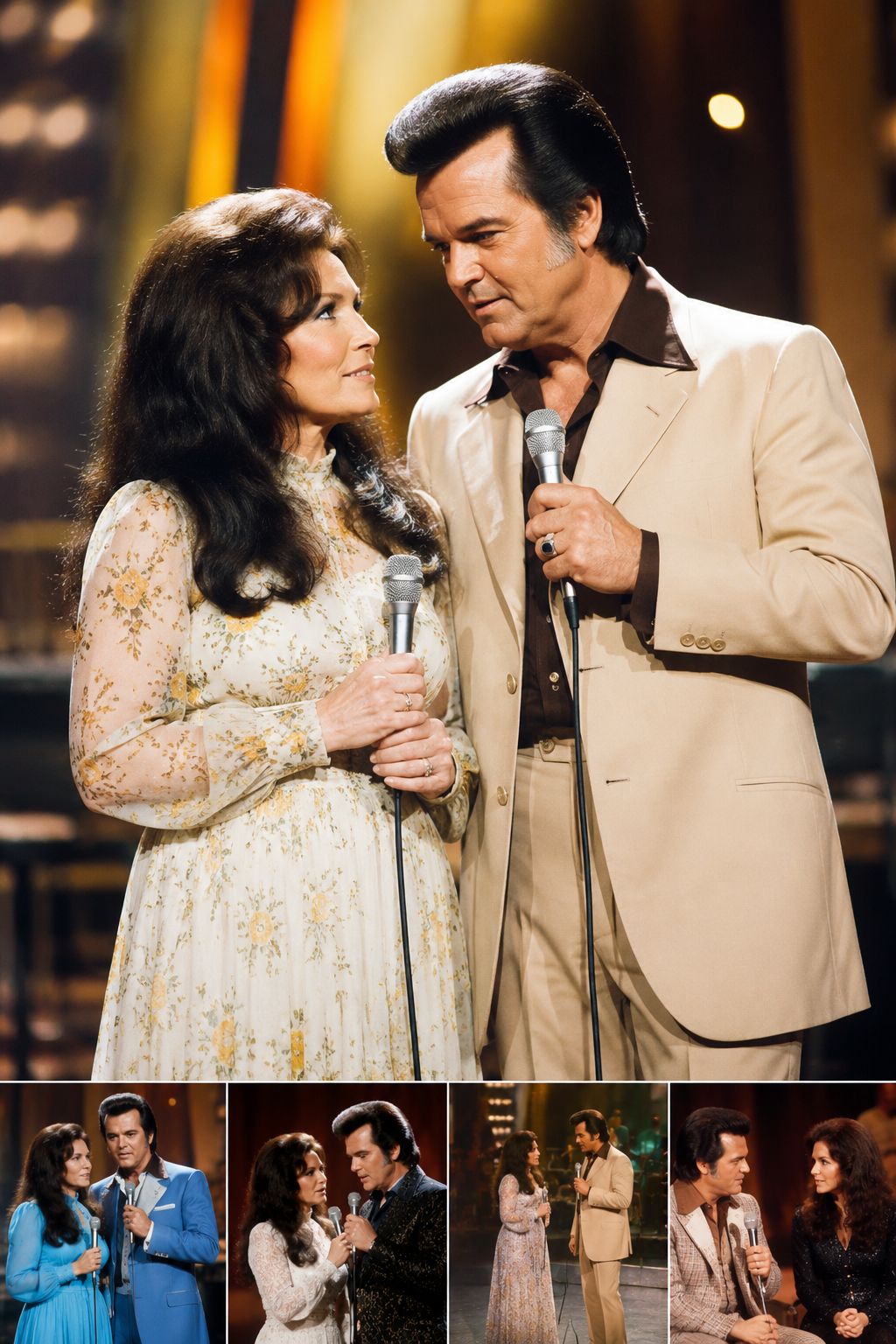
There are singers who can command a crowd.
And then there are singers who can make a crowd feel as if they are listening to something deeply personal.
Conway Twitty belonged to the first group—and, somehow, when he stood beside Loretta Lynn, he became part of the second.
Twitty could walk onto a stage in front of thousands and barely say a word. His voice did the talking. His controlled delivery, emotional restraint, and unmistakable baritone helped make him one of country music’s most successful recording artists. The Country Music Hall of Fame credits him with 40 No. 1 Billboard country hits, an extraordinary achievement that established him as one of the defining voices of his era.
But put Loretta Lynn beside him, and something changed.
The polished mystery disappeared.
The emotional distance seemed to shrink.
Suddenly, Conway wasn’t simply singing at an audience.
He was singing to someone.
And that someone was Loretta.
The Moment Two Country Giants Found Something Bigger Than Either One Alone
By the time Conway Twitty and Loretta Lynn began recording together in 1971, neither artist needed another star to make a career.
Twitty had already transformed himself from a rock-and-roll and rockabilly performer into a dominant country hitmaker. Lynn had established herself as one of Nashville’s most powerful female voices, with songs that spoke directly about marriage, heartbreak, independence, family, and the complicated realities of women’s lives.
Then came “After the Fire Is Gone.”
The pairing immediately worked.
Their voices weren’t identical—and that was precisely the point.
Twitty’s voice could sound smooth, restrained, almost deliberately guarded. Lynn’s voice carried grit, vulnerability, humor, and defiance. When they traded lines, the contrast created tension.
When they joined together, that tension became chemistry.
The Country Music Hall of Fame notes that their first collaboration, “After the Fire Is Gone,” topped the charts in 1971 and launched one of country music’s most successful duet partnerships.
PBS later described the effect of their voices as something that created a dimension that neither artist could produce alone.
That may be the simplest explanation for their magic.
But it doesn’t fully explain it.
Because the magic wasn’t merely musical.
It was emotional.
“When these two voices hit, it creates this dimension that you can’t get singular.”
— Garth Brooks, discussing Conway Twitty and Loretta Lynn’s chemistry
That “dimension” is what listeners heard.
Twitty could sound like a man hiding something.
Lynn sounded like the woman who already knew.
And suddenly, every lyric became a conversation.
Conway Was the Master of Restraint
One of the most fascinating things about Conway Twitty was how little he seemed to need theatrics.
His concerts were famous for their minimalist quality. According to his official biography, Twitty avoided conventional onstage banter and preferred to communicate through his music.
That restraint became part of his mystique.
He didn’t have to explain the heartbreak.
He could simply sing it.
His signature hit “Hello Darlin’” is a perfect example. The emotion comes not from shouting but from control. He lets the listener lean into the words.
That was Conway’s gift.
He understood that sometimes the quieter the voice, the louder the emotion.
But Loretta brought out another side of him.
With Loretta, Conway had someone who could push back.
She didn’t simply receive his emotion.
She answered it.
That changed the musical conversation.
Loretta Lynn Didn’t Let Conway Control the Story
Loretta was not there to play the supporting role.
She was already a superstar in her own right.
Her voice carried the authority of someone who had lived the stories she sang about. Her songwriting often challenged expectations about what a woman in country music could say publicly.
That made her the perfect counterpart to Twitty.
Conway might begin a line with confidence.
Loretta could answer with skepticism.
He might sound seductive.
She could sound amused.
He could suggest regret.
She could make him confront it.
That tension became one of the defining characteristics of their recordings.
Their songs weren’t simply male and female vocals layered over the same melody.
They sounded like two people negotiating an emotional crisis in real time.
And country music audiences understood it immediately.
Five No. 1 Hits—and a Partnership That Became Bigger Than the Records
The numbers are staggering.
PBS reports that Twitty and Lynn recorded 11 studio albums between 1971 and 1988, with five No. 1 songs coming from five different albums. They also won the CMA Vocal Duo of the Year award every year from 1972 through 1975.
Among their signature recordings were:
- “After the Fire Is Gone”
- “Lead Me On”
- “Louisiana Woman, Mississippi Man”
- “As Soon as I Hang Up the Phone”
- “Feelins’”
Their 1973 album Louisiana Woman, Mississippi Man reached No. 1 on the country album chart, while its title track became another chart-topping hit.
The Country Music Hall of Fame also notes that the pair earned a Grammy and four CMA awards for their classic duet recordings.
But statistics only tell part of the story.
The real phenomenon happened when people watched them perform.
Audiences Started Wondering: “Was There Something More?”
This is where their story becomes especially fascinating.
Their songs frequently dealt with temptation, desire, marriage, betrayal, and complicated romantic relationships.
And they didn’t perform those songs like two disconnected singers.
They looked at each other.
They reacted to each other.
They left space for the other person’s voice.
They sounded like they were having a private conversation in front of thousands of people.
That realism caused audiences to speculate about their relationship.
But Loretta herself pushed back strongly against the idea that their onstage chemistry reflected a romantic relationship.
As PBS records, Lynn explained:
“Everybody thought me and Conway had a thing going. And that’s the farthest from the truth.”
Instead, she described Conway as a friend—and emphasized that her husband, Oliver “Doolittle” Lynn, respected and liked him.
That distinction is important.
Because their chemistry didn’t require a secret romance.
It required trust.
The Secret Wasn’t Romance. It Was Musical Trust.
This may be the biggest misunderstanding surrounding Conway and Loretta.
People sometimes assume that powerful chemistry must come from romantic tension.
But great musical chemistry can come from something much more difficult to manufacture:
listening.
Conway listened to Loretta.
Loretta listened to Conway.
Neither voice had to dominate.
They understood when to step forward and when to disappear behind the other singer.
That’s why their call-and-response performances felt so natural.
Listen to “Louisiana Woman, Mississippi Man.”
The structure practically demands interaction. Conway makes a statement. Loretta answers. He pushes forward. She responds. Eventually, their voices merge.
The result feels almost like a theatrical scene.
Except there is no script visible to the audience.
Only instinct.
“Louisiana Woman, Mississippi Man” Captured the Formula
By 1973, they had already proven that their partnership was more than a novelty.
Then came “Louisiana Woman, Mississippi Man.”
Loretta’s husband, Doolittle, helped bring the song to their attention. PBS’s account of the recording describes how he presented the song to the pair, who quickly recognized its potential.
The song became a No. 1 hit.
But its importance goes beyond the chart.
It captured exactly what made Conway and Loretta special.
Two voices.
Two personalities.
Two perspectives.
One emotional world.
And when they finally sang together, the listener didn’t hear Conway Twitty and Loretta Lynn as separate stars anymore.
They heard “Conway and Loretta.”
That distinction is enormous.
The Moment Conway Turned Toward Loretta
Imagine the stage.
The band is behind them.
The audience is waiting.
Conway begins singing.
The crowd knows the voice. They know the phrasing. They know the man who has delivered hit after hit.
Then he turns toward Loretta.
And the atmosphere changes.
Why?
Because suddenly the song has a destination.
He’s no longer simply performing the lyric.
He’s addressing someone.
Loretta looks back.
She answers.
And the audience becomes an observer of something that feels almost private.
That’s the secret.
The emotion moves sideways before it moves outward.
Conway sings to Loretta.
Loretta sings back to Conway.
And the audience feels like it has been invited into the conversation.
That is why their performances could feel more intimate than louder, more theatrical productions.
Their Greatest Achievement Was Making a Duet Feel Like a Relationship
Country music has produced countless famous duos.
But not every duo creates its own emotional language.
Twitty and Lynn did.
Their recordings taught listeners how to hear two singers as characters.
Conway could represent temptation, confidence, regret, or longing.
Loretta could represent desire, doubt, frustration, humor, or resilience.
Neither character was completely innocent.
Neither was completely guilty.
And that gray area is where country music has always been at its most powerful.
Their songs didn’t tell listeners what to think.
They made listeners feel conflicted.
And conflict creates memory.
What Makes Their Legacy So Difficult to Reproduce
Today, vocal technology can make almost any recording sound technically perfect.
But technical perfection isn’t the same thing as emotional chemistry.
Conway and Loretta had imperfections.
They had breathing spaces.
They had different vocal textures.
They had moments where one singer seemed to pull against the other.
Those imperfections created humanity.
That’s why their recordings continue to resonate.
Their partnership wasn’t built on making two voices sound alike.
It was built on making two voices need each other.
And that may be the most important lesson in their legacy.
The Final Truth Behind the Magic
Conway Twitty could sing to millions.
He had the hits.
He had the voice.
He had the mystique.
He had the audience.
But when he turned toward Loretta Lynn, he wasn’t simply another country superstar anymore.
He became half of a conversation.
And Loretta became the answer.
Together, they created something that neither could create alone—a musical relationship so convincing that generations of listeners could still feel the tension, warmth, humor, temptation, and tenderness in their performances.
The Country Music Hall of Fame calls their partnership one of the most successful duet teams in country music history.
That’s the historical answer.
But the emotional answer is simpler:
Conway could make millions listen. Loretta could make him reveal something.
And when he turned toward her, country music suddenly felt less like a concert…
…and more like we were witnessing a private conversation that happened to have millions of witnesses.
That is why the Conway Twitty and Loretta Lynn partnership remains unforgettable.
Not because they were the loudest.
Not because they tried to convince audiences they were something they weren’t.
But because, for a few minutes inside each song, they made us believe that the only two people in the room were Conway and Loretta.
VIDEO: