 By admin
 INTRODUCTION:
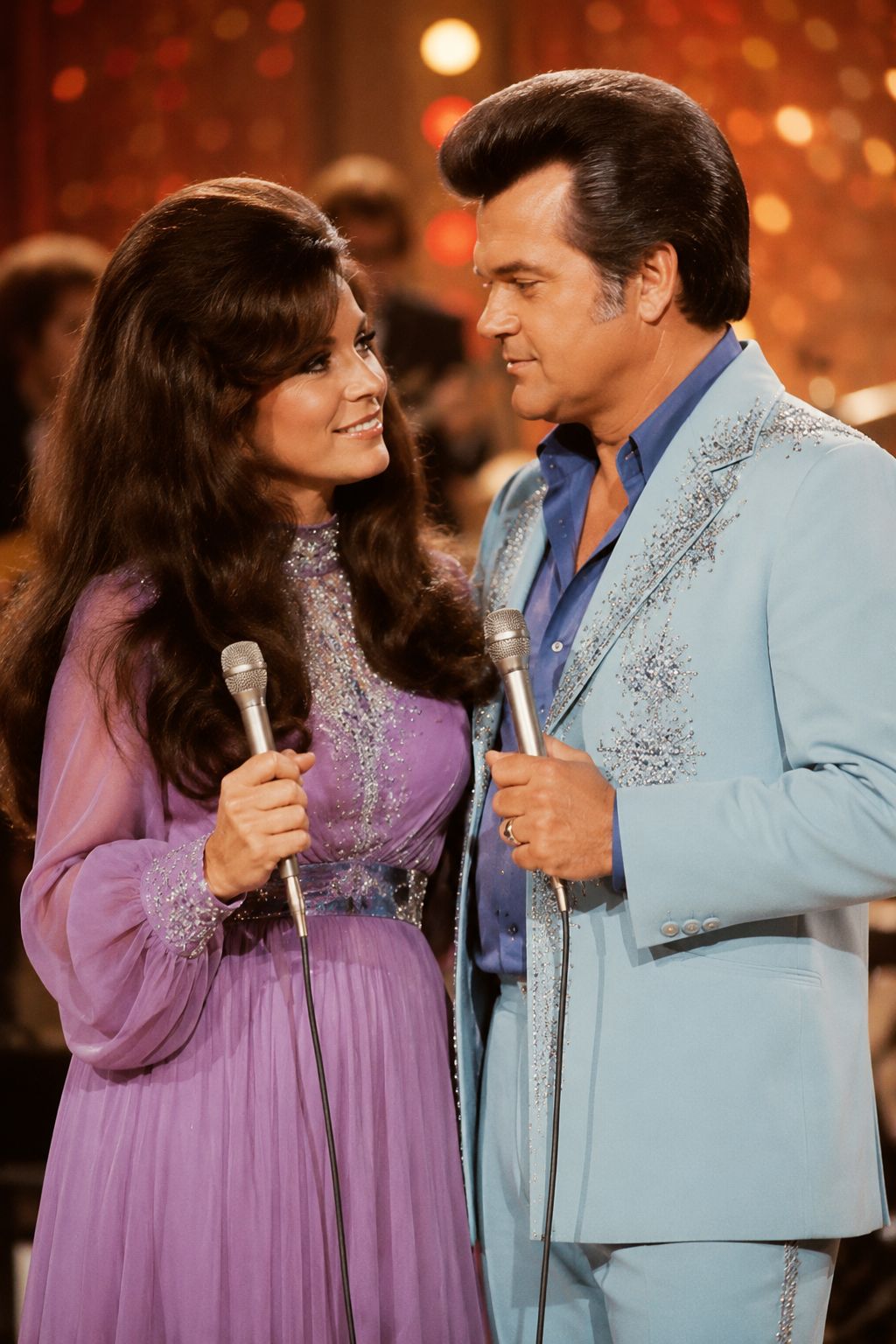
There are some country-music partnerships that feel almost too perfect to be real.
Two voices. Two personalities. Two completely different lives—and somehow, when the microphones turned on, they sounded as if they had been telling the same story for years.
That was the magic of Conway Twitty and Loretta Lynn.
In the 1970s, their duets didn’t merely sound romantic. They looked romantic. They carried the tension of forbidden love, the vulnerability of two people standing too close to the line, and the kind of emotional electricity that made audiences wonder whether they were watching a performance—or witnessing something dangerously close to reality.
And that raises the question fans have asked for decades:
Was the Conway Twitty–Loretta Lynn chemistry genuine, or was it the ultimate country-music publicity machine of the 1970s?
The answer is more fascinating than either theory.
The First Spark Wasn’t a Publicity Meeting
It is tempting to imagine Nashville executives sitting around a conference table and deciding that Conway Twitty and Loretta Lynn would make a profitable romantic duo.
But their story didn’t begin that way.
Lynn and Twitty first sang together while touring overseas in 1969. Lynn later recalled that they started singing in dressing rooms and decided to see what producer Owen Bradley thought when they returned home. Bradley liked what he heard and sent them into the studio.
That detail matters.
Because before the matching album covers, dramatic television appearances and whispered rumors, there was simply two exceptional singers discovering that their voices worked together.
And then came the song that changed everything.
“After the Fire Is Gone.”
Released in 1971, the song became a No. 1 country hit and helped establish one of the most successful male-female partnerships in country music history.
But there was a problem.
The song was about two people whose relationships had lost their passion and who were tempted by someone else.
For a conservative country audience, that wasn’t just a love song.
It was dangerous.
It was intimate.
And when Conway’s low, sensual voice met Loretta’s unmistakable vulnerability, the story suddenly felt less like fiction.
It felt personal.
“Everybody Thought Me and Conway Had a Thing Going”
This is where the mythology exploded.
The songs were romantic. Their performances were emotionally charged. Their chemistry was obvious.
And fans started asking the question that publicity departments could only dream about:
Were Conway and Loretta actually in love?
Loretta eventually addressed the speculation herself.
“Everybody thought me and Conway had a thing going. And that’s the farthest from the truth.”
She explained that she loved Conway as a friend, while emphasizing that they were not lovers.
That statement is crucial because it changes the entire interpretation of their story.
The chemistry was real.
The romance wasn’t.
And those two things can exist simultaneously.
The Most Convincing “Romance” Was Written by Songwriters
Here’s the secret many modern listeners miss.
Conway Twitty and Loretta Lynn weren’t necessarily portraying themselves.
They were portraying characters.
Their greatest songs placed them inside complicated relationships—people who wanted something they shouldn’t want, people trapped in marriages, people struggling with temptation, people who loved someone but knew that love came with consequences.
In other words, they weren’t simply singing love songs.
They were acting through music.
Consider “Louisiana Woman, Mississippi Man.”
The entire premise is built around separation and attraction:
“The Mississippi River can’t keep us apart.”
That’s not subtle.
The song transforms geography into romantic tension. He’s from Mississippi. She’s from Louisiana. The river is the obstacle.
And the audience gets to watch them overcome it.
The song became one of their signature recordings, and Loretta’s husband, Oliver “Doolittle” Lynn, actually played an important role in bringing the song to them. Loretta later recalled that Doolittle found it and presented it as a potential hit.
That detail almost sounds like something from a screenplay.
The husband helping discover the song that would make his wife and another man sound irresistibly attracted to each other.
But that was the strange beauty of their partnership.
There was trust behind the performance.
The Husbands Knew What the Audience Didn’t
If Conway and Loretta were secretly carrying on an affair, the people closest to them would have been in an extraordinarily difficult position.
Instead, the historical record paints a very different picture.
Loretta’s husband, Doolittle, reportedly liked Conway tremendously. Loretta herself said that Conway was one of the few people in the music business her husband genuinely cared about.
That makes the supposed secret-romance theory much harder to sustain.
In fact, one contemporary account preserved by the University of Nevada, Las Vegas Special Collections describes how persistent the rumors became—even while Conway and Loretta publicly denied that anything romantic had happened between them.
At one point, when Twitty’s marriage temporarily broke apart in the 1970s, fans even blamed Loretta. The rumor became so intense that a bomb threat was associated with one of Lynn’s concerts.
Think about that for a moment.
A musical partnership had become so emotionally convincing that some listeners couldn’t separate the characters in the songs from the real people singing them.
That’s not merely successful marketing.
That’s performance at an extraordinary level.
So Was It a PR Stunt?
Here’s where the answer becomes complicated.
Yes—and no.
The entertainment industry absolutely understood the value of the Conway-and-Loretta mystique.
The 1970s were an era when celebrity relationships, rumors and carefully cultivated public images could generate enormous attention. A male-female duo with undeniable chemistry naturally created headlines.
But there is little evidence that the entire relationship was manufactured as some elaborate fake romance.
The stronger explanation is much more interesting:
The music created the illusion, and the industry allowed the illusion to grow.
That’s different.
They didn’t need to pretend to be lovers backstage.
They only needed to step onto the stage and become lovers inside the song.
And they were extraordinarily good at it.
Four CMA Awards Proved the Chemistry Was More Than Hype
The numbers tell another side of the story.
Lynn and Twitty became CMA Vocal Duo of the Year four consecutive times, from 1972 through 1975.
They also earned a Grammy for “After the Fire Is Gone,” while songs such as “Lead Me On,” “Louisiana Woman, Mississippi Man,” and “Feelins’” became defining recordings of their partnership.
This wasn’t a flash-in-the-pan publicity stunt.
It was a sustained artistic partnership.
Their voices were complementary in a way that is surprisingly difficult to manufacture.
Conway brought the dark, smooth, almost conversational masculinity.
Loretta brought strength, vulnerability, humor and emotional defiance.
He could sound like the man who had already made the mistake.
She could sound like the woman deciding whether to forgive him.
Together, they created tension.
And tension is the secret ingredient of great storytelling.
The Stage Made the Illusion Even Stronger
Their records were powerful.
But live performance was where the mythology became almost impossible to resist.
Conway was known for his dramatic, minimalist approach to performing. His concerts had a devoted following, and his stage persona carried an almost mysterious quality.
Put that man beside Loretta Lynn—one of country music’s strongest female personalities—and suddenly you had a natural theatrical contrast.
They could tease each other.
Challenge each other.
Sing as if they were arguing.
Then turn around and deliver a heartbreak ballad that made the audience feel like they were eavesdropping on a private conversation.
That was the trick.
They didn’t have to say they were in love.
They made the audience feel it.
The Ultimate 1970s PR Stunt Would Have Been Easier to Fake
This is perhaps the most ironic part.
If Conway and Loretta had actually wanted to manufacture a romance for publicity, they could have leaned into the rumors far more aggressively.
Instead, they repeatedly maintained that they were friends and musical partners.
Loretta’s own recollections are especially revealing.
She didn’t describe Conway as some forbidden lover.
She described him as a friend.
And that distinction matters.
Because it suggests the emotional intensity audiences witnessed wasn’t necessarily coming from a hidden affair.
It was coming from professional trust.
They trusted each other enough to sing material that required them to appear emotionally exposed.
They trusted each other enough to flirt with the boundaries of what country radio would accept.
And they trusted each other enough to let audiences believe whatever they wanted for three or four minutes at a time.
The Real Romance Was Between Two Voices
Perhaps that’s why their partnership remains so fascinating.
People often search for romance behind great duets.
But sometimes the romance is entirely musical.
Conway Twitty and Loretta Lynn found a rare space where two voices could become characters.
Their songs weren’t documentaries.
They were little dramas.
Every verse introduced a problem.
Every chorus raised the emotional stakes.
Every glance across the stage invited the audience to wonder what might happen next.
And when the song ended, the characters disappeared.
Conway went back to being Conway.
Loretta went back to being Loretta.
But the audience was left holding the emotion.
That is what great entertainers do.
What Remains After the Rumors Fade
Conway Twitty’s official history describes his partnership with Loretta as one of the defining achievements of his career, while the Country Music Hall of Fame recognizes the extraordinary success of their duet recordings and awards.
Their legacy has also survived through the next generation. Conway’s grandson Tre Twitty and Loretta’s granddaughter Tayla Lynn have performed together as Twitty & Lynn, deliberately revisiting the musical chemistry of their grandparents. Their show even appeared at the Grand Ole Opry in 2022.
That may be the strongest proof of all.
Decades later, audiences still want to see that chemistry.
Still want to hear those songs.
Still want to believe, just for a few minutes, that the emotional world inside the record might have been real.
But perhaps we have been asking the wrong question all along.
It wasn’t:
“Were Conway Twitty and Loretta Lynn secretly in love?”
The more meaningful question is:
“How did two people who weren’t lovers make millions of people believe they were?”
The answer is talent.
Trust.
Storytelling.
And the rare musical chemistry that cannot be manufactured in a boardroom.
They didn’t need a real-life romance to create a believable one. They only needed a microphone, a great song, and the courage to make the audience feel everything.
That is why the Conway Twitty and Loretta Lynn story still fascinates country fans.
Maybe it was partly publicity.
Maybe the rumors helped sell records.
Maybe Nashville understood the power of the illusion.
But the emotion?
That part was real.
And when two legends stepped onto the stage together, country music didn’t need to tell the audience what to believe.
For three minutes, they made the audience believe it themselves
VIDEO: