 By admin
 INTRODUCTION:
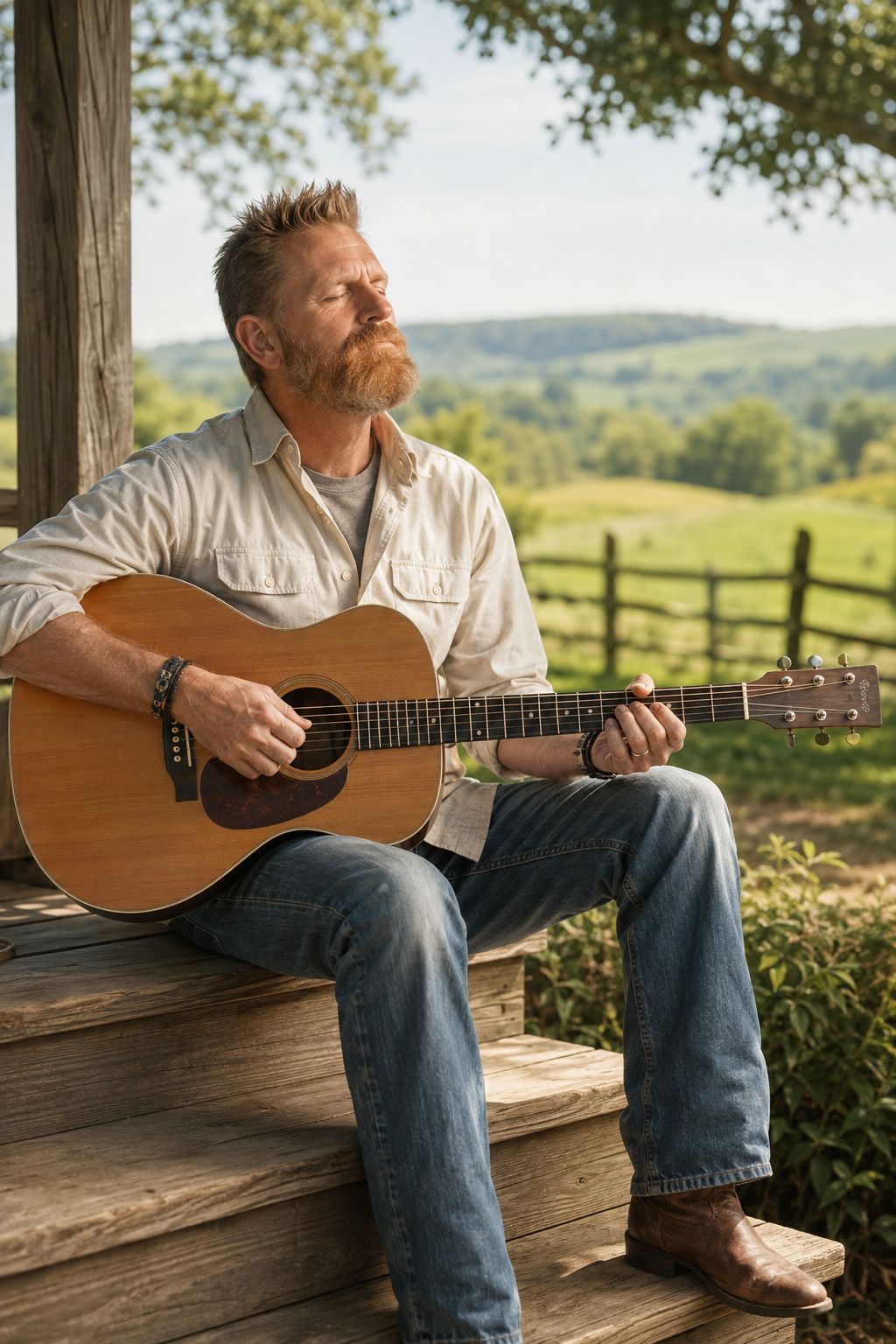
In a genre built on big personalities, bigger stages, rhinestone lights, radio hits, and stories designed to stop listeners in their tracks, Rory Feek has always seemed to occupy a different kind of space.
He never needed to be the man shouting from the center of the room.
He was often the man sitting slightly off to the side, listening.
Watching.
Writing.
And somehow, when he finally spoke, people leaned closer.
That may be the greatest paradox of Rory Feek’s career: the quieter he became, the more powerful his voice seemed to grow.
He built his reputation first as a songwriter, writing songs that other country artists carried onto the radio. His credits included major hits such as Blake Shelton’s “Some Beach,” while his later career with Joey + Rory transformed him from behind-the-scenes songwriter into a performer and storyteller in his own right.
But the most important part of Rory’s story was never simply about chart positions.
It was about meaning.
And eventually, it became about how to tell the truth when life stopped resembling the story you thought you were writing.
The Man Behind the Songs
Long before millions of people knew Rory Feek as half of Joey + Rory, he was already learning one of country music’s oldest lessons:
A great song doesn’t need to scream. It needs to tell the truth.
Rory’s songwriting career gave him a remarkable education in that principle. He wasn’t necessarily the face audiences saw when a song became a hit. He was often the writer behind the curtain—the person turning ordinary observations, relationships, disappointments, humor, and hope into three or four minutes of music.
That role suited him.
Country music has always been fascinated with ordinary lives.
A truck.
A kitchen.
A porch.
A broken heart.
A long marriage.
A child growing up.
A person trying to make peace with yesterday.
Rory understood that those supposedly small things weren’t small at all.
They were the story.
“Every song has a story.”
That philosophy eventually became larger than songwriting.
It became the foundation of the way Rory lived and communicated with his audience.
Then Came Joey
When Rory and Joey Martin Feek became a musical duo, the story changed.
They hadn’t originally planned to become the kind of country act that would attract national attention. Their partnership emerged after a friend encouraged them to audition for CMT’s Can You Duet. They eventually finished third, and the unexpected chemistry between them became one of the most compelling elements of their public story.
Suddenly, audiences weren’t simply listening to Rory’s words.
They were watching a marriage.
They were watching two people who genuinely seemed to enjoy being around each other.
And that distinction mattered.
Joey had the voice.
Rory had the storyteller’s instinct.
Together, they created something that felt remarkably unmanufactured in an industry where image can easily overwhelm substance.
Their music was rooted in traditional country values, but their appeal extended beyond music.
People wanted to know their story.
And Rory was willing to tell it.
Not because every chapter was glamorous.
But because it was real.
The Most Powerful Stories Were the Ordinary Ones
In 2014, Rory and Joey stepped away from much of their music career as they prepared for the birth of their daughter, Indiana.
Rory began documenting their life through his blog, This Life I Live. What began as an attempt to capture everyday family moments would eventually become something much larger.
There were stories about meals.
Farm life.
Children.
Broken pipes.
Small family adventures.
Simple mornings.
Nothing about those subjects sounds like the obvious recipe for a media phenomenon.
But that’s precisely why it worked.
Rory wasn’t pretending that life had to be spectacular to be meaningful.
He was showing people that meaning was already hiding inside ordinary days.
“They’re not just about what’s happening in the stories, they’re usually ‘what’s really happening’ in them.”
That idea explains much of Rory’s appeal.
A story about a farm wasn’t really about a farm.
A story about a child wasn’t simply about childhood.
A story about marriage wasn’t simply about marriage.
There was always another layer underneath.
And that second layer was where Rory’s writing became emotionally powerful.
Then the Story Broke
Every storyteller eventually discovers something terrifying:
You can write the beginning.
You can write the middle.
But you cannot control the ending.
For Rory and Joey, the beautiful family story they were documenting took an unimaginable turn.
Joey was diagnosed with cancer.
Their daughter Indiana was still very young.
The happy future they had imagined suddenly became uncertain.
And Rory continued writing.
This is where his storytelling changed from entertaining to profoundly human.
He wasn’t simply documenting success anymore.
He was documenting fear.
Faith.
Love.
Loss.
The unbearable uncertainty of watching someone you love become seriously ill.
Rory later explained that writing helped him process what he was living through—to understand what he was thinking, feeling, and what larger purpose might exist inside the experience.
That may be one of the most important reasons his writing connected with so many people.
He wasn’t writing from the position of someone who had already figured everything out.
He was writing while still trying to figure it out himself.
And readers recognized that.
The Courage to Show the Shadows
There is a temptation in celebrity storytelling to polish everything.
The romance becomes perfect.
The marriage becomes inspirational.
The tragedy becomes neatly packaged.
The pain becomes a chapter that ends with a lesson.
Rory took a different approach.
He was willing to acknowledge that his own life had contained mistakes, struggles, imperfections, and darkness.
In an interview about his memoir, he explained that he wanted readers to see the shadows too—not only the beautiful love story people had already seen.
That vulnerability made the love story more believable.
Because real love isn’t powerful because nothing goes wrong.
It is powerful because something goes wrong—and people choose what to do next.
Rory didn’t present grief as something that could simply be conquered.
He presented it as something that had to be lived.
And that distinction is enormous.
When the Music Became Something More
After Joey died in 2016, Rory’s artistic identity changed again.
For a period, he stepped away from songwriting and performance.
But the storyteller didn’t disappear.
He simply changed mediums.
The guitar could wait.
The pen couldn’t.
His blog became a place where memory, grief, fatherhood, faith, and everyday life could coexist. His memoir followed. His filmmaking expanded. His stories continued reaching people through books, television, video, and digital media.
Eventually, music returned too.
But when Rory returned to recording, it didn’t feel like an attempt to recreate the past.
It felt like a man bringing everything he had lived through into the next chapter.
That is what makes his artistic evolution so interesting.
He didn’t abandon country music.
He expanded what country storytelling could mean.
Why His Quiet Voice Became So Loud
The irony is beautiful.
Rory Feek never needed to dominate country radio to become an influential storyteller.
He didn’t need the biggest stage.
He didn’t need constant headlines.
He didn’t need to turn his life into a spectacle.
Instead, he did something much harder:
He paid attention.
He paid attention to the details most people overlook.
The sound of a child’s laughter.
A quiet morning.
A memory of someone who is gone.
The complicated emotions inside marriage.
The uncomfortable parts of faith.
The beauty that can exist alongside heartbreak.
That attention became his signature.
And it is still visible in his work today. Rory describes himself not simply as a musician but as a father, farmer, author, artist, and storyteller. His official biography emphasizes storytelling across music, film, books, and digital media.
His current writing continues that tradition. In 2026, he wrote that This Life I Live had been evolving for more than a decade and that the act of writing had helped him process the experiences of his life.
That’s an extraordinary legacy.
Not simply a catalog of songs.
A catalog of perspective.
The Country Music Lesson Rory Feek Quietly Taught
Perhaps Rory’s greatest lesson has little to do with songwriting technique.
It’s this:
You don’t have to be the loudest person in the room to say something unforgettable.
In fact, sometimes quietness creates space for people to hear the truth.
Country music has always been at its best when it gives ordinary people a voice.
Rory Feek simply took that principle beyond the three-minute song.
He turned his marriage into a story.
He turned fatherhood into a story.
He turned grief into a story.
He turned the farm into a story.
He turned uncertainty into a story.
And, perhaps most importantly, he turned an imperfect life into something worth paying attention to.
“The story that means the most to me is the one I get to tell with this life that I’m living.”
That idea may ultimately explain why Rory’s voice continues to resonate.
He isn’t asking us to admire a perfect life.
He’s inviting us to recognize our own lives inside his.
The broken parts.
The beautiful parts.
The unfinished parts.
The days when everything makes sense.
And the days when nothing does.
That’s what the greatest country storytellers have always done.
They don’t merely tell us what happened.
They help us understand why it mattered.
And Rory Feek, in his quiet, patient, deeply personal way, has spent decades doing exactly that.
He never needed to be the loudest voice in country music.
He simply needed to tell the truth.
And sometimes, the quietest voice carries the story the farthest.
VIDEO: