 By admin
 INTRODUCTION:
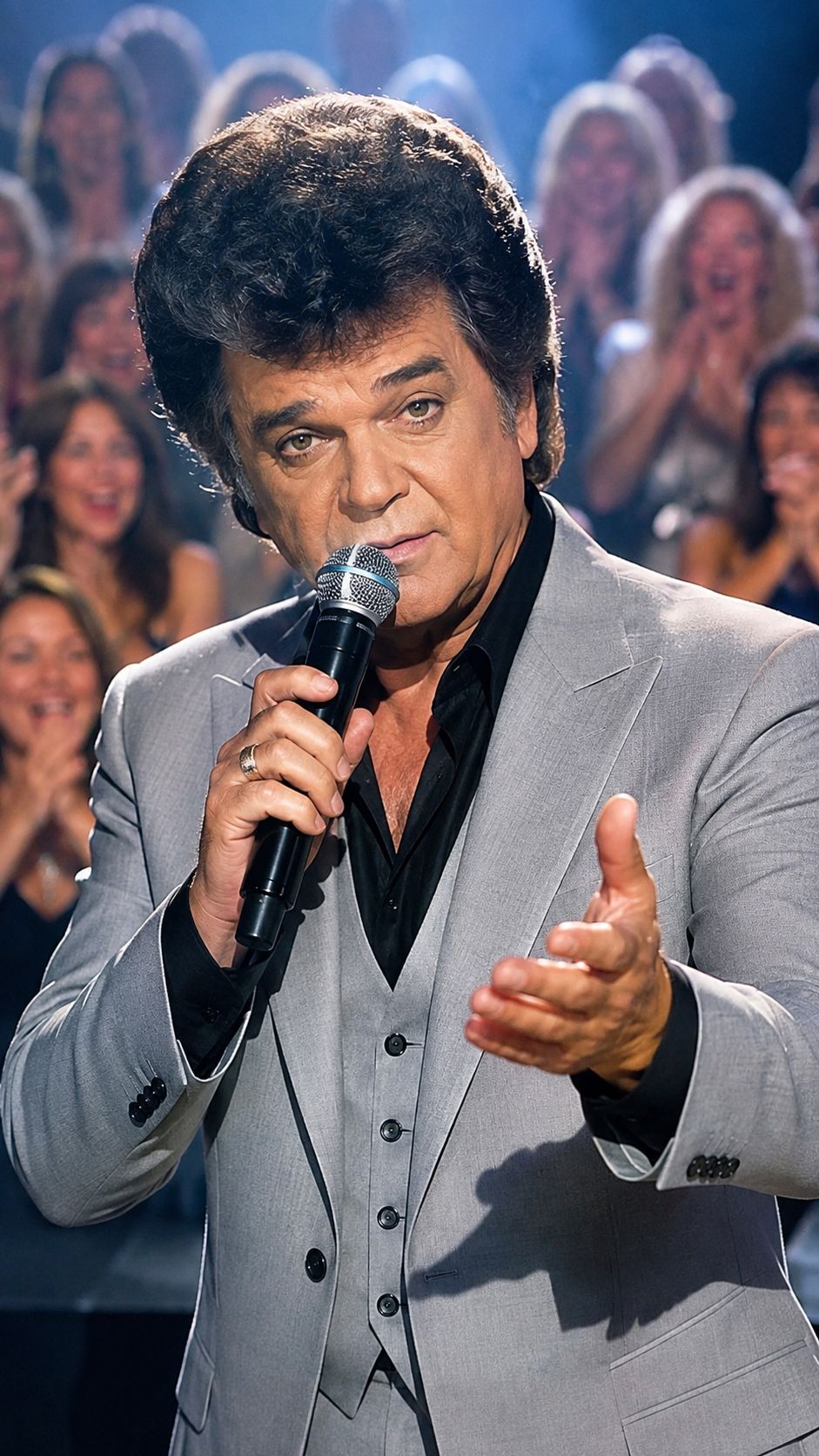
There are singers you admire.
There are singers you remember.
And then there are singers whose voices seem to reach through the decades and speak directly to something buried inside you.
Conway Twitty was that kind of singer.
In the 1970s, when country music was filled with heartbreak, temptation, longing, betrayal, and impossible love, Twitty possessed something almost unfair: a voice that could make a simple sentence sound like a confession whispered directly into someone’s ear.
Women adored him.
Men studied him.
Radio programmers argued about him.
And Nashville eventually had no choice but to surrender to him.
But the story becomes even more remarkable when you remember where he started.
Before he was the mysterious country heartthrob with the pompadour, before women screamed his name at concerts, before songs like “Hello Darlin’” became part of country music history, he was Harold Lloyd Jenkins—a Mississippi-born boy who loved music, baseball, and the sound of country songs.
And his road to becoming Conway Twitty was anything but smooth.
BEFORE THE COUNTRY CROWN, THERE WAS REJECTION
Born in Friars Point, Mississippi, in 1933, Twitty grew up around music. He learned guitar as a child and was already performing with a group by the age of ten. He also possessed enough baseball talent to attract the attention of the Philadelphia Phillies before military service changed the direction of his life.
Then came Elvis Presley.
Hearing “Mystery Train” helped convince the young Twitty that rock and roll might be his way into professional music. He eventually recorded for Sun and Mercury before scoring a massive breakthrough in 1958 with “It’s Only Make Believe.” The song became a worldwide sensation and turned Twitty into a rock-and-roll star.
But success did not make him satisfied.
In fact, it created another problem.
Twitty wanted country music.
The industry wasn’t convinced that country music wanted him.
After years as a rock-and-roll performer, his reputation followed him into Nashville. Country DJs were skeptical of the former teen idol, and some country stations initially refused to play his records.
That is where the viral legend of the “50 rejections” becomes emotionally powerful—even if the exact number cannot be firmly documented.
Because the important truth is that Twitty really did face resistance.
He had already been a star.
And now he had to prove himself all over again.
Imagine having millions of people recognize your name, only to discover that the new audience you desperately wanted didn’t believe you belonged.
Twitty didn’t quit.
He changed direction.
THEN CAME “HELLO DARLIN’”
In 1968, Twitty finally broke through in country music with “The Image of Me,” followed by his first Billboard country No. 1, “Next in Line.”
But 1970 was the year everything changed.
That was the year he released “Hello Darlin’.”
The opening was deceptively simple.
No fireworks.
No complicated musical trick.
Just a man speaking to someone he clearly hadn’t forgotten.
And somehow, millions of listeners understood immediately.
The song spent four weeks at No. 1 on the country chart and became one of Twitty’s defining recordings.
Twitty had discovered the secret weapon that would define his career:
He didn’t sing at women. He sang to them.
That distinction mattered.
His voice was deep, controlled, intimate, and slightly dangerous. He could sound apologetic in one line and confident in the next. He could portray regret without sounding weak and desire without needing to shout.
That combination made him irresistible to a generation of country listeners.
“I pick a song women will like. I like a song that says things a man wants to say and doesn’t know how to say.”
That philosophy, attributed to Twitty in contemporary accounts, may explain his appeal better than almost any statistic.
WHY WOMEN COULDN’T LOOK AWAY
The 1970s were an era when country music wasn’t afraid of complicated emotions.
Love could be beautiful.
Love could be destructive.
Love could be forbidden.
And sometimes, love could be something you weren’t supposed to admit.
Twitty understood all of it.
Songs such as “Fifteen Years Ago,” “How Much More Can She Stand,” “There’s a Honky Tonk Angel,” and “Linda on My Mind” repeatedly placed him inside stories involving longing, guilt, temptation, and emotional conflict.
His appeal wasn’t simply physical.
It was psychological.
He understood that a listener doesn’t necessarily fall in love with a singer because of what the singer says.
Sometimes it’s because of what the singer makes the listener imagine.
That became particularly obvious in 1973.
THE SONG RADIO DIDN’T WANT YOU TO HEAR
Then came “You’ve Never Been This Far Before.”
The song pushed the boundaries of what some country radio programmers were comfortable playing.
Its suggestive romantic imagery caused controversy, and some stations refused to play it. But instead of killing the song, the controversy helped make it irresistible. It reached No. 1 on the country chart and even crossed over to the Billboard Hot 100, where it peaked at No. 22.
It was the classic forbidden-fruit effect.
The more people were told they shouldn’t listen, the more curious they became.
And Twitty knew exactly how to use restraint.
He didn’t need to say everything.
He left room for imagination.
That was part of the magic.
THEN THERE WAS LORETTA
If Twitty’s solo career made him a country superstar, his partnership with Loretta Lynn turned him into half of one of country music’s most beloved duos.
Their voices were dramatically different.
Loretta’s could be earthy, powerful, vulnerable.
Conway’s could be smooth, controlled, almost conversational.
Together, the contrast created electricity.
Their recordings included “After the Fire Is Gone,” “Louisiana Woman, Mississippi Man,” “As Soon as I Hang Up the Phone,” and “Feelins’.” They also collected major awards, including a Grammy and four consecutive CMA Vocal Duo awards.
Onstage, they could make a fictional argument sound like something that had happened five minutes earlier.
Audiences believed them.
They didn’t need to believe the two were actually lovers.
They only needed to believe that the emotions were real.
And they were.
THE CROWDS WERE SOMETHING ELSE
Twitty’s popularity wasn’t merely visible on record charts.
His concerts became legendary.
The Country Music Hall of Fame describes his audiences as fervent female crowds and notes that his shows could resemble religious revivals. Jerry Clower famously nicknamed him “The High Priest of Country Music.”
Think about that.
A country singer standing on a stage in the 1970s.
Thousands of women screaming.
A deep voice rolling across the room.
And a performer who understood that sometimes the most powerful thing a man can do is simply stand still and let the song speak.
Twitty reportedly maintained a remarkably minimalist stage persona for years. He often avoided interviews, parties, television appearances, and even encores.
That mystery only made him more fascinating.
He wasn’t everywhere.
So when he appeared, it mattered.
THE NUMBERS BECAME ABSURD
Eventually, the man who had once struggled to convince country radio that he belonged became one of the most successful artists in the genre’s history.
The Country Music Hall of Fame credits him with 40 Billboard country No. 1 hits, while his official estate biography counts 55 No. 1 singles across the broader recording-industry tally it uses.
Either way, the scale is astonishing.
More than 50 million records sold are cited by his official biography.
Tens of millions of fans saw him perform.
More than 100 major awards are attributed to his career.
And eleven of his Billboard country No. 1s were songs he wrote himself.
The man who couldn’t simply walk into country music had eventually become one of its defining voices.
“I’LL JUST START OVER”
Perhaps the most revealing part of Twitty’s personality came when he was asked what he would do if one of his songs failed to reach No. 1.
His answer was brutally simple:
“I’ll just start over.”
That sentence tells you almost everything.
No excuses.
No self-pity.
No obsession with yesterday.
Just start over.
And when one of his songs eventually peaked at No. 2, that’s essentially what happened: he returned to the top with five more chart-toppers, according to his official biography.
That wasn’t luck.
That was mentality.
THE VOICE THAT OUTLIVED THE MAN
Conway Twitty died suddenly on June 5, 1993, at just 59 years old, after suffering an abdominal aneurysm while traveling after a performance. He was inducted into the Country Music Hall of Fame in 1999.
But death did not erase the fascination.
If anything, it intensified it.
Because every generation eventually discovers something old and realizes it still feels new.
A young listener hears “Hello Darlin’.”
A couple discovers “After the Fire Is Gone.”
Someone hears “You’ve Never Been This Far Before” and suddenly understands why radio programmers once panicked over it.
And then comes the realization:
This man wasn’t simply singing country songs.
He was creating emotional theater.
He understood loneliness.
He understood desire.
He understood regret.
Most importantly, he understood the things people wanted to say but were sometimes too afraid to say themselves.
That’s why his voice still works.
Because the technology changed.
The hairstyles changed.
The radio changed.
The music business changed.
But human longing didn’t.
And that may be Conway Twitty’s greatest legacy.
He wasn’t the loudest singer.
He wasn’t the flashiest performer.
He didn’t need to be.
He simply walked into a microphone, lowered his voice, and made millions of people feel as if he were singing directly to them.
“If you do what you love and you’re able to take care of the people you love, it doesn’t matter what you do. You’re a successful man.”
Those words, preserved by his official biography, may be the most fitting way to remember him.
The boy from Mississippi became a rock-and-roll star.
The rock star became a country outsider.
The outsider became a country king.
And the voice that once had to fight for a place in Nashville ultimately became one of the most recognizable sounds of the 1970s.
Conway Twitty didn’t just survive rejection.
He turned it into fuel.
And decades later, when that deep voice comes through the speakers and quietly says, “Hello, darlin’…”, the room still seems to get a little quieter.
Because some voices don’t belong to one decade.
They belong to memory.
VIDEO: