 By admin
 INTRODUCTION:
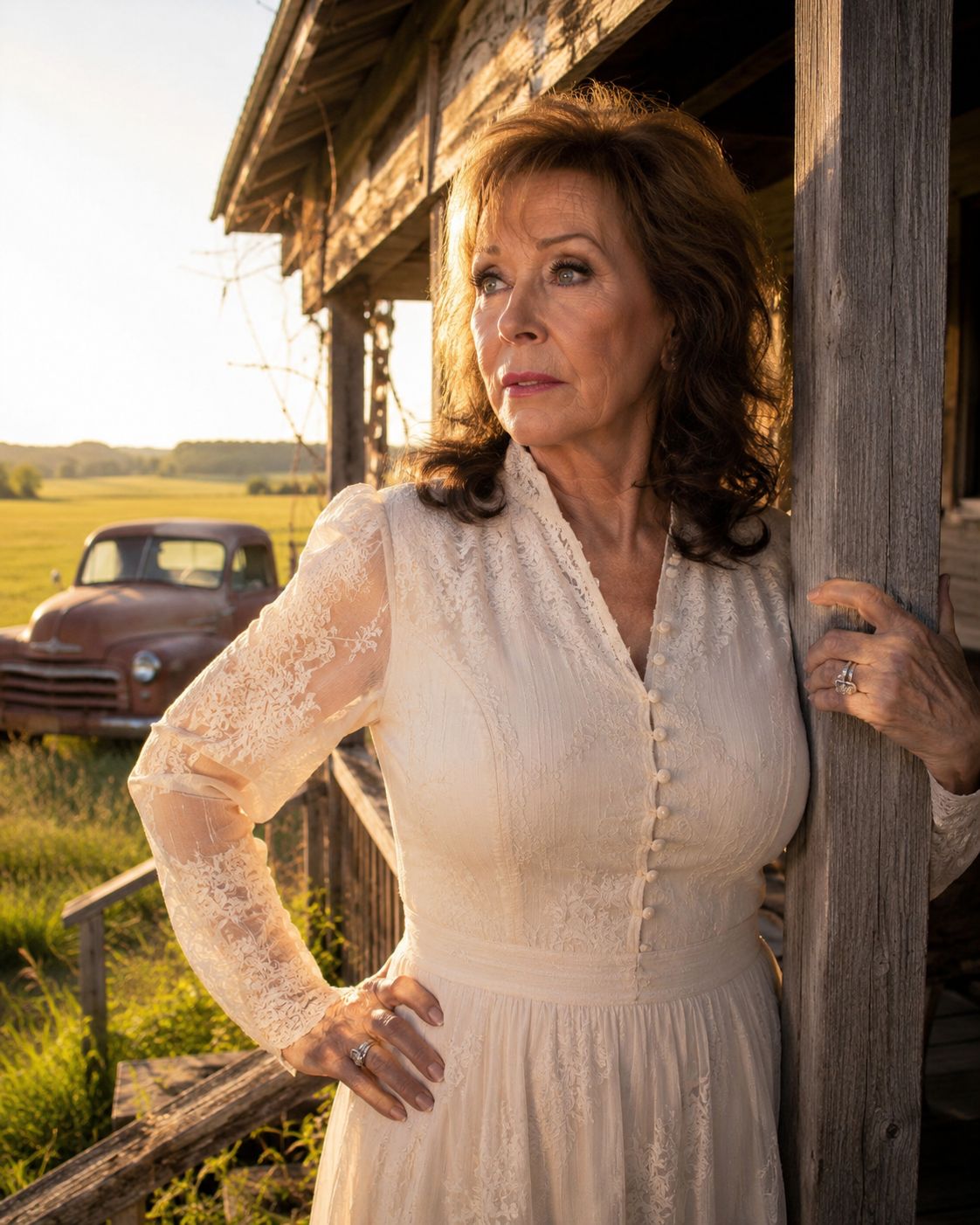
There are many ways to measure a country music legend.
You can count the No. 1 hits.
You can count the awards.
You can count the sold-out concerts, the gold records, the television appearances, and the names engraved into the walls of Nashville’s most sacred institutions.
But sometimes, there is another measurement.
Count the songs they tried to silence.
By that measure, few artists in country music history can stand beside Loretta Lynn.
Lynn became famous for singing about the lives of ordinary people—especially women whose stories were rarely given center stage. She sang about marriage, motherhood, betrayal, loneliness, poverty, drinking, divorce, desire, and the complicated realities of being a woman in a world where men often made the rules.
And according to Lynn’s own account, as many as 14 of her songs were banned from country radio during her career. The exact number has been questioned by historians, but there is no question that several of her most provocative recordings were rejected by radio stations because their subjects challenged the social conventions of the time.
And somehow, that only made Loretta Lynn more powerful.
Because she wasn’t trying to be controversial simply for attention.
She was telling the truth as she saw it.
“I was writing about things that nobody talked about in public.”
That was the heart of Loretta Lynn.
She didn’t need a political speech.
She had a microphone.
She had a pencil.
And she had the courage to put uncomfortable truths into country songs.
THE WOMAN FROM BUTCHER HOLLOW WHO REFUSED TO STAY QUIET
Before she became one of country music’s most celebrated figures, Loretta Lynn came from a world far removed from Nashville’s polished stages.
She was born into poverty in Butcher Hollow, Kentucky, and grew up in a large family. Her childhood experiences would become the raw material for a songwriting career unlike almost anything country music had seen before.
She didn’t write as an outsider looking in.
She wrote as someone who had lived the stories.
Marriage wasn’t an abstract concept.
Motherhood wasn’t an abstract concept.
Financial hardship wasn’t an abstract concept.
Neither was heartbreak.
That authenticity became her greatest weapon.
When Lynn sang about women dealing with difficult husbands, complicated marriages, jealousy, divorce, or exhaustion, millions of listeners recognized themselves.
And sometimes the radio programmers recognized something else.
Danger.
Not because Loretta was promoting some radical fantasy.
Because she was allowing women to speak.
That was revolutionary.
“THE PILL” BECAME THE SONG THEY COULDN’T KEEP QUIET
Few songs demonstrate Lynn’s fearlessness better than “The Pill.”
Released in 1975, the song celebrated birth control and the freedom it could give a married woman who no longer wanted to keep having children. Its subject was explosive in the conservative country environment of the era. The song had reportedly been recorded years earlier, but its release was delayed before finally reaching the public.
Then radio stations started saying no.
According to contemporary reports cited by later accounts, roughly 60 stations refused to play “The Pill.”
But something unexpected happened.
The ban didn’t kill the song.
It helped turn it into an event.
Listeners wanted to hear the forbidden record.
The song ultimately reached No. 5 on Billboard’s Hot Country Songs chart and became Lynn’s biggest pop crossover hit, reaching the Billboard Hot 100 as well.
Think about that for a moment.
Radio stations were saying, “We won’t play this.”
The public answered, “Then we’ll buy it.”
That is the kind of moment that changes an artist’s legacy forever.
SHE DIDN’T WRITE FOR THE MEN IN THE RADIO BOOTHS
This is where Loretta Lynn’s story becomes bigger than one controversial song.
She understood something that many artists take years to learn:
You cannot control what people will think of you. But you can control whether you tell the truth.
Her songs frequently placed women at the center of their own stories.
In “Rated X,” Lynn confronted the double standard surrounding divorced women. A divorced woman could be judged harshly while the men involved escaped much of the same social condemnation. PBS later highlighted the song as one of the recordings that drew radio bans.
Then there was “Wings Upon Your Horns,” which dealt with a young woman’s loss of virginity through a deeply personal and religiously charged perspective.
There was “One’s on the Way,” which looked at the exhaustion and limitations faced by women trying to survive motherhood and domestic life while the women’s liberation movement was transforming America.
And there was “Don’t Come Home A-Drinkin’ (With Lovin’ on Your Mind),” a brutally direct warning to a husband who expected affection after coming home drunk.
These weren’t fantasy characters.
They were women.
Women who were tired.
Women who were angry.
Women who were scared.
Women who loved their husbands but were sometimes furious with them.
Women who wanted something more.
And Loretta gave them a voice.
THE DOUBLE STANDARD WAS PART OF THE STORY
One of the most fascinating elements of Lynn’s legacy is the double standard surrounding controversial country music.
Country music had always contained songs about sex, drinking, infidelity, violence, and broken marriages.
But when Loretta Lynn put some of those subjects into the mouth of a woman—and sometimes gave that woman agency—the reaction could be dramatically different.
That contradiction became part of her artistic identity.
She wasn’t simply singing about women.
She was allowing women to answer back.
And that mattered.
A man could sing about a complicated marriage and be considered rugged.
Loretta could sing about the same marriage and suddenly people were asking whether she had gone too far.
She noticed.
Her audience noticed.
And she kept singing.
RADIO COULDN’T ERASE WHAT PEOPLE HAD ALREADY HEARD
There is a strange irony at the center of Loretta Lynn’s career.
The more some institutions tried to control what she could say, the more valuable her voice became.
The bans became part of the mythology.
The controversy became part of the conversation.
And the songs themselves survived.
That is the thing about great country music.
It doesn’t need permission to become personal.
A woman hears a Loretta Lynn song on an old record.
Suddenly she remembers being 22.
A man hears another song and remembers the woman who left him.
Someone hears “Coal Miner’s Daughter” and remembers their parents.
Someone hears “The Pill” and remembers a time when even talking openly about women’s reproductive choices could cause a national uproar.
That’s why censorship rarely works the way people imagine.
You can turn off the radio.
You cannot turn off memory.
SHE EVENTUALLY GOT EVERYTHING THE INDUSTRY COULD GIVE HER
And here’s where the headline becomes almost poetic.
Because eventually, the same country music establishment that had sometimes rejected Loretta Lynn’s songs had no choice but to acknowledge her greatness.
She became the first woman to win the CMA Entertainer of the Year award, in 1972.
She was inducted into the Country Music Hall of Fame in 1988.
She received the Presidential Medal of Freedom in 2013.
Her career eventually became too enormous to dismiss.
But those honors aren’t what make her story extraordinary.
The awards came later.
The respect came later.
The institutions came later.
The courage came first.
THE REAL LEGACY WASN’T THE TROPHIES
Loretta Lynn died in 2022 at the age of 90, leaving behind one of the most remarkable bodies of work in American country music.
But when people remember her, they shouldn’t only remember the trophies.
Remember the girl from Kentucky.
Remember the woman who turned personal experience into songs.
Remember the songwriter who looked at subjects Nashville considered dangerous and decided they were simply subjects worth singing about.
Remember the artist who could make a husband laugh, a wife cry, a radio programmer nervous, and an entire generation of women feel understood—all within the same song.
She didn’t become a legend because everybody agreed with her. She became a legend because she kept singing when they didn’t.
That’s the difference between being famous and being influential.
Fame depends on applause.
Influence survives disagreement.
Loretta Lynn’s greatest achievement may not have been getting into the Hall of Fame.
It may not have been winning awards.
It may not even have been the enormous number of hit records she created.
It was something simpler.
She made people listen.
And sometimes, she made them uncomfortable.
That was the point.
Because country music has always been at its best when it tells the truth about ordinary life—even when the truth isn’t pretty.
Loretta Lynn understood that better than almost anyone.
She knew that behind every polished Nashville image was a real person.
A real marriage.
A real heartbreak.
A real kitchen.
A real argument.
A real woman wondering whether anyone understood what she was going through.
So she wrote the song.
Radio could ban it.
Programmers could refuse it.
Critics could complain.
But somewhere, somebody would still hear it.
And that somebody would whisper:
“That’s my story.”
Maybe that’s the real Hall of Fame.
Not a building.
Not a trophy.
Not a plaque.
But generations of people hearing your voice long after the people who tried to silence you are gone.
Loretta Lynn didn’t simply survive the bans. She turned them into another chapter of her legend.
VIDEO: