 By admin
INTRODUCTION:
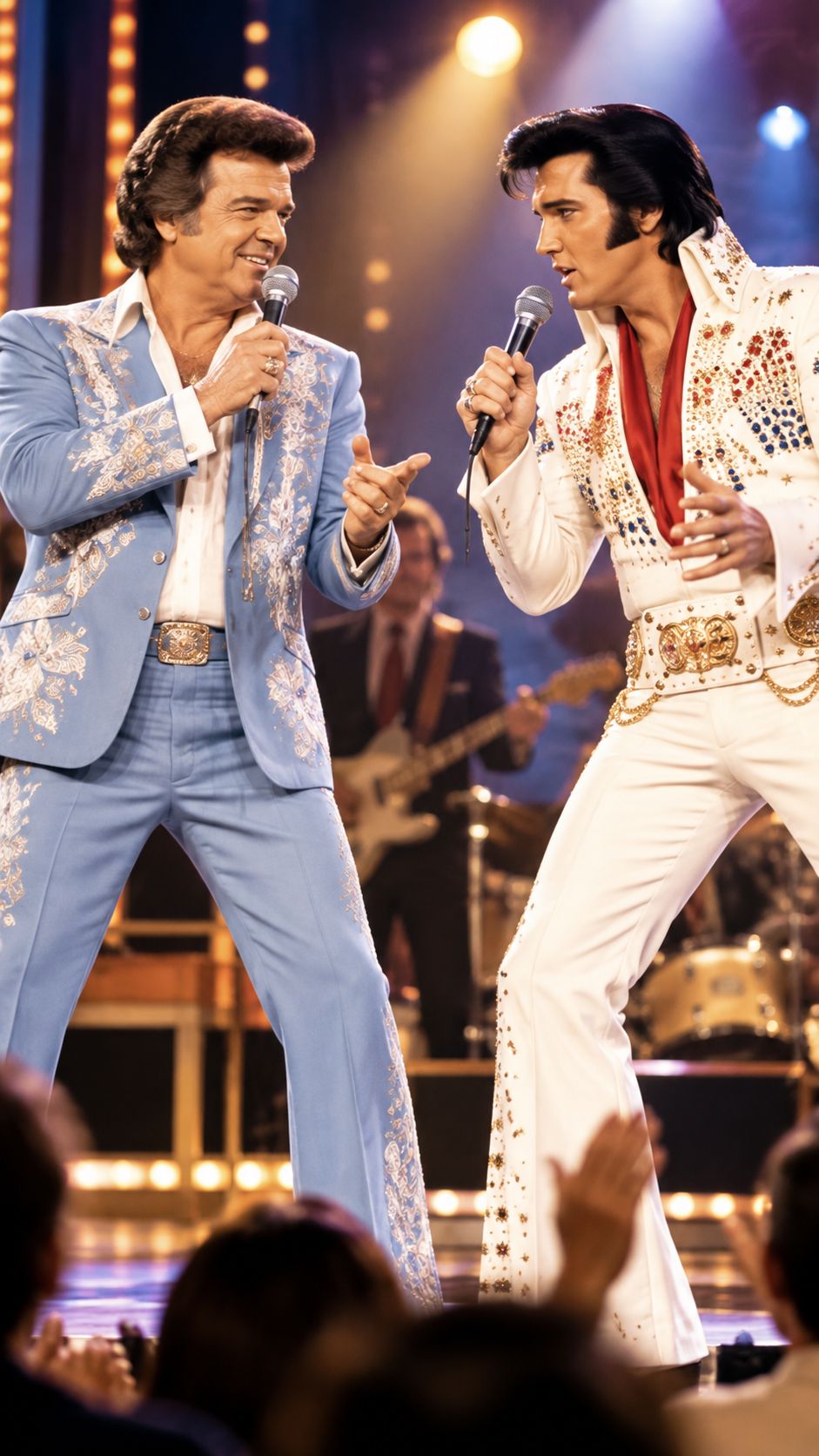
There are moments in music history when two voices seem destined to collide.
One arrives like thunder. The other comes with a darker, deeper growl. One becomes known as “The King.” The other builds a different kind of kingdom—one made of heartbreak, country ballads, broken promises, lonely nights, and songs that sounded as though they had been lived rather than simply sung.
That is the story behind the enduring comparison between Elvis Presley and Conway Twitty.
But was there really a bitter personal rivalry between them?
The historical record suggests something more complicated—and perhaps more fascinating.
Elvis Presley and Conway Twitty were not simply competing singers trying to destroy one another at the top of the charts. They represented two different possibilities for the same musical revolution. Both were Southern-born performers who absorbed country, gospel, blues and rhythm & blues. Both possessed unmistakable stage personalities. And, most importantly, both helped demonstrate just how powerful a male singer could become when vulnerability and swagger occupied the same microphone.
Yet their careers eventually traveled in dramatically different directions.
And that is where the real battle begins.
Two Southern Boys, One Musical Revolution
Before Conway Twitty became one of country music’s most successful hitmakers, he was Harold Lloyd Jenkins, born in Friars Point, Mississippi, in 1933. Elvis Presley, born in Tupelo, Mississippi, in 1935, came from a similarly Southern musical environment.
The two were separated by only a relatively short distance geographically, but their paths through music were radically different.
According to the Country Music Hall of Fame and Museum, Twitty heard Elvis’s music after leaving military service and was inspired enough to travel to Memphis and seek an opportunity at Sun Records.
Imagine that moment.
A young Conway hears this new sound coming from Memphis—the rhythm, the sensuality, the rebellion, the voice—and realizes that the musical world is changing.
Elvis was already becoming the face of that change.
Twitty wanted inside.
But there was a problem.
There was already an Elvis Presley.
So Conway had to find his own voice.
And eventually, he did.
The Song That Made People Think Conway Was Elvis
In 1958, Twitty recorded “It’s Only Make Believe.”
At first, almost nobody knew what was coming.
The song had been written by Twitty and drummer Jack Nance while the pair were touring in Canada. Released as the B-side of “I’ll Try,” it initially looked like an afterthought. But radio programmers began playing the B-side, and everything changed.
The song eventually reached No. 1 on the U.S. pop chart and became an international sensation.
And then came one of the strangest compliments imaginable.
Some listeners actually believed the mysterious singer was Elvis Presley.
The resemblance in vocal texture was close enough that people wondered whether Elvis had secretly recorded the song under another name. Contemporary accounts also emphasized how Twitty’s Elvis-like growl contributed to the confusion.
That tells us something important.
Conway wasn’t merely following the rock-and-roll explosion.
He was good enough to be mistaken for one of its biggest stars.
For a young singer trying to escape Elvis’s shadow, being mistaken for Elvis was both a compliment—and a challenge.
Because eventually, Conway had to stop sounding like somebody else’s revolution.
He had to create his own.
Elvis Built the Empire. Conway Changed the Battlefield.
This is where comparisons between the two men become fascinating.
Elvis Presley became a cultural phenomenon on a scale few entertainers before or after him could match. He transformed popular music, fashion, performance, television and youth culture.
Conway Twitty’s impact was different.
He gradually moved away from rock and roll and toward country music. By the mid-1960s, he was making a career decision that many people around him considered risky.
Rock and roll was where the money and excitement were.
Country music was where Conway believed he belonged.
In one later recollection, Twitty explained that he had already experienced the other side of the musical fence and preferred country. His transition eventually produced a staggering run of country success.
That decision may be one of the most important differences between the two careers.
Elvis remained the central symbol of rock-and-roll stardom.
Conway became one of country music’s defining voices.
He didn’t defeat Elvis by becoming a bigger Elvis.
He escaped the comparison entirely.
The Second Conway Twitty Was Born
When Conway entered country music, something remarkable happened.
The voice that once sounded like a young rock-and-roll heartthrob became the voice of adult heartbreak.
Songs such as “Hello Darlin’”, “You’ve Never Been This Far Before,” “Linda on My Mind,” “Don’t Take It Away,” and “I’d Love to Lay You Down” established an identity that was unmistakably Conway.
The Country Music Hall of Fame notes that Twitty eventually achieved more No. 1 country records than any country artist had achieved at the time of his death, and that eleven of those No. 1 hits were songs he had written himself.
That statistic changes the entire argument.
Because if the question is whether Conway merely lived in Elvis’s shadow, the answer becomes much more complicated.
He began under Elvis’s enormous influence.
But he ended with a kingdom of his own.
Elvis Had the Crown. Conway Had the Confession.
Perhaps the deepest difference between the two singers wasn’t fame.
It was emotional territory.
Elvis often sang about desire, freedom, loneliness, devotion and rebellion with theatrical intensity. Conway specialized in something more intimate: the complicated emotional wreckage left after love goes wrong.
His voice could sound like a man sitting alone after midnight, staring at a telephone that wasn’t going to ring.
That was his weapon.
He didn’t always need spectacle.
Sometimes he only needed a sentence.
Sometimes he only needed a pause.
Sometimes the roughness in his voice did more than an orchestra could accomplish.
Elvis could make a room feel like a stage. Conway could make a heartbreak feel like a confession whispered directly into your ear.
And millions of country listeners responded.
Was There Really a “Fierce Rivalry”?
This is where the mythology deserves some caution.
There is abundant evidence that the two singers were musical contemporaries whose styles were connected by the rock-and-roll explosion of the 1950s. There is also evidence that Twitty’s early sound was compared directly with Elvis’s.
But calling their relationship a documented personal feud or a sustained head-to-head rivalry would overstate the historical record.
The more accurate story is a musical divergence.
Elvis became the defining superstar of rock and popular culture.
Conway eventually became one of the defining superstars of country music.
Their careers intersected through influence, geography, musical roots and audience comparisons—but they ultimately occupied different thrones.
And perhaps that is more interesting than a simple rivalry.
So Who Deserves the Crown?
There is no single objective answer because the crown depends entirely on what is being measured.
If the question is cultural impact, Elvis’s influence was extraordinary.
If the question is rock-and-roll transformation, Elvis stands at the center of the story.
If the question is country-chart dominance, Conway’s record speaks for itself.
If the question is career reinvention, Conway’s journey from rock-and-roll performer to country institution is remarkable.
And if the question is emotional storytelling, generations of country listeners have found something uniquely personal in Conway’s recordings.
That is why comparing them isn’t really about deciding which man was “better.”
It’s about understanding what each one represented.
Elvis Presley represented the explosion.
Conway Twitty represented the evolution.
Elvis helped tear down the walls separating country, blues and rock.
Conway showed how a performer could walk through those walls, cross into another genre, and build an entirely new identity.
The Final Twist
Perhaps the most beautiful part of this story is that Conway never actually needed to defeat Elvis.
He needed to survive the comparison.
And he did.
The young Conway Twitty who sounded enough like Elvis to confuse listeners eventually became a singer nobody could confuse with anyone else.
That may be the greatest victory of all.
His legacy was not simply that he once sounded like the King.
It was that, after borrowing the language of rock and roll, he developed a musical vocabulary of his own.
When Conway Twitty died in 1993, the Country Music Hall of Fame remembered a performer whose stardom had endured across five decades and whose country No. 1 achievements had set a remarkable standard.
The boy from Mississippi had become something entirely different from the young rock-and-roll singer who once chased the sound coming out of Memphis.
He had become Conway Twitty.
And perhaps that is the real lesson behind the supposed Conway Twitty vs. Elvis Presley rivalry.
The greatest victory isn’t becoming the person everyone compares you to. It’s becoming the person nobody can replace.
Elvis remains The King.
Conway remains one of country music’s most enduring voices.
And somewhere between Memphis rock and Nashville heartbreak, their stories became permanently connected—not because one destroyed the other, but because both helped define what Southern music could become.
VIDEO: