 By admin
INTRODUCTION:
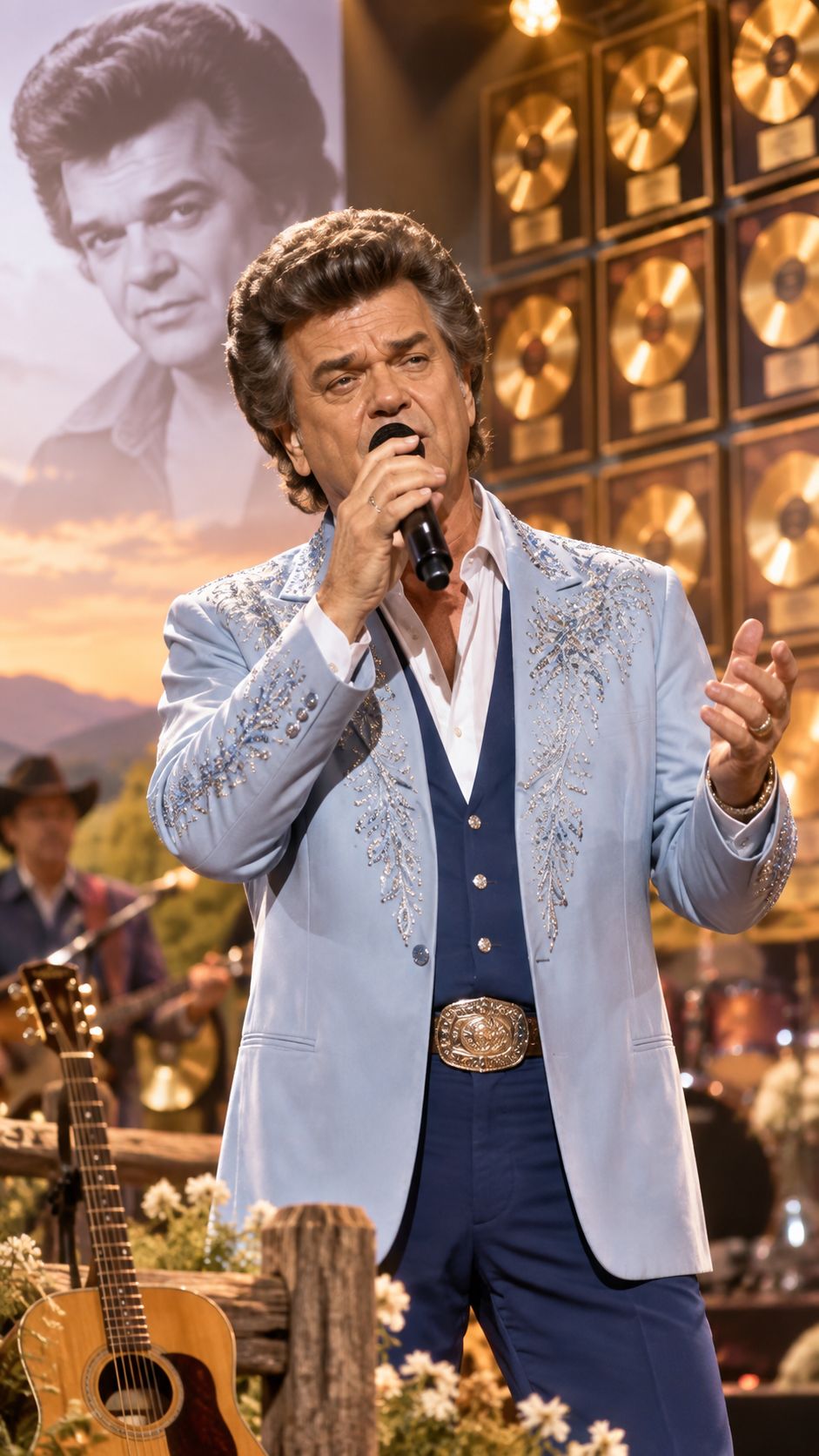
There are numbers in country music that sound impressive.
And then there are numbers that sound almost impossible.
55 No. 1 hits.
For Conway Twitty, that number became part of his legend — a staggering achievement assembled across the major music trade charts during a career that transformed him from a young rock-and-roll sensation into one of the most enduring voices in country music.
But behind that extraordinary statistic was a story far more complicated than a chart record.
It was a story about reinvention.
It was about risk.
It was about heartbreak, desire, ambition, and an artist who refused to let one chapter of his career determine the ending.
And perhaps most remarkably, it was about a man who had already conquered one musical world before walking away from it to build an entirely different empire.
Conway Twitty didn’t simply become a country legend. He reinvented himself into one.
FROM HAROLD JENKINS TO CONWAY TWITTY
Long before audiences knew him as Conway Twitty, he was Harold Lloyd Jenkins, born in Friars Point, Mississippi, in 1933.
Music entered his life early. According to the Country Music Hall of Fame, he was already performing and playing guitar on the radio as a child. His early career, however, wasn’t centered on country music.
Instead, young Jenkins chased the energy of rock and roll.
And he didn’t merely dabble in it.
In 1958, under the name Conway Twitty, he released “It’s Only Make Believe.”
The song exploded.
It reached No. 1 on the Billboard Hot 100, turning Twitty into a major pop and rock star before country music had fully claimed him.
That success could have been the entire story.
For many performers, a No. 1 pop record becomes the destination.
For Twitty, it became only the beginning.
THE DECISION THAT CHANGED EVERYTHING
By the middle of the 1960s, Twitty’s rock-and-roll career was losing momentum.
He faced a decision that could easily have ended differently.
Stay where the audience already knew him — or return to the country music that had been part of his roots.
He chose country.
And that decision would eventually make music history.
Twitty signed with Decca in the mid-1960s and began rebuilding himself. The transition wasn’t instantaneous. He had to convince country audiences that the former rock-and-roll heartthrob belonged in their world.
Then came “Next in Line.”
In 1968, it became his first No. 1 on the Billboard country chart.
That was the beginning of an extraordinary run.
THE VOICE THAT MADE HEARTBREAK SOUND PERSONAL
What separated Conway Twitty from countless other singers wasn’t simply his ability to find successful songs.
It was the way he delivered them.
His voice could sound conversational one moment and devastating the next.
He understood the emotional space between love and betrayal — the uncomfortable territory where people make mistakes, regret them, hide them, confess them, and sometimes repeat them.
Songs such as “Hello Darlin’,” “Fifteen Years Ago,” “How Much More Can She Stand,” “You’ve Never Been This Far Before,” “There’s a Honky Tonk Angel,” and “Linda on My Mind” became essential pieces of his country identity. The Country Music Hall of Fame specifically notes the recurring themes of infidelity and guilt in many of his signature recordings.
That emotional realism became part of his commercial power.
He wasn’t singing about perfect love.
He was singing about complicated love.
And country audiences recognized themselves in those complications.
Twitty understood that heartbreak didn’t need to be beautiful to be honest. Sometimes it only needed to be true.
THEN CAME LORETTA LYNN
If Twitty’s solo career was extraordinary, his partnership with Loretta Lynn created another chapter entirely.
Their voices seemed to understand conflict.
They could sound affectionate, argumentative, vulnerable, stubborn, and passionate — sometimes within the same song.
Their first No. 1 duet, “After the Fire Is Gone,” reached the top of the Billboard country chart in 1971 and helped launch one of country music’s most celebrated recording partnerships. The duo eventually earned a Grammy and four CMA Awards for their collaborations.
Then came songs such as “Louisiana Woman, Mississippi Man,” “Lead Me On,” “As Soon as I Hang Up the Phone,” and “Feelins’.”
The chemistry was unmistakable.
But chemistry alone doesn’t explain their success.
The songs worked because they dramatized adult relationships without pretending everything was simple.
Twitty and Lynn didn’t sing as though love was a fairy tale.
They sang as though love was a battlefield.
WHERE DID THE 55 COME FROM?
This is where the famous number requires some explanation.
The 55 No. 1 figure frequently associated with Twitty comes from combining chart-topping singles across multiple music publications, including Billboard, Record World, Cashbox, and Radio & Records, rather than counting only Billboard’s country chart. Contemporary retrospectives and historical compilations have used that broader calculation.
Billboard’s official country record is different.
Twitty accumulated 40 No. 1s on Billboard’s Hot Country Songs chart between 1968 and 1986. Billboard has documented that total, with “Desperado Love” becoming his 40th and final Billboard country No. 1 in September 1986.
That distinction doesn’t make the achievement smaller.
If anything, it makes the story clearer.
Forty Billboard country No. 1s is already an extraordinary career.
And the broader 55-number statistic reveals just how dominant Twitty was across the competing chart systems of his era.
THE RECORD THAT STOOD FOR YEARS
Twitty’s 40 Billboard country No. 1s became one of the defining records of his career.
He held that record for years before George Strait eventually surpassed it. Billboard now lists Strait with 44 Hot Country Songs No. 1s.
But there’s another astonishing detail.
Twitty reached those 40 country No. 1s in less than 18 years, from “Next in Line” in 1968 to “Desperado Love” in 1986.
Think about that for a moment.
He didn’t spend half a century accumulating chart victories.
He compressed an extraordinary amount of success into one remarkably productive stretch.
AND THEN — SILENCE
In 1993, the story ended far too soon.
Twitty died at only 59 after suffering an abdominal aneurysm.
The man who had once conquered rock and roll, reinvented himself in country music, recorded dozens of chart-topping songs, and helped create some of the most memorable duets in country history was suddenly gone.
But the records remained.
The voice remained.
The songs remained.
And the stories inside those songs remained.
Twitty was inducted into the Country Music Hall of Fame in 1999, further cementing his place in the history of the genre.
BEFORE THE MODERN ERA OF SUPERSTARS
Today, artists such as Taylor Swift demonstrate how enormous a modern music career can become across genres, platforms, charts, streaming, and global audiences.
But comparing Twitty directly with a modern artist requires caution because the music business and chart methodologies have changed dramatically.
Twitty’s era was built around physical singles, radio airplay, record sales, touring, and competing trade publications.
Modern chart success incorporates a much broader digital ecosystem.
So the real significance of Conway Twitty’s 55-number isn’t that it provides a simple “who was bigger?” answer.
It tells us something more interesting.
It shows how completely one performer could dominate the traditional music marketplace.
Before streaming, before social media, before viral clips could resurrect a song overnight, Conway Twitty built his legend one record, one radio station, and one audience at a time.
THE LEGACY THAT REFUSES TO DISAPPEAR
Perhaps the most unbelievable part of the Conway Twitty story isn’t the number 55.
It is everything that came before it.
A Mississippi boy became a rock-and-roll star.
The rock star lost momentum.
The same man reinvented himself as a country singer.
The country singer became a superstar.
The superstar became a duet legend.
And the artist who had already reached No. 1 in pop music eventually became one of the most successful country performers in history.
That’s why Conway Twitty remains so fascinating.
His career wasn’t a straight line.
It was a series of risks.
And every time the music business changed direction, Twitty found another way to move forward.
His 40 Billboard country No. 1s remain an extraordinary benchmark, while the broader historical count of 55 No. 1s across multiple trade charts explains why older country historians and fans continue to speak about his chart dominance with such awe.
The numbers tell us he was successful.
The songs tell us why.
And the story tells us something even deeper:
Conway Twitty never allowed his past to decide his future.
That may be the greatest hit he ever recorded.
VIDEO: