 By admin
INTRODUCTION:
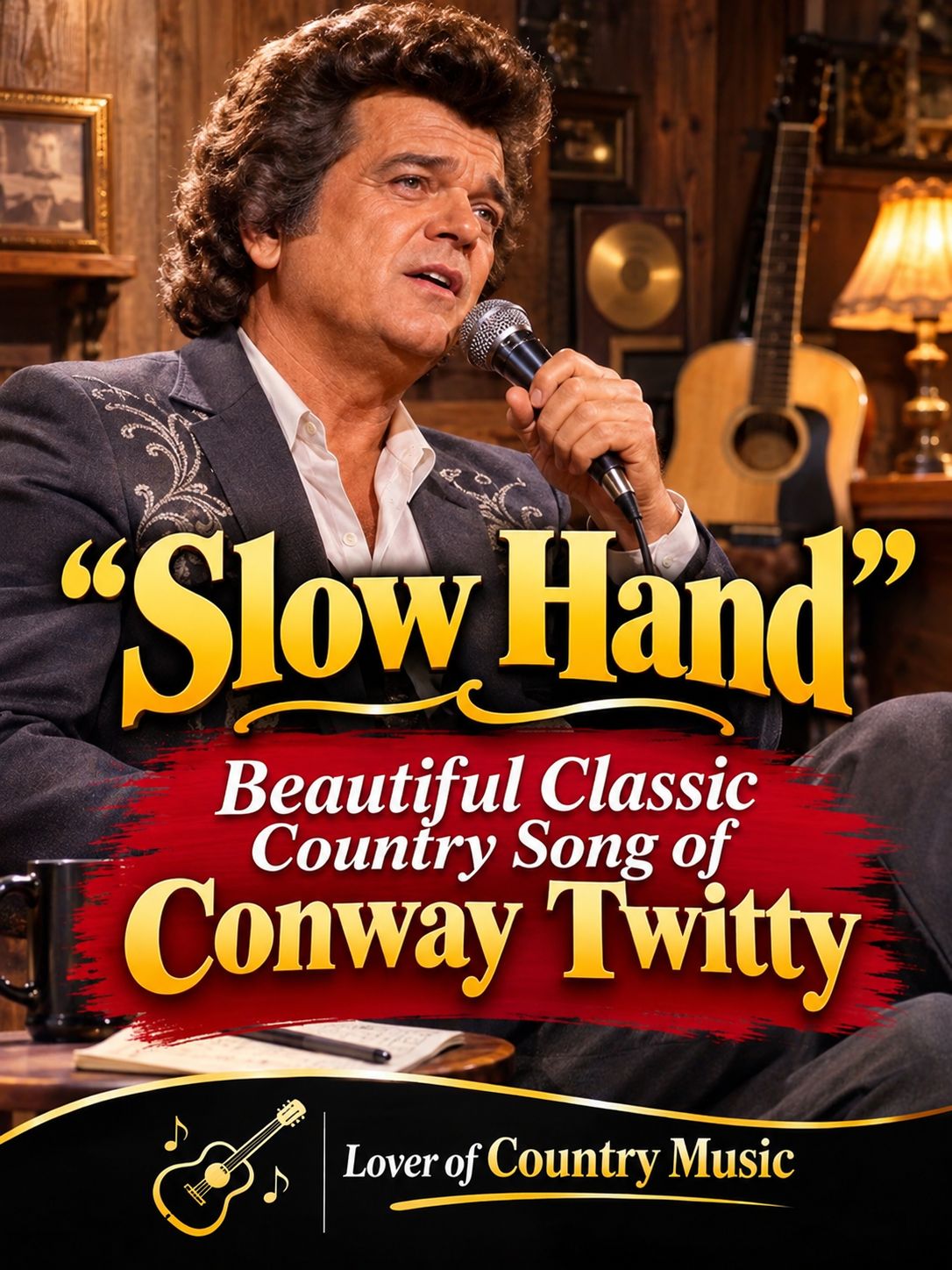
Some songs are simply too beautiful to belong to one generation, one musical genre, or even one particular artist. They possess something timeless, something that allows them to travel across musical boundaries and find a new home in the voices of different performers. Slow Hand is one of those extraordinary songs. Originally recorded by The Pointer Sisters in 1981, this smooth, soulful hit captured the attention of audiences with its irresistible melody, intimate atmosphere, and unforgettable emotional delivery. Yet when country music legend Conway Twitty brought his own interpretation to the song, something remarkable happened. A familiar pop and R&B favorite suddenly acquired a distinctly country soul.
Known for his deep, warm voice and extraordinary ability to communicate emotion, Conway Twitty never needed complicated arrangements or dramatic vocal displays to capture an audience. His greatest strength was the way he could make a song feel personal, as though he were telling a private story directly to every listener. With Slow Hand, he demonstrated that same remarkable gift, transforming an already beloved composition into something that felt unmistakably his own.
Watching Conway perform this song live offers more than an opportunity to revisit a classic recording. It provides a glimpse into the artistry of a man who understood that great music is not limited by genre. Whether listeners remember him for his country ballads, his legendary partnership with Loretta Lynn, or his earlier rock-and-roll success, this performance reminds us why his musical legacy continues to resonate across generations.
1. THE STORY BEHIND SLOW HAND — A SONG THAT CROSSED MUSICAL GENERATIONS
Before Conway Twitty introduced his country interpretation, Slow Hand had already established itself as an important recording in the musical journey of The Pointer Sisters.
Released in 1981, the song appeared on their eighth studio album, Black & White. Written by John Bettis and Michael Clark, it showcased a different side of the group’s musical identity, moving toward a softer, more intimate sound while retaining the polished production and distinctive vocal character that made them famous.
The original recording became a major commercial success. Its smooth rhythm, memorable melody, and romantic atmosphere helped it reach audiences far beyond traditional R&B listeners. It eventually became one of the group’s signature recordings.
What made the song particularly interesting was its simplicity. Rather than depending on an elaborate musical arrangement, it allowed the melody and emotional message to take center stage.
There was a certain confidence in its relaxed rhythm. The song did not rush toward its destination. Instead, it allowed every musical phrase to breathe, creating an atmosphere that felt intimate and inviting.
That quality made Slow Hand an especially interesting choice for a country singer.
Country music has always had a close relationship with storytelling, romance, longing, and emotional honesty. Although the original recording belonged to a different musical tradition, its underlying sentiment was perfectly suited to the expressive possibilities of country music.
And few singers understood those possibilities better than Conway Twitty.
2. CONWAY TWITTY — THE COUNTRY LEGEND WHO NEVER FEARED MUSICAL BOUNDARIES
Born Harold Lloyd Jenkins on September 1, 1933, in Friars Point, Mississippi, Conway Twitty developed a musical identity that could never be confined to a single category.
Before becoming one of country music’s most recognizable voices, he experienced considerable success in rock and roll. His 1958 recording of It’s Only Make Believe became an international hit, introducing audiences to a singer whose voice possessed both youthful energy and remarkable emotional depth.
His early musical experiences helped shape the artist he would eventually become.
When he moved more firmly into country music, Conway did not abandon his earlier influences. Instead, he brought them with him, combining elements of rock, pop, R&B, and traditional country into a distinctive musical personality.
That versatility became one of his greatest strengths.
Throughout his career, he recorded numerous unforgettable songs, including:
- Hello Darlin’
- You’ve Never Been This Far Before
- Linda on My Mind
- Tight Fittin’ Jeans
- I See the Want To in Your Eyes
- Desperado Love
- Crazy in Love
His ability to deliver emotional ballads with sincerity made him particularly popular among country audiences.
By the time he recorded Slow Hand, Conway had already established himself as an artist who could take a song from another musical world and make it sound natural within his own repertoire.
He did not simply imitate the original performers. He interpreted songs through his own personality, vocal style, and understanding of emotional storytelling.
That distinction is important when considering his version of Slow Hand.
3. HOW CONWAY TWITTY TRANSFORMED A POP AND R&B FAVORITE INTO A COUNTRY CLASSIC
When Conway Twitty released his version of Slow Hand in 1982, he demonstrated how a familiar composition could take on a different emotional character through the voice of another artist.
His recording appeared on the album Dream Maker and became a major country hit, reaching the top of the Billboard country singles chart.
The achievement was not simply about taking a successful song and recording it again.
It was about discovering another musical identity hidden within the same composition.
The original version by The Pointer Sisters carried the sophisticated atmosphere of early-1980s pop and R&B. Its smooth production and vocal harmonies created an unmistakable sound.
Conway approached the material differently.
His voice had a natural richness that immediately changed the atmosphere. There was a relaxed confidence in his delivery, accompanied by the distinctive phrasing that had become his trademark.
He understood that the song did not need to be dramatically reinvented. Its strongest qualities were already there.
Instead, he allowed his country sensibilities to shape the performance.
The result was a recording that retained the recognizable character of the original while offering country listeners something familiar and emotionally accessible.
This was one of Conway’s greatest abilities: making songs feel as though they had always belonged to him.
4. THE MAGIC OF HIS VOICE — WHY SLOW HAND SUITS CONWAY SO PERFECTLY
There are singers who impress audiences through technical complexity, and there are singers who connect through the emotional character of their voices.
Conway Twitty belonged to the second category, although his technical abilities were considerable.
His voice carried a distinctive combination of warmth, depth, and controlled intensity.
He knew when to hold a note, when to soften a phrase, and when to allow a little more emotion to enter his delivery.
These qualities were particularly effective in romantic songs.
With Slow Hand, his vocal approach creates an intimate atmosphere. Rather than overwhelming the melody, he works alongside it, allowing the song’s rhythm and emotional message to remain central.
His phrasing also gives the performance a conversational quality.
It feels less like a singer demonstrating his abilities and more like a man sharing a personal feeling through music.
That is something Conway consistently achieved throughout his career.
Consider the emotional character of Hello Darlin’, one of his most recognizable recordings. Its power comes from the way he transforms a simple conversation into a deeply affecting musical moment.
The same instinct appears in Slow Hand, although the musical atmosphere is considerably different.
This ability to move between heartbreak, tenderness, romantic confidence, and playful charm helped make him such a versatile performer.
5. THE LIVE PERFORMANCE — WHEN STAGE PRESENCE BECOMES PART OF THE MUSIC
Studio recordings can preserve a song beautifully, but live performances often reveal another dimension of an artist.
When Conway Twitty performs Slow Hand onstage, the audience has an opportunity to appreciate more than the melody itself.
His stage presence is an important part of the experience.
He had a natural understanding of how to communicate with an audience. He did not need excessive movement or elaborate theatrical gestures. His relaxed manner, familiar expressions, and confident delivery helped establish an immediate connection.
There is something especially compelling about watching an experienced country singer interpret a song that originally came from another musical tradition.
The performance becomes a meeting point between different musical cultures.
For longtime Conway fans, it is a reminder of the qualities that made him such a beloved entertainer. For younger listeners discovering his music, it offers an opportunity to understand why his voice has remained so recognizable.
The live setting also highlights an important truth about country music: the connection between performer and audience can sometimes matter just as much as the recording itself.
A great singer does not simply deliver lyrics.
A great singer makes people feel something.
6. FROM SLOW HAND TO LORETTA LYNN — THE MANY SIDES OF A COUNTRY MUSIC LEGEND
Any discussion of Conway Twitty’s legacy would be incomplete without mentioning his extraordinary partnership with Loretta Lynn.
Together, they created one of the most celebrated duet partnerships in country music history.
Their musical chemistry became especially apparent through recordings such as:
- After the Fire Is Gone
- Lead Me On
- Louisiana Woman, Mississippi Man
- As Soon as I Hang Up the Phone
- Feelins’
Their voices complemented each other in a way that made their collaborations instantly recognizable.
They could portray romantic tension, playful arguments, heartbreak, and reconciliation with remarkable naturalness.
Their recordings earned multiple awards and helped establish a lasting place for the duo in country music history.
Interestingly, the qualities that made Conway such an effective duet partner were also present in his solo recordings.
He understood emotional timing. He knew how to create tension without overdoing it and how to make a simple lyric feel meaningful.
That same instinct allowed him to approach Slow Hand with such confidence.
Whether performing alongside Loretta or interpreting a song originally recorded by another group, he possessed an extraordinary ability to make music feel personal.
7. WHY CONWAY TWITTY’S MUSICAL LEGACY CONTINUES TO MATTER
Conway Twitty passed away on June 5, 1993, at the age of 59, but his influence on country music remains significant.
His career represented an unusual journey through several musical generations.
He began with rock-and-roll success, established himself as a major country recording artist, and continued exploring different musical styles throughout his career.
His achievements included multiple major country music awards, numerous chart-topping recordings, and an extraordinary collection of songs that remain familiar to longtime listeners.
But statistics alone cannot fully explain his lasting popularity.
His greatest contribution was perhaps his understanding of emotional communication.
He could sing about love without making it sound artificial. He could express heartbreak without relying on exaggerated emotion. And he could perform a romantic song with enough confidence to make the audience feel that every word mattered.
Slow Hand is an excellent example of that musical philosophy.
It reminds us that great songs can have more than one life. A composition can begin in one genre, find a new audience in another, and become meaningful in entirely different ways depending on the artist interpreting it.
That is the beauty of musical reinvention.
8. THE TIMELESS APPEAL OF SLOW HAND — A REMINDER OF WHAT MADE COUNTRY MUSIC SPECIAL
Today, when listeners revisit Conway Twitty’s interpretation of Slow Hand, they are experiencing more than a nostalgic recording from another era.
They are hearing an example of an artist who understood that music should never be limited by expectations.
The boundaries between country, pop, rock, and R&B have always been more flexible than people sometimes imagine. Great melodies can travel between genres because human emotions remain remarkably similar, regardless of musical style.
Love, tenderness, attraction, longing, and the desire for genuine connection are universal subjects.
Conway understood that.
He could take a song associated with another group and another musical tradition and introduce it to country audiences without losing its essential identity.
That is not an easy accomplishment.
It requires confidence, musical sensitivity, and a clear understanding of one’s own artistic personality.
Perhaps that is why Slow Hand remains such an interesting part of his musical story.
It captures the versatility of a performer who never stopped exploring new possibilities, even after achieving extraordinary success.
For longtime fans, the song brings back memories of an era when country music was filled with distinctive voices and unforgettable melodies.
For new listeners, it provides a wonderful introduction to the artistry of a singer whose career crossed musical boundaries with remarkable ease.
And perhaps the most beautiful thing about this performance is that it reminds us how a great song never truly belongs to just one moment in time.
The Pointer Sisters gave the world the original magic of Slow Hand. Conway Twitty gave country music his own unforgettable interpretation.
Different voices. Different musical traditions. One timeless song.
And decades later, the music still has the power to make people stop, listen, and remember.
WHAT DO YOU THINK?
Was Conway Twitty’s country interpretation of Slow Hand just as memorable as the original recording by The Pointer Sisters? Or do you believe his deep, unmistakable voice gave the song an entirely new identity?
Some songs deserve to be remembered, and some voices make them impossible to forget.
VIDEO: