 By admin
INTRODUCTION:
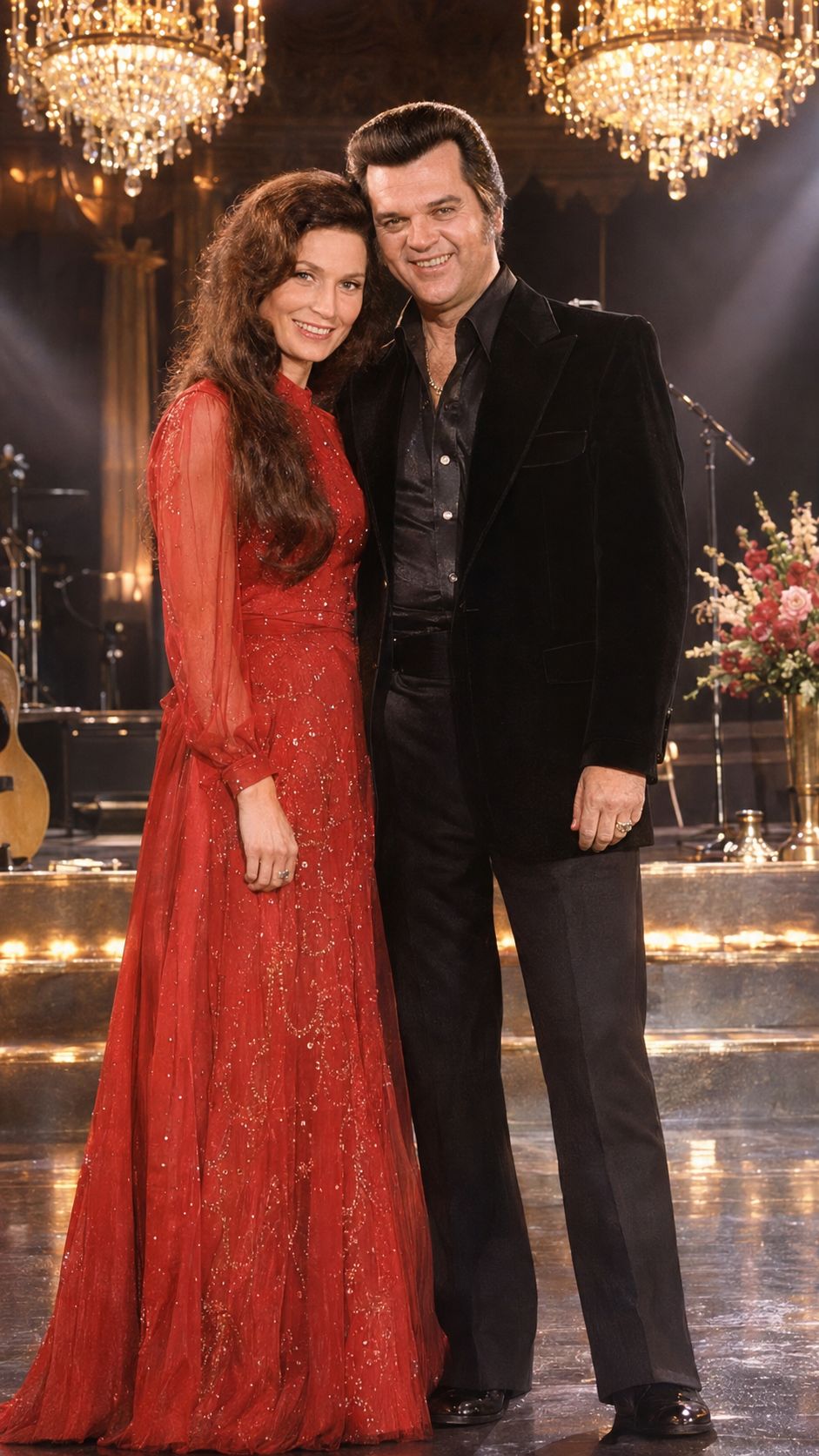
There are some stories in country music that refuse to fade, no matter how many years pass, how many songs are forgotten, or how many legends leave the stage. The extraordinary musical partnership between Conway Twitty and Loretta Lynn is one of them. Together, they created something that seemed almost impossible to explain: a connection so natural, so emotionally powerful, and so convincing that generations of fans began wondering whether the feelings they witnessed in their performances extended beyond the music.
When they stood together beneath the stage lights, singing about heartbreak, devotion, jealousy, forgiveness, and the complicated nature of love, something special happened. Their voices seemed to understand one another without explanation. Their expressions, timing, playful exchanges, and emotional delivery made audiences feel as though they were witnessing two people revealing a private chapter of their lives.
But was that impression ever the whole truth?
Did Conway Twitty and Loretta Lynn share a connection that was deeper than professional friendship, or were they simply two extraordinary performers who understood how to make a song feel real? What did their families, friends, musicians, and closest professional associates actually think about the relationship they presented to the world?
Perhaps the most fascinating part of their story is that not every question has a definitive answer. And sometimes, the unanswered questions become the most enduring part of a legend.
THE BEGINNING OF A PARTNERSHIP THAT FANS COULD NEVER FORGET
The story of Conway Twitty and Loretta Lynn did not begin with a carefully planned romantic image or an attempt to create tabloid headlines. Their musical relationship developed naturally through their shared love of country music.
In 1969, the two artists were part of a country music tour in Europe. They began singing together backstage and in dressing rooms, discovering that their voices blended in a way neither had quite anticipated. What started as informal musical fun eventually attracted the attention of legendary producer Owen Bradley.
The opportunity to record together soon became a reality.
Their first major duet success, After the Fire Is Gone, reached No. 1 on the country charts in 1971. It introduced audiences to a musical partnership that would become one of the most celebrated in country music history.
Over the years, they released numerous successful recordings, including:
-
After the Fire Is Gone
-
Lead Me On
-
Louisiana Woman, Mississippi Man
-
As Soon as I Hang Up the Phone
-
Feelins’
Their success was extraordinary. They recorded 11 studio albums together between 1971 and 1988 and collected four consecutive CMA Vocal Duo of the Year awards from 1972 through 1975.
But their achievements were only part of the story.
What truly fascinated audiences was the way they performed together. Their voices did not simply complement each other. They created an emotional conversation that made listeners feel as though they were witnessing a private relationship unfold before their eyes.
And that was where the questions began.
1. WHY DID THEIR PERFORMANCES FEEL SO PERSONAL?
There are talented singers who can perform a duet beautifully without creating any lasting emotional impression. Then there are performers like Conway Twitty and Loretta Lynn, whose chemistry seemed to transform every song into a living story.
Consider After the Fire Is Gone.
The song explores the emotional emptiness that can remain when affection disappears from a relationship. Its subject matter is complicated, uncomfortable, and deeply human. When Conway and Loretta sang it, they did not sound like two artists simply reading lyrics from a music stand.
They sounded like two people confronting an emotional dilemma.
Conway’s deep, smooth voice brought a sense of maturity and restrained emotion. Loretta’s unmistakable voice added vulnerability, determination, and a distinctly feminine perspective.
Their contrasting vocal personalities created something remarkable.
The same magic appeared in Lead Me On, where the emotional tension between the two voices made the song feel almost cinematic.
For audiences, the experience was powerful enough to blur the distinction between acting and reality.
But there is an important point worth remembering: convincing emotional performances do not necessarily reveal private romantic feelings.
Great singers understand how to enter the emotional world of a song. They can communicate longing without personally experiencing the exact circumstances described in the lyrics.
Perhaps that was one of the greatest strengths of Conway and Loretta. They understood how to make listeners believe every word.
2. WHAT DID LORETTA LYNN REALLY SAY ABOUT THEIR RELATIONSHIP?
Among all the questions surrounding this legendary partnership, one voice deserves particular attention: Loretta Lynn herself.
Over the years, fans repeatedly wondered whether the emotional connection they witnessed onstage reflected a romantic relationship behind the scenes.
However, Loretta addressed the speculation directly.
In interviews, she explained that people often assumed she and Conway were romantically involved because of the songs they recorded. She made it clear that this was not the case.
She described Conway Twitty as a friend, not a lover.
More importantly, she explained that her husband, Oliver Doolittle Lynn, commonly known as Doo, also loved Conway.
That detail changes the way we should understand their story.
If the partnership had been built around a secret romance, the friendship between Conway and Doo would be a very different part of the narrative. Instead, Loretta remembered the two men sharing jokes, conversations, and genuine companionship.
She even recalled how Doo would tell Conway exaggerated stories during their travels, making him laugh so loudly that she knew another entertaining tale was underway.
These memories reveal something that dramatic rumors often overlook.
The relationship was not necessarily mysterious because something romantic was being hidden. It was fascinating because three people had developed a friendship within an industry where professional relationships could be complicated.
And perhaps that genuine friendship was precisely what made the music so believable.
3. WHAT DID CONWAY TWITTY THINK ABOUT LORETTA?
Although Loretta Lynn’s statements provide an important perspective, what about Conway?
He was not simply a singer who happened to find a successful female partner. He was already an established country music superstar with an extraordinary recording career.
According to historical accounts of their partnership, Conway described Loretta as one of his closest friends in the music business.
He also rejected suggestions that their relationship was romantic.
That consistency matters.
Their professional connection was built on mutual admiration, trust, and an understanding of what each could bring to a recording.
Conway possessed a remarkable ability to communicate emotional complexity through his voice. His performances could sound tender, conflicted, playful, or heartbreaking without losing their distinctive character.
Loretta brought a different kind of strength.
She was independent, outspoken, emotionally direct, and capable of communicating an entire lifetime of experience through a single vocal phrase.
Together, they created a balance that neither artist needed to manufacture.
Perhaps Conway recognized that Loretta was not simply another duet partner. She was an artist who could challenge him musically while allowing him to remain completely himself.
That kind of professional respect can produce a connection that audiences interpret as something more.
But the available accounts from both performers point toward a close friendship rather than a secret love affair.
4. WHAT DID DOO LYNN REALLY THINK ABOUT CONWAY?
One of the most interesting parts of this story involves Doo Lynn, Loretta’s husband.
For years, fans have wondered whether he ever felt uncomfortable watching his wife perform romantic duets with another man.
After all, some of the songs were emotionally intense. The lyrics described forbidden attraction, troubled relationships, and feelings that could easily be interpreted as confessions.
Yet Loretta’s own recollections paint a surprisingly warm picture.
She explained that Doo genuinely liked Conway and considered him a friend. In fact, she remembered Conway as one of the very few people in the country music business with whom Doo developed such a close personal connection.
Their friendship extended beyond recording sessions.
They traveled together, shared conversations, and enjoyed one another’s company.
This is particularly important because it challenges the assumption that every convincing musical romance must create tension in real life.
Sometimes, the people closest to the performers understand the distinction between the story being told through music and the relationships existing outside the studio.
Doo apparently understood that distinction.
And rather than becoming an obstacle to the partnership, his friendship with Conway became another part of its history.
5. DID THEIR FAMILIES AND CLOSEST FRIENDS SEE SOMETHING DIFFERENT?
This is perhaps the question that continues to attract the greatest curiosity.
What did the people who knew Conway Twitty and Loretta Lynn away from the cameras really think?
It is tempting to imagine that family members and close friends possessed secret knowledge about the relationship. But responsible storytelling requires separating documented recollections from speculation.
The accounts publicly available from Loretta offer a relatively clear picture.
She remembered Conway as a trusted friend. She described his friendship with Doo warmly and recalled the laughter they shared.
Conway’s own descriptions of Loretta also emphasized friendship and professional admiration.
There is no reliable basis for claiming that their families secretly knew about a romantic relationship or that someone close to them uncovered a hidden affair.
Nevertheless, there are questions about their private conversations, personal memories, and experiences that the public may never fully know.
How did they support each other during difficult periods in their careers?
What conversations took place after emotionally demanding performances?
Did they ever discuss how audiences interpreted their connection?
How much did their friendship influence the way they approached certain songs?
These are interesting questions, but without documented answers, they should remain questions rather than invented revelations.
Sometimes, the truth is less sensational than the rumors, but considerably more meaningful.
6. THE SONGS THAT MADE THE WORLD BELIEVE IN THEIR LOVE
To understand why the speculation survived for so long, we must return to the music.
Louisiana Woman, Mississippi Man presented a different emotional atmosphere from their more serious recordings.
It was playful, energetic, and full of personality. Their voices moved together with a natural rhythm that made the song instantly memorable.
Then came As Soon as I Hang Up the Phone, a dramatic recording that unfolded almost like a miniature radio play.
The emotional storytelling encouraged listeners to imagine the characters as real people. Conway and Loretta understood how to communicate tension through pauses, vocal expression, and carefully delivered lines.
Their performances were not merely about singing in harmony.
They were about creating characters.
And because both artists were exceptionally convincing, audiences became emotionally invested in the stories.
The public did not simply hear two singers performing a song. It heard a relationship.
That distinction explains much of the fascination.
Garth Brooks and Trisha Yearwood have also discussed the extraordinary musical energy created when Conway and Loretta performed together. Their observations help explain why the partnership remains so influential among later generations of country performers.
The magic was real.
But the magic belonged to the music.
7. THE TRAGEDY OF JUNE 5, 1993: WHEN THE PARTNERSHIP LOST ONE OF ITS VOICES
On June 5, 1993, Conway Twitty died after suffering an abdominal aortic aneurysm while traveling from Branson, Missouri, toward Nashville.
He was only 59 years old.
His death brought an unexpected end to one of country music’s most successful partnerships.
For Loretta Lynn, the loss was particularly painful because Conway had become much more than a recording partner.
In a later recollection, she described the circumstances surrounding the final night of his life. Her husband, Doo, was hospitalized following heart surgery, and Conway was working in Branson.
Loretta remembered seeing Conway’s bus approaching the hospital area and going downstairs, intending to meet him so he would not have to search for Doo’s room.
But the evening took a heartbreaking turn.
She recalled that Conway was having difficulty seeing her clearly, and that night he died.
It is difficult to imagine the emotional weight of that memory.
A friendship that had lasted for years, a partnership that had produced unforgettable music, and a connection shared by two families suddenly became part of the past.
Conway would never again stand beside Loretta on a stage.
There would be no new recordings, no more playful exchanges, and no opportunity to create another chapter in their extraordinary musical history.
For fans, his passing also meant that many questions about their experiences together would remain unanswered.
8. PERHAPS THE BIGGEST SECRET WAS THAT THEY NEVER NEEDED TO BE LOVERS
There is something deeply interesting about the way audiences continue to interpret the relationship between Conway Twitty and Loretta Lynn.
People often want to believe that powerful emotional chemistry must have a romantic explanation.
If two performers look at each other with tenderness, sing about forbidden love, and communicate through music as naturally as breathing, audiences begin searching for a hidden story.
But perhaps we have been asking the wrong question all along.
Maybe their partnership was extraordinary precisely because it did not depend on romance.
They were two accomplished artists who recognized something special in each other’s voices. They trusted one another, respected each other’s abilities, and understood the emotional language of country music.
Their friendship gave them a foundation upon which they could perform even the most complicated love songs without allowing the fictional stories to define their real lives.
That is not a less meaningful explanation.
In many ways, it is a more beautiful one.
A genuine friendship can be just as powerful as a romantic relationship. It can survive professional pressures, changing musical trends, and the passage of time.
And the fact that their connection continues to fascinate audiences decades later demonstrates how successfully they communicated that bond through music.
9. THE QUESTIONS THAT TIME MAY NEVER ANSWER
Even with Loretta’s explanations and Conway’s own descriptions of their friendship, some questions will probably remain part of their enduring legend.
What was their favorite memory from all those years of performing together?
Which recording session meant the most to them personally?
Did they ever imagine that audiences would continue discussing their chemistry decades after their final performances?
Did they realize just how deeply their partnership would influence future generations of country music?
And perhaps most importantly, what would they say today if they could hear the conversations fans still have about them?
We may never know every private thought they shared.
But we do know that their musical partnership was genuine, their friendship was publicly acknowledged, and their contributions to country music were extraordinary.
Conway Twitty died in 1993. Loretta Lynn passed away on October 4, 2022. Both left behind musical legacies that continue to inspire listeners.
Their story is no longer being written by the people who lived it. Instead, it survives through recordings, interviews, photographs, memories, and the generations of fans who refuse to forget them.
Perhaps that is why the questions remain so compelling.
The world has spent decades trying to understand what existed between these two legendary voices.
And although the romantic mystery has been addressed by the people involved, the emotional connection that made their performances unforgettable is still worth exploring.
CONCLUSION: A LOVE STORY, A FRIENDSHIP, OR SOMETHING EVEN MORE BEAUTIFUL?
Perhaps the greatest mistake is assuming that every unforgettable musical partnership must conceal a romantic secret.
The story of Conway Twitty and Loretta Lynn reminds us that two people can create extraordinary emotional experiences together without being lovers.
Their music carried passion, heartbreak, temptation, and tenderness. Their friendship carried trust, laughter, and mutual admiration.
Those were two different things, and both were real.
The songs will continue to play. Their voices will continue to meet in recordings long after the people behind them are gone.
And somewhere between the first notes of After the Fire Is Gone and the final harmonies of Louisiana Woman, Mississippi Man, listeners will continue discovering something that makes this partnership so special.
Maybe their greatest love story was never about two people falling in love with each other. Maybe it was about two extraordinary artists falling in love with the music they created together.
And that is a legacy no rumor could ever diminish.
VIDEO: