 By admin
INTRODUCTION:
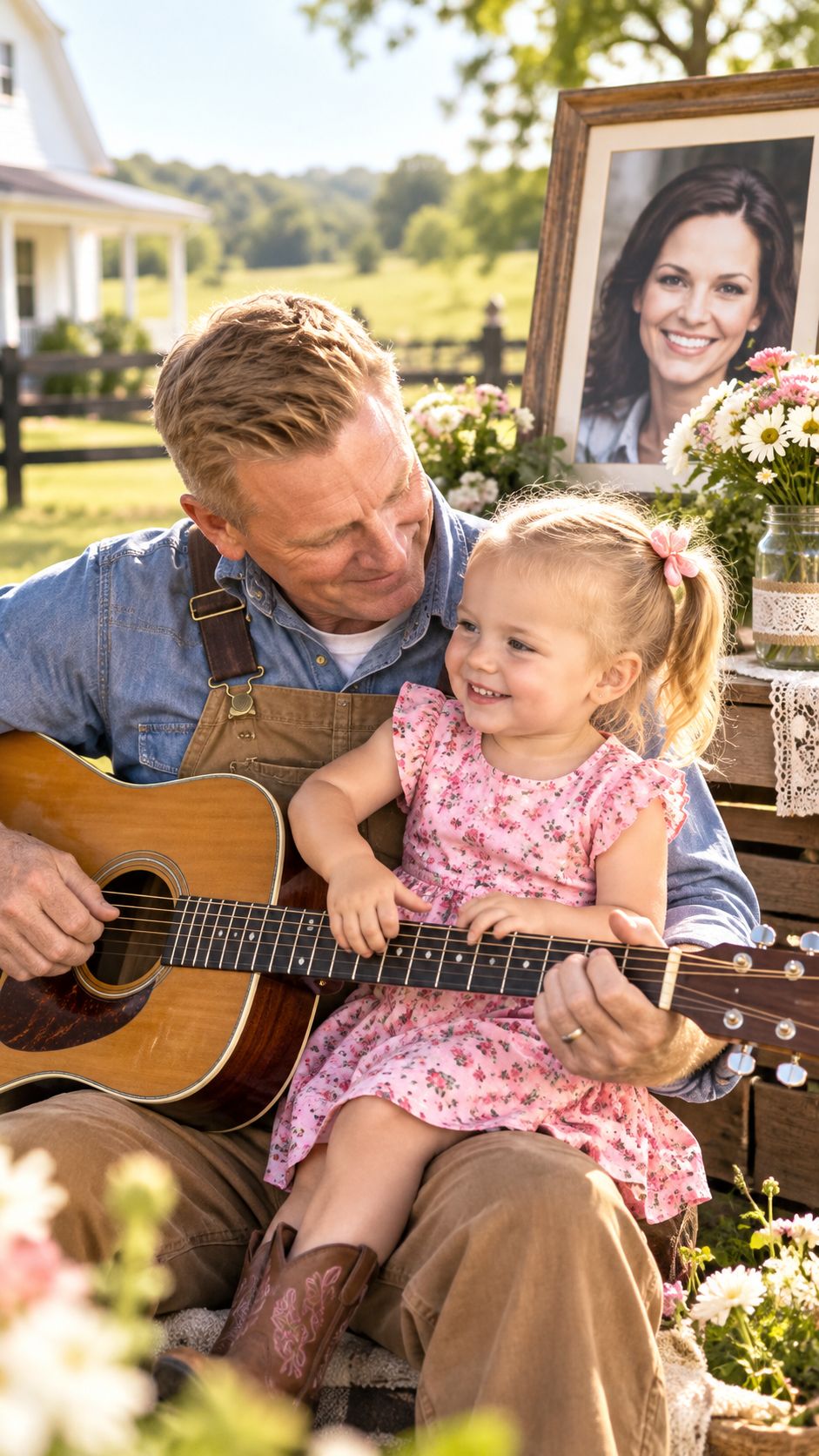
There are love stories in country music that are remembered because of chart records, sold-out arenas, or awards.
And then there are stories remembered because they reveal something much harder to explain: what love looks like after goodbye.
For Rory Feek, the loss of his wife Joey Feek was not simply the end of a marriage or a musical partnership. It became the beginning of a promise — one that required him to keep walking through the life they had imagined together, even after she was no longer beside him.
Joey died on March 4, 2016, at age 40 after battling cervical cancer. Yet before her final days, she had already made plans, expressed hopes for her family, and left Rory with dreams that extended beyond her own lifetime.
And Rory would spend years trying to honor them.
“The hardest part of fulfilling someone’s dream is sometimes having to do it without them.”
That may be the most heartbreaking way to understand the chapter that followed.
The Dream Joey Had Carried for Years
Long before illness changed everything, Joey Feek had dreamed of making a record filled with the hymns she grew up singing.
Music was never simply a career for Joey. It was woven into her childhood, her faith, her family, and eventually her marriage to Rory. She grew up singing in church and dreamed of becoming a country singer from an early age.
When Joey and Rory became known professionally as Joey + Rory, audiences discovered something rare.
They weren’t simply a husband-and-wife country duo.
They seemed to be building a life together in public.
Their music often felt intimate, simple, and deeply rooted in family. Their farm, their daughter Indiana, their faith and their everyday experiences became part of the story surrounding the music.
Then came the diagnosis that changed everything.
Joey was diagnosed with cancer in 2014. After treatment initially brought hope, the disease returned, eventually becoming terminal. Yet even as her physical world became smaller, her creative dreams did not disappear.
Instead, one of those dreams became more important than ever.
She wanted to finish the hymns album.
“Hymns That Are Important to Us” Became More Than an Album
The result was Hymns That Are Important to Us, released in February 2016.
For Joey, it was a deeply personal project — music connected to the faith and songs she had known since childhood. Rory later explained that making the album had been one of Joey’s lifelong dreams, and that she recorded vocals even while undergoing chemotherapy and radiation.
Think about the circumstances.
She wasn’t recording from a position of comfort.
She was recording while confronting the possibility that she might never see the future she had imagined.
That gives the album an emotional weight that goes far beyond its sales or chart position.
And remarkably, it became a major success.
The album reached No. 1 on both the Billboard Top Country Albums and Top Christian Albums charts, giving the couple their strongest sales week.
But the greatest reward was not a chart position.
It was that Joey got to see her dream become real.
She wanted to leave behind songs that could comfort people long after she was gone.
And that is precisely what happened.
Rory Was Left Holding the Promise
Joey died less than a month after the album was released.
Suddenly, the man who had spent years singing beside her was standing on stages alone.
The husband who had shared every major chapter of his adult life with Joey now had to raise their young daughter, Indiana, without her mother.
But Rory’s responsibilities were not limited to parenting.
He had become the keeper of Joey’s unfinished story.
One of the most powerful examples involved the 2017 Grammy Awards.
Joey had told Rory that if the album was nominated, he had to attend. And she had jokingly — or perhaps prophetically — told him that if they won, she would know before he did.
The nomination came.
Rory went.
And Hymns That Are Important to Us won the Grammy for Best Roots Gospel Album.
Rory accepted the award with Joey’s father.
It was an extraordinary moment, but also an agonizing one.
Because the woman whose dream had made the moment possible was no longer physically there to experience it.
The applause was loud. The victory was real. But the empty space beside Rory may have been the loudest thing in the room.
Rory later described the experience as much more than a dream come true for him. It was a moment of honoring the woman who had made the album possible.
Joey’s Wishes Were Bigger Than Music
Perhaps the most moving part of Joey’s final chapter was that her dreams were not primarily about fame.
They were about family.
In the months before her death, Joey and Rory were forced to confront the reality that Indiana would grow up without her mother.
Rory later described how Joey deliberately encouraged their daughter to become increasingly attached to him as she understood that her own time was running short. ABC News reported Rory’s account that Joey wanted him to become the central parent Indiana could depend on after she was gone.
That decision was devastating precisely because it was loving.
Joey wasn’t simply thinking about her final days.
She was thinking about Indiana’s first years without her.
She was trying to prepare her daughter for a future she desperately wished she could share.
And Rory had to carry that responsibility forward.
The Promise to Give Indiana a Life Filled With Love
After Joey died, Rory continued building a life for Indiana that reflected many of the values they had shared.
One example came when Indiana began preschool at High Hopes, a developmental and therapy center in Tennessee. Rory explained that he and Joey had originally planned to homeschool their daughter, but Joey’s illness forced them to reconsider what would best serve Indiana.
It was another reminder that fulfilling Joey’s wishes did not always mean following an exact blueprint.
Sometimes it meant making the best decision possible with the circumstances they had been given.
That may be one of the deepest lessons in Rory’s journey.
Love does not always mean preserving the past exactly as it was.
Sometimes love means carrying its values into an entirely different future.
Rory Also Carried Joey’s Family With Him
There was another wish that reveals just how much Joey cared about the people she loved.
Before her death, Joey asked Rory to take her three sisters and their families on a trip to the American West — a place connected to some of the family’s happiest memories.
After Joey died, Rory followed through.
The trip was beautiful.
And heartbreaking.
Rory later described watching Joey’s sisters play with their children and feeling the pain of knowing Joey could not be there with them. Yet her memory traveled with them through the mountains and trails.
This is where Rory’s story becomes bigger than grief.
He wasn’t simply preserving Joey’s memory in photographs or songs.
He was creating new memories that still included her.
She wasn’t physically present.
But she remained part of the meaning behind the journey.
Even Her Final Hymn Carried a Story
Joey’s final wishes included details about her funeral, including the music she wanted performed.
One request involved the hymn “Leave It There,” a song connected to a memory from the couple’s honeymoon in Montana.
That detail says so much about Joey.
Even at the end, she wasn’t simply thinking about a funeral.
She was thinking about a song.
A memory.
A place.
A moment she had shared with her husband.
Country music has always understood the power of ordinary objects and memories: an old photograph, a front porch, a highway, a wedding ring, a song heard decades earlier.
For Joey and Rory, one hymn could carry an entire marriage inside it.
Rory’s Greatest Tribute Wasn’t Simply Keeping Joey’s Name Alive
After Joey’s death, Rory also worked to preserve the story of the woman she had been before cancer became the center of public attention.
He helped turn years of personal footage into the documentary To Joey, With Love.
Rory explained that he wanted people to see Joey living — not only the painful final months that many followers had witnessed online.
That distinction matters.
Cancer became part of Joey’s story.
But it wasn’t the whole story.
She was a daughter.
A sister.
A wife.
A mother.
A musician.
A farmer.
A woman who loved horses, gardening, family and music.
And, most importantly, she was someone who wanted her life to mean something beyond the circumstances of her death.
Rory’s work helped ensure that distinction would not be forgotten.
The Most Beautiful Part of the Story May Be the Most Ordinary
Perhaps the most powerful image from this entire journey isn’t a Grammy stage.
It isn’t a recording studio.
It isn’t a sold-out show.
It is something much smaller.
Music playing while Indiana eats breakfast.
The Grammy website recalled Rory saying that the family continued listening to the hymns album regularly, and that one morning, after hearing “I Surrender All,” Indiana said “Mama” and clapped.
Imagine that moment.
A little girl hearing her mother’s voice.
A father hearing it too.
The past and present suddenly occupying the same room.
For Rory, that is the real legacy.
Not statistics.
Not awards.
Not headlines.
A daughter’s recognition of her mother’s voice.
Joey may have left the world in 2016, but her voice never truly left the Feek home.
A Love Story That Refused to End at Goodbye
The tragedy of Joey Feek’s story is obvious.
She died far too young.
She left behind a husband and a young daughter.
She never got to watch Indiana grow up.
She never got to see the full impact of the music she created.
But there is another way to tell the story.
Joey left Rory something more powerful than instructions.
She left him a direction.
Raise our daughter.
Keep loving our family.
Finish the music.
Remember where we came from.
Carry the memories forward.
And Rory did what grieving people often have to do: he learned how to turn absence into action.
He raised Indiana.
He honored Joey’s music.
He celebrated her family.
He told her story.
He carried her dreams into rooms she would never physically enter.
That is why the legacy of Joey + Rory continues to resonate with country music listeners.
Their story isn’t compelling simply because it ended tragically.
It is compelling because the love continued working after the tragedy.
And perhaps that is the greatest meaning behind Joey’s final wishes.
She wasn’t asking Rory to pretend she would never be gone.
She was asking him to keep living.
To keep loving.
To keep parenting.
To keep singing.
And most of all, to make sure that the life they built together would not disappear simply because one half of the partnership was gone.
Some love stories end with goodbye. Others become promises that keep walking long after goodbye.
For Rory Feek, fulfilling Joey’s dreams became one of the hardest journeys of his life.
But it also became one of the most beautiful.
Because every song he preserved, every memory he carried, and every moment he gave their daughter became another quiet answer to the same question:
How do you keep loving someone after they are gone?
You keep living the love they gave you.
And, in Rory’s case, you keep the song playing.
VIDEO: